THE IMPLEMENTATION OF JIGSAW TECHNIQUE
IN READING CLASS OF YOUNG LEARNERS
A RESEARCH
By Siti Mina Tamah Ellisa Yani Widjaja
Linda Anggraiani Ong Ervina Larissa Susanto
ENGLISH DEPARTMENT
FACULTY OF TEACHER TRAINING AND PEDAGOGY WIDYA MANDALA CATHOLIC UNIVERSITY
ACKNOWLEDGEMENTS
Above all, the writers would like to express their deepest gratitude to the Lord since they realize that this research would not have been completed without His blessings. In addition, the completion of this research is attributed to various encouragements of many people. To all of them they express their sincere gratitude and appreciation, but only a few may be mentioned.
The writers feel grateful to Prof. Veronica L. Diptoadi, the head of Research Institute of Widya Mandala Catholic University Surabaya. She has provided the opportunity for the writers to submit the proposal to be reviewed. The writers therefore acknowledge indebtedness also to the reviewers – J.V. Djoko Wirjawan, Ph.D., Prof. Eugenius Sadtono, Ph.D., and Prof. Dr. Wuri Soedjatmiko – who have given their valuable input for the improvement of the research.
They are also indebted to Prof. Dr. J.S. Ami Soewandi, the present Rector who has issued an official letter hence giving the chance to them to perform their planned research and assisting the students for their theses. More importantly, as this research involves a lecturer and semester 7 students programming their thesis, the financial as well as moral support is an encouragement for the respective students to really finish their study in 7 semesters.
The gratefulness also goes to Lucia Anna Kamsasi, S. Psi., Yoh. M. Annie Herawati, and Johana Djajadi, the head mistresses of SDK. St. Theresia I Surabaya, and SDK. St. Theresia II Surabaya, and SDK Yohanes Gabriel Surabaya, respectively where the data are obtained and to Afrieyola Petymia, S. Pd., Andreas Andri Sugiono, S. Pd., Fransisca Dian A., the English teachers of the schools whose classes are ‘surrendered’ to the writers for the treatment and the try-out. Without their permission no data can be analyzed.
The gratitude is also expressed to the fifth grade students of 2006 – 2007 school year at SDK. St. Theresia I Surabaya, and SDK. St. Theresia II Surabaya, and SDK Yohanes Gabriel Surabaya. They have participated in this study either in the try-out or in the real treatment.
cannot mention one by one, this research will not appear in its present shape. They are therefore indebted to them.
iii
CHAPTER II REVIEW OF RELATED LITERATURE
2.1 Constructivism …….………..
CHAPTER III RESEARCH METHOD
iv
3.2 Research Method to Answer the Second Research Question 3.2.6 Data Analysis Procedure ………..
3.3 Research Method to Answer the Third Research Question
3.3.1 Research Design ...……… 3.3.2 Subjects ……… 3.3.3 Research Instrument ……….……….
3.3.4 Data ………
3.3.5 Data Collection Procedure ……… 3.3.6 Data Analysis Procedure ………
CHAPTER IV DATA ANALYSIS AND FINDINGS
4.1 Data Analysis and Findings Related to the First Research Question
4.1.1 The Obtained Data …..……… 4.1.2 Data Analysis …..……… 4.1.3 Finding ………
v
4.3 Data Analysis and Findings Related to the Third
Research Question ……… 4.3.1 Ways to Initiate ………. 4.3.2 Ways to Respond ………. 4.3.2 Ways to Evaluate/Acknowledge Responses and Initiations ……….
59 59 60
61
CHAPTER V DISCUSSION OF THE FINDINGS 63 5.1 Discussion of the Findings Related to the First
Research Problem ………. 5.2 Discussion of the Findings Related to the Second
Research Problem …..……… 5.3 Discussion of the Findings Related to the Third
Research Problem ….………..
63
65
72
CHAPTER VI CONCLUSION
6.1 Summary………. 6.2 Recommendations …..………
74 77
BIBLIOGRAPHY 80
APPENDICES
Appendix 1 Research Instrument (The Test) 83
Appendix 2 Calculation of Test Reliability 92
Appendix 3 Calculation of Item Difficulty and Item Discrimination 96
Appendix 4 Lesson Plan for the Treatment 98
Appendix 5 Scores of the Tests 134
Appendix 6 Research Instrument (The Questionnaire) 138
Appendix 7 Interview Transcript 140
Appendix 8 Observation Checklist 156
Appendix 9 Expert Team Discussion Transcript 162 Appendix 10 Calculation of the Pretest Scores 167
Appendix 11 Calculation of ANCOVA 168
Appendix 12 Calculation of the Scores of Post Test at SDK Yohannes Gabriel
ABSTRACT
Traditional reading class is carried out by the teacher’s reading the text being discussed then by some students’ reading in turns. The classroom interaction to discuss the text is then typically teacher-centered. The teacher asks a question; the students wanting to respond raise their hands; the teacher calls on one student and the student called on tries to state the correct answer. This particular classroom structure can be altered to make the class more interactive by jigsaw technique.
Studies related to the implementation of jigsaw technique in Indonesia language classes have in fact been carried out. Most of them have focused on high school settings. Although much work has been done to date, more studies need to be performed to ascertain the implementation of jigsaw technique in other settings, in this case in elementary schools. This particular concern triggers the writers to research on the implementation of jigsaw technique in young learners reading class.
The writers are then conducting this study to achieve the objectives of (1) finding out if there is a significant difference between the reading achievement of young learners taught using jigsaw technique and the one of those taught using the traditional technique, (2) revealing elementary students’ perception on the implemented jigsaw technique, and (3) depicting the classroom interaction patterns in jigsaw classroom of young learners.
A quasi-experimental research applying a non-randomized pretest-posttest control group design was administered to obtain the first research objective. The data used in this study were taken from the scores of the reading test of the fifth grade students of SDK St. Theresia II and SDK St. Yohannes Gabriel belonging to the academic year of 2006-2007. As this study was also a descriptive study concerning the second and third objectives, the data were also obtained from the questionnaire, interview, observation, and audio as well as video recordings.
This study statistically revealed that there was no significant difference on the reading comprehension achievement between the students who were taught using Jigsaw technique and the ones who were taught using traditional technique. However, positive perception on jigsaw technique was revealed from the questionnaire distributed.
1 CHAPTER I INTRODUCTION
1.1 Background
The new curriculum - Kurikulum Berbasis Kompetensi (henceforth KBK) - is applied nation wide starting from the academic year of 2004/2005. This competence-based curriculum officially becomes the substitute of the previous 1994 Curriculum which is based on Pendekatan Kebermaknaan (meaningfulness approach). KBK is implemented to, as stated in “Kurikulum Berbasis Kompetensi Mata Pelajaran Bahasa Inggris” (2001:6), produce outputs who have competitive and comparative qualities based on national and international standard.
One of the theories underlying the emergence of KBK is constructivism. Kaplan (2002) puts forward that constructivism proposes that learning environment should support multiple interpretations of reality, knowledge construction as well as context-rich and experience-based activities. Guided by constructivist principles, teachers believe that learners are engaged in doing something as learning is an active process of which meaning is constructed out, and that learners learn by interaction with their fellow students, teachers and families.
Implicitly stated from the principles of constructivist thinking is that it is high time that teachers abandoned their spoon-feeding technique. The new curriculum being implemented, the Indonesian teachers are inevitably to transform their traditional class into KBK class. The teachers are, in other words, faced with constructivist thinking of how to involve students in relevant tasks so that the students are really engaged in the classroom.
Engaging students in KBK class can be realized by employing cooperative structures one of which is jigsaw. Teachers in favor of Jigsaw believe that each student owns the capability to be the contributor of knowledge. Students are encouraged to learn from their fellow students in their expert team and when they go back to their home team they are encouraged to teach one another the material they have worked on in the expert team. This jigsaw design facilitates students‟ interaction in the class enabling them to value each other as contributors (Aronson, 2005).
2
discussed then by some students‟ reading in turns. The classroom interaction to discuss the text is then typically teacher-centered. The teacher asks a question; the students wanting to respond raise their hands; the teacher calls on one student and the student called on tries to state the correct answer. To this kind of classroom structure, Kagan (1999:16) coins the term of Whole-Class Question-Answer. This particular classroom structure can be altered to make the class more interactive by jigsaw technique.
In jigsaw technique students are grouped in 4 up to 5 students, namely „home group‟. Each student is assigned to read different part of reading text. Students with the same part make a group called an „expert group‟‟ to discuss and master their own part. Then they go back to their own „home group‟ to exchange the information. All members of group should at last understand the whole text. Every member should be responsible for his or her own part and responsible for the success of all teammates in comprehending the text.
The issue is then related primarily to how the teacher can improve on the means to involve students in their reading class. The class teacher is challenged to implement the types of assistance their students need to accomplish a particular task as their competence grows. Simply the teacher is encouraged to bring opportunities for the students to learn maximally on their own in this case by taking part in jigsaw activities to achieve reading skill.
Studies related to the implementation of jigsaw technique in Indonesia language classes have in fact been carried out. Most of them have focused on high school settings. Although much work has been done to date, more studies need to be conducted to ascertain the implementation of jigsaw technique in other settings, in this case in elementary schools. It is this particular concern that arouses the writers to conduct a study on the implementation of jigsaw technique in young learners reading class.
1.2 Statements of the Problem
Based on the rationale mentioned above, the writers pose the following research questions:
3
(2) “What are the elementary school students‟ perceptions on the implementation of Jigsaw technique in their reading class?”
(3) “What classroom interaction patterns exist in the expert team of jigsaw class?” of which the sub-research questions are: “How do young learners initiate the discussion?”, “How do young learners respond to initiations?”, and “How do young learners evaluate/acknowledge responses and initiations?”
1.3 Purpose of the Study
Referring to the research questions previously posed, the writers are conducting this study to achieve the objectives of (1) finding out if there is a significant difference between the reading achievement of young learners taught using jigsaw technique and the one of those taught using the traditional technique, (2) revealing elementary students‟ perception on the implemented jigsaw technique, and (3) depicting the classroom interaction patterns in jigsaw classroom of young learners.
1.4 Significance of the Study
This study is expected to provide some models of jigsaw implementation and also to reveal the feedback of KBK implementation in general and of jigsaw class in particular. The models presented are merely illustrative. It is expected to be persuasive to encourage classroom teachers to create their own student-fronted classrooms. Particular strengths and weaknesses of the implementation can be depicted from the feedback which is in the form of students‟ perception on jigsaw implementation hence assisting the curriculum planner to commence with the follow-up concerning the newly applied KBK in Indonesia. It is expected that this study will contribute to the belief that teaching and learning can be enhanced when the paradigm shift occurs. It is not the teacher who is the only expert in the classroom.
1.5 Limitation of the Study
4
reading. This study is also limited to the young learners studying at the fifth grade of Elementary School.
The subject of the study is limited to the fifth year students of SDK Yohannes
Gabriel Surabaya belonging to the year 2006-2007. The writer considers that the fifth
year students have already had experience in reading independently. They are also old
enough to work in groups.
1.6 Definition of Key Terms
Young Learners are children between the ages of 2-12 years old, approximately corresponding to the elementary school years (Santrock, 1999:18). In this study, they are children between the ages of 10-12 years old. They are students who study at Indonesia Elementary schools more particularly in grade 5.
Jigsaw is one of the cooperative learning techniques. It is a more systematic teaching technique of group work. Groups of 4 – 5 students are formed. Each group member is assigned a sub-part of material to learn and to teach to his group members. To assist in the learning, students working on the same sub-part of the material get together to decide what is important and how to teach it. After learning together in these „expert‟ groups, the original groups – the home teams – reform and students teach one another.
Reading is the process of meaning construction through the dynamic interaction which involves the reader‟s existing knowledge, the information in the text, and the context of the reading situation (Anthony, Pearson, and Raphael, 1993 in Farrell, 2002:1).
1.7 Assumption of the Study
5 1.8 Organization of the Study
6 CHAPTER II
REVIEW OF RELATED LITERATURE
2.1 Constructivism
Richards (2001:159) defines competencies as a description of the essential skills, knowledge and activities needed for effective performance of certain tasks and activities. Meanwhile Kaplan (2002) points out that constructivism is not a teaching theory, but that it is a theory of knowledge and learning. Based on those 2 defined „competence‟ and „constructivism‟ the writer can argue that the prominent underlying theory to deal with concerning Competency-Based Curriculum is constructivism. The following discussion is then centered on constructivism.
Constructivism, pointed out by Kaplan (2002), proposes that learning environment should support multiple interpretations of reality, knowledge construction as well as context-rich and experience-based activities. Considering the core of constructivism, Kaplan (2002) provides 10 basic guiding principles of constructivist thinking. They are as follows:
1. Learners need time to learn since learning is not instantaneous.
2. Learners are engaged in doing something as learning is an active process of which meaning is constructed out.
3. Learners learn to learn as they learn.
4. Learners need activities which engage the mind as well as the hands. 5. Learners learn by using language.
6. Learners learn by interaction with others – their fellow students, teacher and families.
7. Learners need contextual environment.
8. Learners learn by developing from their existing knowledge.
9. Learners are engaged with the world extracting meaning from their experiences. 10. Learners need motivation to accelerate their learning.
7
Knowledge is constructed by humans. Knowledge is not a set of facts, concepts, or laws waiting to be discovered. It is not something that exists independent of knower. Humans create or construct knowledge as they attempt to bring meaning to their experience. Everything that we know, we have made.
Zahorik (1995) in Nurhadi (2004: 44, 45) Unlike behaviorists, constructivists believe that learning process is initiated by the students themselves. Learners construct new knowledge based on the knowledge already possessed by them. Nobody else can „plant‟ this knowledge to the students; they are to do it themselves (Sumarsono, 2004:58).
What can be inferred from the principles of constructivist thinking previously presented is that it is high time that teachers abandoned their spoon-feeding technique. The traditional classroom stage should be changed. One typical way to reveal this shift is the teacher‟s adopting „students teaching other students‟ technique. This then leads us to the next underlying theory.
2.2. Co-operative Learning
Referring to Slavin (1990), Jacobs, Lee and Ball (1996:26) point out that cooperative learning requires students to work together to learn and to be responsible for their fellow students‟ learning as well as their own. Similarly, Nurhadi (2004:112) defines cooperative learning as a learning approach focusing on the use of small groups of students who work together so that learning condition is maximized to attain learning objectives. Meanwhile, Felder (2005:2) viewing cooperative learning from the perspective of teaching puts forward a similar definition of cooperative learning as follows:
Cooperative learning is a successful teaching strategy in which small teams, each with students of different levels of ability, use a variety of learning activities to improve their understanding of a subject. Each member of a team is responsible not only for learning what is taught but also for helping teammates learn, thus creating an atmosphere of achievement. Students work through the assignment until all group members successfully understand and complete it.
8
conflict resolution), and (5) group processing (the reflection or the feedback on how well the group functions and what to continue or change).
Some class activities or techniques or cooperative structures widely suggested and employed are: (see Felder, 2005; Jacobs, Lee and Ball, 1996; Kagan in Orr, 1999; and Nurhadi, 2004)
1. Think-Pair-Share. Students individually think about a question posed by the teacher. They pair up to discuss it and eventually they share it with other pairs, and/or with other groups.
2. Numbered-Heads. Groups of 4 – 5 students are formed and each is given numbers. The teacher poses a question and the students think of the answer making sure each member gets it. The teacher calls out a number (e.g. 2) and each student with number 2 is asked to give the answer.
3. Inside-Outside Circle. Students form circles and stand in pairs. The inside circle faces out; the outside circle faces in. They carry out the task given. They then find new partners by rotating the circle and carry out the same task.
4. Jigsaw. Groups of 4 – 5 students (home teams) are formed and each group is assigned a part of the material to learn and then to teach to the other members in the group. More discussion on jigsaw can be found in the next sub-topic for it is important to have a separate discussion on this particular cooperative structure as the primary theory underlying this paper.
2.3 Jigsaw Technique
Initially introduced by Aronson et al. (1978), this jigsaw structure is meant to provide students with the chance to learn a material from their peers. A material is divided into sections and one section is for each student to take care of. The students who are responsible for the same section get together and form a new group of which the goal is for the students to master the section of the material and to enable them to teach the other members in their original learning group later.
2.3.1 Benefits
9
Students themselves can be the contributors. Aronson (2005) puts it: “This “cooperation by design” facilitates interaction among all students in the class, leading them to value each other as contributors to their common task.”
Talking about the benefits of jigsaw structure, Aronson (2005) claims that it is an efficient way of learning. It is even more beneficial as the process in jigsaw structure encourages listening, engagement, and empathy. Here is what Aronson (2005) points out:
What is the benefit of the jigsaw classroom? First and foremost, it is a remarkably efficient way to learn the material. But even more important, the jigsaw process encourages listening, engagement, and empathy by giving each member of the group an essential part to play in the academic activity. Group members must work together as a team to accomplish a common goal; each person depends on all the others. No student can succeed completely unless everyone works well together as a team.
2.3.2 Strategy to Conduct Jigsaw
The jigsaw classroom is very simple to use. It has several advantages. It is easy to be applied. It is an enjoyable teaching technique. It can be done in short or long period of lesson, and it can be combined with other technique. It is an efficient technique in teaching reading to children. First of all, children are assigned into groups of 4 or 5, and they name their group that indicates their identity. These groups are „home groups‟ (Aronson, 2006). The groups should be diverse in gender, ethnicity, race and ability. All the members of each group are assigned the role: as leader, illustrator, speaker and encourager. The leader is usually the most mature. The speaker is the one who becomes the representative of the group in explaining to the class; the illustrator is the one who makes the illustration to help them to explain the text. The encourager should motivate all the members of the group to state their opinion or to speak.
There are various ways to assign the role for each student. For instance, children count 1 to 5. Children with number one are leaders. Children with number 2 are speakers. Children with number 3 are illustrators. Finally children with number 4 and 5 are encouragers. The passage is divided into 4-5 segments. Each child learns one segment. Each child has direct access only to his or her own segment. The children get time to read their segment from the passage at least twice and become familiar with it.
10
groups. Students in the expert groups have some times to discuss the main points of their segment and to rehearse the presentations they will make to their „home groups‟.
After finishing the discussion, students return to their „home groups‟. Each student presents her or his segment to the group in turns. The other members of the group who do not present their segment may ask questions for clarification. The teacher floats from group to group, observing the process. Teacher may make an appropriate intervention if any group is having trouble in discussion. Eventually, it is best for the group leader to handle this task. Leaders can be trained by whispering an instruction on how to intervene, until the leader gets the hang of it. At the end of the session, teacher gives a quiz on the material so that students quickly come to realize that these sessions are not just fun.
This strategy cannot directly be implemented to teach students in Indonesia. There are some difficulties to implement Jigsaw in the traditional classroom. That is why there are some modifications to adapt the technique with the classroom situation. The numbers of students in a class are too big. The class should be divided into several big groups so that there would be 4-5 students in every home group and expert group. The class will be difficult to be handled the first time Jigsaw is used. Once the students are familiar with the technique, this difficulty can be reduced.
Another difficulty is when every member of the group is assigned a certain role. It will be more complicated to assign them a certain role because they will be confused on what should they do. In implementing the Jigsaw, at least in every group there is a leader who can help the teacher control and manage the discussion. The leader will make all the members of the group active in the discussion.
Jigsaw technique is very good to be used in teaching children to read. However, just like other techniques, jigsaw has some weaknesses that can be overcome. Some ways are as follows (Aronson, 2006):
1. Concerning the problem of dominant children, the leader should control the discussion so members have the same opportunity to speak and state their opinion. This also makes the group run effectively. There will not be one dominant member or passive one.
11 2.4 Classroom Interaction
When language teaching is supposed to be communicative, classroom interaction becomes the essential issue. This is in line with what Brown (2001:165) states as follows: “In the era of communicative language teaching, interaction is, in fact, the heart of communication; it is what communication is all about.” If interaction does not exist, communication does not either.
In classroom interaction, students use language to negotiate meaning. They get the chance to make use of all they have of the language. This implicitly means that it is crucial for the teacher to provide more chance for the students to interact for the sake of real-life exchanges.
2.5 Reading Theory
Ward (1984:2) states, ”The majority of students of English as a foreign language may never speak much English but most of them will have to read English in order to complete their studies”. It means that reading is important toward students‟ success. Recognizing the importance of reading towards students in learning English, many reading specialists have tried to define what reading is.
During the audiolingualism era, reading is viewed as simple speech written down. The students‟ reading skill is developed through the habitual recognition of the written symbol corresponding to familiar language patterns. Thus, the reading instruction can be started only after students have developed the knowledge of spoken language (Silberstein, 1987:28).
From the psycholinguistic perspective, reading is viewed as a complex information-processing skill. Goodman in Silberstein (1987:30) writes that reading is “a psycholinguistic guessing game” that involves an interaction between thought and language. According to him, comprehension in reading does not result from the precise identification of all elements of the text, but from the skill in selecting the fewest, most productive cues necessary to produce guesses, which are right the first time.
12
comprehend the text successfully if they have the background knowledge before towards what they read.
According to Weaver (1994:15), learning to read means learning to bring meaning to a text in order to get meaning from it. Reading is shortly bringing meaning to a text to reveal its meaning. Nuttall (1996:30) pointing out a general aim for a reading program states that a reading class is held to enable learners to enjoy reading in the foreign language. To achieve the aim, a teacher needs, among others, to find out what students can and cannot do, and to choose or plan effective tasks and activities for the students.
2.6 Jigsaw Technique and Reading Achievement
The nature of jigsaw is, implicitly, a group work. In group work, students interact with their classmates. Reading a text, they are expected to construct meanings thus revealing their achievement in reading. Involved in jigsaw activities, they are expected to use reading to interact with their peers. Freire (1970) and Heath and Hoffman (1986) in Hudelson (1999) claim that the goal in teaching reading for children in elementary school settings is for them to use reading to explain, analyze, argue about and act upon the world. This communication practice involves other people. This is done in their group interaction where information exchange occurs. The students may suggest, or argue by pointing out the important details stated in the text or respond to their peers‟ ideas.
In line with this issue, Christison (1990) puts forward that an activity which requires an information exchange – or communication practice – among students assists them to possess a deeper understanding of the text being studied. If students achieve their reading skill, they will be able to answer the questions given. This implies that a group work technique – more particularly Jigsaw – can be employed in Reading class to enhance students‟ reading ability which is indicated in their ability in answering the reading comprehension questions.
2.7 Teaching Young Learners
13
children development of the skills, culture, language awareness and curiosity about the world, (3) language learning should lead to children‟s positive attitude toward language learning in general, and (4) language learning should assist children to acquire some language elements they study.
Driven by such language learning goals, a teacher will be required to think of appropriate activities to teach the students. This simply leads to the consideration in designing classroom activities. Williams (1994: 208-09) puts forward seven points to consider when designing ones. They are interest, challenge, purpose, language use, language input, conceptual appropriateness, and learning promotion. To this, Vale (1995:28) claims that it is not what but how children learn that matters. Children learn best when they become “the owners of their work”.
2.8 Previous Study
14
CHAPTER III RESEARCH METHOD
To answer the research questions set forth in section 1.2 as an attempt to achieve the objectives stated in section 1.3, the writers in this study have carried out certain methodological activities. Primarily this study employs two kinds of research design: qualitative and quantitative designs. The quantitative research design is employed to answer the first question while the qualitative one is employed to answer the second and third research questions. As each research question yields its own research method, this chapter is presented to reveal 3 sub-chapters related to the first, second and third research questions. This chapter is then intended to describe these items one by one in that order.
3.1 Research Method to Answer the First Research Question 3.1.1 Research Design
This study is a quasi-experiment applying a non-randomized pretest-posttest control group design. The choice of this design was based on the consideration that it was not just possible to randomly assign subjects to group. The writer used the two existing classrooms.
Before the experiment started, a pretest was administered to the existing group, both the experimental and the control groups. After the treatments had been completed, a posttest was administered to both groups. Their mean scores were compared and tested at .05 level of significance to determine the effects of treatments.
The design of this study could be illustrated as follows:
The Research Design
Group Pretest Treatment Posttest
E Y1 X1 Y2
C Y1 X2 Y2
Where: E refers to the experimental group where jigsaw was conducted. C refers to the control group where no jigsaw was conducted.
15
3.1.2 Variables
This study used two types of variables: (1) independent variables, and (2) dependent variables. The independent variables referred to the Jigsaw technique used in the experimental group, and to the non-jigsaw technique (the teacher-centered whole class discussion technique) in the control group. The dependent variables referred to the students‟ reading comprehension which was represented in the students‟ post-test scores.
3.1.3 Treatments
The treatment was done three times for each group, experimental and control group. The treatment was done once a week with the time limitation of 40 minutes. There was a pretest before the treatments and a posttest after the treatments for both groups.
3.1.3.1 Treatment in the Experimental Group
The students in the experimental group were taught using Jigsaw technique. The materials given for the treatments consisted of reading passages and the comprehension questions.
First, the teacher performed the pre-instructional activities. The teacher greeted the students, asked some triggering questions based on the pictures on the white board and stated the objective of the lesson.
16
4 in Apple group formed one group. The students in Banana and Cherry were also grouped similarly. Twelve expert teams were then formed. Then the teacher asked them to discuss the passage and the answers of the questions in their expert team. The students were not allowed to write anything. In turns each student shared his or her opinion. The teacher floated from group to group, observed the discussion and helped the group which had trouble. To ensure that the students discussed seriously, the teacher told them that there would be a quiz in the end of the lesson. After the students discussed in the expert teams, the teacher told the students to go back to their home teams. In their home teams, they had to share what they had got in their expert teams. Each student was given time to share. The teacher then discussed the answers of the questions.
The last was the post-instructional activity. At the end of the lesson, the students had to do the reading quiz individually. The purpose of giving the quiz in the experimental group was to make the students considered that the treatment was important. Therefore, it was expected that the students would perform well and seriously in every treatment.
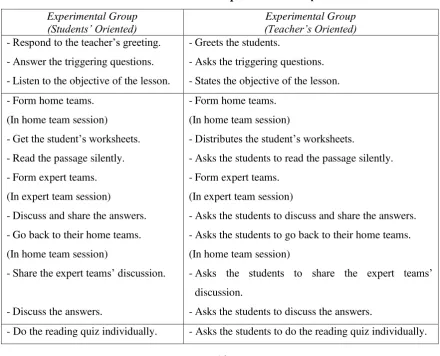
Table 3.1
Treatment in the Experimental Group Experimental Group
(Students’ Oriented) (Teacher’s Oriented)Experimental Group -Respond to the teacher‟s greeting.
-Answer the triggering questions.
-Listen to the objective of the lesson.
-Greets the students.
-Asks the triggering questions.
-States the objective of the lesson.
-Form home teams.
(In home team session)
-Get the student‟s worksheets.
-Read the passage silently.
-Form expert teams.
(In expert team session)
-Discuss and share the answers.
-Go back to their home teams.
(In home team session)
-Share the expert teams‟ discussion.
-Discuss the answers.
-Form home teams.
(In home team session)
-Distributes the student‟s worksheets.
-Asks the students to read the passage silently.
-Form expert teams.
(In expert team session)
-Asks the students to discuss and share the answers.
-Asks the students to go back to their home teams.
(In home team session)
-Asks the students to share the expert teams‟
discussion.
-Asks the students to discuss the answers.
17
3.1.3.2 Treatment in the Control Group
Students in the control group were taught using traditional technique. The materials given for control group were the same with the one given to experimental group.
Like the pre-activities in the experimental group, the ones in the control group were greeting the students, asking some triggering questions based on the pictures on the white board and stating the objective of the lesson.
The whilst-instructional activities were quite different from the ones in the experimental group. After distributing the student‟s worksheets, the teacher asked the students to read the text silently. Then she asked some students to read the passage per paragraph loudly. Next, she explained the difficult words asked by the students. After explaining, she asked the students to find the main idea of each paragraph orally. Then she asked the students to answer the reading comprehension questions. Next, the teacher discussed the answers of the questions.
18
Table 3.2
Treatment in the Control Group
Control Group
(Students’ Oriented) (Teacher’s Oriented)Control Group -Respond to the teacher‟s greeting.
-Answer the triggering questions.
-Listen to the objective of the lesson.
-Greets the students.
-Asks the triggering questions.
-States the objective of the lesson.
-Get the student‟s worksheets.
-Read the passage silently.
-Some students read the passage per
paragraph.
-Find the difficult words per paragraph.
-Listen to the teacher explaining the
difficult words.
-Do the exercises.
-Discuss the answers.
-Distributes the student‟s worksheets.
-Asks the students to read the passage silently.
-Asks some students to read the passage per
paragraph.
-Asks the students to find the difficult words per
paragraph.
-Asks the students to listen to the teacher
explaining the difficult words.
-Asks the students to do the exercises.
-Asks the students to discuss the answers.
-Do the reading quiz individually. -Asks the students to do the reading quiz
individually.
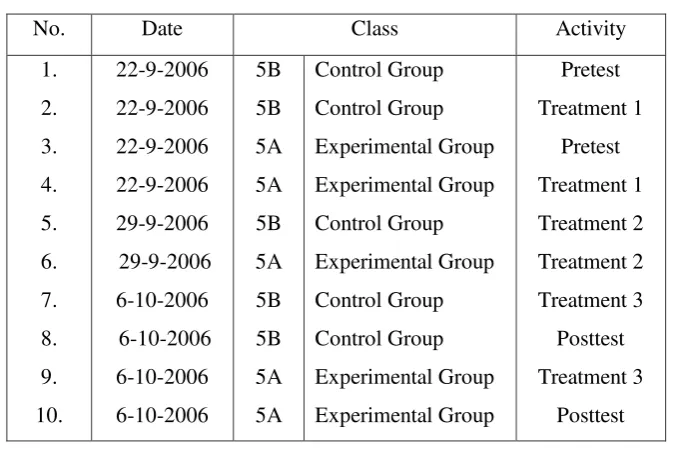
3.1.3.3 Schedule of the Treatment
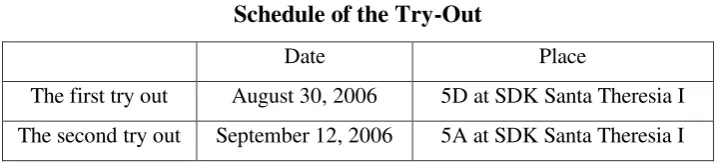
The treatments were done during three meetings. Each meeting was 40 minutes. Before administering the treatments, the writer tried out the research instrument at SDK Santa Theresia I (Santa Theresia I Elementary School Surabaya). The complete schedule of the try out and the treatments can be seen as follows:
Table 3.3
Schedule of the Try-Out
Date Place
The first try out August 30, 2006 5D at SDK Santa Theresia I
19
Table 3.4
Schedule of the Treatment at SDK Yohannes Gabriel
No. Date Class Activity
Schedule of the Treatment at SDK St. Theresia II
20
constructed the reading comprehension questions and reading quiz exactly the same materials were used in the experimental and control groups.
3.1.4 Population and Sample
The population of this study is the fifth year elementary school students belonging to the school year of 2006-2007 of SDK St. Theresia II (Santa Theresia II Elementary School Surabaya) and SDK Yohannes Gabriel (Yohannes Gabriel Elementary School Surabaya). The samples of this study were the only two classes available at each school: classes 5A and 5B. The student samples were not selected by a randomized sampling procedure, because this study was conducted in the classroom setting. At SDK Yohannes Gabriel, class 5A was randomly decided to be the experimental group and class 5B the control group. At SDK St. Theresia II, class 5A was randomly decided to be the control group and class 5B the experimental group. At SDK Yohannes Gabriel, the sample was 96 students (48 students from each class). At SDK St. Theresia II, the sample was 84 students (43 students of 5A, and 41 students of 5B)
3.1.5 Research Instrument
A reading comprehension test was developed for this study. It was used for the pretest and posttest for the experimental and control groups. There were 26 items in the research instrument. It was administered with a time limitation of 30 minutes. The test itself was in the form of multiple choice having four options for each item with only one correct answer. Three passages were used for this test. Two reading passages were made by the writer herself by adjusting to the textbook used in the school and the other was taken from a commercially published textbook for the fifth grade students of elementary school (See Appendix 1 for the details of the instrument). The test was then tried out to know the reliability, the level of difficulty and the discrimination power of the test.
21
3.1.5.1 Validity of the Test
The instrument devised is a reading comprehension test containing thirty items of multiple choice questions each of which has four options. The type of test validity employed is the content validity since the test designed in this study is oriented on matching the test content with the instructional objective being investigated. The test materials are in fact covered in the course book used in the teaching learning process.
3.1.5.2 Reliability of the Test
The reliability of the test was ensured by employing KR Formula 21 as proposed by Gronlund (1982:133) and Brown (1996:197). The level of difficulty of each item of
To determine the test‟s reliability of this study, the test was tried out twice. The result of the calculation for the first try out was 0.7257. It was greater than 0.316, so it showed that the test achieved reliability. However, there were 8 items on the test which had low discrimination power, so the writer revised the test and did the try out again. The calculation of the second try out was 0.7742. It was also shown that the revised test was reliable (See Appendix 2 for the detailed calculation).
3.1.5.3 Level of Difficulty
To analyze the level of difficulty for each item, the writer used the level of difficulty formula (Heaton, 1979: 176).
The formula of level of difficulty is:
N R
22
Where R = correct answer, and N = number of testes
According to Heaton (1979), there are the criteria of level of difficulty: Index difficulty (FV) Interpretation
.00 - .14 very difficult
.15 - .29 difficult
.30 - .70 acceptable
.71 - .85 easy
.86 – 1.00 very easy
According to Ebel (1979: 89), a good test should consist of some difficult questions and some easy questions that can challenge for both better students and poorer students. The test was tried out twice because on the first try out there were 8 items which had low discrimination power.
There are four level of difficulty. They are very difficult, difficult, acceptable, easy, and very easy. The analysis of the level of difficulty for the first try out showed that no item was very difficult, one item (question 19) was difficult, twenty-two items were acceptable (questions 1, 3, 4, 5, 6, 7, 8, 9, 10, 15, 17, 18, 20, 21, 22, 23, 24, 25, 26, 27, 28, 29, 30), three items (questions 2, 11, 16) were easy and four items (questions 12, 13, 14, 23) were very easy (For the complete calculation see Appendix 3).
From the calculation of the second try out, it was known that there were still 4 numbers (2, 12, 28 and 30) who had low discrimination power, the writer decided to drop those numbers. There were 26 items in the research instrument. It contained of containing 20 acceptable questions (questions 1, 3, 4, 5, 6, 7, 8, 9, 10, 15, 17, 18, 20, 21, 22, 24, 25, 26, 27 and 29) , 1 difficult question (question 19), 2 easy questions (questions 11 and 16) and 3 very easy questions (questions 13, 14 and 23). The complete calculation can be found in Appendix 3.
3.1.5.4 Discrimination Power
The formula for estimating the Discrimination Power is:
n
correctL correctU
D
23 N = number of students in one group According to Harris (1969), the criteria of DP are:
Discrimination Index (D) Interpretations -1.00 until +.19 low
+.20 until +.39 satisfactory +.40 until +1.00 very effective
The test was tried out twice. The result of the first try out of the test showed that eight items (questions 2, 12, 13, 15, 17, 23, 28, 30) were low, eleven items (questions 1, 3, 4, 5, 8, 9, 15, 17, 21, 22, 27) were satisfactory and eleven items (questions 6, 7, 10, 18, 19, 20, 22, 24, 25, 26, 29) were very effective (For the complete calculation, see Appendix 3).
The result of the first test try out showed that there were 8 items that had low discrimination power. Those items could not really differentiate between the proficient students from the poor students. Then the writer revised the test and did the try out again. For the second try out, the writers only analyzed the 8 items which had low discrimination index. Those were questions 2, 12, 13, 15, 17, 23, 28 and 30. The result showed that question number 2 was low, question number 12 was low, question number 13 was satisfactory, question number 15 was satisfactory, question number 17 was satisfactory, question number 23 was very effective, question number 28 was low and question number 30 was low (For the complete calculation, see Appendix 3).
Four items still had low discrimination power. Because of the writers‟ limited time to finish her experiment, the writer decided not to include those 4 items in the test. Therefore, the test consisted of only 26 numbers. It contained 14 satisfactory items (questions 1, 3, 4, 5, 8, 9, 11, 13, 14, 15, 16, 17, 21 and 27) and 12 very effective items (questions 6, 7, 10, 18, 19, 20, 22, 23, 24, 25, 26 and 29).
3.1.6 Data Collection Procedure
24
based on the consideration that at the three schools the same books and teaching technique were used. The first try out was done on August 30, 2006. From the first try out it was found that the test was reliable, but it was not good because there were 8 items having low discrimination power. Then the writers revised the test and tried it out again. The second try out was also done at SDK St. Theresia I. It was on September 12, 2006. The result of the second try out was better than the first one, the test was also reliable, but there were still 4 items which had low discrimination power. Because of the writers‟ limited time, they decided to drop those 4 items. Therefore, the test consisted of only 26 items.
While preparing the test, the writers also made the lesson plans for the treatment for both experimental and control groups. For each meeting, the students discussed a reading passage and sixteen reading comprehension questions. Since there would be three meetings, the writers wrote three reading passages and sixteen questions for each. They themselves wrote the two passages and they modified a reading passage taken from “A Day with Didi” by Wihartini and Anggraeni. All of the topics were about daily activities using the Simple Present Tense. They also wrote a short quiz containing six multiple-choice questions for each passage. These quizzes were written based on the consideration that students would learn seriously during the reading passage discussion.
One of the lesson plans for the experimental group was tried out at SDK St. Theresia I on August 30, 2006. It was chosen also based on the same consideration as the one stated previously for the try out of the test. One of the writers carried out the try out of the lesson plan. Another writer observed the class. From the try out it was known that the time allocation was not proper with the real class condition and the writer had difficulty in grouping the students. Then she made the revision based on what she had observed.
25
At SDK St. Theresia II, the data were obtained on September 21 and 22 , 2006 for the pretests of the experimental and for the control groups respectively and October 12 and November 6, 2006 for the posttests of experimental group and for the control group respectively.
In the experimental group, the pretest was conducted on September 21, 2006 at 11.15 until 11.45. Then from 11.50 until 12.30 the first treatment was done. On the following week, to be exact on September 28, 2006 from 11.15 until 11.55, the second treatment was implemented. The third treatment was actually scheduled on October 5, 2006. The students did not have classes because they had a rehearsal for their school anniversary celebration. The treatment was then carried out on the following week, on October 12, 2006 from 11.15 until 11.55. Five minutes later, from 12.00 until 12.30, the posttest was conducted.
In the control group, the pretest was administered on September 22, 2006 at 09.45 until 10.15. Then from 10.20 until 11.00 the first treatment was done. On the following week, to be exact on September 29, 2006 from 09.45 until 10.25, the second treatment was implemented. On the following week, on October 6, 2006, the third treatment was carried out from 09.45 until 10.25. From 10.30 until 11.00 the posttest was conducted.
At SDK Yohannes Gabriel, the first treatment for the control and experimental groups was done on the same day, September 22, 2006. For the control group the treatment was done at 07.25 until 08.45. At 07.25 - 07.55, the writer administered a pretest. The students were informed that the result of the test would be included in their final mark. The students were therefore expected to do the test seriously. Then, she prepared for the treatment. At 08.05 – 08.45, the writer conducted the treatment in the control group using traditional technique. For the experimental group the treatment was done at 09.40 until 10.30. At 09.40 – 10.10, the writer administered a pretest. The students were also informed that the result of the test would be included in their final mark. They were also expected to do the test seriously. At 10.10, the writer asked the students to collect the test. Then the writer prepared the classroom setting for the treatment. At 10.20 -11.00, the writer conducted the treatment in the experimental group using jigsaw technique.
26
traditional technique. For the experimental group the treatment was done at 09.40 until 10.30. In this group, the writer directly taught the students using jigsaw technique.
The last treatment was done on October 6, 2006. For the control group the treatment was done at 07.25 until 08.45. First, it was started by giving the students the treatment using traditional technique at 07.25 – 08.05. Then the writer administered the posttest. It was from 08.05 – 08.35. The writer reminded the students to do the test seriously because the result of the test would be included in their final mark. For the experimental group the treatment was done at 09.40 until 11.00. At 09.40 – 10.20, the writer conducted the treatment in the experimental group using jigsaw technique. Then it was continued by giving the students posttest. It was at 10.10 – 10.50. The writer also reminded the students to do the test seriously because the result of the test would be included in their final mark. After conducting the posttest and getting the scores of the pre test and posttest, the writers analyzed them (see Appendix 5 for the scores obtained).
3.1.7 Data Analysis Procedure
The data of this study were obtained from the pre and posttest scores. The writers analyzed the data by preparing t-test to get the answers of the research questions. Since the t-test was used to see the means of two different groups of students, the t-test prepared was t-test for significance of the difference between two means for independent samples (Ferguson, 1959:137; Ary et al., 1979:147-148; Hatch and Lazaraton, 1991:261).
Firstly, the writers analyzed the pretest scores. The pretest scores obtained were used to determine whether the two groups were of more or less the same ability before the treatments were given as there were only two classes available in each class for the experiment. The t-test for significance of the difference between two means for independent samples was employed.
27
covariance –would be employed. However since “the analysis of covariance with pretest scores as the covariate are usually preferable to simple gain-score comparisons” (as claimed by Campbell and Stanley, 1963:23,49), and since the analysis of covariance is preferred to a direct comparison of gain scores because “gains are limited in size by the difference between the test‟s ceiling and the magnitude of the pretest score” (as claimed by Tuckman, 1988:145), the writers would employ covariance analysis – specifically, the ANCOVA (Analysis of Covariance) formula.
All the statistical calculations were performed by the help of SPSS statistical computing packages. The writers did not do manual calculation. The purpose was to save time as well as to make use of the helpful computerized program. The manual calculation was carried out when analyzing the test reliability, the level of difficulty and the discrimination power.
3.2The Research Method to Answer the Second Research Question 3.2.1 Research Design
This study was descriptive in nature. This study presented information concerning jigsaw phenomenon. The design of this study was illustrated as follows:
Research Problem
Data Collection (video recording,
observation,
questionnaire, and interview)
Data Analysis
Findings
28
obtained data from those instruments were analyzed and interpreted. The findings were then analyzed in order to answer the research problem.
3.2.2 Subjects
This study was administered to the fifth grade (5B) students of SDK St. Theresia II and the fifth grade (5A) students of SDK Yohanes Gabriel in the academic year 2006/2007. They were the students involved as the samples in the experimental group where jigsaw technique was implemented (Refer to 3.1.4 Population and Sample).
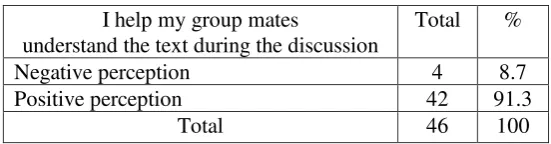
At SDK St. Theresia II, there were 39 students involved in this study. At SDK Yohanes Gabriel, there were 46 students. Altogether there were 85 students as the respondents of this study. They were those students present on the third treatment when they learnt using jigsaw technique.
3.2.3 Research Instrument
To obtain the data, the writers used four types of instruments. They are questionnaire, interview, video recordings and observers. Those instruments are important, useful, and effective and also support each other. Each instrument is described as follows:
3.2.3.1 Questionnaire
A questionnaire is a means of eliciting the feelings, beliefs, experiences, perception or attitude of some sample of individuals (Key, 1997). The writers chose to use questionnaire because it is a good way of collecting certain type of information quickly and because it is relatively cheap (Bell, 1993). The writers formulated a set of questionnaire in Indonesian covering ten items. They are closed questions formulated in such a way to make the students reveal their perceptions on the implementation of Jigsaw in their classroom.
29
percents to 80 percents to be true. And finally, if the issues were more that 80 percents, the respondents could choose the fourth range point (strongly disagree).
There were ten statements formulated to reveal students‟ perception on Jigsaw technique. Those statements were divided in three categories. They include perception on expert group activities (accommodated in statements 1 – 6), perception on the home group activities (statements 7 – 8) and overall perception to the jigsaw technique (statements 9 – 10) (Please refer to Appendix 6 for the complete questionnaire).
The questionnaire was piloted first to test how long it took respondents to complete them, to check that all statements and instructions were clear and to enable the writers to remove items which were not suitable (Bell, 1993).
3.2.3.2 1nterview
According to Moser and Kalton in Bell (1993), an interview is a conversation between interviewer and respondent with the purpose of eliciting certain information from the respondent. The writers conducted interviews to 17 students in order to support, to confirm and to clarify the data obtained from the questionnaire.
The writers conducted Delphi interviews based on the statements on the questionnaire. The respondents were asked series of statements that reveal their agreement or disagreement about jigsaw. This technique of interview was conducted to clarify respondents‟ answers to the questionnaire. It was used to strengthen the obtained data from questionnaire. This is in line with what Birley and Moreland (1998) claim. The data from the interview were recorded and later transcribed to be analyzed (the interview transcript appears in Appendix 7).
3.2.3.3 Observers
30
The first range point (strongly disagree) could be chosen if the issues were less than 20 percents to be true. The observers could choose the second range point (disagree) if the issues were around 21 percents up to 50 percents to be true. The third range point (agree) could be chosen if the issues were around 51 percents to 80 percents to be true. And finally, if the issues were more that 80 percents to be true, the observers could choose the fourth range point (strongly disagree).
The observers did the task to strengthen and support the students‟ answers in the questionnaire. The observers were of non-participant sort – they only observed the class situation. They did not directly participate in the lesson. The results from the observation were compared with the result of other instruments afterward as proposed by Bell (1993).
3.2.3.4 Video Recordings
Besides the observation checklist, the writers also video-recorded the students‟ interaction during the lesson. The writers were assisted by a cameraman to do the recordings. The video recording allowed the writers to collect the conversation and movement during the discussion, which might support the writers‟ interpretation of students‟ perception on jigsaw implementation. In other words, this video recording was used to catch any conversation and movement that the observer might miss during the observations.
3.2.4 Data
The main data to answer the second research question were the subjects‟ responses shown in the questionnaire. The supporting data were the students‟ answers to the questions in the interview, the classroom activities captured by the video-camera, and the opinion of the observers as revealed in the observation sheet.
3.2.5 Data Collection Procedure
Actually, the data were taken when the writers did the treatment concerning the first research question (refer to 3.1.3.1 Treatment in the Experimental Group).
31
The questionnaire was tried out when the jigsaw lesson plan was tried-out to the pilot group on August 30, 2006 (Refer to 3.1.6). The pilot group was the fifth grade students of SDK Santa Theresia I.
After the try-out, it was found that the questionnaire was completely filled out in four minutes. From the try out, the writers found that two statements were too difficult and confusing for the respondents, therefore the two items were deleted. The questionnaire was not tried-out again because it was already clear and unambiguous for the respondents.
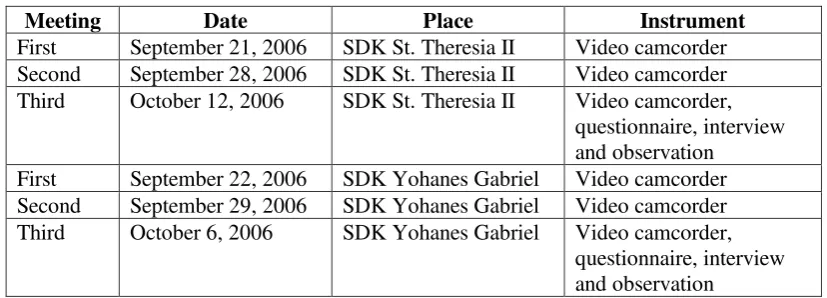
When the real experiment was carried out (refer to 3.1.3.3 Schedule of the Treatment) at SDK St. Theresia II and SDK Yohanes Gabriel in three meetings of the experimental groups, the recording took place. The questionnaires were distributed only on the third meeting. The interview and observation were conducted on the same day. On October 12, 2006, the questionnaires were distributed to the fifth grade students of SDK St. Theresia II. The interview and observation were also conducted on the same day. At SDK Yohanes Gabriel, they were conducted on October 6, 2006. The schedule of the treatment is shown as follows:
Table 3.6
Schedule of Data Collection Related to the Second Research Question
Meeting Date Place Instrument
First September 21, 2006 SDK St. Theresia II Video camcorder Second September 28, 2006 SDK St. Theresia II Video camcorder Third October 12, 2006 SDK St. Theresia II Video camcorder,
questionnaire, interview and observation
First September 22, 2006 SDK Yohanes Gabriel Video camcorder Second September 29, 2006 SDK Yohanes Gabriel Video camcorder Third October 6, 2006 SDK Yohanes Gabriel Video camcorder,
questionnaire, interview and observation
32
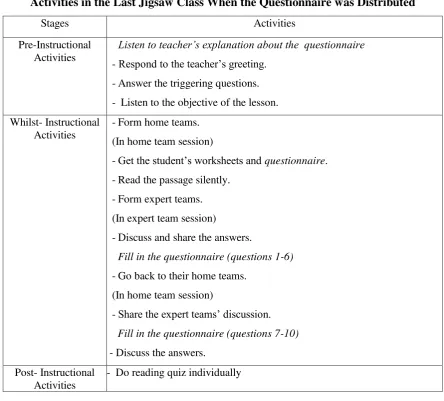
distributed, the questionnaires were also distributed. The questionnaires were not directly filled. The students filled the questionnaire in two stages. First, after finishing the discussion in the „expert group‟, the students filled in the questionnaire. They were asked to fill in numbers 1 – 6. These questions were related to their perception on „expert group‟ work (See Appendix 6 for the questionnaire). Then the second was after all the members in „home group‟ shared their part. The students filled in the questionnaire again. They answered questions 7 – 10. These questions were related to their perception on „home group‟ work and their overall perception on jigsaw. The writers provided the table (on the next page) to describe the more detailed activities in the last treatment when the questionnaire was distributed.
33
Table 3.7
Activities in the Last Jigsaw Class When the Questionnaire was Distributed
Stages Activities
Pre-Instructional Activities
Listen to teacher’s explanation about the questionnaire
- Respond to the teacher‟s greeting.
-Answer the triggering questions.
- Listen to the objective of the lesson.
Whilst- Instructional Activities
-Form home teams.
(In home team session)
-Get the student‟s worksheets and questionnaire.
-Read the passage silently.
-Form expert teams.
(In expert team session)
-Discuss and share the answers.
Fill in the questionnaire (questions 1-6)
-Go back to their home teams.
(In home team session)
-Share the expert teams‟ discussion.
Fill in the questionnaire (questions 7-10)
- Discuss the answers.
Post- Instructional Activities
- Do reading quiz individually
3.2.6 Procedure of Data Analysis
The data analysis was done in some steps as follows:
1. The subjects‟ responses from the questionnaire were tallied and the percentages were
counted.
2. The data from the recorded interview was transcribed. Then, the writers compared the
result of interview with the questionnaire.
3. The results of observation from the observers were compared.
4. The data from the video recording ware reviewed. Then, they were compared to the results of observation checklist.
34 another.
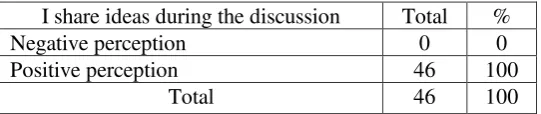
6. Those data were merged into two revealing positive response and negative response. Positive response was taken from „strongly agree‟ and „agree‟ answers, while
„disagree‟ and „strongly disagree‟ answers belonged to negative response.
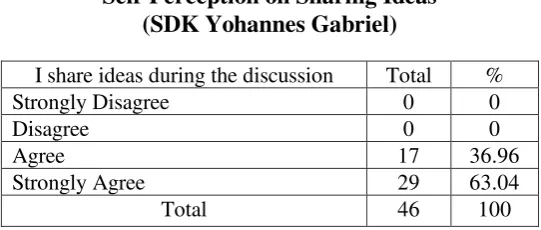
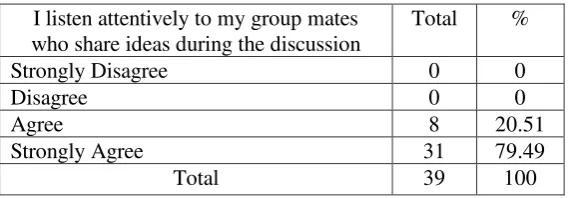
7. The obtained data were then interpreted. When the percentage of positive response was more than 60 percents, positive perception on that particular issue was obtained. On the other hand, when the percentage of negative response was more than 60 percents, negative perception was obtained.
8. The writers finally drew the conclusion based on the findings of the questionnaire, interview, video recording and observation.
3.3The Research Method to Answer the Third Research Question 3.3.1 Research Design
This study was descriptive in nature. It presented information concerning classroom interaction in jigsaw class. The design of this study is summarized as follows:
Research Problem
Data Collection (audio recording)
Data Analysis
Findings
Based on the research problem formulated, the writers collected the data by using two types of instruments. They were audio and video recordings. The obtained data from the instrument were analyzed and interpreted. The findings were then used in order to answer the third research problem.
3.3.2 Subjects
35
2006/2007. They were the students involved as the samples in the experimental group where jigsaw technique was implemented (Refer to 3.1.4 Population and Sample).
At SDK St. Theresia II, there were 39 students involved in this study. At SDK Yohanes Gabriel, there were 46 students. They were those students present on the third treatment when they learnt using jigsaw technique. More particularly, they were those working in their expert teams formed in the last treatment of the experimental group (the jigsaw class).
In each class, one expert team consisting of 4 students was chosen from the expert teams formed. Altogether there were two expert teams - one from SDK St. Theresia II and one from SDK Yohannes. Gabriel. Consequently, the exact subjects were 8 students who were chosen purposively to get the data to answer the first research question.
3.3.3 Research Instrument
To obtain the data, the writers used a tape recorder. The instrument was „hidden‟ inside a small bag which was put in the center of the chosen expert team. It was set to record the discussion the students had while they were trying to be the experts of that particular paragraph.
3.3.4 Data
The data were in the form of student-student interaction appearing in the expert team where the jigsaw technique was implemented. The data to be analyzed were the ones revealing how students interact or communicate hence revealing interaction patterns existing in the expert team of jigsaw class (see Appendix 9 for the expert team discussion transcript).
3.3.5 Data Collection Procedure
Similar to the one stated in the procedure to get the data for the second research question (refer to 3.2.4), the data for the third research question were actually taken when the writers did the treatment concerning the first research question (refer also to
3.1.3.1 Treatment in the Experimental Group).
36
first treatment of jigsaw class at SDK St. Theresia II. On September 22, 2006 they also recorded another one at SDK Yohannes Gabriel. It was found out that the expected subjects‟ voice was too much disturbed by the other noise – from the whole big class who were also working or discussing their task in their groups.
The writers then tried hard to find a solution to this problem. They eventually made up their mind to do the recording outside the classroom. When the expert teams were formed, one expert team was asked to go outside the classroom to do the assigned task. They did it outside not too far away from the classroom door.
On October 6, 2006 the writers (Siti Mina Tamah and Linda Anggraini) assisted the other writer (Ong Ervina L. Susanto) who was conducting the jigsaw technique in the class. They recorded the discussion of the chosen expert team in the last treatment of jigsaw class at SDK Yohannes. On October 12, 2006 other data were also taken at SDK St. Theresia II. They recorded the discussion of another chosen expert team in the last treatment of jigsaw class taught by the other writer (Elisa Y. Widjaya).
3.3.6 Procedure of Data Analysis