*Corresponding author.
Journal of Econometrics 96 (2000) 293}356
An empirical analysis of earnings dynamics
among men in the PSID: 1968
}
1989
John Geweke
!,",
*, Michael Keane
",#
!Department of Economics, University of Iowa, 121 E. Market Street, Iowa City, IA 52242, USA bDepartment of Economics, University of Minnesota, USA
cDepartment of Economics, New York University, USA
Received 1 December 1997; received in revised form 1 April 1999
Abstract
This study uses data from the Panel Survey of Income Dynamics (PSID) to address a number of questions about life cycle earnings mobility. It develops a dynamic reduced form model of earnings and marital status that is nonstationary over the life cycle. The study reaches several"rm conclusions about life cycle earnings mobility. Incorporating non-Gaussian shocks makes it possible to better account for transitions between low and higher earnings states, a heretofore unresolved problem. The non-Gaussian distribution substantially increases estimates of the lifetime return to post-secondary education, and substantially reduces di!erences in lifetime earnings attributable to race. In a given year, the majority of variance in earnings not accounted for by race, education and age is due to transitory shocks, but over a lifetime the majority is due to unobserved individual heterogeneity. Consequently, low earnings at early ages are strong predictors of low earnings later in life, even conditioning on observed individual characteristics. ( 2000 Elsevier Science S.A. All rights reserved.
Keywords: Earnings mobility; Panel data; Non-Gaussian disturbances; Markov Chain Monte Carlo
1. Introduction
This paper models the earnings process of male household heads, using data from the Panel Study of Income Dynamics, 1968}1989. The estimated model
addresses a number of questions about life-cycle earnings mobility. It provides answers to questions such as: What is the probability that a household head with earnings in the bottom quintile of the earnings distribution in one year will still be in the bottom quintile in a subsequent year? What fractions of the variance in lifetime earnings are due to observed heterogeneity, unobserved heterogeneity, and transitory shocks, respectively?
Income mobility has been studied in many previous papers, including McCall (1973), Shorrocks (1976), Lillard and Willis (1978), MaCurdy (1982), Gottschalk (1982), Gottschalk and Mo$t (1994). However, we believe that recent advances in econometric methods}in particular, Bayesian inference via Gibbs sampling
} make it worthwhile to reexamine this question, because they allow one to estimate much more sophisticated models of the stochastic process for income or earnings than were possible in previous work.
In the classic paper on earnings mobility by Lillard and Willis, the approach is to estimate a standard earnings function, where the dependent variable is log annual earnings and the regressors are education, labor force experience and its square, race, and time e!ects, and where the error term is assumed to consist of an individual random e!ect that is normally distributed in the population plus a time-varying normally distributed"rst-order autoregressive error component. They estimate this model on data from the PSID for male heads of households over the 1967}1973 period. They"nd that the regressors explain 33% of the variance in log earnings, the random e!ect accounts for 61% of the error variance, and"rst-order serial correlation is 0.40.
Some drawbacks of this model are apparent from a comparison of predicted and actual transition probabilities. For instance, the model predicts that, for whites, the probability of being in poverty in 1969 conditional on having been in poverty in 1968 is 46.9%, while the actual sample frequency is only 37%. Thus, the model overstates short-run persistence of the poverty state. Also, the pre-dicted probability of a white person being in poverty in 1969 if he was in poverty in 1968 but not in 1967 is 34.6%, whereas if he was in poverty in 1967 but not in 1968, the predicted probability of being in poverty in 1969 is only 17.9%. The actual sample frequencies of the person being in poverty in 1969 given these past histories are 23.5% and 21.1%, respectively. This again suggests that the model overstates short-run persistence.
A number of possible reasons may explain why the normally distributed random e!ect plus "rst-order autoregressive error structure (AR(1)) might overstate short-run persistence and, more generally, fail to fully capture the complexity of observed earnings mobility patterns. One is that the time-varying error term may follow a more complex time-series process than the AR(1) assumed by Lillard and Willis. Another potential problem is that the time-varying error components may not be normally distri-buted. In fact, Lillard and Willis note that &the actual distributions [of log earnings] for both blacks and whites are leptokurtic and slightly
negatively skewed relative to normal curves with the same mean and standard deviation'.
In this paper we focus on the implications of nonnormality of the time-varying error components for estimates of earnings mobility. As described below, it is feasible to undertake Bayesian inference using the Gibbs sampler for models with complex error structures. The latter may have a complex serial correlation structure, with non-Gaussian shocks. In our model the proportion of shock variance due to transitory e!ects varies with age, for example, and the shape of each of two key shock distributions depends on seven free parameters. Our work is related to recent work by Horowitz and Markatou (1996), who have developed semiparametric methods for estimating models with random e!ects plus a transitory error component. They apply this semiparametric approach to a sample of white male workers from the 1986}1987 Current Population Surveys. They"nd that the transitory component is not normal (it has fatter tails), and show how&the assumption that it is normally distributed leads to substantial overestimation of the probability that an individual with low earnings will become a high earner in the future'. In our view, the adoption of a#exible mixture of normals structure for the time-varying errors has some important advantages over a semiparametric approach. In particular, it easily accommodates serial correlation and nonstationarity over the life cycle, and makes fewer demands on the data than do semiparametric methods. The approach of Hirano (1998) to constructing a complex error structure is similar to that taken here. He also uses methods for Bayesian inference much like the ones applied in this paper. However, Hirano uses much smaller, more homogene-ous samples than we do, because unlike our model his does not include covariates, and he is unable to use earnings histories that exclude the initial period.
Another reason for reexamining the question of earnings mobility is that much more data is available now than when the classic studies by Lillard and Willis and MaCurdy were done. The PSID now extends over more than 20 yr. Given the objective of distinguishing among alternative serial correlation
speci-"cations for the error term, tests based on more than 20 yr of data should have much greater power than ones that use only 7 or 10 yr of data. In particular, one would need a lengthy panel in order to have much hope of distinguishing individual e!ects from an autoregressive coe$cient near one. The model in this paper takes advantage of the longer period, but it also includes data from men who were only observed over very short periods}even as short as one year. In conjunction with a model that permits nonstationarity over the life cycle, the use of all these data required several innovations in methodology, described sub-sequently.
Finally, we should note that a Bayesian approach has important advantages over classical approaches for studying earnings mobility. Speci"cally, we can form complete posterior distributions for earnings given any initial state (e.g., parents were black and high school educated) or given any subsequent history
(e.g., respondent obtained a college degree and has a particular earnings history up through age 30). This is, in e!ect, exactly what Lillard and Willis do, but the posterior distributions they construct are based on classical point estimates. In a Bayesian approach, the posterior distributions are formed by integrating over the posterior distributions of model parameters, thus accounting for parameter uncertainty. In this context, parameter uncertainty is likely to be important, especially since it is di$cult to distinguish between individual e!ects and very strong autoregressive error components. Thus, a prediction of the probability that someone in poverty today will still be in poverty 10 yr from now, based on point estimates of the fraction of variance due to a random e!ect and the parameters of a complex autoregressive error process, all estimated on only 20 yr of data (not to mention 7 to 10 yr of data), and ignoring the uncertainty in those estimates, does not seem particularly credible.
2. The PSID data
The PSID data set is based on a sample of roughly 5000 households that were interviewed in 1968. Of these, about 3000 were sampled to be representative of the nation as a whole and about 2000 were low-income families that had been interviewed previously as part of the Census Bureau's Survey of Economic Opportunity. The members of these households have been tracked every year since then. People who entered either the original households or split-o!s from the original households are also tracked. For example, if after 1968 a child in one of the original households left home to form a new household, then that new household as well as its members are tracked.
The structure of the PSID data is unusual, in that the household is treated as the unit of observation, yet households are unstable over time. Thus, to form a time series of earnings or marital status for an individual in the PSID data, one must determine what household that individual was in during each year of the data (based on unique household identi"ers) and then read the individual's earnings and marital status from the relevant household record. For example, if a person was in a particular household in a particular year, and one wants to know the person's earnings, one can determine whether the person was the household head and, if so, read o! the earnings-of-household-head variable. Unless the person was the household head in a particular year, data on that individual tend to be scanty.
We use the PSID data for 1968}1989 in our analysis. The full data set contains observations on 38,471 di!erent individuals. We apply several screens to the data. First, we consider only men aged 25}65, and for these men we use only the person-year observations in which the person can be identi"ed clearly as a household head. Our de"nition of household head is stricter than that in the PSID. Approximately 10% of the males identi"ed as household heads in the
1Appendices A}G are available through http://www.econ.umn.edu/&geweke/papers.html.
PSID in any given year report they are still students, or that they are keeping house, permanently disabled, in prison, or otherwise institutionalized. We do not count such men as household heads in these periods. Second, we screen out those individuals for whom education or race is unavailable. Third, we drop the observation for the "rst year a person was a household head, if the earnings information for that year is contained in the data set. We do this because in many cases that is the"rst year the person works full time, and he may not work the entire year. Such part-year earnings "gures may severely understate the person's actual initial earnings potential. Finally, if an individual has missing earnings or marital status observations following his "rst period of accepted data (due, say, to nonresponse in a particular year), we drop all observations for that person from that point onward. This last screen is convenient, but not essential, because data augmentation methods (see Appendix C1) could be used to treat the missing observations as latent variables assuming an independent censoring process. The resulting sample for analysis contains 4766 persons and 48,738 person-year observations. By far the bulk of the sample reduction comes from the"rst screen: restricting the sample to males aged 25}65 who at some point in the data set are household heads. There are 5267 such individuals in the PSID. The various missing data screens only eliminate 501 of these.
Table 1 reports on the earnings distribution of the analysis sample, condi-tional on demographics. We de"ne earnings quintiles based on the full sample. In 1967 dollars these are$3817,$5786,$7798 and$10,454 (to convert to 1998 dollars multiply by 4.88). In Table 1 we report for each of 24 subsamples (two race categories crossed with three education and four age categories) the number of person-year observations in each earnings quintile.
An important aspect of the PSID data is that the earnings questions are retrospective. Most interviews are conducted in March, and the questions refer to earnings in the previous year. Thus, the earnings data in our sample are primarily from 1967 to 1988. We date the observations according to the year of the earnings data, rather than the year of the interview. Consistent with the prior literature on male earnings dynamics and distribution, we drop person-year observations in which reported annual earnings are zero, on the grounds that annual earnings that are truly zero for a male household head are an unusual event. In fact, zero reported annual earnings for males classi"ed as household heads by the PSID are a fairly common event, occurring in approximately 7% of all the person-year observations for males aged 25}65. However, once we apply our stricter de"nition of a household head, and drop the observations for"rst time heads, the percent of zeros becomes quite small at most ages. It averages about 1.5% over ages 25}43, increases slowly to about 4% in the late 1940s and
Table 1
Some sample properties of earnings data (full sample)
Cell counts
Personal characteristics Number in earnings quintile
Race Education Age 1st 2nd 3rd 4th 5th Total
White (12 25}34 516 624 461 290 111 2002
White (12 35}44 464 562 557 472 276 2331
White (12 45}54 582 677 622 536 449 2866
White (12 55}65 883 601 454 397 269 2604
White 12}15 25}34 993 1504 1812 1682 891 6882
White 12}15 35}44 457 682 1065 1301 1284 4789
White 12}15 45}54 294 518 703 1063 1052 3630
White 12}15 55}65 374 403 481 580 545 2383
White *16 25}34 332 319 513 812 843 2819
White *16 35}44 95 129 230 502 1448 2404
White *16 45}54 45 90 105 300 1136 1676
White *16 55}65 83 71 87 211 598 1050
Nonwhite (12 25}34 944 524 274 94 23 1859
Nonwhite (12 35}44 747 577 420 183 81 2008
Nonwhite (12 45}54 881 655 369 201 94 2200
Nonwhite (12 55}65 817 405 217 96 59 1594
Nonwhite 12}15 25}34 859 917 716 446 169 3107
Nonwhite 12}15 35}44 156 254 314 283 157 1164
Nonwhite 12}15 45}54 82 111 127 109 72 501
Nonwhite 12}15 55}65 71 39 52 43 47 252
Nonwhite *16 25}34 49 70 111 84 62 376
Nonwhite *16 35}44 1 3 34 29 43 110
Nonwhite *16 45}54 1 9 9 24 18 61
Nonwhite *16 55}65 21 5 14 9 21 70
Totals 9747 9749 9747 9747 9748 48738
Sample distributions
Personal characteristics Proportion in earnings quintile
Race Education Age 1st 2nd 3rd 4th 5th
White (12 25}34 0.258 0.312 0.230 0.145 0.055
White (12 35}44 0.199 0.241 0.239 0.202 0.118
White (12 45}54 0.203 0.236 0.217 0.187 0.157
White (12 55}65 0.339 0.231 0.174 0.152 0.103
White 12}15 25}34 0.144 0.219 0.263 0.244 0.129
White 12}15 35}44 0.095 0.142 0.222 0.272 0.268
White 12}15 45}54 0.081 0.143 0.194 0.293 0.290
White 12}15 55}65 0.157 0.169 0.202 0.243 0.229
White *16 25}34 0.118 0.113 0.182 0.288 0.299
White *16 35}44 0.040 0.054 0.096 0.209 0.602
White *16 45}54 0.027 0.054 0.063 0.179 0.678
White *16 55}65 0.079 0.068 0.083 0.201 0.570
Table 1 (Continued)
Personal characteristics Proportion in earnings quintile
Race Education Age 1st 2nd 3rd 4th 5th
Nonwhite (12 25}34 0.508 0.282 0.147 0.051 0.012
Nonwhite (12 35}44 0.372 0.287 0.209 0.091 0.040
Nonwhite (12 45}54 0.400 0.298 0.168 0.091 0.043
Nonwhite (12 55}65 0.513 0.254 0.136 0.060 0.037
Nonwhite 12}15 25}34 0.276 0.295 0.230 0.144 0.054
Nonwhite 12}15 35}44 0.134 0.218 0.270 0.243 0.135
Nonwhite 12}15 45}54 0.164 0.222 0.253 0.218 0.144
Nonwhite 12}15 55}65 0.282 0.155 0.206 0.171 0.187
Nonwhite *16 25}34 0.130 0.186 0.295 0.223 0.165
Nonwhite *16 35}44 0.009 0.027 0.309 0.264 0.391
Nonwhite *16 45}54 0.106 0.148 0.148 0.393 0.295
Nonwhite *16 55}65 0.300 0.071 0.200 0.129 0.300
5% in the late 1950s, and then jumps rapidly to 12.5% at age 62 and to 23% at age 65. The large increases at ages 62 and 65 are due to retirement.
As we discuss in Section 3, in our approach to modeling earnings of male household heads we will adopt the view that the latent earning process runs from age 25 to 65, but that the actual earnings value at any age may be unobserved for various reasons. For example, the latent earnings will be unob-served near the beginning of the life cycle if the person still lives at home or is still a student and is therefore not yet a head. Similarly, we view the earnings process as again becoming unobserved at the end of the life cycle at the point when the person retires. This perspective justi"es our ignoring the zero earnings observa-tions for retired men, just as we ignore the zero observaobserva-tions for the young men who are still students or living with parents, and instead viewing latent earnings as unobserved in such cases.
The zeros reported for younger male heads (those under age 62) pose a greater problem. Upon examining the zero observations, we found that 15% of these people were working on the interview date. And, of those not working, only about one quarter reported an unemployment spell of over three months. This makes us suspicious whether many of these people actually had zero labor earnings over the entire previous calendar year. Thus, we suspect that many of these zeros arise due to mis-reporting, and it seems sensible to omit them as well. Since we treat the stochastic process for earnings as beginning at age 25, we face an initial conditions problem if we do not observe an individual's earnings until an age later than 25. Of the individuals in the sample, only 1728 are observed at age 25, and for these there are 15,604 person-year observations. In part of our analysis, we only use this subsample, which we refer to as the
&young men' sample. This avoids the initial conditions problem. For the full sample, we develop and apply data augmentation methods to the earlier,
missing years. It is worth noting that 569 individuals in the sample have only one year of data, and many others have short records of only a few years of data. Our data augmentation procedure enables us to more than triple the sample size available for inference and to introduce data from later in the life cycle that otherwise could not be used. This procedure can be applied generally in nonstationary models for panel data with partial or interrupted individual records.
3. The model
We model the annual earnings of male household heads between ages 25 and 65. An individual becomes a household head when he ceases to be a dependent; he may be either single or married. For each male in the PSID, our sample begins the year after he became a household head, the year he turns 25, or the year he entered the PSID, whichever is latest. It ends when he left the PSID or turned 65, whichever is later.
In our model the latent process for annual earnings begins at age 25, regardless of the age at which an individual's earnings are "rst observed. We model earnings at ages greater than 25 as a function of lagged earnings, a set of exogenous personal characteristics (education, age, race, and parents' educa-tion), current marital status, individual speci"c disturbances, and serially corre-lated shocks. At age 25 annual earnings are a (di!erent) function of the exogenous personal characteristics, and a "rst-period shock. Realizations of annual earnings from this latent process are observed only when the individual is a household head, is present in the sample, and has been a household head for at least one year. In one variant of the model the"rst-period and subsequent-period shocks are Gaussian. We refer to this as the&normal model'. In another variant these shocks are mixtures of three normal distributions and therefore non-Gaussian. We refer to this as the&mixture model'.
In previous cross-section studies marital status appears to have had a large positive partial correlation with male earnings, even after controlling for human capital variables and other demographic characteristics. Thus, to forecast a man's earnings over all or part of his life cycle it could be important to forecast his marital status as well. We therefore model earnings and marital status jointly.
Marital status is determined in a probit equation. At ages beyond 25 the probit is a function of lagged marital status, lagged earnings, a set of exogenous personal characteristics (education, age, and race), and a serially correlated Gaussian shock. Marital status at age 25 is determined by a probit equation in which the probit is a (di!erent) function of the exogenous personal character-istics and a"rst-period shock. As with the earnings model, the latent marriage process begins at age 25 regardless of the age at which an individual enters the
2The marital status data are as of the interview date, while the income data are retrospective. Thus, marital status from March of yeartis paired with income from yeart!1. It is di$cult to pair March of yeart!1 marital status with yeart!1 income information, because a person who was a household head attmay not have been a head att!1. In this case, timet!1 information on marital status is often scanty. Note that in either case we must pair point-in-time measures from either March of yeart!1 or March of yeartwith annual data that span those dates. Neither approach to dating is&correct', since both involve an arbitrary pairing of point-in-time with annual measures. Given the data structure of the PSID, it is much more straightforward to pair the March of yeartpoint-in-time measures with the yeart!1 income data, since both are collected in the same interview.
data set. Realizations from this process are observed only when the individual is a household head, is present in the sample, and has been a household head for at least one year.2
The joint model is fully recursive, with current marital status a!ecting current earnings, while current earnings do not a!ect current marital status. This model is applied to a panel of nindividuals, i"1,2,n. Individual i is observed in
periodsS
i,2,¹i, whereSi and¹i are determined as just described. Period 1
corresponds to age 25, period 2 to age 26, etc. Because the"rst-period model is not the same as the model for later periods, and since age appears as a covariate in the later periods, the processes for earnings and marital status are nonstation-ary. Therefore, ifS
i'1, the distribution of the"rst observation on earnings and
marital status is an impractically complicated explicit function of the parameters of the model. We avoid this complication by treating the unobserved earnings and marital status in periods 1,2,Si!1 as latent variables, as described in
Section 4 and Appendix C. Because of this, it turns out to be harmless to assume that individuals are observed in periods 1,2,¹i. With this convention, let
X
it"log real earnings of individuali in periodt;
x
i1"(k1]1) vector of period 1 explanatory variables for individuali
(i"1,2,n);
x
it"(k2]1) vector of periodtexplantory variables for individual i
(t"1,2,¹i; i3X2).
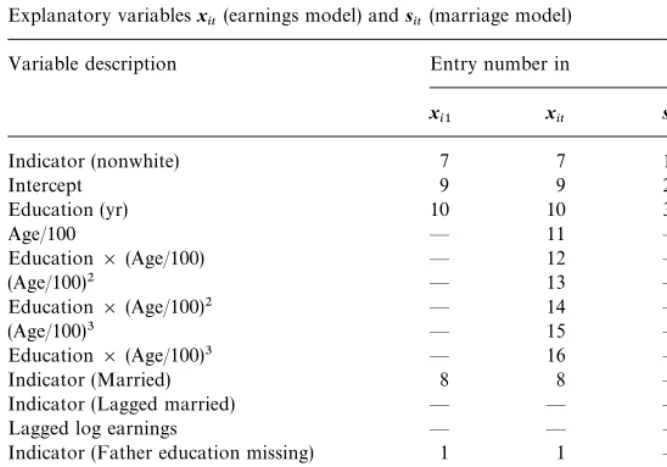
Table 2
Explanatory variablesx
it(earnings model) andsit(marriage model)
Variable description Entry number in
x
i1 xit si1 sit
Indicator (nonwhite) 7 7 1 1
Intercept 9 9 2 2
Indicator (Married) 8 8 * *
Indicator (Lagged married) * * * 8
Lagged log earnings * * * 9
Indicator (Father education missing) 1 1 * *
Indicator (Father education 12#) 2 2 * *
Indicator (Father education 16#) 3 3 * *
Indicator (Mother education missing) 4 4 * *
Indicator (Mother education 12#) 5 5 * *
Indicator (Mother education 16#) 6 6 * *
The model of individual earnings is
y
i1 contains indicator variables for parents' education and the
individual's race, and the individual's years of education and current marital status. The vectorx
it (t*2) contains these variables and, in addition, a
poly-nomial in education and age, through the"rst power in education and the third power in age. These are all standard covariates in earnings equations. The functional form of (1) is chosen so that bj is, to a good approximation, the marginal e!ect of the corresponding covariate on the unconditional expecta-tion of log real earnings. Thus the polynomial in age and educaexpecta-tion provides
a model of the e!ects of aging and education on expected log real earnings that is quite#exible. The"rst period is taken to be fundamentally di!erent from the remaining periods. Covariates will not have the same e!ects then as later. Given the dynamic structure, it would be inappropriate to assume that these e!ects are the same.
The shocksei1, gi2, git (t*3) are mutually independent across both time and individuals. The shocks e
i1 are identically distributed, as are the shocks g
it (t*2), but the two do not necessarily have the same distribution. Individual
heterogeneity consists of two components. The"rst-period shock is that portion of"rst-period earnings that is unanticipated across individuals, conditional on
"rst-period covariates. Part of this shock may be a transitory"rst-period e!ect (2), but part of it can also be permanent (the coe$cient/in (1)). The mean level of earnings in the dynamic equation (1) is also heterogeneous, by virtue of the shockqi. The variance of the disturbance vectore@i"(ei1,2,eiT) is a function of
the six terms var(ei1), var(git), p2
q, o, o8, and/: in general a variance matrix for
disturbances from any three years corresponds to six values of these parameters, and the fraction of variance due to unobserved heterogeneity (inqi andei1) can range from zero to one and can change smoothly from year to year.
Serial correlation in the distribution of earnings, conditional on covariates, enters the model by means of the parameterscando. All of the covariates inx
it,
except current marital status, are either time invariant or are deterministic polynomial functions of time. Thus the only nondeterministic covariate, marital status, provides most of the distinction between andcando: e!ects of lagged marital status are present if and only ifcO0. IfoO0 butc"0 there is serial correlation in earnings but no lagged impact of marital status on earnings.
In the mixture model the distributions ofei1andgitare each mixtures of three normal distributions; e.g.,
The shock distribution thus belongs to a seven-parameter family in each case. This feature of our model is unusual but important. It turns out that shocks are indeed non-Gaussian, and the mixture of three normal distributions goes far to resolve the puzzle about predicted and actual transitions noted in the introduc-tion. The normal model is a special case of this model, which imposes the constraintp
j2"1,pj1"pj3"0 (j"1, 2).
The choice of three components for the mixture of normals was based on inspection of the posterior distribution of theeitwhen the shocks are assumed to be normal. We found through experimentation that a three-component mixture model could approximate the posterior distribution of theeit reasonably well. Given the lack of experience with mixture models this complex, we did not wish to use more components. Based on the results reported below, it seems clear that
3For further discussions of"nite normal mixture models see West and Harrison (1989), Section 12.3.4, and Roeder and Wasserman (1997). On in"nite normal mixture models with Dirichlet process priors see Escobar and West (1995) and MacEachern and Mueller (1995).
experimentation with more components for the mixture of normals is war-ranted. An alternative is to allow an in"nite number of components, and use a Dirichlet process prior for the number of components actually observed in the sample. The latter approach was taken by Hirano (1998), but his model excludes covariates, and allows either random e!ects or autocorrelation in transitory shocks but not both.3
The earnings model has 45 free parameters. It is completed with a prior distribution for these parameters. We choose a prior distribution in the light of two criteria. First, the functional form of the prior distribution should be one that is#exible but also convenient in obtaining the posterior distribution. This relationship between the functional form of the prior and posterior is treated in Appendices 1 and 2 of this paper, and in detail in Appendices A and B. Second, the prior distribution should center about values that are plausible in the context of the earnings and income mobility literature, but should also be di!use enough to permit all reasonable (and in the process, many unreasonable) departures from these values. A detailed presentation of the prior distribution is made in Appendix 3.1.
One feature of the prior distribution is worth emphasis, for it copes with the interpretation of the e!ects of age and education on earnings in a way that is also useful in the subsequent presentation of results. The prior distribution for the coe$cients of the age-education polynomial is developed by considering the di!erence between expected log earnings at age a
2 and education e2, and
expected log earnings at age a
1 and education e1, denoted G(a1,a2;e1,e2).
Independent, normal prior distributions for G(25, 35; 12, 12), G(35, 45; 12, 12),
G(45, 55; 12, 12), G(25, 25; 12, 16), G(35, 35; 12, 16), G(45, 45; 12, 16) and
G(55, 55; 12, 16) were constructed. Combined with another independent prior distribution for expected log earnings at age 25 and education level 12, these eight distributions imply a joint normal distribution on the coe$cients in the polynomial in education (powers 0 and 1) and age (powers 0 through 3). Since individual coe$cients in this polynomial have no interesting interpretation, we make use of this convention as well in subsequently reporting posterior means. Assessment of the sensitivity of the posterior distribution to changes in the prior is useful in interpreting the results. Corresponding to each posterior mean, we report the posterior standard deviation, and the prior mean and standard deviation. This facilitates a quick approximation of the sensitivity of the poste-rior mean to the pposte-rior mean using the familiar relation that is exact in the Gaussian case:hM"(h
MhM
#hh)/(h
M
#h), whereh,h, andhM are the prior, data, and
posterior means, respectively; and h
1 and hare the prior and data precisions.
Since the posterior precision ishM"h
1
#h, the sensitivity of the posterior mean to the prior mean isLhM/Lh"h
1/(h1
#h), which is simply the ratio of the posterior variance to the prior variance. This expression is invariant to rescaling of h, bounded between 0 and 1, and naturally interpreted as a ratio.
3.2. Marital status model
We adopt a dynamic probit speci"cation for marital status. Denote
d
it"1 if individualandd iis married in periodt it"0 if not (t"1,2,¹i;i"1,2,n);
s
i1"(p1]1) vector of period 1 explanatory variables
for individuali(i"1,2,n);
s
it"(p2]1) vector of period texplanatory variables
for individuali(t"2,2,¹i;i3X2);
mH
it"Probit (latent) that determinesdit (t"1,2,¹i;i"1,2,n).
The model for marital status is
mHi1"hI@s
i1contains an intercept, the individual's education, and a race indicator.
The vectors
it (t*2) contains these variables and, in addition, lagged marital
statusd
i,t~1and log real earningsyi,t~1, and a polynomial in education and age,
through the"rst power in education and the second power in age. As in the earnings model, the speci"cation of the "rst-period equation is di!erent from the other periods. The most important factor dictating a di!erent structure is that we do not have available lagged earnings for the"rst period, as explained above. We retain an explicit latent-variable formulation for the model for two reasons. First, this representation is readily amenable to the computational methods outlined subsequently. Second, in extensions and elaborations of this work, we intend to allow for the possibility that shocks to continuous and
discrete variables may be dependent. This possibility is facilitated by the latent-variable representation.
The marital status model has 13 free parameters. It is completed with a prior distribution for these parameters, designed according to the same criteria used in developing the earnings model prior. A detailed presentation of the marital status model prior distribution is made in Appendix 3.2. As in the earnings model it is necessary to cope with the interpretation of the e!ects of age and education} here, on the marital status probit. The prior distribution for the coe$cients of the age-education polynomial is developed by considering the di!erence between the expected marital status probit at agea
2and educatione2,
and the expected marital status probit at age a1 and education e1, denoted
*(a1,a2;e1,e2). Independent, normal prior distributions for *(25, 40; 12, 12),
*(40, 55; 12, 12), *(25, 25; 12, 16), *(40, 40; 12, 16) and*(55, 55; 12, 16) were con-structed. Combined with another independent prior distribution for the ex-pected marital status probit at age 25 and education 12, these six distributions imply a joint normal distribution on the coe$cients in the polynomial in education (powers 0 and 1) and age (powers 0 to 2). Since individual coe$cients in this polynomial have no interesting interpretation, we make use of this convention as well in subsequently reporting posterior means.
4. Bayesian inference
This section provides an overview of the methodology for conducting Bayesian inference in the earnings-marital status model. This description as-sumes familiarity with Bayesian inference and with the Gibbs sampling algo-rithm for drawing values from a posterior distribution. Accessible introductions to both topics for economists include Chib and Greenberg (1995,1996) and Geweke (1996,1999). More general references are Gelman et al. (1995) and Gilks et al. (1996).
The objective here is to provide an overview of the methods that are described in complete detail in Appendices A, B, and C. To that end, some additional notation is useful. Let z
i denote the vector of time invariant or deterministic
characteristics of individual i: i.e., all variables except earnings and marital status. Let¸
it be an integer latent variable indicating from which of the three
normal distributions the shock ei1 (if t"1) or git (if t*2) was drawn. Let
Y@
it"(yi1,2,yit), D@it"(di1,2,dit) andMHit"(mHi1,2,mHit). Finally, lethE
de-note the 45]1 vector of parameters in the earnings model, andhM the 13]1 vector of parameters in the marital status model.
The earnings model outlined in Section 3.1 and described in complete detail in Appendix 1 provides the probability density functions
p
E(yitDYi,t~1,Dit, zi,qi,¸it,hE), pE(qiD hE), pE(¸itD hE).
The marital status model outlined in Section 3.2 and described in complete detail in Appendix 2 provides the probability density function and probability function
p
M(mHitDYi,t~1,MHi,t~1,zi,hM), pM(ditDmHit).
The corresponding prior distributions for each model provide, respectively, p
We use a Gibbs sampling algorithm to make draws from this conditional distribution. (More precisely, a Gibbs sampling algorithm is used to construct a Markov chain whose unique invariant distribution is this distribution.) The algorithm proceeds in three groups of steps, detailed in Appendices A, B, and C, respectively.
In the"rst group of steps, the parameter vectorh
Eis divided into eight blocks.
A drawing is made from each block, conditional on all other parameters and latent variables. Then the individual e!ectsq
i (i"1,2,n) are drawn
individ-ually and in succession, exploiting their conditional independence. Finally the
¸
it (t"1,2,¹i;i"1,2,n) are drawn in succession, again taking advantage of
conditional independence. This completes a set of drawings from the conditional distributions for all parameters and latent variables in the earnings model, given (Y
i,Ti,Di,Ti)ni/1. The algorithm is described in Appendix A. Details for the
parameters of the mixture distribution are given in Appendix F.
In the second group of steps, the parameter vector hM is divided into two blocks. A drawing is made from each block, conditional on all other parameters and latent variables. Then the probitsmH
it (t"1,2,¹i;i"1,2,n) are drawn
individually; these are conditionally independent across individuals but not across time periods. This completes a set of drawings from the conditional distributions for all parameters and latent variables in the marital status model, given (Y
i,Ti, Di,Ti)ni/1.
In the third group of steps, "rst the unobserved earnings (Y
i,Si~1)ni/1 are
drawn. These are conditionally independent across individuals and jointly normally distributed. Then, the unobserved probits and marital statuses (D
i,Si~1, MHi,Si~1)ni/1 are drawn. These are conditionally independent across
individuals, but not across time periods, and so are drawn in succession for each individual. For the sample of young men, allS
i"1 and this third group of steps
is skipped.
Because the shocks ei1 and git have mixture of normals distributions, the likelihood function is unbounded. The essential problem is that coe$cients on the covariates can be chosen to make the conditional means of several log earnings observations identical to their observed values, given in one of the three normal distributions. As the variance term for that distribution approaches zero, the likelihood function is unbounded. This property of the mixture of normals likelihood function was"st demonstrated by Kiefer and Wolfowitz (1956); for an extended discussion, see Titterington et al. (1985, Section 4.3). As a consequence, numerical problems can arise in maximum likelihood algorithms and there is no assurance that any given bounded local maximum of the likelihood function is consistent (Redner and Walker, 1984). Appendix F shows that given conven-tional gamma priors for the precision terms h
k(j), the posterior distribution
exists, as do moments of bounded functions of interest. Appendix F also shows that the posterior moment of an unbounded function of interest exists if the corresponding prior moment exists after reducing the degrees of freedom para-meters in the chi square priors for the precision termsh
i(j)by 2#e(e'0). With
the exception of four moments noted in Table 3, the"rst and second moments of all unbounded functions of interest reported here satisfy the latter condition.
The Gibbs sampling algorithm simulates a Markov chain in high-dimen-sional space. By following all of the steps of the algorithm detailed in Appendices A, B, and C, it can be veri"ed that the probability that this Markov chain will move from any point in this parameter space to any region of the space with strictly positive posterior probability, in exactly one complete step of the algorithm, is nonzero. The chain is therefore ergodic (Tierney, 1994; Geweke, 1996): i.e., if EMg(hE, hM)D[z
i, (yit,dit)t/STi i]ni/1N exists, then the corresponding
sample average of g(hE,hM) from the posterior simulator converges almost surely to this posterior moment.
Operationally, the Gibbs sampling algorithm produces a"le with one record for each iteration. Each record has 58 entries, the parameter values for that iteration. Some posterior moments can be approximated directly from this"le by corresponding sample averages of explicit functions of parameters. (One example is the serial correlation parameteroin the earnings model. Another is the di!erence in unconditional expected log real earnings at ages 35 and 25, given 16 yr of education.) Most of the questions we investigate, however, have to do with properties of the earnings process. To facilitate this investigation, we construct a second"le of simulated earnings and marital statuses, based on the Gibbs sampling output"le and the personal characteristics of the individuals in the sample. Corresponding to the personal characteristics of each individual in the sample, we randomly select ten sets of parameter values from the Gibbs sampling output"le. Then we simulate the model from period 1 (age 25) through period 41 (age 65) and record the simulated path of earnings and marital status in each case. (For details of the simulation procedure, see Appendix D.) The simulated values are then used to approximate the probabilities of various
Table 3
Prior and posterior means and standard deviations for parameters and functions of interest, earnings and marital status models
Young men Full sample
Prior Mixed model Normal model Mixed model Normal model
Earnings period 1 covariates
Father ed missing 0.050 (0.200) !0.163 (0.056) !0.237 (0.080) !0.124 (0.067) !0.175 (0.075) Father ed 12# 0.050 (0.100) 0.014 (0.023) 0.025 (0.036) !0.011 (0.027) 0.013 (0.034) Father ed 16# 0.100 (0.100) 0.001 (0.036) !0.019 (0.051) !0.042 (0.041) !0.062 (0.051) Mother ed missing 0.050 (0.100) 0.059 (0.065) 0.081 (0.096) 0.133 (0.105) !0.189 (0.091) Mother ed 12# 0.050 (0.200) !0.021 (0.021) !0.006 (0.032) !0.030 (0.028) !0.011 (0.030) Mother ed 16# 0.100 (0.100) !0.032 (0.046) !0.029 (0.061) 0.023 (0.052) 0.003 (0.058) Nonwhite indicator !0.100 (0.100) !0.191 (0.024) !0.261 (0.035) !0.195 (0.030) !0.203 (0.034) Marital status current 0.200 (0.200) 0.072 (0.022) 0.083 (0.029) !0.006 (0.048) 0.092 (0.028) Intercept 7.22 (4.00) 7.85 (0.079) 7.86 (0.116) 8.09 (0.158) 6.88 (0.215) Education 0.065 (0.075) 0.050 (0.006) 0.045 (0.009) 0.032 (0.011) 0.123 (0.017)
Earnings periodtcovariates
Father ed missing 0.050 (0.200) !0.196 (0.050) !0.139 (0.065) !0.040 (0.100) !0.079 (0.040) Father ed 12# 0.050 (0.100) !0.011 (0.021) 0.045 (0.028) 0.085 (0.042) 0.069 (0.020) Father ed 16# 0.100 (0.100) 0.016 (0.033) 0.010 (0.042) !0.060 (0.076) !0.013 (0.033) Mother ed missing 0.050 (0.100) 0.093 (0.067) 0.122 (0.093) !0.103 (0.066) !0.052 (0.026) Mother ed 12# 0.050 (0.200) !0.006 (0.018) !0.009 (0.025) !0.019 (0.040) !0.017 (0.017) Mother ed 16# 0.100 (0.100) !0.086 (0.042) !0.046 (0.050) 0.005 (0.089) 0.024 (0.036) Nonwhite indicator !0.100 (0.100) !0.208 (0.021) !0.268 (0.026) !0.164 (0.051) !0.267 (0.019) Marital status current 0.200 (0.200) 0.036 (0.008) 0.081 (0.013) 0.050 (0.009) 0.100 (0.009) Earnings age 25, Ed 12 8.00 (4.00) 8.54 (0.024) 8.41 (0.030) 8.51 (0.037) 8.41 (0.023) Earnings age 35 vs. 25, Ed"12 0.150 (0.100) 0.236 (0.117) 0.245 (0.024) 0.231 (0.029) 0.261 (0.019) Earnings age 45 vs. 35, Ed"12 0.100 (0.100) 0.109 (0.023) 0.125 (0.034) 0.081 (0.008) 0.155 (0.010) Earnings age 55 vs. 45, Ed"12 0.050 (0.100) 0.157 (0.116) 0.099 (0.095) !0.043 (0.008) !0.113 (0.009) Earnings ed 16 vs. 12, Age"25 0.260 (0.150) 0.195 (0.026) 0.173 (0.038) 0.294 (0.034) 0.287 (0.041) Earnings ed 16 vs. 12, Age"35 0.340 (0.200) 0.341 (0.021) 0.450 (0.029) 0.469 (0.038) 0.362 (0.016) Earnings ed 16 vs. 12, Age"45 0.370 (0.225) 0.374 (0.033) 0.389 (0.055) 0.483 (0.040) 0.352 (0.013) Earnings ed 16 vs. 12, Age"55 0.400 (0.250) 0.284 (0.197) 0.400 (0.230) 0.447 (0.037) 0.318 (0.014)
Table 3 (Continued)
Young men Full sample
Prior Mixed model Normal model Mixed model Normal model
Properties ofxrst period shock!
Mean 1 !3.00 (1.00) !1.966 (0.233) * !2.625 (0.271) *
Mean 2 0.00 (0.00) 0.00 (0.00) * 0.00 (0.00) *
Mean 3 0.100 (0.100) 0.147 (0.029) * 0.199 (0.004) *
Standard deviation 1 1.425 (0.102) 1.345 (0.074) * 1.525 (0.114) *
Standard deviation 2 1.127 (0.081) 0.791 (0.035) 0.774 (0.013) 0.776 (0.033) 0.809 (0.016) Standard deviation 3 0.319 (0.022) 0.329 (0.013) * 0.321 (0.013) *
Probability 1 0.020 (0.014) 0.058 (0.011) * 0.046 (0.007) *
Probability 2 0.480 (0.050) 0.337 (0.033) * 0.385 (0.029) *
Probability 3 0.500 (0.050) 0.606 (0.031) * 0.568 (0.028) *
PM(log (0.2)] 0.052 (0.012) 0.041 (0.004) 0.019 (0.002) 0.041 (0.003) 0.023 (0.002) P ((log (0.5)] 0.149 (0.016) 0.111 (0.005) 0.185 (0.004) 0.113 (0.004) 0.195 (0.005) P[(log (0.8)] 0.296 (0.023) 0.250 (0.006) 0.387 (0.002) 0.242 (0.006) 0.391 (0.002) P ((log (0.9)] 0.367 (0.029) 0.321 (0.009) 0.446 (0.001) 0.309 (0.008) 0.448 (0.001) P ((0] 0.442 (0.035) 0.401 (0.010) 0.500 (0.000) 0.383 (0.009) 0.500 (0.000) P['log (1.111)] 0.476 (0.038) 0.508 (0.012) 0.446 (0.001) 0.529 (0.010) 0.448 (0.001) P['log (1.25)] 0.385 (0.039) 0.402 (0.012) 0.387 (0.002) 0.424 (0.010) 0.391 (0.002) P[['log (2)] 0.149 (0.020) 0.103 (0.006) 0.185 (0.004) 0.110 (0.006) 0.195 (0.005) P['log (5)] 0.038 (0.009) 0.008 (0.001) 0.019 (0.002) 0.008 (0.001) 0.023 (0.002)
Properties oftth period shock!
Mean 1 !3.00 (1.00) !0.955 (0.088) * !0.899 (0.043) *
Mean 2 0.00 (0.00) 0.00 (0.00) * 0.00 (0.00) *
Mean 3 0.100 (0.100) 0.064 (0.046) * 0.066 (0.014) *
Standard deviation 1 1.425 (0.102) 1.313 (0.058) * 1.284 (0.029) *
Standard deviation 2 1.127 (0.081) 0.574 (0.015) 0.466 (0.003) 0.462 (0.008) 0.448 (0.002) Standard deviation 3 0.319 (0.022) 0.146 (0.003) * 0.117 (0.001) *
Probability 1 0.020 (0.014) 0.044 (0.006) * 0.051 (0.003) *
Probability 2 0.480 (0.050) 0.272 (0.009) * 0.315 (0.005) *
Probability 3 0.500 (0.050) 0.684 (0.009) * 0.634 (0.007) *
P ((log (0.5)] 0.149 (0.016) 0.056 (0.002) 0.068 (0.001) 0.050 (0.001) 0.061 (0.001) P[(log (0.8)] 0.296 (0.023) 0.144 (0.002) 0.316 (0.001) 0.138 (0.002) 0.309 (0.001) P[(log (0.9)] 0.367 (0.029) 0.236 (0.006) 0.410 (0.001) 0.208 (0.002) 0.407 ((0.001) P ((0] 0.442 (0.035) 0.400 (0.013) 0.500 (0.000) 0.369 (0.005) 0.500 (0.000) P['log (1.111)] 0.476 (0.038) 0.386 (0.013) 0.410 (0.001) 0.384 (0.006) 0.407 ((0.001) P['log (1.25)] 0.385 (0.039) 0.806 (0.006) 0.316 (0.001) 0.171 (0.003) 0.309 (0.001) P[['log (2)] 0.149 (0.020) 0.035 (0.003) 0.068 (0.001) 0.027 (0.001) 0.061 (0.001) P['log (5)] 0.038 (0.009) 0.002 (0.0003) (0.001 ((0.001) 0.001 (0.0001) (0.001 ((0.001)
Other earnings model parameters
c(lagged earnings) 0.500 (0.500) !0.090 (0.015) !0.201 (0.014) !0.121 (0.007) !0.213 (0.008)
o8(autocorrelation period 2) 0.500 (0.500) 0.375 (0.032) 0.529 (0.038) 0.344 (0.027) 0.398 (0.032)
o(autocorrenation periodt) 0.500 (0.500) 0.652 (0.029) 0.737 (0.016) 0.655 (0.008) 0.739 (0.100)
/("rst period perm. e!ect) 0.400 (0.500) 0.209 (0.017) 0.225 (0.025) 0.240 (0.018) 0.320 (0.028)
pq (s.d. individual shock) " 0.260 (0.012) 0.215 (0.017) 0.366 (0.016) 0.302 (0.017)
Variances and decompositions
Disturbance variance, age 25 0.914 (0.236) 0.614 (0.045) 0.599 (0.020) 0.738 (0.057) 0.655 (0.027) Distrubance variance, age 30 " 0.455 (0.021) 0.473 (0.013) 0.505 (0.015) 0.528 (0.010) Distrubance variance, age 45 " 0.442 (0.020) 0.445 (0.011) 0.488 (0.014) 0.498 (0.007) Disturbance variance, age 60 " 0.442 (0.020) 0.445 (0.011) 0.488 (0.014) 0.497 (0.008) Fraction var. transitory, age 30 0.461 (0.290) 0.752 (0.019) 0.748 (0.019) 0.608 (0.017) 0.615 (0.013) Fraction var. transitory, age 45 0.478 (0.299) 0.785 (0.024) 0.826 (0.025) 0.638 (0.017) 0.679 (0.017) Fraction var. transitory, age 60 0.476 (0.299) 0.785 (0.024) 0.826 (0.025) 0.638 (0.017) 0.680 (0.017) Correlation, ages 25 and 30 0.186 (0.271) 0.313 (0.019) 0.392 (0.018) 0.354 (0.020) 0.459 (0.023) Correlation, ages 30 and 45 0.526 (0.305) 0.230 (0.021) 0.212 (0.023) 0.376 (0.017) 0.355 (0.015) Correlation, ages 45 and 60 0.522 (0.316) 0.216 (0.023) 0.182 (0.023) 0.363 (0.017) 0.326 (0.016) Correlation, ages 25 and 45 0.186 (0.257) 0.246 (0.024) 0.262 (0.028) 0.295 (0.022) 0.368 (0.030) Correlation, ages 30 and 60 0.534 (0.291) 0.229 (0.022) 0.204 (0.024) 0.375 (0.017) 0.348 (0.016) Correlation, ages 25 and 60 0.183 (0.258) 0.246 (0.024) 0.261 (0.029) 0.295 (0.022) 0.367 (0.031)
Marital status period 1 covariates
Nonwhite indicator 0.000 (0.255) !0.442 (0.119) !0.444 (0.123) !0.593 (0.116) !0.606 (0.118) Intercept 0.000 (0.255) 2.046 (0.390) 2.049 (0.390) 4.567 (0.335) 4.549 (0.328) Education 0.000 (0.128) !0.075 (0.030) !0.074 (0.030) !0.232 (0.025) !0.226 (0.027)
Table 3 (Continued)
Marital status period t covariates
Nonwhite indicator 0.000 (0.255) !0.771 (0.110) !0.772 (0.113) !0.961 (0.092) !1.015 (0.023) Probit age 25, Ed 12 0.000 (0.255) 0.028 (0.204) 0.028 (0.208) 0.078 (0.219) 0.138 (0.193) Probit age 40 vs. 25, Ed"12 0.000 (0.255) 0.545 (0.124) 0.554 (0.133) 0.898 (0.116) 0.906 (0.073) Probit age 55 vs. 40, Ed"12 0.000 (0.255) !0.101 (0.236) !0.109 (0.240) 0.294 (0.068) 0.293 (0.071) Probit ed 16 vs. 12, Age"25 0.000 (0.255) !0.207 (0.133) !0.207 (0.132) !0.662 (0.103) !0.667 (0.085) Probit ed 16 vs. 12, Age"40 0.000 (0.255) 0.210 (0.145) 0.218 (0.144) !0.258 (0.076) !0.283 (0.060) Probit ed 16 vs. 12, Age"55 0.000 (0.255) !0.066 (0.249) !0.072 (0.250) !0.092 (0.064) !0.099 (0.075) Lagged marital status 0.680 (0.680) 0.546 (0.056) 0.536 (0.055) 0.668 (0.052) 0.645 (0.040) Lagged earnings 0.000 (0.510) 0.125 (0.025) 0.127 (0.025) 0.177 (0.023) 0.182 (0.227)
Other marital status model parameters
j(autocorrelation) 0.700 (0.700) 0.907 (0.006) 0.909 (0.006) 0.926 (0.008) 0.931 (0.002)
!Prior moments shown are for the mixed normal model, not the normal model.
"Prior moments that do not exist.
312
J.
Geweke,
M.
Keane
/
Journal
of
Econometrics
96
(2000)
293
}
events (e.g., lengths of spells of earnings below a speci"ed value) conditional on various combinations of personal characteristics. Since these probabilities are based on the posterior distribution, they re#ect our uncertainty about para-meters as well as our uncertainty about events conditional on parapara-meters.
All results presented here for the sample of young men are based on 10,000 iterations of the Gibbs sampler following an initial 2000 iterations which were discarded. These computations were undertaken on a Sun Model 20 worksta-tion, and required about 25 s per iteration for each model. For the mixture model based on the full sample, all results are based on 2500 iterations of the Gibbs sampler following an initial 294 iterations which were discarded. These computations required about 332 s per iteration. For the normal model based on the full sample all results are based on 1500 iterations of the Gibbs sampler following an initial 276 iterations which were discarded. These compu-tations required about 325 s per iteration. Computational times for the full sample are much longer than for the young men sample, because there are 48,738 rather than 15,604 person-year observations and because in the full sample 47,594 person-year observations were multiply imputed in the data augmentation step described in Appendix C, whereas this step is unnecessary in the young men sample. In all four models, the relative numerical e$ciency (Geweke, 1989) of the Monte Carlo approximation ranged from about 0.05 for some posterior moments to nearly 1.0 for others. This indicates moderate serial correlation in the algorithm and is not indicative of convergence problems. Both indications are con"rmed by examination of the simulated functions of interest. Multiple executions of the algorithm would provide further assurance of conver-gence (Gelman and Rubin, 1992) but are precluded by the computing time required.
5. Results
Table 3 and Figs. 1 and 2 report results for two models, mixture and normal, and two samples, young men and full. The table reports prior and posterior means and standard deviations for the parameters and some functions of interest in each model and for each sample.
5.1. Earnings model,xrst period
The"rst 10 rows of Table 3 report the results for"rst-period earnings. All four model/sample combinations imply that "rst-period earnings are substantially lower for blacks than whites, ceteris paribus. For example, the posterior mean for the race dummy in the mixture model based on the full sample is!0.195, implying that "rst-period earnings are roughly 20% lower for blacks. All four sets of results indicate that those with missing values for father's education tend
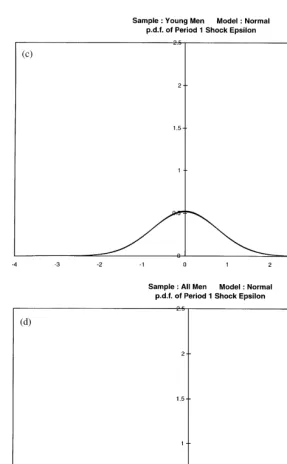
Fig. 1. Posterior distributions of p.d.f. ofe i1.
Fig. 1. (Continued)
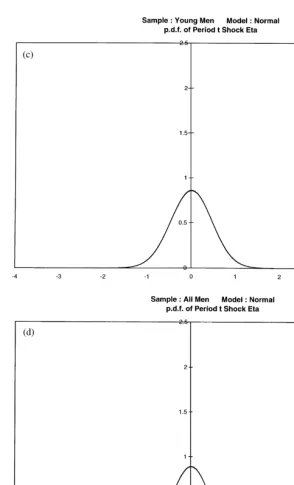
Fig. 2. Posterior distributions of p.d.f. ofgit.
Fig. 2. (Continued)
to have lower initial earnings, but there is little evidence of any other relation between parents'education and initial earnings. In the case of parents'education the data are not very informative }comparing posterior and prior standard deviations, note that changes in prior means produce a response in posterior mean exceeding one-tenth of the prior mean change in most cases. For the race dummy the change is about one-tenth and for the other"rst period covariates it is less. For the other regressors, the four sets of results imply rather di!erent e!ects. For example, the mixture model based on the full sample implies that each additional year of education is associated with a 3% increase in initial earnings, while the normal model based on the full sample indicates a 12% increase. The mixture model based on the full sample provides no evidence of an association between initial marital status and initial earnings, whereas the other three models indicate that married men have initial earnings that are 7}9% greater than single men, ceteris paribus.
5.2. Earnings model,subsequent periods
The next 16 rows of Table 3 report the results for the model of earnings in the second period and onward. The four sets of results imply earnings ranging from 16% to 27% lower for blacks than whites, ceteris paribus. And the four models imply that married men have earnings that range from 4% to 10% greater than single men. The parents' education variables show no clear pattern across the models. Most are within two posterior standard deviations of zero, and poste-rior means respond by more than one-tenth to changes in pposte-rior means in the mixture model.
We do not report results for the parameters of the education and age polynomials, which are di$cult to interpret, but rather report posterior means and standard deviations for earnings di!erences across certain age and educa-tion categories, corresponding to the funceduca-tions G(a
1,a2; e1,e2) described in
Section 3.1. For example, the posterior mean for earnings at age 35 vs. 25 at education level 12 in the mixture model based on the full sample is 0.231, implying earnings growth of roughly 23% from age 25 to 35 for those with 12 yr of education. For age 45 vs. 35 the growth is 8%, whereas for 55 vs. 45 it is
!4%. Thus, this model implies that earnings growth slows substantially with age and turns negative in the 50s. As another example, the posterior mean for earnings at education level 16 vs. 12 at age level 35 in the mixture model based on the full sample is 0.469, implying that college graduates earn roughly 47% more than high school graduates at age 35, ceteris paribus.
The coe$cient con lagged earnings is negative and small in absolute value (about!0.1), whereas the serial correlation coe$cientois substantial (about 0.5). Thus there is strong evidence for persistence in earnings conditional on the covariates, but there is very little impact of current marital status on future earnings.
It is interesting to note that using the young men sample posterior standard deviations for the earnings at age 55 vs. 45 parameters are more than an order of magnitude greater than using the full sample. This is because in the young men sample no individual is more than 46 yr old. Thus, the data are not directly informative on earnings growth from age 45 to 55. The posterior mean for that parameter is just a combination of information from the prior and extrapolation of the age-earnings pattern from earlier ages. Notice that in the young men sample the posterior standard deviations for earnings are comparable to prior standard deviations for ages above 45, and that posterior means are all within a prior standard deviation of the prior mean at these ages. By contrast, when the sample is informative (younger ages for the young men sample and all ages for the full sample) posterior standard deviations range from 2% to 20% of prior standard deviations. This re#ects the deliberate weakness of the prior (as discussed fully in Appendix 3) and the #exibility of the richly parameterized polynomial in age and education. Through this parameterization we accomplish formally what a nonparametric, non-Bayesian approach has as its informal goal: when there is no information in the data the posterior should re#ect the prior, and not unwarranted extrapolation from data points with little relevance.
5.3. Properties of the shocks
The next two panels in Table 3 report various properties of the"rst-period andtth period shocks. For each shock there are 18 rows. The "rst nine rows report the three means, three standard deviations, and three probabilities from the mixture of three normals. Recall that the means are ordered and the second mean is set to zero, as identifying restrictions beyond the priors for these parameters (which are discussed in Appendix 3), and of course the three probabilities must sum to one: thus, there are seven free parameters. The mean of the mixture is nonzero, but since the wage equation has an intercept, the entire mixture may be renormalized to have a mean of zero. The next nine rows report some values of the cumulative distribution function (c.d.f.) for each shock, after this normalization.
Individual parameters in the mixture distribution are not tightly estimated relative to the prior. Changes in the prior means of the mixture standard deviations and probabilities often produce a corresponding change of 50% or more in the posterior mean.
Since the c.d.f.'s and probability density functions (p.d.f.'s) of these shocks are functions of the distribution parameters, posterior moments and distributions of the c.d.f.'s and p.d.f.'s are easily determined. Table 3 exhibits the c.d.f.'s at nine points, after normalization to a mean of zero. The distribution is clearly asymmetric and is very accurately determined: e.g., for thetth period shockgit, posterior means for the full sample show the probability of a shock that cuts
wages by 50% or more is 5%, while the probability of a shock that more than doubles wages is 2.7%; posterior standard deviations are negligible.
The priors have little in#uence on the posterior means of the c.d.f.'s. At none of the nine points displayed in Table 3 does a change in the prior mean for the c.d.f. produce a change 10% as large in the posterior mean. This contrasts with the parameters of the mixtures themselves ("rst nine lines of Table 3) where the prior is more in#uential. Thus the data dominate in determining the posterior means of the c.d.f.'s of the shocks to earnings, but the prior is more in#uential in structuring the three Gaussian components of the mixture.
The implied p.d.f.'s are shown in Figs. 1 and 2. Each p.d.f. itself has a posterior distribution, re#ecting uncertainty about the parameters of that distribution. To convey the p.d.f. posterior distributions, the panels plot the posterior mean, median, and quartile for each point of evaluation of the p.d.f.'s. Due to the tightness of the posterior distributions, these four are visually nearly indistin-guishable. For the normal mixtures the asymmetry of the distribution is evident in every case. The mixture distributions are clearly leptokurtic, strongly skewed to the left, with modes at positive values. The mode is around log(1.18) for the
"rst-period shock and around log(1.09) for the tth period shock. The normal distributions are of course symmetric. Relative to the mixture distributions they assign less probability near zero (log(0.88) to log(1.32) for thetth period shock), less probability far from zero (below log(0.325) and above log (4.50) for thetth period shock), and more probability in between.
5.4. Dynamics of the earnings model
Of crucial importance for forecasting life-cycle earnings mobility are the covariance structure parameters and the coe$cient on lagged earnings. Results for these are reported in the next 5 rows of Table 3. For example, in the mixture model based on the full sample the coe$cientcon lagged earnings is!0.121. This is many posterior standard deviations from zero, but small in magnitude. On the other hand, serial correlation in the shocks is substantial in magnitude,
o having a posterior mean of 0.655. The only lagged covariate that is not perfectly collinear with the current value is marital status. Thus, the results imply that lagged marital status has very little e!ect on current period earnings, but there is modest serial correlation in the disturbance e
it to current period
earnings. The normal mixture model exhibits less serial correlation than the normal model.
In the mixture model based on the full sample, the posterior mean for the standard deviation of the individual e!ects is 0.366. Thus, a person with a one standard deviation above the average qi value would have earnings about 37% above average, given his personal characteristics. The marital status coe$cient in the same model and sample is about 0.05, implying that marital status is unimportant relative to unobserved individual e!ects in explaining the
variance of persistent wage di!erentials across men. Finally, the posterior mean for/in the mixture model based on the full sample is 0.240. This implies that the
"rst-period shock could be decomposed into independent permanent and tran-sitory components, with the permanent component having about one-"fteenth the variance of the transitory component.
Combined, these parameters imply a variance structure for disturbances to the wage equation over the lifetime. Some aspects of this variance structure are reported in the next 13 rows of Table 3. Variances are highest at age 25 but then drop quickly to a level that remains constant for the remaining years. Since all ages contain the common variance component (1!c)2[p2
q#/2var(ei1)], this is
accounted for by var(ei1)'var(git)/(1!o2). The fraction of variance accounted for by the transitory shockgitis about the same from age 30 onward; in the full sample this fraction is about two-thirds. Correlations between ages separated by at least"ve years are mainly accounted for by the permanent componentsqiand
ei1; consistent with the fraction of variance due to the permanent component, these values are about one-third. The posterior means of all of these variances, and their decomposition, are heavily data driven. In most cases, a change in the prior mean has an impact of less than one percent on the corresponding posterior mean.
5.5. Marital status model
The last several rows of Table 3 contain the results for the marital status model. In the mixture model based on the full sample, the posterior mean for the education coe$cient in the"rst-period marital status model is!0.232, imply-ing that more educated men are much less likely to be married at age 25. But note that the posterior mean for the di!erence in probits between college and high school graduates at age 55 is only !0.092, implying that most of the association between education and marital status is eliminated by that age. Also interesting is that the posterior mean for the lagged earnings coe$cient is 0.177, implying that marital status probabilities are higher for men with greater lagged earnings.
For the young men sample, the posterior distributions of the earnings and marital status models are independent. Thus the posterior distribution of the marital status model parameters are the same in the normal and mixture models. All di!erences in Table 3 are due to noise in the posterior simulator. For the full sample, the posterior distributions of the two sets of parameters are linked through the unobserved earnings and marital status between age 25 and the"rst sample data for all men who were not in the sample at age 25. In the case of the young men sample, the posterior means and standard deviations for the marital status model in Table 3 are nearly identical across the mixture and normal models, and in the case of the full sample they are quite similar.
6. Simulations of earnings distributions and earnings mobility
In this section we report on simulated earnings distributions and earnings mobility for the four model/sample combinations. The simulations are per-formed as discussed in Section 4 and Appendix D. We"rst report on compari-sons of simulated and actual earnings data in order to evaluate model"t. We next contrast the predictions of the four models for features of earnings distribu-tions and earnings mobility. Finally, we compare the implicadistribu-tions of the models for features of the distribution of the present value of lifetime earnings.
6.1. Modelxt
Table 4 provides a comparison of the in-sample"t of the four models for the young men sample and the full sample.
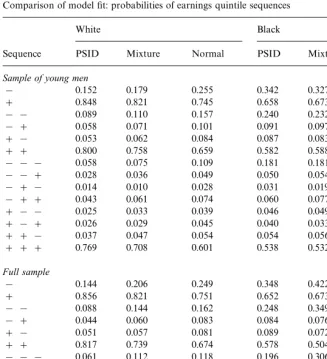
As discussed in Section 2, the full sample was used to de"ne earnings quintiles. Using these quintiles, we calculated the frequency of various quintile sequences for men in the full sample and in the young men sample. In Table 4, we use the symbol&!'to denote a year in which the person is in the bottom quintile of the earnings distribution, and&#'to denote a year in which he is not. For example, in the young men sample, the frequency of&!'is 0.152 for whites and 0.342 for blacks. And if we look at the set of all two year sequences, the frequency of
&!!'is 0.089 for whites and 0.240 for blacks.
We next simulated earnings data from the four models. The simulations are based on the exogenous variables for the men in the young men and full samples (i.e. race, education, parents'education). That is, the simulations cover only the years in which the men are observed in the respective samples, so as to allow comparison of simulated with sample earnings distributions.
Table 4"rst compares the"t of the mixture and normal models to the quintile sequence data in the young men sample. The mixture model provides a much better "t to observed sequence probabilities than does the normal model. For example, the actual frequencies of&!!!'and&###'sequences for blacks in the young men sample are 0.181 and 0.538, respectively. The mixture model predicts frequencies of 0.181 and 0.532, while the normal model predicts 0.278 and 0.355 respectively. In fact, for every sequence considered, the mixture model comes closer to replicating the sample frequency than does the normal model. Table 4 next compares the"t of the mixture and normal models to the quintile sequence data in the full sample. With only three exceptions out of 28 cases (the
&!#!',&#!#'and&##!'sequences for blacks), the mixture model comes closer to replicating the sample sequence frequencies than does the normal model. However, the agreement between sample frequencies and simulated frequencies for the mixture model is not nearly as close as it was in the young men sample. Obviously, it is more challenging to"t earnings distribu-tions and transition frequencies for a 25}65 age range than a 25}46 age range.
Table 4
Comparison of model"t: probabilities of earnings quintile sequences
White Black
Sequence PSID Mixture Normal PSID Mixture Normal
Sample of young men
! 0.152 0.179 0.255 0.342 0.327 0.469
# 0.848 0.821 0.745 0.658 0.673 0.531
! ! 0.089 0.110 0.157 0.240 0.232 0.346
! # 0.058 0.071 0.101 0.091 0.097 0.124
# ! 0.053 0.062 0.084 0.087 0.083 0.111
# # 0.800 0.758 0.659 0.582 0.588 0.420
! ! ! 0.058 0.075 0.109 0.181 0.181 0.278
! 0.144 0.206 0.249 0.348 0.422 0.491
# 0.856 0.821 0.751 0.652 0.673 0.509
! ! 0.088 0.144 0.162 0.248 0.349 0.381
! # 0.044 0.060 0.083 0.084 0.076 0.110
# ! 0.051 0.057 0.081 0.089 0.072 0.105
# # 0.817 0.739 0.674 0.578 0.504 0.404
! ! ! 0.061 0.112 0.118 0.196 0.306 0.318
##! 0.039 0.044 0.054 0.056 0.049 0.061
# # # 0.792 0.696 0.625 0.539 0.452 0.343
Note: The earnings quintiles are de"ned using full PSID data set on male household heads aged 25}65. In the column headed&Sequence',&!'indicates the person is in the bottom quintile of the earnings distribution, and&#'indicates they are not. A&} } }'indicates the person is in the bottom quintile for three consecutive years. For purposes of comparison with the PSID data, the simulation for a person covers only those periods for which data is observed for the person in the relevant PSID sample (young men or full).
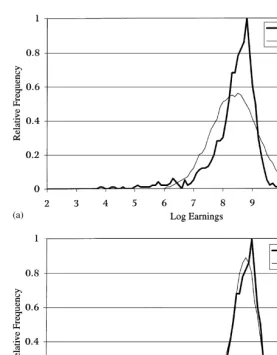
It is also interesting to examine how the models "t the cross-sectional log earnings distribution at various ages. Fig. 3a reports kernel density estimates for log earnings at age 25 in both the young men sample and the simulated data from the normal model estimated with the young men sample. (This and all
Fig. 3. Log earnings density estimate}age 25 of young samples (a) Normal (b) Normal mixture.
other density estimates reported in this paper were obtained using a Parzen kernel with a bandwidth of 0.10). As is apparent, the normal model fails to capture important features of the earnings distribution. It underestimates the mode, places too little mass near the mode, has an excessive interquartile range, and fails to capture the long left tail of the observed earnings distribution.
Fig. 3b reports the same kernel density estimates for the mixture model. Clearly, this model captures the shape of the earnings density much better than the normal model. Figs. 4a and b report similar density estimates at age 30 based on the young men sample. Again, the mixture model does much better, but not quite as well as at age 25.
Fig. 4. Log earnings density estimate}age 30 of young samples (a) Normal (b) Normal mixture.
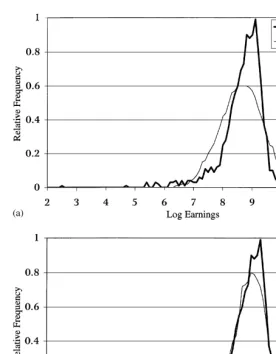
We now turn to evaluation of the earnings distribution in models based on the full sample. Kernel density estimates for log earnings at ages 25, 30, 45, and 60 in the full sample, using the normal model and the mixture model, are reported in Figs. 5}8. The interesting pattern in these "gures is that, based on the full sample, the mixture model"ts the log earnings distributions much better than the normal model at ages 25 and 30, but at age 45 it only does slightly better. As can be seen in Fig. 7b, by age 45 the mixture model su!ers from the same basic set of problems that were attributed to the normal model above (i.e., it underesti-mates the mode, places too little mass near the mode, and has an excessive interquartile range). By age 60 the superiority of the mixture model is again