Delignification of rye straw using hydrogen peroxide
Run Cang Sun *, J.M. Fang, J. Tomkinson
The BioComposites Centre,Uni6ersity of Wales,Bangor,Gwynedd,Wales LL57 2UW, UK Accepted 14 January 2000
Abstract
Alkaline peroxide delignification of rye straw has been first investigated in this paper. The results showed that treatment of dewaxed and water-extracted rye straw with 2% H2O2at pH 11.5 for 12 h at 20, 30, 40, 50, 60, and 70°C
resulted in a dissolution of 52.7, 75.7, 81.8, 83.1, 85.8, and 87.8% of the original lignin, and 44.2, 52.5, 70.0, 70.0, 71.3, and 71.9% of the original hemicelluloses, respectively. The isolated pure lignin fractions contained rather low amounts of neutral sugars, 0.4 – 1.1%, and had weight-average molecular weights between 2420 and 3480 g mol−1. They
contained almost equal amounts of noncondensed guaiacyl and syringyl units with fewerp-hydroxyphenyl units. The
b–O– 4 ether bonds together with b–b and b– 5 carbon – carbon linkages were found to be present in the lignin structural units. Hydroxycinnamic acids such asp-coumaric and ferulic acids appeared to be strongly associated to lignin molecules. Comparison of these lignin samples indicated that the alkaline peroxide treatment of the straw under the conditions given did not affect the overall structure of lignin. © 2000 Elsevier Science B.V. All rights reserved.
Keywords:Rye straw; Hydrogen peroxide; Lignin; Hemicelluloses; Degradation
www.elsevier.com/locate/indcrop
1. Introduction
World production of rye, one of the major cereal crops, exceeds 30 million tons per annum, which yields about 40 – 50 million tons of straw (Ghaly and Ergudenler, 1994). This straw and other agricultural residues exiting as waste streams from commercial crop processing plants have little inherent value and have traditionally constituted a disposal problem. These materials
represent an abundant, inexpensive, and readily available source of renewable lignocellulosic biomass. However, their utilisation as a carbohy-drate source for glucose and ethanol production, and as a metabolic energy source in ruminant feeds, has been severely hampered by the low efficiency with which organisms and enzymes are able to convert the polysaccharide portion of the residue into monomeric sugars (Gould, 1989). The low conversion efficiency for lignocellulosic mate-rials and low digestibility is largely due to the lignin component of the cell wall and its associa-tion with other cell wall polysaccharides, which prevents the degradation of cellulose mainly by acting as a physical barrier between the cellulose enzyme and it substrate.
* Corresponding author. Tel.:+44-1248-370588; fax:+ 44-1248-370594.
E-mail address:[email protected] (R.C. Sun)
Lignin is an aromatic biopolymer, an integral cell wall constituent in all vascular plants includ-ing the herbaceous varieties. Lignin is unique among biopolymers in that there is limited control over its biosynthesis, and the factors guiding this process are not yet fully understand (Ammalahti et al., 1998). Lignin is built up by oxidative cou-pling of three major C6– C3 (phenypropanoid) units, namely, syringyl alcohol (S), guaiacyl alco-hol (G), andp-coumaryl alcohol (H), which form a randomised structure in a tridimensional net-work inside the cell walls. The major interunit linkage is an aryl – aryl ether type. Besides the some 20 different types of bonds present within the lignin itself, lignin seems to be particularly associated with the hemicellulosic polysaccha-rides. Owing to its crosslinking, lignin in situ is usually insoluble in all solvents, unless it is de-graded by physical or chemical treatments (Sun et al., 1999).
There is no known method for release of unal-tered lignin from plant cell walls, and chemical or biochemical degradation methods produce low molecular weight products in modest yields only. However, numerous treatments have been devel-oped in an effort to increase the removal of lignin from straw and grass. These processes utilise physical, chemical, and/or biological methods to remove lignin and decrease cellulose crystallinity. Among these, the processes such as autohydroly-sis, alkaline cooking, and steam explosion require substantial energy input in the form of heat and tend to generate toxic side products. Other draw-backs typical of conventional treatments include loss of the hemicelluloses with the solubilized fraction (Gould, 1989). For example, in the cook-ing such as chemical pulpcook-ing processes lignin is dissolved from the raw material at high pressures and temperatures under aqueous alkaline, neutral or acidic conditions. Important delignification re-action include the cleavage of phenolic a–O– 4 linkages, cleavage of non-phenolic b–O– 4 link-ages, and removal of residual lignin fractions, either by cleavage of carbon – carbon linkages or by carbohydrate degradation, releasing lignin-car-bohydrate fractions, which are mainly oxidised into aliphatic carboxylic acids.
It is well known that hydrogen peroxide reacts with lignin under alkaline conditions and has widely been used for many years to bleach high-lignin wood pulps. The bleaching effect of hydro-gen peroxide has been attributed to its ability to react with various coloured carbonyl-containing structures in lignin. This reaction has been ex-plained through the reactions of the hydroperox-ide anion (HOO−), formed in an alkaline medium
according to the equilibrium:
H2O2+HO−lHOO−+H2O where the pKa=11.6 at 25°C.
This anion is a strong nucleophile that, during bleaching, preferentially attacks ethylenic and car-bonyl groups present in lignin. As a consequence, such chromophores as quinones, cinnamaldehyde, and ring-conjugated ketones are converted to nonchromophoric species during the alkaline so-lution (Dence, 1996; Pan et al., 1998). On the other hand, hydrogen peroxide is unstable in alka-line conditions and readily decomposes, particu-larly in the presence of certain transition metals such as manganese, iron, and copper. This metal-catalysed decomposition of hydrogen peroxide is undesired in the bleaching process, since it leads to a loss of bleaching capacity and generates more active radicals such as the hydroxyl radicals (HO) and superoxide anion radicals (O2
−), which
on the solubilization of lignin from rye straw in our newly developed process in which straws are sequentially treated with water and alkaline per-oxide solutions. The isolated lignin preparations are physico-chemically characterised and the re-sults are reported.
2. Material and methods
2.1. Material
Rye straw was obtained from Compak Co. (Gainsborough, UK), and was ground to pass a 0.7 mm size screen. The composition (w/w) of the rye straw used was cellulose 37.9%, hemicelluloses 36.9%, lignin 17.6%, protein 3.3%, ash 3.0% and wax 2.0%. All weights and calculations were made on an oven-dried (50°C, 16 h) basis. All chemicals used were of analytical or reagent grade.
2.2. Alkaline peroxide treatment
The dried powder was first extracted with toluene – ethanol (2:1, v/v) in a Soxhlet for 6 h. The dewaxed straw was then treated with water at 50°C for 2 h. After isolation of the water-soluble hemicelluloses by precipitation of water-extracts in three volumes ethanol, water-soluble lignin fraction was obtained by reprecipitation at pH 1.5, adjusted by 10% HCl, from the supernatant solution. Samples free of wax and water solubles (10.0 g) were added to 250 ml of distilled water containing 2% H2O2 (w/v) in a jacketed reaction vessel heated with water from a thermostat-con-trolled circulating bath. The suspension was ad-justed to pH 11.5 with 4 M NaOH and allowed to stir gently for 12 h at 20, 30, 40, 50, 60, and 70°C, respectively. In comparison, one sample was treated with dilute alkaline solution at pH 11.5 for 12 h at 50°C in the absence of H2O2 from water-soluble free and dewaxed rye straw. During initial stages of stirring, oxygen evolution was active, and substantial frothing occurred, requiring that extractions were conducted in vessels with vol-umes two to three times those of extraction mix-tures. No further adjustments in pH were made during the course of the treatment. Under these conditions, the reaction pH remained nearly con-stant for 2 h before slowly rising to a final value of ca 13.0. The insoluble residue was collected by filtration, washed with distilled water until the pH of the filtrate was neutral, and then dried at 60°C. The supernatant fluid was adjusted to pH 5.5 with 10% HCl and then concentrated. The released hemicelluloses were precipitated by pouring the concentrated supernatant fluid into three volumes of ethanol. The solubilized lignins were obtained from the corresponding supernatants as the method above (Fig. 1).
2.3. Characterisation of the lignin fractions PL
FT-IR spectra were obtained on a FT-IR spec-trophotometer (Nicolet, 750) using a KBr disc containing 1% finely ground samples. The solu-tion-state 13C-NMR spectrum was obtained on a Bruker 250 AC spectrometer operating in the FT mode at 62.4 MHz under total proton decoupled Fig. 1. Scheme for isolation of pure lignin (PL) from the
Table 1
The yield of lignin (percent dry matter) solubilized in water, dilute alkaline solution, and 2% H2O2treatment of water-soluble-free and dewaxed rye straw at pH 11.5 for 12 h at different temperatures
WSb
2% H2O2(pH 11.5, 12 h) treatment temperature (°C) DASc Yield
30a 40a 50a 60a 70a 20a
11.2 12.1 12.3
Total solubilized lignin 7.8 12.7 13.0 2.8 1.1
8.2 9.0 8.1
Isolated pure lignin (PL)d 5.5 7.8 7.8 1.7 0.6
1.0 1.2 1.2 1.3
1.0 1.3
Lignin associated in the isolated hemicelluloses 0.8 0.2
2.0 1.9 3.0 3.6
Lignin solubilized in the supernatant (pH 1.5)e 1.3 3.9 0.3 0.3
aThe lignin fractions obtained by treatment of water-soluble-free and dewaxed rye straw with 2% H
2O2at pH 11.5 for 12 h at different temperatures.
bThe lignin fraction obtained by treatment of the dewaxed rye straw with water at 50°C for 2 h.
cThe lignin fraction extracted with dilute alkaline solution (pH 11.5) at 50°C for 12 h in the absence of H 2O2 from water-soluble-free and dewaxed rye straw.
dRepresent for the lignin fraction obtained by precipitation of the supernatant solution at pH 1.5 after isolation of the hemicelluloses.
eRepresent for the lignin fraction which is still solubilized in the supernatant (pH 1.5) after precipitation of the pure lignins (PL).
conditions. They are recorded at 25°C from 250 mg of sample dissolved in 1.0 ml DMSO-d6 after 28 000 scans. A 60° pulse flipping angle, a 3.9 ms pulse width and 0.85 s acquisition time were used. Methods of uronic acid analyses, UV spectra recording, measurement of the molecular-average weights of lignin fractions, and determination of phenolic acids and aldehydes with HPLC in ni-trobenzene oxidation mixtures have been de-scribed in previous papers (Lawther et al., 1995; Sun et al., 1995). Neutral sugar composition in isolated lignin fractions was determined as alditol acetates (Blakeney et al., 1983). All nitrobenzene oxidation results represent the mean of at least triplicate samples and each oxidation mixture was chromatographed twice. Other experiments were performed in duplicate. The standard errors (S.E.) or deviations (S.D.) were observed to be lower than 6.2% except for the variation among the triplicate nitrobenzene oxidation (7.8 – 15.8%).
3. Results and discussion
3.1. Lignin yield
The yield of lignin resulting from the various alkaline peroxide procedures was expressed as a
water-soluble fragments. This increasing yield, therefore, offset the negative effect of temperature on the yield of PL decreased.
All in all, the data in Table 1 showed that the rate of alkaline peroxide delignification was strongly influenced by temperature. Increasing temperature from 20 to 70°C resulted in yield of total solubilized lignin from 7.8 to 13.0%. The reason for this high rate of delignification at high temperature is that hydrogen peroxide decomposi-tion is strongly dependent upon temperature, which generates more active radicals such as hy-droxyl radicals (HO) at high temperature, partic-ipating in degradation reactions of lignin and polysaccharides.
As mentioned above, the hydroperoxide anions (HOO−) are principal active species involved in
the elimination of chromophores in lignin struc-tures, particularly conjugated carbonyl structures that are prone to react with the hydroperoxide anion. On the other hand, the peroxide decompo-sition products such as the hydroxyl radicals and superoxide anion radicals (O2) are thought to cause the oxidation of lignin structures which leads to the introduction of hydrophilic (carboxyl) groups, the cleavage of some interunit bonds and, eventually, the dissolution of lignin even though they also may participate in the bleaching mecha-nism, at least to a small extent (Dence, 1996). At alkaline pH, these radicals are formed during the degradation of H2O2in a reaction with hydroper-oxide anion in the presence or in the absence of transition metals:
H2O2+HOO−HO+O2+H2O
In the absence of reactants for HO and O2−, these radicals again react with each to form O2 and HO−, giving an overall O
Our earlier studies on the solubilization of lignin from maize stem using hydrogen peroxide showed that the delignification reaction was strongly dependent on pH, with a sharp increase at pH 11.5 and a continuous increment up to pH 12.6 (Sun and Tomkinson, 2000). It was,
there-fore, not necessary to continuously regulate the reaction pH at 11.5, even though over the course of the treatment (12 h) the reaction pH rose from 11.5 to ca 13.0, since over 80% of the original lignin was solubilized during the treatment tem-peratures above 40°C. Interestingly, as the reac-tion pH became more alkaline, increasing amounts of hemicelluloses were solubilized as shown by over 70% of the original hemicelluloses released at 40 – 70°C. The current results obtained were in good agreement with the studies of delig-nification with alkaline peroxide from wheat straw by Gould (1984, 1985). The author showed that treatment of wheat straw with 1% H2O2 at room temperature and pH between 11.5 and 12.5 re-sulted in 60% degree of delignification.
be limited to a relatively low value, because of its high cost.
Another reason for this relatively high solubi-lization of lignin from rye straw during the alka-line extraction is probably due to water pretreatment prior to alkaline peroxide extraction, which removed the straw contaminants such as soil and metals by the washing contributes, at least in part, to enhance the rate of delignification, since these transition metals such as Fe, Cu, and Mn act as catalysts for decomposition of hydro-gen peroxide under alkaline conditions. On the other hand, magnesium salts such as MgSO4 and sodium silicate are well-known peroxide stabilisers or as a metal deactivator. The results obtained in our experiments showed that 2% H2O2was capa-ble of reducing the lignin content from rye straw significantly at pH 11.5 for 12 h at 40 – 70°C. The addition of sodium silicate had no effect (or an adverse effect) on the straw delignification (data not shown). This observation was consistent with the finding that improvement in H2O2 stabilisa-tion was not a pre-required condistabilisa-tion for good delignification of soft wood even under particu-larly severe conditions (120°C) (Lachenal et al., 1980). Dence and Omori (1986) also mentioned that the use of silicate was deemed superfluous when sufficient sodium hydroxide was available. The results obtained here were in disagreement
with some of published conclusions. Studies based on the mechanism of alkaline peroxide delignifica-tion of agricultural residues, (Gould, 1985) indi-cated that removal of heavy metal contaminants from the wheat straw (for example, by acid pre-wash, by addition of chelators, or by alkaline precipitation) essentially eliminate O2 evolution from the H2O2reaction mixture, even at very high straw concentrations [6 – 10% (w/v)]. Lachenal et al. (1992) reported that after ethylenediaminete-traacetic acid (EDTA) pretreatment of the pulp, not only was hydrogen peroxide delignification improved, but also bleaching was enhanced and cellulose degradation was less. At the same time, peroxide consumption was lower.
3.2. UV absorption
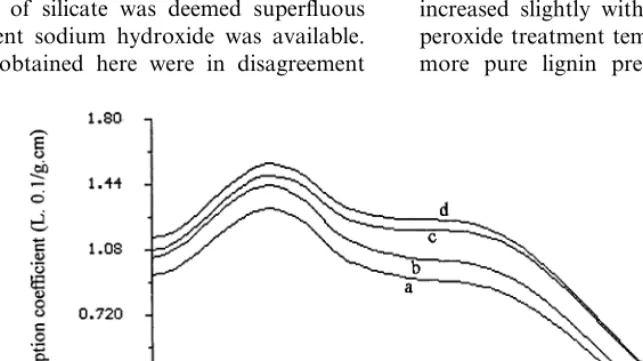
To verify the purity of the isolated PL frac-tions, they were studied by UV spectroscopy at l 260 – 370 nm. As shown in Fig. 2, the four PL preparations exhibited the basic UV spectrum typical of lignins with a maximum at 280 nm, originating from nonconjugated phenolic groups in the lignin (Scalbert et al., 1986). Interestingly, as shown in the spectra, the absorption coefficient increased slightly with the increment of alkaline peroxide treatment temperature, suggesting that a more pure lignin preparation can be obtained
Table 2
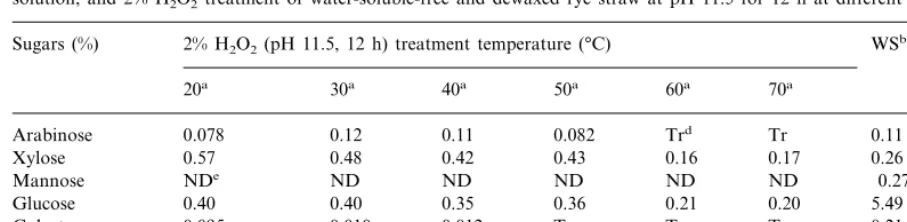
The content of neutral sugars (percent dry weight, w/w) in isolated pure lignin (PL) fractions solubilized in water, dilute alkaline solution, and 2% H2O2treatment of water-soluble-free and dewaxed rye straw at pH 11.5 for 12 h at different temperatures
WSb DASc Sugars (%) 2% H2O2(pH 11.5, 12 h) treatment temperature (°C)
30a 40a 50a
20a 60a 70a
0.12
Arabinose 0.078 0.11 0.082 Trd Tr 0.11 0.10
0.48 0.42 0.43 0.16
0.57 0.17
Xylose 0.26 0.30
ND ND ND ND
Mannose NDe ND 0.27 0.12
0.40 0.35 0.36 0.21
aThe lignin fractions obtained by treatment of water-soluble-free and dewaxed rye straw with 2% H
2O2at pH 11.5 for 12 h at different temperatures.
bThe lignin fraction obtained by treatment of the dewaxed rye straw with water at 50°C for 2 h.
cThe lignin fraction extracted with dilute alkaline solution (pH 11.5) at 50°C for 12 h in the absence of H 2O2 from water-soluble-free and dewaxed rye straw.
dTr, trace. eND, not detected.
when the alkaline peroxide performed at a rela-tively higher temperature. This observation indi-cated that the purity of PL was paralleled by the total yield of lignin solubilized during the perox-ide treatment.
3.3. Sugar composition of the associated hemicelluloses
As compared to the lignin fraction released during the water treatment, all the PL prepara-tions contained rather low amounts of bound polysaccharides as shown by 0.4 – 1.1% neutral sugar content, indicating that treatment of the straw with alkaline peroxide under the conditions used significantly cleaved the ether bonds between lignin and hemicelluloses in the cell walls of rye straw in addition to saponification of hydroxycin-namic esters such as betweenp-coumaric acid and lignin/polysaccharides or between ferulic acid and hemicelluloses. Xylose and glucose were identified as the main sugar components. Obviously, an increase in the alkaline treatment temperature from 20 to 70°C resulted in a decrease in the level of associated polysaccharides from 1.1 to less than 0.4% in the PL fractions. These data implied that an increase in alkaline peroxide treatment temper-ature can peel more lignin from most of the neighbouring polysaccharide moieties (Table 2).
3.4. Content of phenolic acids and aldehydes
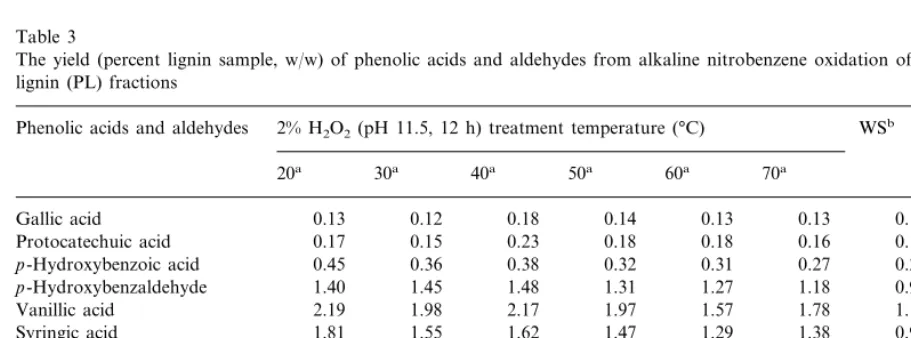
The standard procedures for analysing lignins by chemical degradative techniques such as alka-line nitrobenzene oxidation degradation result in information of degradative products, which can be used to derive information about the composi-tion of the original polymer (Billa et al., 1996). In the case of alkaline nitrobenzene oxidation, the three constitutive monomeric lignin units p -hy-droxyphenyl (H), guaiacyl (G), and syringyl (S) produce the corresponding p -hydroxybenzalde-hyde, vanillin, and syringaldehyde. In order to gain insight into the lignin, the isolated eight lignin preparations were studied by alkaline ni-trobenzene oxidation, and the contents of pheno-lic acids and aldehydes in each of the preparations are given in Table 3. The predominant oxidation products were found to be vanillin and syringalde-hyde. The presence of fewer p -hydroxybenzalde-hyde and p-hydroxybenzoic acid was considered most probably to be indicative of non-condensed
as SGH-lignin such as cereal straw and grass type lignin. The relative molar ratios of S (the rela-tively total moles of syringaldehyde and syringic acid) to G (the relatively total moles of vanillin and vanillic acid), and to H (the relatively total moles of p-hydroxybenzaldehyde and p -hydroxy-benzoic acid) appeared to be of approximately the same order (4 – 5:6 – 7:1), indicating the same origi-nal lignin. These results were in partial agreement with the studies on degradation of lignin in natu-ral substrates by xylotrophs and soil saprotrophs
from rye straw. The authors (Babitskaya and Shcherba, 1994) reported that chromatographic analysis of the products of oxidation with ni-trobenzene showed that rye straw lignin was guai-acyl – syringyl with a slight prevalence of syringyl structures (G:S:H=43:53:1). In comparison, a relatively higher content of p -hydroxybenzalde-hyde and p-hydroxybenzoic acid in the nitroben-zene oxidation products obtained in our experiments was presumed largely due to the par-tial oxidation of p-coumaric acid. Similarly, a slightly higher molar ratio of G suggested that a
considerable proportion of ferulic acid was oxi-dised into vanillin or vanillic acid under the ni-trobenzene oxidation conditions used in our experiment. As can be seen in Table 3, the lower yields of oxidation products, obtained in the ab-sence of H2O2 from the water-soluble and dilute alkali-soluble lignin preparations, indicated a higher degree of condensation of the two isolated PL preparations, whereas the higher yields of oxidation products found in the cases of alkaline peroxide extractable PL preparations may be ex-plained by a lower degree of condensation of PL fractions. This report is the first paper concerning the above details of lignin composition and it provides the quantitative values of a high propor-tion of aryl ether-linked guaiacyl and syringyl units in the lignin fractions, obtained from the alkaline peroxide treatment of rye straw.
3.5. Molecular weight distribution
To illustrate whether the extent of degradation occurred during the process of alkaline peroxide
Table 3
The yield (percent lignin sample, w/w) of phenolic acids and aldehydes from alkaline nitrobenzene oxidation of the isolated pure lignin (PL) fractions
0.17 0.15 0.23 0.18 0.18 0.14 0.12
Protocatechuic acid
0.27
0.45 0.36 0.38 0.32 0.31 0.22 0.24
p-Hydroxybenzoic acid
p-Hydroxybenzaldehyde 1.40 1.45 1.48
1.57 1.78 1.18 0.98
2.19
Vanillic acid 1.98 2.17 1.97
Syringic acid 1.81 1.55 1.62 1.47 1.29 1.38 0.90 0.89
8.91
Syringaldehyde 11.00 10.58 10.98 9.48
0.64 0.62 0.44 0.54
p-Coumaric acid 0.61 0.60 0.38 0.52
Ferulic acid 0.85 0.67 0.59 0.69 0.78 0.68 0.81 0.59
27.07
Molar ratio (S:G:H)d 5:7:1 5:7:1 5:7:1 4:6:1
aThe lignin fractions obtained by treatment of water-soluble-free and dewaxed rye straw with 2% H
2O2at pH 11.5 for 12 h at different temperatures.
bThe lignin fraction obtained by treatment of the dewaxed rye straw with water at 50°C for 2 h.
cThe lignin fraction extracted with dilute alkaline solution (pH 11.5) at 50°C for 12 h in the absence of H 2O2 from water-soluble-free and dewaxed rye straw.
Table 4
Weight-average (M( w) and number-average (M( n) molecular weights and polydispersity (M( w/M( n) of the pure lignin (PL) fractions isolated with 2% H2O2at pH 11.5 for 12 h in different temperatures from rye straw
WSb
2% H2O2(pH 11.5, 12 h) treating temperature (°C) DASc
30a 40a 50a
20a 60a 70a
2650 2930 3310
M( w 2420 3480 3040 2830 2980
M( n 620 660 690 920 1020 960 640 780
4.0 4.2 3.6 3.4 3.2 4.4 3.8
M( w/M( n 3.9
aThe lignin fractions obtained by treatment of water-soluble-free and dewaxed rye straw with 2% H
2O2at pH 11.5 for 12 h at different temperatures.
bThe lignin fraction obtained by treatment of the dewaxed rye straw with water at 50°C for 2 h.
cThe lignin fraction extracted with dilute alkaline solution (pH 11.5) at 50°C for 12 h in the absence of H 2O2 from water-soluble-free and dewaxed rye straw.
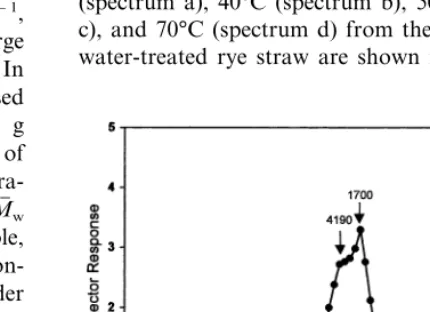
treatment, all the molecular weights of PL prepa-rations were calculated from the GPC chro-matograms, and the weight-average (M( w) and number-average (M( n) molecular weights and the polydispersity (M( w/M( n) of the lignin fractions are given in Table 4. As can be seen in Table 4, the eight lignin fractions showed no significant differ-ence in their molecular-average weights, which ranged M( w from 2420 to 3480 g mol−1. An increase in temperature from 20 to 60°C during the 2% H2O2treatment at pH 11.5 for 12 h led to an increment of M( w from 2420 to 3480 g mol−1, indicating an increase in solubilization of large molecular size lignins at higher temperature. In contrast, as the temperature was further increased to 70°C, the M( w slightly decreased to 3040 g mol−1, implying that a minimal degradation of the lignins occurred at a relatively higher tempera-ture of 70°C. As expected, a similar level of M( w between the water-soluble, dilute alkali-soluble, and 2% H2O2-soluble lignin preparations demon-strated that the alkaline peroxide treatment under the conditions used did not degrade the macro-molecular structure of lignin to any noticeable extent. In addition, the eight PL fractions also gave a fairly analogous elution pattern, and molecular weight distribution of the lignin frac-tion, obtained by 2% H2O2 treatment (40°C, pH 11.5, 12 h) of the water-soluble free of rye straw, is shown in Fig. 3. As can be seen from the diagram, the molecular weight distribution showed two main peaks corresponding to
polystyrene molecular weights of 4190 and 1700 g mol−1. The elution profile showed a wide poly-molecularity, ranging from oligomer up to polystyrene of molecular weight over 20 000 g mol−1.
3.6. FT-IR spectra
The FT-IR spectra of PL preparations, ex-tracted with 2% H2O2at pH 11.5 for 12 h at 20°C (spectrum a), 40°C (spectrum b), 50°C (spectrum c), and 70°C (spectrum d) from the dewaxed and water-treated rye straw are shown in Fig. 4. The
Fig. 4. The FT-IR spectra of pure lignin (PL) fractions iso-lated with 2% H2O2at pH 11.5 for 12 h at 20°C (spectrum a); 40°C (spectrum b); 50°C (spectrum c); and 70°C (spectrum d) from the dewaxed and water-treated rye straw.
finding that alkaline peroxide treatment did not affect the overall structure of lignin from rye straw.
3.7. 13C-NMR spectrum
The PL fraction, obtained by treatment of the straw sample with 2% H2O2 at 70°C for 12 h at pH 11.5, was also studied by 13C-NMR spec-troscopy (Fig. 5). Most of the observed signals have been previously assigned in straw and wood lignin spectra (Nimz et al., 1981; Scalbert et al., 1986; Imamura et al., 1994; Kondo et al., 1995). As can be seen from Fig. 5, the most striking characteristic of the 13C-NMR spectrum is the almost absence of typical polysaccharide signals between 57 and 103 ppm. The spectrum does show a signal at 63.2 ppm (C-5, Xyl internal unit) for the associated hemicelluloses, however, the peak intensity is rather weak. The carbonyl reso-nances from uronic acids and esters may con-tribute to signal at 174.8 ppm, which indicates C-6 in methyl uronates (Himmelsbach and Bar-ton, 1980).
The signals for aromatic part of the lignin appear in the region between 104.4 and 170.0 ppm. The syringyl (S) residues were indicated by signals at 152.3 (C-3/C-5, S), 138.2 (C-4, S etherified), 134.2 (C-1, S etherified), 133.4 (C-1, S nonetherified), 106.8 (C-2/C-6, S witha-CO), and 104.4 ppm (C-2/ C-6, S). Guaiacyl (G) residues gave signals at 149.8 and 149.3 ppm (C-3, G etherified), 148.0 and 147.1 (C-4, G etherified), 145.7 (C-4, G nonetherified), 134.2 (C-1, G etherified), 133.4 (C-1, G nonetherified), 119.3 (C-6, G), and 114.9 ppm (C-5, G). Thep -hydrox-yphenyl (H) residues appeared as two signals at 128.7 and 128.0 ppm (C-2/C-6, H). These signals confirmed that the lignin preparation could be justified as SGH-lignin. The signals at 168.2 (C-g, PC ester), 159.9 (C-4, PC ester), 144.7 (C-a, PC ester), 130.2 (C-2/C-6, PC ester), 125.9 and 125.3 (C-1, PC ester), and 115.9, 115.7, and 115.4 ppm (C-3/C-5, PC ester) represented the esterified p -coumaric acid. Etherified ferulic acid was ob-served with signals at 167.4 (C-g, FE ether, data not shown in the spectrum), 144.4 (C-a, FE ether), and 122.4 ppm (C-6, FE ether). Esterified spectral profiles and the relative intensities of the
bands were rather similar in four spectra, which confirmed that the ‘core’ of lignin structure did not change significantly during the alkaline perox-ide treatment at the different temperatures. The band at 1706 cm−1 has been assigned to the unconjugated ketone and unconjugated carbonyl stretching, while the band at 1636 cm−1has been attributed to carbonyl stretching conjugated with aromatic rings (Vazquez et al., 1997). Aromatic skeleton vibrations in the PL preparations are assigned at 1598, 1511, and 1425 cm−1. Absorp-tion at 1464 cm−1
indicates CH deformations
and aromatic ring vibrations. The bands at 1334, 1270, and 1225 cm−1
have been assigned to ring breathing with CO stretching. The 1334 cm−1 band has been associated with syringyl units, and 1270 cm−1 band with guaiacyl units. The bands at 1129 and 1033 cm−1indicate the aromatic CH in-plain deformation for syringyl type and guaia-cyl type, respectively. Aromatic CH out of
ferulic acid was identified with a signal at 122.9 ppm (C-6, FE ester). It seems clear that the
p-coumaric acid is linked to lignin by ester bonds, while the ferulic acid is linked to lignin by ether and ester bonds. On the basis of study on the hydroxycinnamic acids, particularly fer-ulic and p-coumaric acids in the cell walls of wheat straw, we (Sun and Lawther, 1998) previ-ously reported that p-coumaric acid was mostly esterified to lignin or polysaccharides, while fer-ulic acid appeared almost equally in etherified linkages with lignin and in esterified bonds to arabinose in hemicelluloses. Similarly, in the cell walls of rye straw, in addition to the etherified linkages between ferulic acid and lignin, ferulic acid at least in part, also esterified to hemicellu-lose.
The spectrum also indicated that b–O– 4 link-ages (C-a in b–O– 4, 72.2; C-b in b–O– 4, 86.1 ppm; C-g in b–O– 4, 60.1 ppm) were the major linkages between lignin structural units. The
common carbon – carbon linkages such as b–b (C-g in b–b units, 71.7 ppm, data not shown in the spectrum) and b-5 (C-4 in b-5 units, 144.7 ppm, overlapped with C-a, PC ester) were also present. These signals indicated that the linkages in this rye straw lignin is mainly composed of b–O– 4 ether bonds together with small amounts of b–b and b-5 carbon – carbon linkages. These results suggested that alkaline peroxide under the conditions used here might not attack the b-aryl ether structure to a significant extent. The signals representing the g-methyl, a and b-methylene groups in n-propyl side chains appeared in the spectrum between 14.1 and 33.8 ppm. A very strong signal at 56.0 ppm corresponded to the OCH3 in syringyl and guaiacyl units.
On the basis of the forgoing data, it can be concluded that treatment by alkaline peroxide under the conditions given did not affect the overall structure of lignin from rye straw. Simi-lar results have been reported by Dence (1996),
Fig. 5.13CNMR spectrum of pure lignin (PL) fraction extracted with 2% H
Lachenal et al. (1992) in the studies on the be-haviour of lignin in kraft pulp during hydrogen peroxide delignification. The authors stated that hydrogen peroxide was unable to attack phenols of the type present in lignin under alkaline condi-tions. That is, no degradation of the phenolic ring was observed during the alkaline peroxide treat-ment. However, at a relatively higher temperature such as 90°C, some depolymerization of lignin may occur and carboxyl groups are created (Dence, 1996).
In conclusion, the six lignin preparations, ob-tained by treatment of the dewaxed and water-ex-tracted rye straw with 2% H2O2at pH 11.5 for 12 h at 20 – 70°C, and one alkali lignin fraction, isolated under similar conditions but in the absence of peroxide, showed similar chemical composition and physico-chemical properties. They were rela-tively free of polysaccharides and contained almost equal amounts of noncondensed guaiacyl and sy-ringyl units with fewer p-hydroxyphenyl units. They seem more condensed than wood lignins, but corresponded to the condensation degree of wheat straw lignins. Meanwhile, the lignin in rye straw cell walls appeared to be very closely associated to glucuronic acid or 4-O-methylglucuronic acid by ester bonds. p-Coumaric acid was found to be linked to lignin by ester bonds, while ferulic acid was linked by their phenolic groups via ether bonds to lignin and also principally linked by their car-boxyl groups via ester bonds to hemicelluloses.
Acknowledgements
The authors are grateful for the financial sup-port of this research from the European Commu-nity under the Industrial and Materials Technologies Programme (Brite-EuRam III)-De-polymerisation, Polymerisation and Applications of Biosustainable Raw Materials for Industrial End Uses.
References
Ammalahti, E., Brunow, G., Bardet, M., Robert, D., Kilpelainen, I., 1998. Identification of side-chain structures
in a poplar lignin using three-dimensional HMQC-HO-HAHA NMR spectroscopy. J. Agric. Food Chem. 46, 5113 – 5117.
Babitskaya, V.G., Shcherba, V.V., 1994. Degradation of lignin in natural substrates by xylotrophs and soil saprotrophs. Microbiology 63, 37 – 41.
Billa, E., Tollier, M.T., Monties, B., 1996. Characterisation of the monomeric composition of in situ wheat straw lignins by alkaline nitrobenzene oxidation: effect of temperature and reaction time. J. Sci. Food Agric. 72, 250 – 256. Blakeney, A.B., Harris, P.J., Henry, R.J., Stone, B.A., 1983. A
simple and rapid preparation of alditol acetates for monosaccharide analysis. Carbohydr. Res. 113, 291 – 299. Dence, C.W., 1996. Chemistry of mechanical pulp bleaching.
In: Dence, C.W., Reeve, D.W. (Eds.), Pulp Bleaching — Principle and Practice. Tappi Press, Atlanta, GA, pp. 349 – 361.
Dence, C.W, Omori, S., 1986. A survey of hydrogen peroxide bleaching of mechanical and chemimechanical pulp-factors affecting brightness. Tappi J. 69, 120 – 125.
Ghaly, A.E., Ergudenler, A., 1994. Reaction kinetics of rye straw for thermochemical conversion. Can. J. Chem. Eng. 72, 651 – 656.
Gould, J.M., 1984. Alkaline peroxide delignification of agri-cultural residues to enhance enzymatic saccharification. Biotechnol. Bioeng. 26, 46 – 52.
Gould, J.M., 1985. Studies on the mechanism of alkaline peroxide delignification of agricultural residues. Biotech-nol. Bioeng. 27, 225 – 231.
Gould, J.M., 1989. Alkaline peroxide treatment of agricultural by-products. United States Patent No. 4806475, pp. 1 – 4. Himmelsbach, D.S., Barton, F.E., 1980.13C nuclear magnetic
resonance of grass lignins. J. Agric. Food Chem. 28, 1203 – 1208.
Imamura, T., Watanable, T., Kuwahara, M., Koshijima, T., 1994. Ester linkages between lignin and glucuronic acid in lignin – carbohydrate complexes fromFagus crenata. Phyto-chemistry 37, 1165 – 1173.
Kondo, T., Watanabe, T., Ohshita, T., Kyuma, T., 1995. Comparative characterisation of dioxane-soluble lignins released by ball milling and by sheep digestion from forage grasses. J. Sci. Food Agric. 68, 383 – 388.
Lachenal, D., Choudens, C.D., Monzie, P., 1980. Hydrogen peroxide as a delignifying agent. Tappi 63, 119 – 122. Lachenal, D., Wable, F., Damiens, P., Ledon, H., 1992. The
potential of H2O2 as delignifying and bleaching agent — application to new bleaching sequences. Pan Pacific Pulp and Paper Technology Conference Proceedings, JTAPPI, Tokyo, pp. 33 – 37.
Lawther, J.M., Sun, R.-C., Banks, W.B., 1995. Extraction, fractionation, and characterization of structural polysac-charides from wheat straw. J. Agric. Food Chem. 43, 667 – 675.
Pan, G.X., Bolton, J.L., Leary, G.J., 1998. Determination of ferulic and p-coumaric acids in wheat straw and the amounts released by mild acid and alkaline peroxide treatment. J. Agric. Food Chem. 46, 5283 – 5288. Scalbert, A., Monties, B., Guittet, E., Lallemand, J.Y., 1986.
Comparison of wheat straw lignin preparations I. Chemi-cal and spectroscopic characterizations. Holzforschung 40, 119 – 129.
Sun, R.C., Lawther, J.M., Banks, W.B., 1995. Influence of alkaline pre-treatment on the cell wall components of wheat straw. Ind. Crops Prod. 4, 127 – 145.
Sun, R.C., Lawther, J.M., 1998. Fractional and structural characterization of ball-milled and enzyme lignins from wheat straw. J. Appl. Polym. Sci. 68, 1633 – 1641. Sun, R.C., Tomkinson, J., 2000. Physico-chemical
characteri-zation of lignins from maize stems by treatments with
hydrogen peroxide, peroxymonosulfuric acid, peroxy-formic acid, and peracetic acid, J. Agric. Food Chem. (in press).
Sun, R.C., Tomkinson, J., Bolton, J., 1999. Effect of precip-itation pH on the physico-chemical properties of the lignins isolated from the black liquor of oil palm empty fruit bunch fibre pulping. Polym. Degrad. Stability 63, 195 – 200.
Troughton, N., Sarot, P., 1992. The efficient use of hydro-gen peroxide as a chemical pulp delignification ahydro-gent. In: Tappi Pulping Conference Proceedings. Tappi Press, At-lanta, GA, pp. 519 – 524.
Vazquez, G., Antorrena, G., Gonzalez, J., Freire, S., 1997. FTIR, 1H and 13C NMR characterization of acetosolv-solubilized pine and Eucalyptus lignins. Holzforschung 51, 158 – 166.