Jurnal Penelitian Sains Volume 13 Nomer 3(D) 13314
Phosphorus and Ammonium Ions Removal by Using The
Microalgae
Dunaliella salina
Wike Ayu Eka Putri1) dan Moh. Muhaemin2)
1)Marine Sciences Department, MIPA Faculty, University of Sriwijaya, Sumatera Selatan, Indonesia 2)Aquaculture Department, University of Lampung, Lampung, Indonesia
Abstract: Biological treatment for industrial effluent was performed in laboratory scale experiment by using marine microalgaeDunaliella salina. The dark colored wastewater, containing high level of organic matter and low pH which may prevent microalgae growth. The research showed that within 5 days of incubation in the wastewater,D. salinagrew from 3×10⁶to 1.5×10
7 cell/mL. D. salina reduced approximately phosphorus (29%), and ammonium ionic (68%). The
research demonstrated the possibility of using marine microalgae for bioremediation treatment of industrial wastewater, specifically.
Keywords: phosphorus, ammonium, biological treatment,Dunaliella salina E-mail: wike [email protected], m [email protected]
September 2010
1 INTRODUCTION
I
ndustrial wastewater composition varies highly.Several different industries may discharge their wastewater in many ways and those made the wastew-ater more difficult to treat. Each wastewwastew-ater treat-ment was unique and possible degrading by microor-ganism. Because of The industrial wastewater came from different sources and main characteristics, it may has a possibility to inhibit the microalgae growth.The main aim of primary treatment in the common procedure for wastewater remediation was to elimi-nate mainly suspended solid; and after the waste wa-ter must be treated microbiologically to further elim-inated solids and organic matter (OM). OM degrada-tion may produce nutrients enrichment in wastewa-ter which usually treated chemically. In decades, that phenomena has been a growing interest in developing biological systems based on microalgae which might cheaper and more environmentally friendly[1]. In the other hand, microalgae treatments are complementary and has not been regulating in our country.
The microalgae can absorb molecule released dur-ing the early stage process in wastewater treatment. Many species of marine microalgae are used for ter-tiary wastewater treatment to remove various com-pounds of phosphorus, nitrogen, heavy metal, and toxic residues from wastewater[2,3,4,1].
D. salina is a type of halophile pink marine micro
algae. D. salinacells lack a rigid cell wall, and the cell
is enclosed solely by a thin elastic plasma membrane.
As a result, the cells’ morphology is strongly influ-enced by osmotic changes. D. salina is a kind of the
unicellular green alga which is responsible for most of the primary production in hyper saline environments worldwide.
The aim of this research was to evaluate a sequential treatment of microalgae as a potential absorbent for industrial wastewater effluent.
2 MATERIALS AND METHODS
The industrial wastewater used in this research was the untreated washing water from all process from large sugar mill industry in Lampung Province that pro-cesses molasses to produce citric acid, ethanol, acetic acid, and various acetates. The mill potentially pro-duces approximately 250 m3/h of this wash water.
The algae used were unicellular green algae D. salina. It was collected from Balai Besar
Pengemban-gan Budidaya Laut (BBPBL) Hanura pure isolate and grown in the photo bioreactor consisted of an airlift pump that dive the culture fluid through a horizon-tal tubular solar receiver. The tohorizon-tal culture volume is 0.5 m3. Air was continuously supplied at a flow rate 0.02 mol.s−1. The research was conducted on October-December 2009.D. salina were stored and maintained
in a synthetic mineral solution under illuminating con-ditions. D. salina was acclimatized in filtered sterile
wastewater for 10 days. This allowed the micro al-gae to exceed its population to the needed inoculation level by avoiding predation in wastewater. The
syn-c
Wike &/Phosphorus and Ammonium Ions . . . Jurnal Penelitian Sains 13 3(D) 13314 thetic mineral solution composition (mg/L) was NaCl,
7; CaCl2, 4; MgSO4.7H2O, 2; KH2PO4 21; K2HPO4 10; Na2HPO4, 35; NH4Cl 10.
Wastewater samples were analysed in triplicates by taken 150 mL wastewater for ammonium ion, and phosphorus concentration. Wastewater samples were taken every 24 h and analysed using specific standard methods[5].
D. salina population growth was measured by
tak-ing samples every 24 h and counttak-ing by light mi-croscopy using Hematocytometer. Growth rate (K) was determined by using the formula:
K=(lnN t1−lnN t0) t1−t0
where N t1 is the number of cell at sampling and N t0 is the initial number of cell at the beginning of the experiment.
3 RESULT AND DISCUSSION
D. salina growth in diluted (1:10) wastewater
in-creased constantly for the first 3 days, reaching av-erage density 1.5×10⁷ cell/mL (Figure 1). Microal-gae growth decreased slightly in 4th-6thday of culture. Using non-sterile wastewater as a substrate was sup-ported the D. salina growth to a lesser extend and
was variable. Figure 1 showed 3 phases of microal-gae growth. The first phase, microalmicroal-gae population growth rapidly in the first 3 day of culture (DOC) which indicated that the presence of dilute wastewa-ter has not been affected the microalgae growth. The second phase, microalgae population growth decrease slightly between 3-4 DOC which indicated that the presence of dilute wastewater affected significantly to inhibit population growth. The third phase, microal-gae population growth decrease constantly between 4-5 DOC which indicated that the ambient level of di-lute wastewater to affect the microalgae growth was reached closely.
Figure1: TheD. salina growth in industrial wastewater
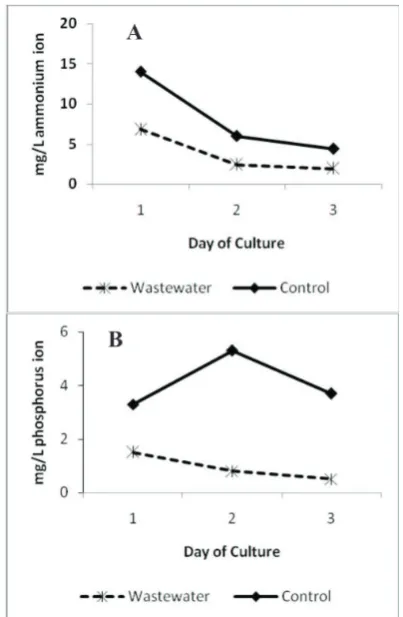
After 3 DOC, the initial ammonium ion concen-tration in the wastewater was vary (3.2-6.6 mg/L
NH+4) (Figure 2A). The ammonium ion removal from wastewater byD. salinaranged from 20.8-64.7%, with
an average of 42.8%. The decrease of ammonium ion from industrial wastewater has the same trend with the control. It showed that the ammonium ion removal from industrial wastewater, in case, was lower than the ammonium ion removal from agro-industrial wa-ter (94%) and even from domestic wastewawa-ter (89%) (Data not shown). The observed removal of ammo-nium ions from untreated wastewater is probably by an air-stripping mechanism[6].
Figure2: Removal of (A) Ammonium and (B) Phospho-rus from dilute (1:10) wastewater
The initial phosphorus concentration was also high (1.2-3.1 mg/L PO−3
4 ). Treatment of wastewater with
D. salinagradually decreased the phosphorus
concen-tration. The removal level of phosphorus ion from the treated wastewater ranged from 38-47%, with an average of 42%. The phosphorus removal from the industrial waste water was also slightly lower than from agro-industrial water (59%) and from domestic wastewater (75-82%). It indicated that phosphorus re-moval from the waste water accumulated into the algal biomass as showed by Chevalier and De la Noue[7]and Valderrama et al.[1].
Wike &/Phosphorus and Ammonium Ions . . . Jurnal Penelitian Sains 13 3(D) 13314
4 CONCLUSIONS
There was there phases of microalgae growth as a spe-cific adaptation from dilute wastewater presence in medium. Specifically, the result proposed a sequen-tial treatment process for industrial wastewater by us-ing microalgae D. salina. The microalgae treatment
removed nutrients (phosphorus and ammonium ions) from wastewater with specific level.
References
[1]Valderrama, L.T., C.M.D. Campo, C.M. Rodriguez, L.E. de-Bashan, and Y. Bashan, 2002, Treatment of recalcitrant wastewater from ethanol and citric acid production using the microalgae Chlorella vulgaris and the macrophyte Lemna minuscule,Water Research, 36: 4185-4192 [2]Gonzales, L.E., R.O. Canizales, and S. Baena, 1997,
Effeciency of ammonia and phosphorus removal from a Colombian agroindustrial wastewater by the microalgae Chlorella vulgaris and Skenedesmus dimorphus,
Bioressource Technol, 60: 259-262
[3]Muhaemin, M., 2004, Toxicity and Bioaccumulation of Lead in Chlorella and Dunaliella,Journal of Coastal Development, Vol VIII(1): 27-33
[4]Muhaemin, M., 2006, The Initial Adsorption of Pb2+ to Dunaliella salina,Journal of Coastal Development, Vol. IX(2): 97-105
[5]APHA, AWWA, WPCF, 1992,Standard methods for the
examination of water and wastewater, 17thed., Madrid, 1105 p
[6]De la Noue, J. and D. Proulx, 1988, The potential of microalgae biotechnology: a review of production and uses of microalgae,Biotechnol. Adv., 6: 725-770
[7]Chevalier, P. and J. De la Noue, 1985, Wastewater
nutrient removal with microalgae immobilized in K-carrageenan,Enzyme Microbial. Technol., 7: 621-624