A COMPARATI
TIVE STUDY ON THE STUDENTS' I
LLING AL-QUR’AN BETWEEN STUD
ONAL CLASS PROGRAM OF IAIN SA
OR HIGH SCHOOL ALUMNI (SMA/SM
SENIOR HIGH SCHOOL ALUMNI (M
A GRADUATING PAPER
o the Board of Examiners as a Partial Fulfillm ments for the Degree of Sarjana Pendidikan( on Department of Teacher Training and Educ ate Institute for Islamic Studies (IAIN) Salatiga
MOTTO
لﺎﻗ ﮫﻨﻋ ﷲ ﻲﺿر نﺎﻤﺜﻋ ﻦﻋ
:
ﻠ ﺻ ﷲ ل ﻮ ﺳ ر ل ﺎ ﻗ
ﻰ
ﻢﻠﺳو ﮫﯿﻠﻋ ﷲ
:
َﻢﱠﻠَﻌَﺗ ْﻦَﻣ ْﻢُﻛُﺮْﯿَﺧ
ُﮫَﻤﱠﻠَﻋَو َنَأ ْﺮُﻘْﻟا
)
ي ر ﺎ ﺨ ﺒ ﻟ ا ه ا و ر
(
From Utsman r.a. said that Rasulullah saw. said:
“The best of you are those who learn of Al-Qur’an and teach it”.
DEDICATION
This graduating paper is dedicated to:
1. My beloved superheroes, Mrs. Dwi Indarti and Mr. Harmanto. Thank you for
your praying, support, and everlasting love.
2. My beloved brothers and sisters, mas Fahmi, dek Afiz, dek Nia, dek Wafa’,
and dek Haris, who always cheer me up and support me.
3. My beloved ones, Hanifah, Irma, Anifa, Rahma, and Sefty. Thank you for
always be with me.
4. My best friends, all of ICP 2012 members who always say that yes we can.
5. My big family of International Class Program of IAIN Salatiga, KAMMI
Salatiga, FALMA Salatiga, Yaa Bismillah, and LDK Fathir Ar-Rasyid, who
has spent the time together whether in happy or difficult time.
6. My kind and joyful friends who always support me to finish this graduating
ACKNOWLEDGMENT
In the name of Allah, the Most Gracious, the Most Merciful. First, the
writer would like to thank to Allah SWT. because of His blessing, the writer can
finish this graduating paper as a partial fulfillment of the requirements for the
Undergraduate Degree of Islamic Education.
Peace and salutation always be given to our beloved Prophet Muhammad
saw. that we hope his blessing in the judgment day.
However, this success would not be achieved without the support,
guidance, advice, help, and encouragement from individuals and institutions.
Therefore, the writer would like to express the deepest gratitude to:
1. Dr. Rahmat Hariyadi, M.Pd., as The Rector of the State Institute for
Islamic Studies of Salatiga.
2. Suwardi, M.Pd., as the Dean of Teacher Training and Education Faculty.
3. Siti Rukhayati, M.Ag., as the Head of Islamic Education Department.
4. Sari Famularsih, M.A., as the Head of International Class Program.
5. Achmad Maimun, M.Ag. and Sari Famularsih, S.Pd.I. MA., as my
Academic Counselor thank you for your supports, advices, and helps for
this graduating paper from the beginning to the end.
6. My beloved father (Harmanto) and my beloved mother (Dwi Indarti) thank
you for all support, finance, encouragement and pray.
ABSTRACT
Syahidah, Hade Hilma. 2017.A Comparative Study on the Students' Intensity of Recalling Al-Qur'an between Students of International Class Program of IAIN Salatiga from Senior High School Alumni (SMA/SMK) and Islamic Senior High School Alumni (MA/MAK). A Graduating Paper. Islamic Department. Teacher Training and Education Faculty. State Institute for Islamic Studies (IAIN) Salatiga. Counselor: Achmad Maimun, M.Ag. and Sari Famularsih, M.A.
Question of the study from this research are: 1) How is the students’ intensity of recalling Al-Qur’an for the students of International Class Program of IAIN Salatiga from senior high school alumni (SMA/SMK)?, 2) How is the students’ intensity of recalling Al-Qur’an for the students of International Class Program of IAIN Salatiga from Islamic senior high school alumni (MA/MAK)?, 3) Is there a significant differentiation on the students’ intensity of recalling Al-Qur’an between students of International Class Program of IAIN Salatiga from senior high school alumni (SMA/SMK) and Islamic senior high school alumni (MA/MAK)?.
As a quantitative research, the data collection method that was used by the writer was questionnaire. Documentation was used to get additional information. The subject of this research was taken 9 students of International Class Program of IAIN Salatiga from senior high school alumni (SMA/SMK) and 9 students of International Class Program of IAIN Salatiga from Islamic senior high school alumni (MA/MAK). The data that collected, thus it was analyzed with the statistic technique T-test. The result there was no significant differentiation on the students’ intensity of recalling Al-Quran between students of International Class Program of IAIN Salatiga from senior high school alumni (SMA/SMK) and Islamic senior high school alumni (MA/MAK). It proved by t count value which is lower thanttable on the significance level 5% (-0,711 < 2,120).
TABLE OF CONTENTS
TITLE ... i
DECLARATION ... ii
ATTENTIVE CONSELOR NOTES ... iii
PAGE OF CERTIFICATION... v
MOTTO ... vi
DEDICATION ... vii
ACKNOWLEDGEMENT ... viii
ABSTRACT... x
TABLE OF CONTENTS... xi
LIST OF TABLES ... xiv
CHAPTER I INTRODUCTION A. Background of the Study ... 1
B. Question of the Study... 4
C. Purpose of the Study ... 5
D. Action Hypothesis... 5
E. Significance of the Study ... 6
F. Limitation of the Study ... 6
G. Definition of Key Terms ... 7
H. Method of Study ... 10
CHAPTER II LITERATURE REVIEW
A. Recalling Al-Qur’an... 17
1. The Definition of Recalling Al-Qur’an... 17
2. The Advantages of Recalling Al-Qur’an ... 18
3. Supporting Factors of Recalling Al-Qur’an... 18
4. Inhibiting Factors of Recalling Al-Qur’an... 20
B. The Differences between Senior High School (SMA/SMK) and Islamic Senior High School (MA/MAK)... 22
1. The Characteristic ... 22
2. The Curriculum Structure ... 24
3. The Islamic Education Material and Al-Qur’an Subject ... 31
CHAPTER III RESEARCH REPORT A. Research Setting... 32
1. Research Location... 32
2. Profile of IAIN Salatiga ... 32
3. Profile of Teacher Training and Education Faculty... 35
4. Profile of International Class Program... 37
B. Data Presentation ... 39
1. Participants of Research... 39
2. Data of the Students’ Intensity of Recalling Al-Qur’an... 41
3. The Validity Test ... 44
CHAPTER IV DATA ANALYSIS
A. Preface Analysis... 47
1. Data Analysis the Students’ Intensity of Recalling Al-Qur’an (Senior High School Alumni) ... 47
2. Data Analysis Students’ Intensity of Recalling Al-Qur’an (Islamic Senior High School Alumni) ... 51
B. Further Analysis... 56
C. Hypothesis Test... 59
D. Discussion ... 62
CHAPTER V CLOSURE A. Conclusion ... 64
B. Suggestion... 65
LIST OF TABLES
Table 1.1 : The Indicators of the Students’ Intensity of Recalling Al-Qur’an
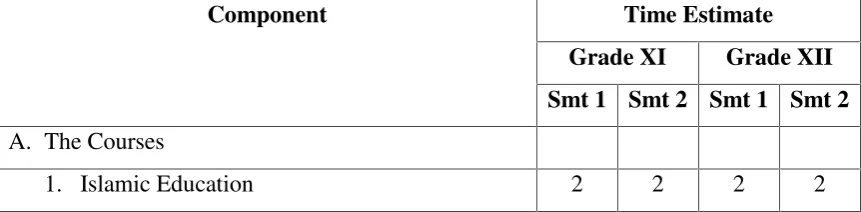
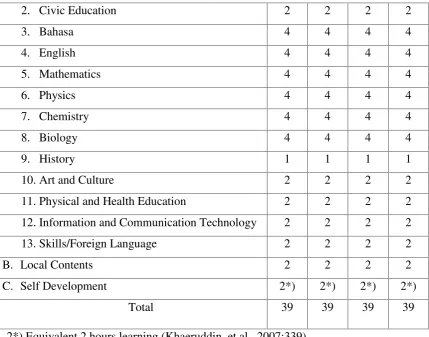
Table 2.1 : The Curriculum Structure of SMA (Natural Sciences Program)
Table 2.2 : The Curriculum Structure of MA (Natural Sciences Program)
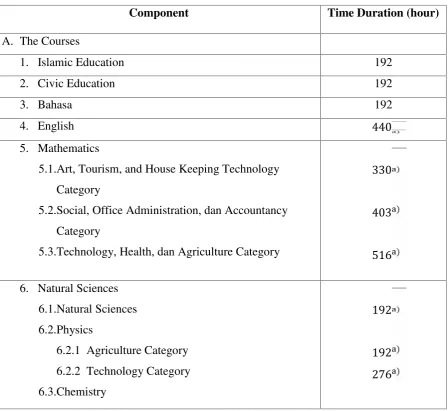
Table 2.3 : The Curriculum Structure of SMK/MAK
Table 3.1 : The Students of International Class Program of IAIN Salatiga from
Senior High School Alumni Respondents (SMA/SMK)
Table 3.2 : The Students of International Class Program of IAIN Salatiga from
Islamic Senior High School Alumni Respondents (MA/MAK)
Table 3.3 : The Questionnaire Result Distribution of International Class Program
Students of IAIN Salatiga from Senior High School Alumni
(SMA/SMK)
Table 3.4 : The Questionnaire Result Distribution of International Class Program
Students of IAIN Salatiga from Islamic Senior High School Alumni
(MA/MAK)
Table 3.5 : The Questionnaire Calculation of International Class Program
Students of IAIN Salatiga from Senior High School Alumni
(SMA/SMK)
Table 3.6 : The Questionnaire Calculation of International Class Program
Students of IAIN Salatiga from Islamic Senior High School Alumni
Table 3.7 : The Validity Test Result (Senior High School Alumni)
Table 3.8 : The Validity Test Result (Islamic Senior High School Alumni)
Table 3.9 : The Reliability Test Result (Senior High School Alumni)
Table 3.10: The Reliability Test Result (Islamic Senior High School Alumni)
Table 4.1 : Frequency Distribution of the Students’ Intensity of Recalling
Al-Qur’an (Senior High School Alumni)
Table 4.2 : Frequency Distribution of the Students’ Intensity of Recalling
Al-Qur’an (Islamic Senior High School Alumni)
Table 4.3 : Comparison Coefficient on the Students’ Intensity of Recalling
Al-Qur’an between Students of International Class Program of IAIN
Salatiga from Senior High School alumni ( ) and Islamic Senior High
CHAPTER I INTRODUCTION A. Background of the Study
Islam as rahmatan lil ‘alamin religion organizes of all aspects of humans’ life, written perfectly in Moslem scripture called Qur’an.
Al-Qur’an which is the main source of Islamic teachings, this is the real truth as a
way of life (Shihab, 1996:18). Al-Qur’an Al-Kareem revealed himself with
various features and natures. One of them, it was authentic scripture that
guaranteed by Allah, and was always maintained. Allah SWT. said:
َن ْﻮُﻈِﻓﺎَﺤَﻟ ُﮫَﻟ ﺎﱠﻧِإَو َﺮْﻛﱢﺬﻟا ﺎَﻨْﻟﱠﺰَﻧ ُﻦ ْﺤَﻧ ﺎﱠﻧِإ
“We have, without doubt, sent down the message; and We will assuredly guard it (from corruption)”. (Q.s. Al-Hijr: 9)
Thus Allah ensures the authenticity of Al-Qur’an, collateral that was
provided on the basis of His almighty and omniscient, and because of the
efforts that conducted by the creatures, especially by humans. With the
guarantee of that verse above, every Moslem believe that what they read and
heard as Al-Qur’an not slightly different between what was read by the
Messenger Muhammad saw., what was heard and read by his friends also
(Shihab, 1996:5).
Recalling Al-Qur’an is a glorious work, both in front of humans
especially in front of Allah SWT. Many eminences and advantages that can be
hereafter. In addition,hufazis holding an important role in maintaining purity and authenticity of Al-Qur’an until the end of time (Sugianto, 2004:130).
Recently Moslems start opened and stirred their heart up into
habituating the way of the Messenger Muhammad saw. one of which is
recalling of Allah’s commandment on Al-Qur’an. Many activities clearly
support for recalling, including musabaqoh hifdzil Qur’an, scholarship for
tahfiz students, television show as “Hafiz Indonesia” RCTI, and others. And Indonesian Moslems are very enthusiastic to receive them.
When we are talking about littlehufaz, our memory remember one of the participants in a television show “Hafiz Indonesia” RCTI named Musa.
Musa had has recalled Al-Qur’an at the age that he still very young. He was
the trending topic of Moslems in Indonesia. Vice Minister of Religion Prof.
Dr. Nasaruddin Umar who was judging in the event of “Hafiz Indonesia” was
said that he is one of the miracles.
His achievement goal makes him go to Jeddah, Saudi Arabia. Musa
was representative from Indonesia included in the international recalling
Al-Qur’an competition challenges withhufaz from all over the world. And Musa became the youngest participant who won a perfect score from 25 children in
the world.
The Musa’s success is the result by his father’s strong will and hard
work. His father commits to give intensive mentoring to Musa for recalling
From the story above, it explained that the parents have an important
role in the child’s success in recalling Al-Qur’an. But this role has proven to
the parents that have high consistency to do it. It is different with parents who
have a busy activities in outside, they only will be hinging on the school
environment for their children. And the best quality schools are the target of
them, if they want to see a successful life for their children in this world and
the hereafter. It is starting from the level of elementary school, junior high
school, and senior high school.
In Indonesia, senior high school to be the last education institution of
government programs in education sector namely the program 12 years study.
According to UU Sisdiknas no.20 Chapter VI Section 18, senior high school
divided intoSekolah Menengah Atas (SMA) andSekolah Menengah Kejuruan
(SMK), while Islamic senior high school divided on a levelMadrasah Aliyah
(MA) andMadrasah Aliyah Kejuruan(MAK).
If the family environment that influential on the recalling Al-Qur’an
success level, and is the educational background of someone influence it
also?. Whereas, basically the subjects of Islamic education that taught in
senior high school having a more little time compared with Islamic senior high
school.
Therefore, the writer will observe and compare the students’ intensity
of their recalling Al-Qur’an after joining in International Class Program,
which is in IAIN Salatiga. Finally, the writer is interested in conducting
INTENSITY OF RECALLING Al-QUR’AN BETWEEN STUDENTS OF
INTERNATIONAL CLASS PROGRAM OF IAIN SALATIGA FROM
SENIOR HIGH SCHOOL ALUMNI (SMA/SMK) AND ISLAMIC SENIOR
HIGH SCHOOL ALUMNI (MA/MAK)”.
B. Question of the Study
To clarify the problem that is going to be analyzed, the statements of
the problems are formulated as follow:
1. How is the students’ intensity of recalling Al-Qur’an for the students of
International Class Program of IAIN Salatiga from senior high school
alumni (SMA/SMK)?
2. How is the students’ intensity of recalling Al-Qur’an for the students of
International Class Program of IAIN Salatiga from Islamic senior high
school alumni (MA/MAK)?
3. Is there a significant differentiation on the students’ intensity of recalling
Al-Qur’an between students of International Class Program of IAIN
Salatiga from senior high school alumni (SMA/SMK) and Islamic senior
C. Purpose of the Study
In relation to the research question already stated the purpose of this
research are:
1. To find out the students’ intensity of recalling Al-Qur’an for the students
of International Class Program of IAIN Salatiga from senior high school
alumni (SMA/SMK).
2. To find out the students’ intensity of recalling Al-Qur’an for the students
of International Class Program of IAIN Salatiga from Islamic senior high
school alumni (MA/MAK).
3. Finding a significant differentiation on the students’ intensity of recalling
Al-Qur’an between students of International Class Program of IAIN
Salatiga from senior high school alumni (SMA/SMK) and Islamic senior
high school alumni (MA/MAK).
D. Action Hypothesis
Hypothesis is a predicated answer of research problem with data
(Arikunto, 2006:102). According to the explanation of theories before, the
writer states the hypothesis as follows: there is no significant differentiation
on the students’ intensity of recalling Al-Qur’an between students of
International Class Program of IAIN Salatiga from senior high school alumni
E. Significance of the Study
The writer hopes that the results of this research can give information
about recalling Al-Qur’an. Such information is expected to be useful for the
researcher, parents, students, and institutions, particularly IAIN Salatiga.
1. Theoretically
This research can give a contribution to the Islamic education thought,
especially in the field of recalling Al-Qur’an.
2. Practically
a. For the Parents
The result of this research is expected to give clear information that
their children have the same competency and ability in recalling
Al-Qur’an.
b. For the Students
The result of this research is expected becomes a consideration and
motivation for senior high school alumni and Islamic senior high
school alumni in the way of recalling Al-Qur’an.
F. Limitation of the Study
The study only conducted to International Class Program of IAIN
Salatiga. This study focused on the students’ intensity of recalling Al-Qur’an,
and it will compare the students’ intensity of recalling Al-Qur’an from senior
G. Definition of Key Terms
To avoid misinterpretation or misunderstanding about the title of this
research, the writer would like to clarify and explain the terms that used in this
research as follows:
1. A Comparative Study
Comparative study is kind of descriptive research to looking for the
natural answer about causality, with analyzing the elements causes of
something or certain phenomenon (Nazir, 2005:58).
2. Students
Students are person who studying at college, polytechnic, or
university or anyone who studies or who is devoted to acquisition
(Hornby, 1994:859). In this research, the students are all of member of
International Class Program of IAIN Salatiga. The number of all is 69
students that have three study programs; there are 30 students of English
Department, 17 students of Arabic Department, and 22 students of Islamic
Education.
3. Intensity of Recalling Al-Qur’an
a. Intensity
Intensity is put up a good fight for having a very strong effect (Hazim,
2005:191). In other words, intensity is the condition where someone
excited about doing something that can be measured by the frequency
b. Recalling Al-Qur’an
Recalling Al-Qur’an is effort to remember Al-Qur’an according to the
order of contained inmushaf as worship, and maintain the authenticity of Allah’s commandment (Munjahid, 2007:74).
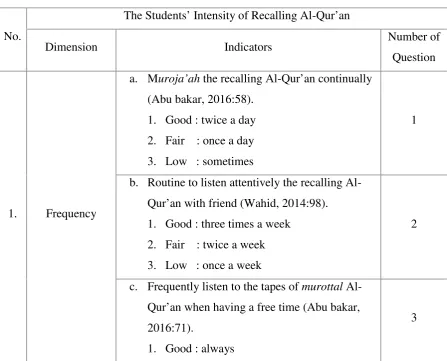
c. The Indicators of the Students’ Intensity of Recalling Al-Qur’an
The indicators of the students’ intensity of recalling Al-Qur’an level
based on interview result by thetahfizlecturer. And the writer presents in the following table:
Table 1.1
The Indicators of the Students’ Intensity of Recalling Al-Qur’an
No.
The Students’ Intensity of Recalling Al-Qur’an
Dimension Indicators Number of
Question
1. Frequency
a. Muroja’ahthe recalling Al-Qur’an continually
(Abu bakar, 2016:58).
1. Good : twice a day
2. Fair : once a day
3. Low : sometimes
1
b. Routine to listen attentively the recalling
Al-Qur’an with friend (Wahid, 2014:98).
1. Good : three times a week
2. Fair : twice a week
3. Low : once a week
2
c. Frequently listen to the tapes ofmurottal Al-Qur’an when having a free time (Abu bakar,
2. Fair : sometimes
3. Low : never
d. Intense to submit the recalling Al-Qur’an to the
lecturer (Wahid, 2014:78).
a. Juzof Al-Qur’an that has been recalled before join in International Class Program.
1. Good : more than fivejuz
2. Fair : one-fivejuz
3. Low : less than onejuz
5
b. AdditionalJuzof Al-Qur’an while in
International Class Program every semester.
1. Good : onejuz
2. Fair : half ofjuz
3. Low : quarter ofjuz
6
c. Additional pages of Al-Qur’an every week to
the lecturer (Abu bakar, 2016:88).
1. Good : two page
2. Fair : one page
3. Low : half of page
7
d. The number of verses of Al-Qur’an that was
recalled very well.
a. Willingness to comprehend the verses of
Al-Qur’an.
1. Good : more than 75%
2. Fair : 50% - 75%
3. Low : less than 50%
b. Comprehend the verses of Al-Qur’an that was
recalled (Abu bakar, 2016:89).
1. Good : more than 75%
2. Fair : 50% - 75%
3. Low : less than 50%
10
H. Method of Study
Method of the research are ways that conducted by a researcher to
collect the data, classify, and analyze data in a study using measurements and
knowledge, this is done to reveal the truth (Koentjaraningrat, 1994:13).
The role of the method in a research is essential to achieve goals of the
study. The method used in this research is:
1. Approach
In this research, the writer uses quantitative approach. Quantitative
is a process of getting knowledge by using a number of data as instruments
to explain the subject (Margono, 2005:8). It uses and deals with statistical
calculation. The statistical calculation is the process of using information
discovered from studying numbers by adding, multiplying, subtracting or
dividing numbers to judge the number or amount of something.
2. Subject of the Study
Subject is something which is being discussed, considered or
of students called population. From that, sample as the representative of
this will be taken from the population mentioned.
a. Population
Population is all members of the research subject (Arikunto,
2006:130). Best (1981:8) states that “population is any group of
individuals that have one or more characteristics in common”. So, in
this research, population of the study was the students of International
Class Program of IAIN Salatiga.
b. Sample
Sample is a part of the population which is investigated (Arikunto,
2006:131). If the quantity of research subject less than 100, then it will
be better to take all of it. So, it was regarded as a population research.
But if the quantity of research subject is more than 100, the researcher
can take 10-15% or 20-25% from the population.
This study using stratified random sampling, according to Deni
(2014:147) stratified random sampling is a method of random
withdrawal and multilayer. This technique was performed when the
population consists of several stratums and the sample reflects stratum
also, then the respondent will be selected at random from each stratum.
In this research, the first sample will be taken 9 students of
International Class Program of IAIN Salatiga from senior high school
alumni (SMA/SMK), this sum of respondent be a permanent number
9 students of International Class Program of IAIN Salatiga from
Islamic senior high school alumni (MA/MAK) at random from each
stratum. And the gender (male or female) was not considered in this
study.
3. Technique of Collecting Data
a. Interview
Interview is a way to collect information materials carried by a
question and answer dialogue or orally either unilaterally or face to
face (Sudjana, 1992:82).
There are two types of interviews that can be used as collection
tool materials, namely:
1. Guided interview often known as structured or systematic
interviews.
2. Unguided interview or simple interview so the process of data
collection is done freely and not systematic.
In the implementation the writer uses guided and unguided
interviews, the meaning is in carrying out the interview, the
interviewer only brings outline guidance about the things that will be
asked so the implementation of the interview feel more relaxed, calm,
and close to the interviewee (Sudjana, 1992:83). The writer uses this
b. Questionnaire Method
According to Sutopo (2006:82), questionnaire method is a
technique of collecting data indirectly (researcher did not directly ask
the respondent). The instrument also called the questionnaire contains
a number of questions that must be answered or responded by the
respondent. Respondent has the freedom to give an answer or respond
appropriately with their perception or their condition.
In this research, the questionnaire method used to know the
students’ intensity of recalling Al-Qur’an to the students of
International Class Program of IAIN Salatiga.
c. Documentation
Robert (2011:149) states that many documents can be useful
simply by nature of the details they contain. In other words,
documentation is used as evidence to proof the result of research.
Soeharto (1989:74) argues that generally evidence is an object to help
the writer to decide the problem. The document might in the form of
text, images, or monumental works of someone.
4. Technique of Data Analysis
In order to analyze the data, the following step will be applied:
a. Preface analysis.
After obtained the data, the writer will require an accounting early data
collected. In this case, the writer uses calculation of percentage
P = x 100%
P : percentage
F : frequency of answer
N : sum of respondent
b. Making the independent T-test.
The writer uses T-test formula as the technique of data analysis
(Utsman, 2015:153).
The formula is:
=
−
+
t :tcount value
: mean of first sample
: mean of second sample
: variant of first sample
: variant of second sample
: sum of first subject sample
: sum of second subject sample
c. Consultationttable in the level of significance 1% and 5%.
d. Ift count is higher than t table, so there is a significant differentiation on the students’ intensity of recalling Al-Qur’an between students of
alumni (SMA/SMK) and Islamic senior high school alumni
(MA/MAK).
e. Iftcount is lower than ttable, so there is no significant differentiation on the students’ intensity of recalling Al-Qur’an between students of
International Class program of IAIN Salatiga from senior high school
alumni (SMA/SMK) and Islamic senior high school alumni
(MA/MAK).
I. Thesis Organization
To make easier for the reader to understand the contents of the
graduating paper, the writer decides to organize this paper into five chapters:
Chapter I is the introduction which consists of the background of the
study, question of the study, purpose of the study, action hypothesis,
significance of the study, limitation of the study, definition of key terms,
method of study, and thesis organization.
Chapter II is a theoretical review. This part presents the research result
theories or related research studies on the similar field.
Chapter III is present research methodology. It contains the research
setting and data presentation.
Chapter IV is present data analyze. The research questions will get
answer in this chapter. To make it clearer for the readers, the writer suggests
Chapter V is closing contains the conclusion and suggestion for the
further research. The last terms of this research are a bibliography and
CHAPTER II LITERATURE REVIEW A. Recalling Al-Qur’an
1. The Definition of Recalling Al-Qur’an
Recalling is a process of repeating something well enough either
by reading or listening (Rauf, 2004:47). According to Nur Faizah
(2008:97), Al-Qur’an is Allah’s commandment that there is no equal it,
sent down to the Messenger Muhammad saw., completed of the prophets
and the messengers, with an intermediary Jibril, and written in mushaf
then was forwarded mutawatir to us, as well as read and learn that is worship, which begins with Surah Al-Fatihah and covered with Surah
An-Nas.
Recalling Al-Qur’an in Arabic word called hifdz al-Qur’an ( ﻆ ﻔ ﺣ ن آ ﺮ ﻘ ﻟ ا ) is the arrangement of the form of idhofah, which is defined as form of effort to remember Al-Qur’an according to the order of contained in
mushaf with a view worship, keep, and maintain the Allah’s commandment (Munjahid, 2007:74). In other words, recalling Al-Qur’an
is a process to maintain and preserve the chastity of the scripture that was
given to the Messenger Muhammad saw. by rote to avoid possibly the
alterations, counterfeits and can keep from forgetfulness, good as a whole
2. The Advantages of Recalling Al-Qur’an
Kahil (2010:19-23) explains the advantages of recalling
Al-Qur’an as follows:
a. Al-Qur’an is the Allah’s commandment and recall it includes a great
activity.
b. Recalling Al-Qur’an is like recalling the biggest world dictionary,
because it contains about science of the world and the hereafter, story
of who ever was and who is to come, about law and act that regulate
human life.
c. Al-Qur’an is the cure for body and soul illnesses.
d. Human will not waste the time in a pointless manner by recalling
Al-Qur’an.
3. Supporting Factors of Recalling Al-Qur’an
Many factors that made someone has an excuse to continue have
enthusiasm in recalling Al-Qur’an, either from own factor or other. In this
case, the supporting factors of recalling Al-Qur’an divides into seven
factors, as had been concluded below:
a. Health Factor
Health being the important factor for hufaz, if they have a healthy body so the process of recalling Al-Qur’an will be more easy without
b. Psychological Factor
Besides of the healthy body, the other supporting important factor
is the health of psychology. Psychological factor that is capable of
supporting in recalling Al-Qur’an it includes calmness soul, both in
terms of the mind and heart. To maintain the stability of psychological,
hufazneeds to increasedzikir and makes a positive activity, so they do not get a problem that makes worry until disturbing their recalling
Al-Qur’an.
c. Intelligence Factor
The intelligence of everyone is diverse, so this factor is influencing
enough on the process of recalling Al-Qur’an. Nevertheless, lack of
intelligence is no reason to lose enthusiasm in recalling Al-Qur’an,
because for the much needed to care for owned intelligence is the
diligence and consistent.
d. Motivation Factor
Hufaz really needs motivation from the closest person, because with this motivation, spirit of someone in recalling Al-Qur’an will be
kept. Besides motivation from the family, friends, and the
environment; the owned motivation needs to be a priority in recalling
Al-Qur’an.
e. Age Factor
Basically, learned are not know the time and the age. It includes
age. But it cannot be denied that the more matures the age of someone,
the more complex problems mindful of the things. By that reason, the
age is recommended for recalling Al-Qur’an is those who are in the
productive age (Wahid, 2014:139-142).
f. Method Factor
Every Hufaz wants a quick time and have strong stick recalled in brain memory on the process of recalling Al-Quran. That could be
done ifhufaz using appropriate methods, and have the persistence and consistent in going through the process. The method that used byhufaz
are different according to their wish and capability (Wahid, 2014:65).
g. Participation of Allah SWT. Factor
Recalling Al-Qur’an will not fare well without the participation of
Allah, because He is the one who have an intention above everything.
However, His will is not going down without an effort. The effort that
human can do is to pray, especially the parent’s prayer that very
efficacious. History has proven that prayer has a tremendous influence
for the development of the children’s recalled Al-Qur’an (Abubakar,
2016:51).
4. Inhibiting Factors of Recalling Al-Qur’an
Several factors that cause the process of recalling Al-Qur’an is
a. Too ambitious to increase a new recalling Al-Qur’an.
This ambition could have been had a positive impact, on the
condition to increase a new recalling Al-Qur’an that accompanied by
increase the intensity of muroja’ah. But often that happened to hufaz
want to immediately complete their recalling Al-Qur’an, even before
the recalling Al-Qur’an isdhabit and fluently, He hasty moved to next recalling Qur’an. This has resulted from the previous recalling
Al-Qur’an being disorderly (Wahid, 2014:138).
b. Not routinely to repeat (muraja’ah) the recalling Al-Qur’an.
In recalling Al-Qur’an, someone should have a specific schedule to
muraja’ah his recalling Al-Qur’an, either in prayer or not. So hufaz
should be able to set a time, because when they were lazy to repeat it,
then their recalling Al-Qur’an will fade sooner (Wahid, 2014:135).
According to the word of the Messenger Muhammad saw. the
following:
“Keep Al-Qur’an by my soul was in his hand. Al-Qur’an is faster separated from the hearts of hufaz than the loss of a camel from the bonds.” (H.R. Bukhari)
c. Do not want to sound off the recalling Al-Qur’an to others (Al-Kahil,
2010:90).
If the Messenger Muhammad saw. frequently ask Jibril to listen
attentively his recalling Al-Qur’an in every year ofRamadhan, then as a human being, we should not too believe in our own selves because
others, so hufaz will not know where the mistake is (Sugianto, 2004:105).
B. The Differences between Senior High School (SMA/SMK) and Islamic Senior High School (MA/MAK)
1. The Characteristic
a. The Characteristics of Senior High School (SMA/SMK)
Sekolah Menengah Atas (SMA) is one form of formal education unit that organizes public education at secondary education level as a
continuation of SMP, MTs, or other equivalent forms (RPP Dikdasmen
Chapter 1 Section 11). This educational unit is under the auspices of
the Ministry of Education and Culture (KEMENDIKBUD). This
school is known as an education institution curriculum focuses on
general subjects. With the Islamic education material only as a subject
into a unity subject of Islamic Education (PAI) which is not detailed as
in secondary education under the auspices of the religious institutions
(Tilaar, 2006:134). Where graduates are expected to compete and
continue their studies to university.
Sekolah Menengah Kejuruan (SMK) is one form of formal education unit that organizes vocational education at secondary
education level as a continuation of SMP or MTs. Schools that are
independently and to follow further education in accordance with the
vocational program (Ditjen PMPTK, 2008:27). And the graduates are
expected to work in accordance with their skill.
b. Characteristics of Islamic Senior High School (MA/MAK)
Madrasah Aliyah (MA) is one form of formal education unit that organizes public education with the peculiarities of Islamic religion at
secondary education level as a continuation of SMP, MTs or other
forms equivalent (Regulation of the Minister of Religious Affairs
number 60 Year 2015 Chapter 1 Section 6). This educational unit
under the auspices of the Ministry of Religious Affairs (KEMENAG)
is known as a religious educational institution are therefore more
focused on religious subjects. Matter of Islamic Education (PAI) is
divided into several parts, namely Fiqh, Aqidah Akhlaq, Al-Quran Hadist, Islamic Cultural History, and Arabic. This fifth study various aspects of this matter which is expected to bring learners and graduates
into private religious and noble character.
Madrasah Aliyah Kejuruan (MAK) is one form of formal education unit that organizes vocational education with the
peculiarities of Islamic religion at secondary education level as a
continuation of SMP, MTs or other forms equivalent (Regulation of
the Minister of Religious Affairs number 60 Year 2015 Chapter 1
Section 7). Just like other vocational schools, MAK also teaches skills
distinguishes MAK with another vocational school subjects are
weighted more PAI, so that students are not only able to master the
material but also material vocational religion. This hopes graduates are
able to compete and get a job with appropriate skills.
2. The Curriculum Structure
a. The Curriculum Structure of Sekolah Menengah Atas (SMA) and
Madrasah Aliyah(MA)
The curriculum structure is a pattern and arrangement of subjects
that must be taken on by learners in learning activities (Robandi,
2009:11). The curriculum structure ofSekolah Menengah Atas (SMA)/
Madrasah Aliyah(MA) covers the learning substance is pursued in the education for three years from grade X to grade XII. The curriculum
structure is based on Graduates Competency Standards (SKL) and
Competency Standards Subjects (SKMP). Organizing classes in
SMA/MA is divided into two groups, there are grade X is public
program attended by all students, and grade XI and grade XII are a
program of majors which consists of four programs: (1) Natural
Sciences Program, (2) Social Sciences Program, (3) Language
Program, and (4) Religious Program, that specifically for MA (Ditjen
PMPTK, 2008:27).
1. The Curriculum of Grade X
self-with criteria of characteristic potentials/superiority areas and
the material cannot be grouped into the existing subjects.
Self-development aims to provide opportunities to express
themselves according to their talents and interests of learners.
b. Each subject has the allocation of teaching hours.
c. Allocation of time every hour lesson is 45 minutes.
d. Effective week for one academic year (two semesters) is 34-38
weeks.
2. The Curriculum of Grade XI and Grade XII
a. Class XI and XII consisted of 13 subjects, local content, and
self-development.
b. Program of majors have a separate subject.
c. Each subject has the allocation of teaching hours.
d. Allocation of time every hour lesson is 45 minutes.
e. Effective week for one academic year (two semesters) is 34-38
weeks.
Table 2.1
The Curriculum Structure of SMA (Natural Sciences Program)
Component Time Estimate
Grade XI Grade XII Smt 1 Smt 2 Smt 1 Smt 2 A. The Courses
2. Civic Education 2 2 2 2
11. Physical and Health Education 2 2 2 2
12. Information and Communication Technology 2 2 2 2
13. Skills/Foreign Language 2 2 2 2
B. Local Contents 2 2 2 2
C. Self Development 2*) 2*) 2*) 2*)
Total 39 39 39 39
2*) Equivalent 2 hours learning (Khaeruddin, et al., 2007:339)
Region, school or madrasahcan add total time estimate or change time estimate of subjects in accordance with the needs of student,
school, madrasah, or region in the School Based Curriculum (KTSP). In this case,madrasahadded time estimate to religious subjects.
Table 2.2
The Curriculum Structure of MA (Natural Sciences Program)
Component Time Estimate
1. Islamic Education
a. Al-Qur’an Hadits 2 2 2 2
b. Aqidah Akhlaq 1 1 -
-c. Fiqih 2 2 2 2
d. History of Islamic Civilization - - 1 1
2. Civic Education 2 2 2 2
12. Physical and Health Education 2 2 2 2
13. Information and Communication Technology 2 2 2 2
14. Skills/Foreign Language 2 2 2 2
e. Local Contents 2 2 2 2
f. Self Development 2*) 2*) 2*) 2*)
Total 45 45 45 45
2*) Equivalent 2 hours learning (Khaeruddin, et al., 2007:399)
b. The Curriculum Structure of Sekolah Menengah Kejuruan(SMK) and
Madrasah Aliyah Kejuruan(MAK)
Implementation of SMK and MAK are intended to provide work
capability in accordance with a certain skill. The curriculum structure
knowledge, personality, character, and skills to live independently and
to follow further education in accordance with the vocational program
(Ditjen PMPTK, 2008:27). The structure of the SMK and MAK
divided into three components were taken on for 3 years, there are:
1. Normative component, it contains a competency that aims to make
the students become citizens who behave in accordance with the
values in the society, nation, and state. Which include normative
component there are Religious Education, Civic Education,
Bahasa, Physical and Health Education, and Arts and Culture.
2. Adaptive component, it contains a competency that aims to make
students able to adapt and develop themselves in accordance with
the times, as well as the demands of the working world according
to their skills. Adaptive component consisted of subjects in
English, Mathematics, Natural Sciences, Social Studies, Computer
Skills and Information Management, and Entrepreneurship.
3. Productive component, it contains a competency that aims to make
students able to getting tasks done in the working world in
accordance with the skill program. Productive component
competence is competency standards that obtained in specified
areas of skills by professional associations, the inventory and the
consensus of the working world, as well as related parties. The
SMK and MAK apply Dual System Education (PSG) also, which
was designed and implemented jointly learning in the school, the
working world, or industry. Learning implementation in the working
world based on the readiness and availability of activities in
accordance with competencies in the curriculum (Wina, 2006:66-67).
Table 2.3
5.1.Art, Tourism, and House Keeping Technology
6.3.1 Agriculture Category
6.3.2 Technology and Health Category
6.4.Biology
9. Physical and Health Education 192
10. Vocational Sciences
10.1. Computer Skills and Information Management
10.2. Entrepreneurship
Notation Statement (Khaeruddin, et al., 2007:343)
) : The time duration is a minimum number of hours to be used by any
skills program. The skills programs that require more time,
additional hours are integrated into the same subject, beyond the
number of hours specified.
) : Consisting of various subjects are determined according to the needs
of each skills program.
) : The number of hours Vocational Competency is basically in
) : Equivalent 2 hours learning.
3. The Islamic Education Material and Al-Qur’an Subject
From the text above, it can be concluded that senior high school
and Islamic senior high school have the same structure of general subjects,
and the differences among them is in the subject matter of Islamic
Education (PAI). In senior high school Islamic education material
summarized into one subject, whereas in Islamic senior high school is
divided into four subjects, there are Al-Qur’an Hadits, Aqidah Akhlaq, Fiqh, and History of Islamic Civilization. And this impact on the total allocated time per week, 39 hours for senior high school (SMA/SMK) and
45 hours for Islamic senior high school (MA/MAK).
On the other side, students of International Class Program from
Islamic senior high school (MA/MAK) are more accustomed to recalling
the verses of Al-Qur’an and Hadits as compared to students of International Class Program from senior high school (SMA/SMK).
Because in most of the Islamic material in Islamic senior high school
requires the students to memorize, understand, and explore the materials
that based on Al-Qur’an and Hadits. Differ from the students who are in senior high school or vocational senior high school. In addition, most of
madrasah there is Al-Qur’an material enrichment, such as tahfidz
CHAPTER III RESEARCH REPORT A. Research Setting
1. Research Location
The research takes place in the International Class Program of IAIN
Salatiga, located in Campus III Southern Ring Road Km. 2 Salatiga.
2. Profile of IAIN Salatiga
IAIN Salatiga is one of the state institutes for Islamic higher education
located in Salatiga, the city of comfort to study. IAIN Salatiga integrates
personal development from multi-dimension, including spirituality,
intellectuality, and professionalism through the quality assurance of
learning processes and outputs. Thus, the alumni are capable to competing
in the job market and academic vacancies with high competences and
great characters.
In the beginning, in 1970 IAIN Salatiga is a Walisongo Education
Faculty of IAIN Semarang. As time passes, on 21 March 1997 Education
Faculty of IAIN Walisongo switch the status becomes a State Institute for
Islamic Studies (STAIN) Salatiga. And today, STAIN Salatiga has
switched the status becomes IAIN Salatiga on 6 March 2015. And it was
strengthened according to the President Regulation (Perpres) No. 143 Year
2014, dated 17 Oktober 2014.
a. Vision
In 2030, being a referral of Indonesian Islamic studies for the
establishment of peace and dignity community.
b. Mission
1. Conducting education in various disciplines of Islamic sciences
based on the Indonesian values.
2. Conducting research in various disciplines of Islamic values for the
strengthening of Indonesian values.
3. Carrying out the community services based on the research to
strengthen the Indonesian values.
4. Developing a culture of campus community that reflects the values
of Islam in Indonesia.
5. Organizing the management of professional and accountable
higher education.
IAIN Salatiga starts to open the new faculties when switching the
status from STAIN. Nowadays, IAIN Salatiga has 5 faculties and 2
programs.
a. Teacher Training and Education Faculty
1. Islamic Education
2. Arabic Department
3. English Department
4. Science Department
6. Educational Teacher forRaudhatul Athfal
7. Educational Teacher forMadrasah Ibtidaiyah
b. Syari’ahFaculty
1. Islamic Family Law
2. Syari’ahEconomics Law
3. Constitutional Law
c. DakwahFaculty
1. Communication and Broadcasting Islam
2. Islamic Society Development
3. Management ofDakwah
d. Ushuluddin,Adab, and Humanities Courses 1. Al-Quran andTafsirSciences
2. HaditsSciences
3. Philosophy of Religion
4. History and Islamic Culture
5. Language and Arabic Literature
e. Economics and Islamic Business
1. Islamic Banking S1
2. Islamic Banking Diploma
3. Syari’ahEconomics
f. Post Graduate Program
3. Syari’ahEconomics
4. Islamic Basic Education Sciences
g. International Class Program
Cross Study Program under Teacher Training and Education Faculty.
3. Profile of Teacher Training and Education Faculty
Teacher Training and Education Faculty in carrying out the duties and
functions have a vision and mission that guide the implementation of the
Tri DharmaCollege. a. Vision
Excels in the education development based on the Islamic and
Indonesian values.
b. Mission
1. Conducting education and technology-based teaching, Islamic, and
Indonesian values.
2. Conducting research to encourage efforts to improve the quality of
Islamic education in Indonesia.
3. Increasing the participation of faculty in the education
development, culture, and Islamic civilization in Indonesia.
4. Increase cooperation with various parties in implementing the Tri DharmaCollege, especially in the field of education.
Teacher Training and Education Faculty has seven education
a. Islamic Education (PAI)
Islamic Education has a vision to become a center of excellence in
education, research, and development of research-based Islamic
Education in 2025. And hopes graduated from this would be PAI
teachers that have pedagogical competence, professional, personal,
social, ICT, and Islamic competence.
b. Arabic Department (PBA)
The vision of this department is in 2025 became the majors that
produce Arabic language educators who are competent and excel in the
mastery of information technology-based Islamic values.
c. English Department (TBI)
English Department had a vision in 2030 into a program of study
that produces competent English educators, superior, and dignified in
the mastery of information technology-based Islamic values.
d. Science Department
The vision of this department is in 2030 became a reference center
of competent natural sciences educators, have akhlakul karimah, and spirited sciencenterpreneurship with Indonesian Islamic concept.
e. Math Department
This department has a vision in 2030 to realize the superior and
innovative majors in the field of mathematics education based on
f. Educational Teacher forRaudhatul Athfal(PGRA)
Educational Teacher for Raudhatul Athfal has a vision in 2030 became the excelled majors in developingRaudhatul Athfal education based Indonesian Islamic concept for the realization of human dignity.
g. Educational Teacher forMadrasah Ibtidaiyah(PGMI)
This department has a vision in 2025 into a program of study that
produces competent Madrasah Ibtidaiyah educator and excels in the mastery of information technology.
h. International Class Program (Cross Study Program)
4. Profile of International Class Program
International Class Program is a cross study program of educational
faculty in IAIN Salatiga. The implementation of International Class
Program is proposed to provide the best service to students who have the
potential and high motivation to study. One the learning system and
facilities that provided to the students of this class is applying Arabic and
English in the teaching and learning process.
All of the students in this program have a different experience than the
other regular students. They had the opportunity to teach at the Sekolah Indonesia Luar Negeri (SILN) around Asia. In addition to teaching and learning in schools, they also learn the local culture that is different from
Indonesia.
Moreover, the source of the data of this research is all of member of
member is 69 students that have three study programs there are 30 students
of English Department, 17 students of Arabic Department, and 22 students
of Islamic Education.
The vision, mission, and core value of International Class Program are
described below:
a. Vision
The ultimate choice for learning in Islamic higher education with
international recognition.
b. Mission
A caring and socially responsible Islamic institution that explores
the potential of learners, educators, staff, and organization in Indonesia
and South East Asia through the quality provision of internationally
recognized programs.
c. Core Value
The acronym of International Class Program’s Core Value is
EDUCATION. The abbreviation of EDUCATION is mentioned
below:
E: Encourage
We encourage students to express individual’s thought, emotion, and
spirituality.
D: Dedicate
U: Understand
We understand that every person is unique.
C: Core
We intend the individual to core with others.
A: Activate
We activate the individual as well as collective power.
T: Talent
We explore the talent of every individual
I: Integrity
We promote integrity of individuals to remain community welfare.
O: Optimistic
We create optimistic individuals at any circumstances.
N: Nurture
We nurture individuals confidently to encounter the bright future.
B. Data Presentation
1. Participants of Research
In this research, the first respondents will be taken 9 students of
International Class Program of IAIN Salatiga from senior high school
Table 3.1
The Students of International Class Program of IAIN Salatiga from Senior High School Alumni Respondents (SMA/SMK)
No. Name Student Number Majors
1 Bilal Yanuar Sugrindro AS 23020150016 PBA
2 Nikmah Hilyatul Khoiri 23020150049 PBA
3 Siti Faizza Turrohmah 23030150012 TBI
4 Fajar Purwaningsih 23030150040 TBI
5 Amira M.D. 11314036 TBI
6 Fita Widyastuti 11314060 TBI
7 Lina Shofiah 11314131 TBI
8 Nina Desyana Farikhah 11313007 TBI
9 Indana Khoirun Nida 11313102 TBI
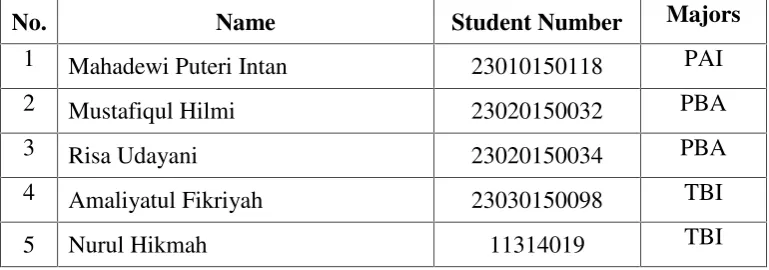
The second respondents will be selected 9 students of International
Class Program of IAIN Salatiga from Islamic senior high school alumni
(MA/MAK), there are:
Table 3.2
The Students of International Class Program of IAIN Salatiga from Islamic Senior High School Alumni Respondents (MA/MAK)
No. Name Student Number Majors
1 Mahadewi Puteri Intan 23010150118 PAI
2 Mustafiqul Hilmi 23020150032 PBA
3 Risa Udayani 23020150034 PBA
6 Lailatul Istianah 11314024 TBI
7 Ni’ma Amalia 11314107 TBI
8 Anifatur Rodhiyah 11113258 PAI
9 Novia Fajar Masyitoh 11313018 TBI
2. Data of the Students' Intensity of Recalling Al-Qur'an
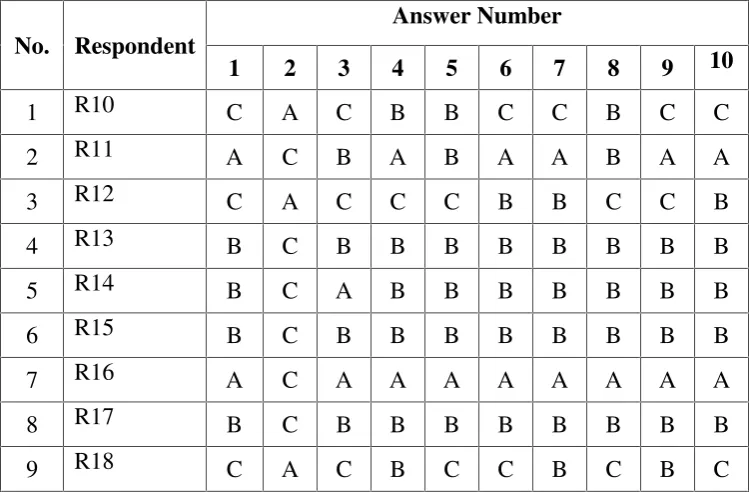
The Students’ intensity of recalling Al-Qur’an was measured by using
questionnaire which consists of 10 questions with 3 choices for each
question. The answers that have been collected are recorded to the specific
tables.
Table 3.3
The Questionnaire Result Distribution of International Class Program Students of IAIN Salatiga from Senior High School Alumni
Table 3.4
The Questionnaire Result Distribution of International Class Program Students of IAIN Salatiga from Islamic Senior High School Alumni
(MA/MAK)
Because the respondent’s answer was from the data, the writer makes
the data coded. Coding is data processing by setting and provides answer
categories code on each answer. The writer changes the result of
questionnaire to be the quantitative data obtained into questionnaire score:
a. Score 3 for option A
b. Score 2 for option B
c. Score 1 for option C
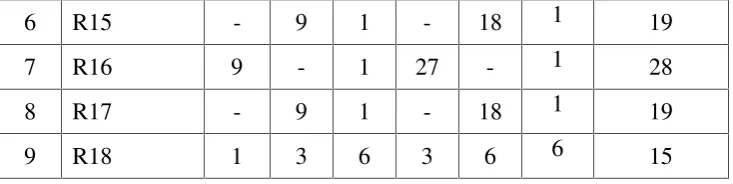
Data concerning the students’ intensity of recalling Al-Qur’an obtained
Table 3.5
The Questionnaire Calculation of International Class Program Students of IAIN Salatiga from Senior High School Alumni
(SMA/SMK)
The Questionnaire Calculation of International Class Program Students of IAIN Salatiga from Islamic Senior High School Alumni
6 R15 - 9 1 - 18 1 19
the students’ intensity of recalling Al-Qur’an between students of
International Class Program of IAIN Salatiga from senior high school
alumni (SMA/SMK) and Islamic senior high school alumni (MA/MAK), it
is necessary to test the validity of that question from each item. From the
validity test calculation result gained the r count that consulted with r
table. If r count > r table it means valid, and if r count < r table it means
not valid, and it is based on the r table Pearson coefficient for N = 9 in the
5% significant level is 0,666. In this test, the writer uses IBM SPSS
Statistics version 23. The validity test data results present in this table
below:
Table 3.7
The Validity Test Result (Senior High School Alumni) Question Number r count r table The Validity Level
6 0,859 Valid
The Validity Test Result (Islamic Senior High School Alumni) Question Number r count r table The Validity Level
1 0,969
reliability on it. The reliability test calculated using IBM SPSS Statistics
Table 3.9
The Reliability Test Result (Senior High School Alumni)
Reliability Statistics
Cronbach's
Alpha N of Items
.925 10
From the table above, it is shown that the value of alpha is 0,925 then
consulted with the r table Pearson coefficient for N = 9 in the 5%
significant level is 0,666. So r count = 0,925 > r table = 0,666, it can be
concluded that the items are reliable.
Table 3.10
The Reliability Test Result (Islamic Senior High School Alumni) Reliability Statistics
Cronbach's
Alpha N of Items
.831 10
From the table above, it is shown that the value of alpha is 0,831 then
consulted with the r table Pearson coefficient for N = 9 in the 5%
significant level is 0,666. So r count = 0,831 > r table = 0,666, it can be
CHAPTER IV DATA ANALYSIS A. Preface Analysis
1. Data Analysis the Students’ Intensity of Recalling Al-Qur’an (Senior
High School Alumni)
This data analysis is the answer to the first question of the study that
aims to determine the students’ intensity of recalling Al-Qur’an of
International Class Program Students of IAIN Salatiga from senior high
school alumni (SMA/SMK). To obtain this objective, the writer uses steps
are:
a. Determining the width of the interval
To determine the width of the interval, the writer uses the formula:
I = R+1 K
Explanation:
I = Interval
R = Range (the highest value limit minus the lowest value limit)
K = Sum of Class
After looking the existing data, it can be incorporated into the formula:
I = R = (28 - 14) + 1 = 15 = 5
K 3 3
No Interval Nomination
1. 24-28 High
2. 19-23 Fair
3. 14-18 Low
Total
From the interval that calculated, it can be classified as the following
criteria:
1. The total scores of 24-28 mean that the value of the students’
intensity of recalling Al-Qur’an level (senior high school alumni)
included in the high category.
2. The total scores of 19-23 mean that the value of the students’
intensity of recalling Al-Qur’an level (senior high school alumni)
included in the fair category.
3. The total scores of 14-18 mean that the value of the students’
intensity of recalling Al-Qur’an level (senior high school alumni)
included in the low category.
After knowing the number of students in each category, and then
look for the percentage by the following formula:
P = x 100%
Explanation:
P = Percentage
Thus, the results are:
1. There is one respondent for the high category the students’
intensity of recalling Al-Qur’an (senior high school alumni), by
percentage:
P = x 100% = x 100% = 11%
2. There are two respondents for the fair category the students’
intensity of recalling Al-Qur’an (senior high school alumni), by
percentage:
P = x 100% = x 100% = 22%
3. There are six respondents for the low category the students’
intensity of recalling Al-Qur’an (senior high school alumni), by
percentage:
P = x 100% = x 100% = 67%
For more details, the result of the analysis of the students’ intensity of
recalling Al-Qur’an (senior high school alumni) presented in a table
below:
No Interval Category Frequency Percentage
1. 24-28 High 1 11%
2. 19-23 Fair 2 22%
3. 14-18 Low 6 67%
b. Count the score of means of the students’ intensity of recalling
Al-Qur’an
Table 4.1
Frequency Distribution of the Students’ Intensity of Recalling Al -Qur'an (Senior High School Alumni)
After known the mean value of students’ intensity of recalling
Al-Qur’an (senior high school alumni), then the result matched on the
table of variable quality as follows:
Interval Qualification
24 – 28 High
19 – 23 Fair
14 – 18 Low
International Class Program of IAIN Salatiga from SMA/SMK alumni
is 18,22, which is rounded 18. Because the value of 18 in the interval
14-18, so the students’ intensity of recalling Al-Qur’an by students of
International Class Program of IAIN Salatiga from SMA/SMK alumni
is in the category of "Low". This category is possible because when
they are still at the SMA/SMK level they do not more receive Islamic
material in schools. Which is the writer have described in the previous
chapter that they only receive Islamic material 2 hours of subjects. It is
likely that this factor affect their intensity of recalling Al-Qur’an.
2. Data Analysis Students’ Intensity of Recalling Al-Qur’an (Islamic
Senior High School Alumni)
This data analysis is the answer to the second question of the study that
aims to determine the students’ intensity of recalling Al-Qur’an of
International Class Program Students of IAIN Salatiga from Islamic senior
high school alumni (MA/MAK). To obtain this objective, the writer uses
steps are:
a. Determining the width of the interval
To determine the width of the interval, the writer uses the formula:
I = R+1 K
Explanation:
I = Interval
K = Sum of Class
After looking the existing data, it can be incorporated into the formula:
I = R = (28 - 15) + 1 = 14 = 4,67 be rounded 5
K 3 3
Thus, the width of the interval within a class and the classification are:
No Interval Nomination
1. 25-28 High
2. 20-24 Fair
3. 15-19 Low
Total
From the interval that calculated, it can be classified as the following
criteria:
1. The total scores of 25-28 mean that the value of the students’
intensity of recalling Al-Qur’an level (Islamic senior high school
alumni) included in the high category.
2. The total scores of 20-24 mean that the value of the students’
intensity of recalling Al-Qur’an level (Islamic senior high school
alumni) included in the fair category.
3. The total scores of 15-19 mean that the value of the students’
intensity of recalling Al-Qur’an level (Islamic senior high school
alumni) included in the low category.
After knowing the number of students in each category, and then look
P = x 100%
Explanation:
P = Percentage
F = Frequency
N = Sum of respondent
Thus, the results are:
1. There are two respondents for the high category the students’
intensity of recalling Al-Qur’an (Islamic senior high school
alumni), by percentage:
P = x 100% = x 100% = 22%
2. There is one respondent for the fair category the students’ intensity
of recalling Al-Qur’an (Islamic senior high school alumni), by
percentage:
P = x 100% = x 100% = 11%
3. There are six respondents for the low category the students’
intensity of recalling Al-Qur’an (Islamic senior high school
alumni), by percentage:
P = x 100% = x 100% = 67%
For more details, the result of the analysis of the students’ intensity
of recalling Al-Qur’an (Islamic senior high school alumni) presented in
No Interval Category Frequency Percentage
1. 25-28 High 2 22%
2. 20-24 Fair 1 11%
3. 15-19 Low 6 67%
Total 100%
b. Count the score of means of the students’ intensity of recalling
Al-Qur’an
Table 4.2
Frequency Distribution of the Students’ Intensity of Recalling Al -Qur'an (Islamic Senior High School Alumni)
Interval Central
After known the mean value of students’ intensity of recalling
Al-Qur’an (Islamic senior high school alumni), then the result matched on