INCREASING THE STUDENTS’ WRITING ABILITY BY USING SIX THINKING HATS STRATEGY AT JUNIOR HIGH
SCHOOL PGRI 01 BANDAR SURABAYA
By:
SHELLA APRELLIA Student Number: 1501070304
Tarbiyah and Teacher Training Faculty English Education Department
STATE INSTITUTE FOR ISLAMIC STUDIES OF METRO
1441 H/2019 M
PGRI 01 BANDAR SURABAYA
Presented as a Partial Fulfillment of the Requirements for the Degree of Sarjana Pendidikan (S.Pd)
In English Department
By:
SHELLA APRELLIA Student Number 1501070304
Tarbiyah and Teacher Trainning Faculty English Education Department
Sponsor : Dr. Dedi Irwansyah, M.Hum Co. Sponsor : Trisna Dinillah Harya, M.Pd
STATE INSTITUTE OF ISLAMIC STUDIES OF METRO 1441H / 2019 M
ii
ABSTRACT
BY : SHELLA APRELLIA
The purpose of this research was to increasing the students’ writing ability in Junior High School PGRI01 Bandar Surabaya, Central Lampung. The researcher expects that Six Thinking HatsStrategy could help the students in learning process and be one of the strategies to increase the students’ writing ability.
In this research, the researcher conducted classroom action research (CAR) which was done in two cycles. Each cycle consist of planning, acting, observing and reflecting. The subjects of this research was 30 students in seventhgraders of Junior High School PGRI01 Bandar Surabaya. In collecting data, the researcher used test (pre-test, post test I and post test 2), observation and documentation. The research was conducted collaboratively with the English teacher of Junior High School PGRI 01 Bandar Surabaya.
The result of this research shows that Six Thinking Hats Strategyhas positive result in increasing the students’ writing abilityof the seventh graders of Junior High School PGRI01 Bandar Surabaya. It can be proven by the students average score from pre test to post test. The average score in pre-test is51.63, post-test I is57 and become 66.5in post-test II. It means that the usingSix Thinking Hats Strategy can increasethe students’writing ability.
Keywords: Writing Ability, Six Thinking Hats Strategy, Classroom Action Research (CAR), Junior High School PGRI 01 Bandar Surabaya
vii
BERPIKIR DI SMP PGRI01 BANDAR SURABAYA
ABSTRAK OLEH :
SHELLA APRELLIA
Tujuan dari penelitian ini adalah untuk meningkatkan kemampuan menulis siswa di SMP PGRI01 Bandar Surabaya, Lampung Tengah. Peneliti berharap Strategi Six Thinking Hats dapat membantu siswa dalam proses pembelajaran dan menjadi salah satu strategi untuk meningkatkan kemampuan menulis siswa.
Dalam penelitian ini, peneliti melakukan penelitian tindakan kelas (PTK) yang dilakukan dalam dua siklus. Setiap siklus terdiri dari perencanaan, tindakan, pengamatan dan refleksi. Subjek penelitian ini adalah 30 siswa kelas VII SMP PGRI01 Bandar Surabaya. Dalam mengumpulkan data, peneliti menggunakan tes (pre-test, post test I dan post test 2), observasi dan dokumentasi.
Penelitian ini dilakukan secara kolaboratif dengan guru Bahasa Inggris SMP PGRI01 Bandar Surabaya.
Hasil penelitian ini menunjukkan bahwa Strategi Six Thinking Hats memiliki hasil positif dalam meningkatkan kemampuanmenulis siswa padasiswa kelas VII SMP PGRI01 Bandar Surabaya. Hal ini dapat dibuktikan dengan skor rata-rata siswa dari pre test hingga post test. Skor rata-rata pada pre-test adalah 51,63, post-test I adalah 57 dan menjadi 66,5 pada post-test II. Ini berarti bahwa menggunakan Strategi Six Thinking Hats dapat meningkatkan kinerja menulis siswa.
Keywords : Kemampuan Menulis, Strategi Six Thinking Hats, Penelitian Tindakan Kelas (PTK), SMP PGRI 01 Bandar Surabaya
viii
O you who believe, make patience and prayer as your help, verily Allah is with those who are patient.
(Al-Baqarah 2:153)
xi
This piece of work is dedicated to:
My Beloved Parents (Mr. Maryono and Mrs.Suniyah)
My Beloved Sisters (Reysya Mega Artika)
My Beloved Lectures Of English Education Study Program Of Instituate Islamic Collage Of Metro
My Beloved Friends who help me in every condition and situation My Beloved Campus IAIN Metro
xii
COVER ... i
TITLE ... ii
APPROVAL PAGE ... iii
LEGISLATION PAGE ... vi
ABSTRACT ... vii
STATEMEN OF RESEARCH ORIGINALITY ... ix
MOTTO ... xi
DEDICATION PAGE ... xii
ACKNOWLEDGEMENT ... xiii
TABLE OF CONTENS ... xiv
LIST OF TABLE ... xvii
LIST OF FIGURE ... xix
LIST OF APPENDICES ... xx
CHAPTER I INTRODUCTION ... 1
A. Background of the Study ... 1
B. Problem Identification ... 6
C. Problem Limitation ... 6
D. Problem Formulation ... 6
E. Objective and Benefits the Study ... 7
F. Prior Research ... 8
CHAPTER II THEORITICAL REVIEW ... 13
A. Concept of Writing Ability ... 13
1. Nature of Writing ... 13
2. Writing Proces ... 14
3. Characteristics of Good Writing ... 15
4. Types of Writing ... 16
5. Assessment of Writing ... 18
B. Concept of Six Thinking Hats Strategy ... 20
1. Definition of Six Thinking Hats Strategy ... 20
xiv
Writing ... 22
C. Action Hypothesis ... 25
CHAPTER III RESEARCH METHODOLOGY ... 26
A. The Variable and Operational Definition of Variable ... 26
1. Variable of Research ... 26
2. Operational Definition of Variable ... 26
B. Setting of the Research ... 28
C. Subject of the Research ... 28
D. Action Plan ... 29
1. Classroom Action Research ... 29
2. The Steps in the Research ... 31
E. Data Collecting Technique ... 37
1. Test ... 38
2. Observation ... 38
3. Documentation ... 39
4. Field Note ... 40
F. Instrument of the Research ... 40
1. Writing Test Question ... 40
2. Observation Sheet ... 40
G. Data Analysis ... 41
H. Indicators of Success ... 42
CHAPTER IV RESULT OF THE RESEARCH AND INTERPRETATION ... 43
A. Research Setting ... 43
B. Research Result ... 44
1. Pre-test Activity ... 44
2. Cycle I ... 47
3. Cycle II ... 56
C. Interpretation ... 65
xv
Cycle II ... 69
D. Discussion ... 71
CHAPTER V CONCLUSION AND SUGGESTION ... 73
A. Conclusion ... 73
B. Suggestion ... 73 BIBLIOGRAPHY
APPENDICES
CURRICULUM VITAE
xvi
Table 2. The Criteria Students’ Writing Grade ... 20
Table 3. The Number of Students ... 29
Table 4. The Condition of Teacher and Official Employees at Junior High School PGRI 01 Bandar Surabaya ... 43
Table 5. Students’ Pre-test Grade ... 45
Table 6. Descriptive Statistics ... 46
Table 7. Note of Writing Criteria Symbol ... 46
Table 8. Frequency of Students’ Grade in Pre-test ... 46
Table 9. The Students’ Grade of Post-test I ... 50
Table 10. Descriptive Statistics ... 50
Table 11. Frequency of Students’ Grade in Post-test I ... 51
Table 12. The Students’ Learning Activity Observation in Cycle I ... 52
Table 13. The Frequency of Students’ Activities in Cycle I ... 53
Table 14. The Comparison between Pre-test and Post-test I Grade in Cycle I ... 54
Table 15. The Comparison Frequency of Students’ Pre-test and Post-test I in Cycle I ... 55
Table 16. The Students’ Post-test II Grade ... 58
Table 17. Descriptive Statistics ... 59
Table 18. The Frequency of Students’ Grade in Post-test II ... 59
xvii
Table 21. The Comparison between Post-test I Grade and Post-test II
Grade ... 63 Table 22. The Comparison of Students Frequency Grade in Post-test I and Post-test II ... 64 Table 23. The Comparison of Writing Essay of Pre-test, Post-test I
Grade in Cycle I and Post-test II Grade in Cycle II ... 67 Table 24. The Comparison Frequency of Students’ Pre-test, Post-test I
Grade in Cycle I and Post-test II Grade in Cycle II ... 68 Table 25. The Percentage of Students Activities in Cycle I and Cycle II ... 69
xviii
Bandar Surabaya ... 4
Figure 2. Kemmis and Mc Taggart Model ... 30
Figure 3. The Students’ Quantity of Junior High School PGRI 01 Bandar Surabaya ... 44
Figure 4. The Percentage of the Students’ Grade in Pre-test ... 47
Figure 5. The Percentage of the Students’ Grade on Post-test I ... 51
Figure 6. The Percentage of Students Activities in Cycle I ... 53
Figure 7. The Comparison of Percentage of the Students’ Completness Grade on Pre-test and Post-test I ... 55
Figure 8. The Percentage of the Students’ Grade in Post-test II ... 59
Figure 9. The Percentage of Students Activity in Cycle II ... 61
Figure 10. The Percentage of Comparison of Students’ Grade on Pos-test I and Post-test II ... 64
Figure 11. The Comparison Grade of Students Writing Ability in Pre-Test, Post-Test I in Cycle I and Post-Test II in Cycle II ... 68
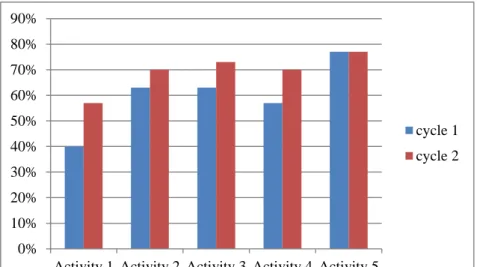
Figure 12. Figure of Learning Activity in Cycle I and Cycle II ... 70
xix
APPENDICES I
1. Syllabus ... 78
2. Lesson Plan ... 86
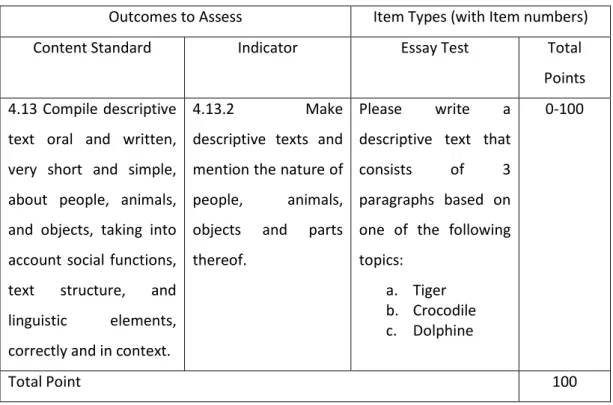
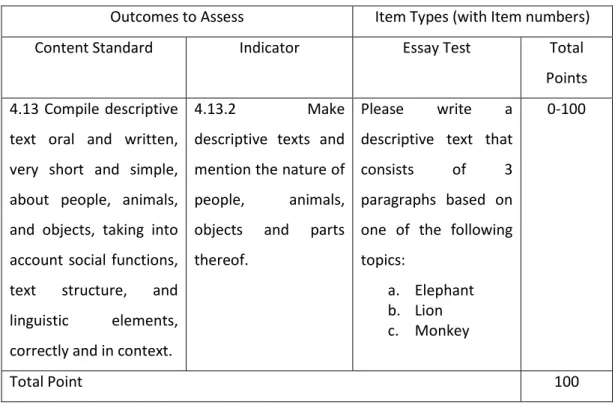
3. Instrument Blueprint Of Writing ... 108
4. Table of Test Specification Pre-Test ... 109
5. Table of Test Specification Post-Test I ... 110
6. Table of Test Specification Post-Test II... 111
7. Field Notes ... 112
8. Documentation Sheet ... 113
9. Observation Sheet of The Writer Cycle I ... 114
10. Observation Sheet of The Writer Cycle II ... 115
11. Observation Sheet of Students’ Cycle I ... 116
12. Observation Sheet of Students’ Cycle II ... 118
13. The Students’ Score of Pre-Test ... 120
14. The Students’ Score of Post-Test I ... 124
15. The Students’ Score of Test II ... 128
16. Documentation ... 132
17. List of Attendees 1 ... 134
18. List of Attendees 2 ... 136
19. List of Attendees 3 ... 138
20. List of Attendees 4 ... 140
21. List of Attendees 5 ... 142
APPENDICES II 1. Surat Izin Survey ... 144
2. Surat Balasan Survey ... 145
3. Sk Bimbingan Skripsi ... 146
4. Surat Tugas ... 147
5. Surat Izin Research ... 148
6. Surat Balasan Research ... 149
xx
9. Kartu Konsultasi Bimbingan Skripsi ... 152
xxi
A. Background of the Study
English is an international language used in communication at an international level. English mastery is very beneficial for everyone who will compete in various aspects which include of aspects of education, economics, socio-culture, politics and security. English in Indonesia is a foreign language that has not been obtained since the birth. Therefore, English instruction has an important role that can be performed in both formal and informal institutions.
In addition, teaching English is a meaningful effort used not only to transfer knowledge of English but also to familiarize language learners to use English in their daily live. Teaching English includes a variety of language skill which include of listening, speaking, reading and writing.As one of the English skill, writing is an activity to create a note or information on a media by using characters.
Moreover, writing is an activity of expressing ideas, thoughts, experiences and knowledge in the form of notes using scripts, symbols that are made systematically so that they can be easily understood by others.
Writing is one of the complex activities including integrated movement of fingers, hands, arms and eyes. Writing is an activity in the form of pouring ideas with complex ability through productive active activities in the form of letters and numbers symbolically so that they can be understood by others.
Moreover, writing is an activity that has many benefits. For this reason, it is necessary to develop writing and practice abilitycontinuously.
Writing expands and increases vocabulary growth, improves writing fluency and composing sentences. Writing activities enhance the ability to organize. Prospective researchers develop a personal writing style and get used to looking for organizing in accordance with his own ideas.
The ability to write is influenced by various aspects that can be categorized in aspects of linguistics and non-linguistic aspects. Linguistic aspects that contribute significantly to the progress of one's writing abilitythat include of English vocabulary mastery, English grammar mastery, mechanical writing and punctuation. The ability to write is also influenced by non-linguistic aspects that include of the use of teaching media for the application of writing teaching strategies, environmental support and psychological factors.
However, writing is not an easy matter to be mastered. There are many problems got by the students in the writing process caused by the limitations of the linguistic and non-linguistic aspects possessed by students. Problems that exist in writing due to low linguistic ability include low vocabulary pronunciation, limitations in mastery of English grammar, inability to apply mechanical writing and punctuation, inability to detect writing context. The limitations of the English vocabulary will limit the author to effectively express the contents of the message using the right word choices.
Moreover, the low mastery of English vocabulary will make it difficult for the author to express the contents of the message appropriately by using the right language construction. Insufficiency in the concept of punctuation and writing mechanics will adversely affect the low quality of writing. The inability of the author to understand the context of the writing will result in the author being wrong in expressing the contents of the message in writing correctly.
Furthermore, the problems in writing are also caused by the low non-linguistic aspects that support the researcher. Problems caused by low linguistic aspects are caused, among other things, by the limited teaching media in effective writing, inaccurate teaching strategies applied, low environmental support and low psychological factors.
In line with the writing problems above, the researchers also found writing problems experienced by seventh grade students. Writing problems are obtained from the results of the presurvey conducted by researchers on the 16th of April 2019 at the seventh grade students of Junior High School PGRI 01 Bandar Surabaya.
The writing results of the seventh grade students of Junior High School PGRI 01 Bandar Surabaya are illustrated based on the minimum completeness criteria of seventh grade students, namely 65. The results of these categories are presented in the following diagram.
Adapted from data pre-survey writing ability at Junior High School PGRI 01 Bandar Surabaya
Figure 1
Data Pre-Survey Writing Ability at Junior High School PGRI 01 Bandar Surabaya
Based on the results of the pre-survey above, it can be seen that the number of students whose writing grade is able to achieve the Minimum Mastery Criteria (MMC) is less than the number of students whose writing score is not able to achieve MMC. That is because the number of students who are able to achieve MMC is 4 students (13%); meanwhile, the number of students who are unable to achieve MMC is 26 students (87%).
Therefore, it is concluded that students of the seventh grade at Junior High PGRI 01 Bandar Surabaya have unsatisfactory or low writing ability.
Based on the results of the pre-survey, the problems of the seventh grade students of Junior High PGRI 01 Bandar Surabaya in writing English were due to the low vocabulary they had. In addition, the seventh graders of Junior High School PGRI 01 Bandar Surabaya also has limitations in mastering English grammar. They also have difficulty
13%
87%
The Categorization of Students Writing Ability Junior High School PGRI 01 Bandar Surabaya
developing ideas from a topic into a coherent and cohesive text. The students of the seventh grade of Junior High SchoolPGRI 01 Bandar Surabaya have low motivation in writing an English text.
In line with writing problems of students of the seventh grade at Junior High School PGRI 01 Bandar Surabaya, there is a need for an effort to increase students' writing abilitys. One effort to improve students' writing ability through the application of appropriate teaching strategy. Six Thinking Hats is one of the appropriate teaching strategies used to improve writing abilitys. Six Thinking Hats strategy is an important strategy for a leader, usually used to look at decision choices from various important perspectives. This will encourage someone to move out of the habit of thinking style and help him to get a more comprehensive view of a situation. This technique is very powerful in helping the decision making process that comes from several important points of view.
Six Thinking Hats is a strategy that is easily understood and used in learning to increase writing abilitys. Six Thinking Hats strategy has tremendous benefits in the process of teaching writing. Six thinking hats can create the same conditions of thought, so that the same language of thought is created, optimizes the work of the brain and focuses on writing.
Produce better thinking in writing. Optimizing brain function to think by using a hat path to compose words in a writing. Encourage people to think in parallel.
Based on the illustration above, the researcher will attempt to improve the writing abilityof seventh grade students at Junior High School
PGRI 01 Bandar Surabaya. Increasing students' writing abilitywill be carried out by researchers with the application of the SixThinking Hats strategy through a classroom action research. In this case, the researcher formulated a research proposal titled: "INCREASING THE STUDENTS’
WRITING ABILITY BY USING SIX THINKING HATS STRATEGY AT JUNIOR HIGH SCHOOL PGRI 01 BANDAR SURABAYA”
B. Problem Identification
Based on the results of the pre survey conducted at Junior High SchoolPGRI 01 Bandar Surabaya, the researcher had identified several research problems, as follows:
1. Students have difficulty in developing ideas in the process of writing.
2. Students have limitation in mastering English vocabulary.
3. Students have low writing motivation.
4. Students have limitation in mastering English grammar.
5. Students have insufficient writing ability.
C. Problem Limitation
Based on several problems that have been identified, the researcher limits the problem by focusing on the research problem of number 5 that is the students’ insufficiency in writing ability.
D. Problem Formulation
Based on the limitation of the problem, the researcherhad formulated the research problems as follows: "Does the application of Six Thinking Hats Strategy improve the writing ability of the students’ of Junior High SchoolPGRI 01 Bandar Surabaya?"
E. Objective and Benefits the Study 1. Objective of the Study
The purpose of this study is to find out whether the application of Six Thinking Strategy improve the writing ability of the students at Junior High SchoolPGRI 01 Bandar Surabaya.
2. Benefits of the Study a. For the Student
This research is expected that students can improve their writing abilitythrough this strategy. From this study students can write easily and have no difficulty in making an essay. Through the use of six thinking hats Strategy students will be actively involved in the writing process because this strategy has steps that will motivate students in the process of writing a text.
b. For the Teacher
This research is expected that teachers can teach writing abilityeasily. By using the six thinking hats strategy the teacher can teach well without any more difficulties.
c. For the Next Researcher
This research is expected to be one of the references for future researchers who will seek to improve writing through the application of the Six Thinking Hats Strategy.From this research, the next researcher gets a detailed description of Six Thinking Hats Strategy both in terms of theory and practice.
F. Prior Research
This research will be conducted by considering several previous studies related to the use of the Six Thinking Hats strategy in teaching writing.
The first prior research was conducted by Dhanapal and Ling.1 The teaching strategy used in the first prior reasearch is six thinking hats strategy. The research method used in the first prior research is qualitative to understand the reasons and levels of application in the English class.
Samples from the first prior research are analysis of data from teacher and student survey questionnaires. Results from the first prior research prove that increasing the effectiveness of thinking independently in all classes.
This research and the first prior research have similarities and differences. The similaritiesbetween the first prior research and this research lies in the teaching strategy. This research and the first prior research apply the teaching strategy of six thinking hats. Whereas the difference between this research and the first prior research lies in the differences in the study sample and the research method. Samples examined from the first prior research are teachers and students while the sample of this study is seventh grade students of Junior High SchoolPGRI 01 Bandar Surabaya. The method of this research is classroom acton reasearch while the first prior method of research is qualitative research methods.
1 Dhanapal, S., & Ling, K. T. (2014). Six Thinking Hats: A Study to Understand the Reasons and Extent of their Application in the English Language Classroom. Journal of English Language and Literature , 82-87.
The second prior research was conducted by Dhanapal and Ling.2 The teaching strategy used in the second prior reasearch is six thinking hats strategy. The research method used in the second prior research is a mixture of quantitative and qualitative research. The results of the second prior research prove that Six Thinking Hats Strategy can improve learning by developing critical thinking abilitys.
This research and the second prior research have similarities and differences. The similarities between the second prior research and this study lies in the teaching strategy. This research and the second prior research applied the teaching strategies of Six Thinking Hats. While the difference between this research and the second prior research lies in the differences in language abilityand research methods. The language abilitystudied in the second prior research are thinking ability while in this study are writing abilitys. The method of this research is classroom acton reasearch while the second prior method of research research method mixes between quantitative and qualitative.
The third prior research was conducted by Hani, et all.3 The language abilitystudied in the third prior research are speaking abilitys.
Whereas the teaching strategy used in the third prior reasearch is six thinking hats strategy. The research method used in the third prior research is experimental research. Samples from the third prior research include 48
2 Dhanapal, S., & Ling, K. T. (2013). A Study to How Six Thinking Hats Enhance the Learning of Environmental Studies. IOSR Journal of Research & Method in Education (IOSR-JRME) , 20-29.
3 Hani, U., Petrus, I., & Sitinjak, M. D. (2017). The Effect of Six Thinking Hats and Critical Thinking on Speaking Achievement. Advances in Social Science, Education and Humanities Research (ASSEHR) , 85-88.
students who are evenly divided into experimental groups and control groups. The results of the third prior research prove that Six Thinking Hats Strategy can improve students' speaking ability in the experimental group rather than the control group that does not use the Six Thinking Hats Strategy.
This research and the third prior research have similarities and differences. The similarities between the third prior research and this study lies in the teaching strategy. This research and the third prior research applied the teaching strategies of Six Thinking Hats. While the difference between this research and the third prior research lies in differences in language abilitys, research samples and research methods. The language abilitystudied from the third prior research are speaking abilitywhile the language abilityused in this study are writing abilitys. The samples examined from the third prior research included 48 students who were divided into experimental and control groups while the sample of this study was seventh grade at Junior High SchoolPGRI 01 Bandar Surabaya.
The method of this research is classroom acton reasearch while the third prior method of research is experimental research methods.
The fourth prior research was conducted by Kivunja.4 The abilityof the language studied in the fourth prior research are thinking abilitys.
While the teaching strategy used in the fourth prior reasearch is six thinking hats strategy.
4 Kivunja, C. (2015). Using De Bono's Six Thinking Hats Model to Teach Critical Thinking and Problem Solving AbilityEssential for Success in the 21st Century Economy. Creative Education , 380-391.
This research and the fourth prior research have similarities and differences. The similarities between the fourth prior research and this research are teaching strategies. This research and the fourth prior research applied the teaching strategy of Six Thinking Hats. While the difference between this research and the fourth prior research lies in differences in language abilitys. The language abilitystudied in the fourth prior research are thinking abilitywhile in this study examine writing abilitys.
The fifth prior research was conducted by Anggraini.5 The language abilitystudied in the fifth prior research are writing abilitys.
Whereas the teaching strategy used in the fifth prior reasearch is six thinking hats strategy. The research method used in the fifth prior research is experimental research. The fifth prior research sample is a class X student consisting of X8 as an experimental class and class X9 as a control class. The results of the fifth prior research prove that Six Thinking Hats Strategy can improve students' writing abilitywith an average value in the experimental class 75.64 while the control class that does not use Six Thinking Hats Strategy the average value is 71.03 which means the hypothesis of research is acceptable.
This research and the fifth prior research have similarities and differences. The similarities between the fifth prior research and this research lies in language ability and teaching strategies. This research and the fifth prior research examined writing ability and applied the teaching strategies of Six Thinking Hats. While the difference between this research
5 Anggraini, S. (t.thn.). The Effect Of Using Six Thinking Hats Strategy Toward Students’ Writing Achievement. 1-8.
and the fifth prior research lies in the differences in the sample research and research methods. The sample examined from the fifth prior research was the tenth grade students of Padang 7 High School while the sample of this study was the seventh grade students of Junior High SchoolPGRI 01 Bandar Surabaya. The method of this research is classroom acton reasearch while the fifth prior method of research is experimental research methods.
Based on all the contents of prior research, it is known that Six Thinking Hats strategy is a very effective teaching strategy to improve students' writing abilitywith all their advantages and disadvantages.
Therefore, researchers in this case will conduct classroom action research by considering several previous studies with the aim of improving the writing ability of seventh grade students of Junior High SchoolPGRI 01 Bandar Surabaya.
CHAPTER II
THEORITICAL REVIEW
A. Concept of Writing Ability 1. Nature of Writing
In learning English there are four abilitythat must be mastered by students, namely listening, speaking, reading and writing. All abilityare very important for learning English directly. In this study the researcher focuses on writing ability because in reality teaching students have difficulty in writing English abilitys.
According to Cornbleet and Carter, writing is always around us even every day, even though we don't read it we always see written texts ranging from shopping lists to academic essays.6 In addition, Brown defined that writing is the exclusive domain ability of experts and scholars in educational institutions.7
Besides that, according to Kane,writing is a rational and valuable activity. In addition, writing requires practice of mind and mastery of techniques that anyone can learn.8Meanwhile, Weir said that writing is a social cultural act whose thoughts are not limited by individual researchers.9Moreover,Hayland said that writing is a way of sharing personal meaning emphasizing personal power to build understanding
6 Cornbleet, Sandra, dan Ronald Carter. The Language of Speech and Writing.
London and New York: Routledge, 2001, 5.
7 Brown, H. Douglas. Language Assessment Principles and Clasroom Practices.
New York: Longman University Press, 2007, 218.
8 Kane, Thomas S. The Oxford Essential Guide to Writing. New York: Oxford University Press, 1988, 5.
9 Weir, Cyril J. Language Testing and Validation . New York: Palgrave Macmillan, 2005, 108.
of a topic.10Besides that, according to Harmer said that Writing is one of the four English language abilitythat are part of the English learning syllabus. Therefore, it can be used for various purposes where mastery of writing effectively can be seen as the main goal for students.11
2. Writing Process
There are several processes for writing well. For this section, according to Harmer defines the writing process as follows:12
a. Planning
The author will plan what they will write. Before writing they try to determine what will be written on a writing. They plan however the author has thought about what is needed before writing it on a piece of paper. When planning a researcher must think of three main problems. First, it must consider the purpose of writing because it affects one, among others, not only the type of text produced, but also the language used, and the information chosen for inclusion. Second, researcher do not only think about the results they write, not only affect the form of writing, but also the choice of language whether formal or informal. Third, the researcher must consider the structure of the content of a work, how to properly order facts, ideas, or arguments that will be included in the writing.
10 Hyland, Ken. Second Language Writing. USA: Cambridge University Press, 2003, 9.
11 Harmer, Jeremy. How to teach Writing. New York: Logman University Press, 2004, 31.
12 Ibid. 4.
b. Drafting
Drafting is a design strategy for compiling and developing continuous writing procedures to conclude that information found during planning can be a part of what success or not.
c. Editing (reflecting and revising)
After the researchers write the draft, they then read what they had written to see where it worked and where it didn't. Reflections and revisions are often assisted by readers or editors who comment and make suggestions. The reaction of other readers to the paper will help the author make the right revisions.
d. Final version
After the researchers has edited their draft, made the changes they deem necessary, they produced their final version. This may look very different from the original plan and the first concept, because the changes have changed in the editing process. But the author is now ready to send written text to the intended audience.
Planning Drafting Editing Final Version Based on the diagram above, it is known that there are four writing processes, namely planning, drafting, editing, and the last final version or final draft.
3. Characteristic of Good Writing
There are three good characteristic of writing according to Boardman, namely:13
13 Natanael Saragih, et all. The Effectiveness of Using Recount Text to Improve Writing Ability. IOSR Journal Of Humanities And Social Science (IOSR-JHSS).
(www.iosrjournals). Volume: 19, February 2014, 57.
a. Coherence
Coherence means staying united, coherence is basically a matter of having the right part of writing with a clear process.
Paragraphs have coherence when supporting sentences are ordered according to principles. The sentences are arranged so that readers can understand ideas easily. The principles for ordering depend on the type of paragraph written.
b. Cohesion
Cohesion is another characteristic of a good paragraph. When a paragraph has cohesion, all supporting sentences are connected to each other in support of the topic sentence.
c. Unity
The last characteristic of a well written paragraph is unity. All supporting sentences must be relate to the topic sentence.
Writing paragraphs has several characteristics, namely coherence, cohesion and unity. The paragraph can be said to be good when all three characteristics are found in a paragraph.
4. Types of Writing
There are several types of writing. For this section, according to Kane defines the type of writing as follows:14
a. Exsposition
The exposition is written with the aim of explaining a topic of discussion through short and concise paragraphs. So if someone
14 Kane, Thomas S. The Oxford Essential Guide to Writing. New York: Oxford University Press, 1988, 7.
reads the paragraph, then he will get some information related to the topic itself. Then this text is known to also have sentences that are inviting or attracting attention from the reader. In other words, a reader is able to be interested in following or doing something that is explained through the text.
b. Description
Description is about sensory experience. How things look, sound, feels. Mostly about visual experiences, but descriptions also relate to other types of perceptions. The description also describes a certain object. What is explained in a description text can be people, places, events, atmosphere, events or other things.
c. Narration
Narrative is a form of paragraph development in an essay or paper in which describes a series of events in a sequence from time to time, starting from the beginning, middle, to the end
d. Persuasive
Persuasion means inviting, persuading, or telling.
persuasion text is a text that aims to invite, tell, or persuade the reader to do something in accordance with what was conveyed by the author.
e. Argumentation
Argumentative is a paragraph that contains an explanation based on evidence, reason and an example of real events that are
intended to influence the reader so that they are sure of the problem.
Writing has several types for writing paragraphs, namely exposition, description, narration, persuasion, and argumentation.
Each has different characteristics, functions and components. In this research focus on writing description text.
5. Assessment of Writing
There are several categories on assessment writing, namely content, organization, vocabulary, language use and mechanics.
Table 1.
Rubic Score
Categorization Score Level Criteria
Content 30-27 Excellent to very good
Knowledgeable- substantive-etc.
26-22 Good to
average
Some knowledge of subject-etc.
21-17 Fair to poor Limited knowledge of subject- little subtance- etc.
16-13 Very poor Does not show
knowledge of subject- non substantive-etc.
Organization 20-18 Excellent to very good
Fluent expression- ideas clearly stated- etc.
17-14 Good to
average
Somewhat choppy- loosely organized but main ideas stand out- etc.
13-10 Fair to poor Non fluent- ideas
confused or
disconnected- etc.
9-7 Very poor Does not communicate- no organization- etc.
Vocabulary 20-18 Excellent to very good
Sophisticated range- effective word/idiom choice and usage-etc.
17-14 Good to
average
Adequate range-
occasional errors of word/idiom form, choce,
usage, but meaning not obscured.
13-10 Fair to poor Limited range- frequent errors of word/idiom form, choice, usage-etc.
9-7 Very poor Essentially translation- little knowledge of English vocabulary.
Language use 25-22 Excellent to very good
Effective complex constructions- etc.
21-19 Good to
average
Effective but simple constructions-etc.
17-11 Fair to poor Major problems in simple/complex
constructions- etc.
10-5 Very poor Virtually no mastery of sentence construction rules-etc.
Mechanics 5 Excellent to
very good
Demonstrates mastery of conventions-etc.
4 Good to
average
Occasional errors of spelling, punctuation-etc.
3 Fair to poor Frequent errors of spelling punctuation, hatsitalization-etc.
2 Very poor No mastery of
conventions- dominated by errors of spelling, punctuation,
hatsitalization, paragraphing-etc.
Adapted from J.B Heaton in Writing English Language15
Based on the table above, each category has a different maximum score. That is content 30 score, organization 20 score, vocabulary 20 score, language use 25 score, and mechanics 5 score. Therefore, the highest grade is 100.
15 Heaton, J. B. Writing English Language Test. London and New York:
Longman Group UK Limited, 1988, 146.
Table 2.
The Criteria Students’ Writing Grade
No Criteria Grade
1. Excellent 86-100
2. Good 68-85
3. Fair 47-67
4. Very Poor >46
Adapted from J.B Heaton in Writing English Language B. Concept of Six Thinking Hats Strategy
1. Definition of Six Thinking Hats Strategy
In the teaching and learning process writing in English will be easier when using strategies. Six Thinking Hats strategy is suitable for teachers to use in the learning process in writing in the English class.
Below are some insights about six thinking hats strategies.
Six thinking hats is used to describe a group discussion tool and individual thinking. Six thinking hats can help students organize their discussion on systematic topics. Each hat has a different color representing a different way of thinking. Six thinking hats can be used in the educational environment to have good effects and to form effective discussions, this strategy can be used in another way, namely modeling effective writing strategies.16
The six thinking hats strategy has been used by many organizations to develop creative thinking.17One of de Bono's most famous strategies
16 Redfern, Andrew. The Essential Guide to Classroom Practice. London and New York: Routledge, 2015, 178.
17 Matthwes, Ruth, dan Jo Lally. The Thinking Teacher's Toolkit. New York:
continuum, 2010, 118.
is the six thinking hats. That means there are six different roles or ways of defining a hat with a different color.18
Based on the above understanding, the researcher concludes that six hat thinking is a strategy used to develop creative thinking. These six hats have six different colors. Each color represents a different way of thinking. The color of the hat is white hat, yellow hat, black hat, red hat, green hat, and blue hat. This strategy can be used to help students in learning English. More precisely, in writing abilitystudents can more easily improve their writing abilityby using a six-hat thinking strategy.
2. Benefit of Six Thinking Hats Strategy
Six thinkingats strategy has several benefits including the following. According to Matthews and Lally, the benefits of Six Thinking Strategy are as follows.19
1) Six thinking hats strategy is used to develop creative thinking.
2) In the strategy of six thinking, the solutions produced by brainstorming must be considered together.
3) Six thinking hats strategy involves thinking abilityand is useful in courses of thinking and reasoning abilitys.
Whereas according to Redfern the benefits of six thinking hats strategy are as follows.20
18 Starko, Alane Jordan. Creativity in the Classroom. London: Lawrence Erlbaum Associates Publishers, 2005. P 214
19 Ibid. 119.
20 Redfern, Andrew. The Essential Guide to Classroom Practice. London and New York: Routledge, 2015, 178.
1) Six thinking hats can help students organize their discussion on a topic in a systematic way. Each hat has a different hat that is applied to different situations, such as discussing problems, generating new ideas and solutions.
2) Six thinking hats can be used in an educational environment and have a good effect on developing effective discussions.
3) Six thinking hats can be used by modeling effective writing methods.
3. Implementation of Six Thinking Hats Strategy in Teaching Writing
According to Redfern, the application of the six thinking hats strategy to writing learning in the English class is as follows.21
1) Before starting the activity, students must have an appreciation of each hat and the type of thinking related to each colour.
2) Before starting an extended piece of writing, the teacher gets the students to arrange the Thinking Hats into a writing frame. Each hat can represent a different paragraph and can be used multiple times. A set of Thinking Hat cards could be used to good effect.
3) The teacher gets students to think about the purpose of their answer and plan the relevant components in a sensible order.
4) The students discuss the structure of an answer and represent it by using the Six Thinking Hats to model good practice.
Based on the explanation above it can be concluded that the implementation of Six Thinking Hats strategy as follows:
21Ibid., 178-179.
1) Students with their pair record their definition about topic and teacher construct a class statement regarding the topic based on their response.
2) Teacher distributes graphic organizer for the six thinking hats strategy and explain each of six area of hats that should be answered.
3) Teacher lead discussion on students’ thinking process.
4) Students make draft based on discussion.
5) Students change their draft and then revise it.
6) Students make their draft into the text.
Here is the example of writing ideas in the form of Six Thinking Hats Strategy
white hat
red hat
yellow hat
black hat
green hat
blue hat
Source: Adapted from Andrew Redfern in The Essential Guide to Classroom Practice
C. Action Hypothesis
Action hypothesis of this research is as follows:
“Six thinking hats strategy can increase writing ability among the seventh graders at Junior High SchoolPGRI 01 Bandar Surabaya.”
CHAPTER III
RESEARCH METHODOLOGY
A. The Variable and Operational Definition of Variable 1. Variables of Research
This research consists of two variables; they are independent and dependent variables. The independent variable in this research is six thinking hats strategy that will be implemented to increase the students’ writing ability in easy way. This strategy is useful to make their writing is excellent in paragraphs of sentences.
The dependent variable of this research is writing as one of the four of language skills that has to be mastered by the students in order to be able to write their ideas effectively.
2. Operational Definition of Variable
Operational definition is the definition that based on characteristic of the things that will be defined, and it can be observed or measured.
Meanwhile, variable can be defined as an attribute of a person or a subject which varies from object to object.22 According to Raymond mark the definition an operational tells us what activities or operation we need to perform to measure a concept or variable.23
Based on the statement, the definition operational of the variable in this research are:
a. Dependent Variable
22 John creswell, Research Design Qualitative, Quantitative, and Mixed Method Approaches, (Lincoln: SAGE Publications,2002), 24.
23 Raymond,Esential research Method for Social Work, ( Engaged Learning:
United State of America,2010), 70.
According to Hatch, Dependent Variable is the major variable that will be measure in the research. Dependent variable is a variable that can improve by an independent variable.24The dependent variable of this research is students’ writing ability that focuses on the students’ ability.
To measure writing ability of students, the researcher will take in writing test by asking the students to compose a short descriptive text. The students will compose the descriptive text in 25 minutes about animals. It is a simple test as a sample to know about the students’ writing ability. The indicators of a written test in this variable are:25
1) The students are good in content of writing. The content should be relevant to the topic.
2) The students are good in organization of writing. The students are able to compose descriptive text based on the appropriate generic structure of descriptive text.
3) The students are able to write descriptive text by using good mechanics writing.
4) The students are able to write vocabulary should be relevant to the topic.
5) The students are good in language use of writing. The language use should be relevant with the topic.
24 Ibid, .63
25 JB Heaton, Writing English Language Test (Longman Inc.: United States of America,1990), 146.
b. The independent Variable
According to Evelyn, Independent Variable is variable that the researcher suspects may relate to or improve the dependent variable.
In a sense, the dependent variable “depends” on the independent variable. 26
This variable was be measured by observation. To observe this variable the researcher was use observation sheet. The indicators of this variable are:
1) The students are good respond to learn writing using six thinking hats strategy.
2) The students have more concentration to write the descriptive text in English.
3) Students are able to explore or compose descriptive text by using six thinking hats strategy.
B. Setting of the Research
The reseacher conducted Classroom action research at Junior High School PGRI 01 Bandar Surabaya. The setting of the research is Jl.
Pendidikan No. 2 Sidodadi, Kec. Bandar Surabaya, Kab. Central Lampung.
C. Subject of The Research
26 Evelyn Hatch and Anne Lazaraton, The Research Design and Statistics For Applied Statistic,( USA: Heinle Publisher, 1991), 64
The subject of this research is the seventh grader of Junior High School PGRI 01 Bandar Surabaya. The total of students are 30 students.
While, the object of this research is the students’ descriptive text writing ability at class VII Junior High School PGRI 01 Bandar Surabaya.
Table 3.
The Number of Students No
Grade Sex
Total
Male Female
1 VII 15 15 30
D. Action Plan
1. Classroom action research
The research uses the classroom action research. According to Car and Kemmis by Burns, action research is a self-reflective investigation carried out by students in social situations, teachers improve their own rationality and justice practices.27
In addition, Singh states that action research is a method for improving and modifying class work systems in schools.28 Besides that, according to McNiff and Whitehead, action research is investigating how to improve learning and take social action.29
From several theories and explanations above, it can be concluded that classroom action research is a dynamic process that has
27 Anne Burns, Collaborative Action Research for English Language Teacher, ( Cambridge; Cambridge University Press, 1999 ), 30.
28 Singh, Yogesh Kumar. Fundamental of Research Methodology and Statistics.
New Delhi: New Age International Publisher, 2006, 261.
29 McNiff, Jean, dan Jack Whitehead. Action Research. London: Sage Publications, 2006, 15.
several aspects, actions, observes, and reflects on each cycle, it is a class to improve the quality of learning practices.
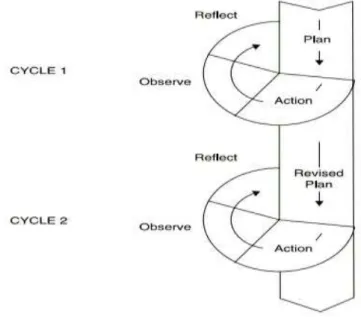
Classroom action research (CAR) has various models but in this research the researcher uses Kemmis and Taggart research design.
According to Kemmis and Taggart as cited by Burnsaction research is dynamic and complementary process which consists of four essential phases such as planning, action, observation, and reflection in spiral system.30 This phases can be seen by following figured:
Figure 2. Kemmis and Mc Taggart Model31
This figure describes the sequence of the research which is precede by planning, following by action, observation, and reflectionthat implement in each cycle in spiral system. The acumption is if the determine outcame in the first cycle cannot be achive or there
30 Anne Burns, Collaborative Action Research for English Language Teacher, ( Cambridge; Cambridge University Press, 1999 ), 32.
31 Anne Burns, Doing Action Research in English Language Teaching, (New York: Routledge, 2010), 9.
may be found new problem, so it will probably be continue and resive in the next cycle that have same phase on the first cycle.
In this case, the researcher will conduct classroom action research in class VII Junior High School PGRI 01 Bandar Surabaya.
The reason why researcher conducted classroom action research is because researcher wanted to improve the writing abilityof seventh grade students at Junior High School PGRI 01 Bandar Surabaya by using a six thinking hats strategy.
2. The steps in the research
There are four steps in cycle. There are planning, action, observation, and reflection, if the first has failed and the cycle must be review again in the second cycle and so on. That can be illustrate by like this procedures as follows:
a. Cycle 1 1) Planning
After analyzing the finding of the preliminary study such as identifying and diagnosing student’s problem in writing ability that occure in the classroom and concluding the finding in preliminary study. Then the researcher prepared some plans to conducted the classroom. They were the following:
a) The researcher prepared a lesson plan including learning procedures, media, and relevant material to be applied in the acting phase.
b) The researcher prepared learning resources for students.
The researcher determines the method to be applied in the active phase. In this case, the researcher used a six thinking hats strategy to improve writing abilitys.
c) The researcher prepared the observation format and also evaluates the format to evaluate student activities after the learning process.
d) Researcher design criteria for success.
2) Action
The researcher collaborated to implement the action that had been arranging in planning phase. This activities were implementing on the following steps:
a) Pre teaching avtivity
1) The researcher starts the lesson by greeting to the students.
2) The researcher and students pray together.
3) The researcher checks students’ attendance.
4) The researcher informs to the students about the competence, the indicator and the objectives that should be achieve.
b) While teaching activity
1) The researcher prepared students to start learning by using six thinking hats strategy.
2) The researcher explain each color of the hat to students about how to apply the meaning of each hat that is poured into a descriptive text.
3) Researcher provide material and facilities in the form of descriptive text topics and steps for writing descriptive text to students during discussions by applied the six thinking hats strategy.
4) The researcher confirms students' writing ability by examined their understand.
5) After students become more proficient in using this strategy, the researcher gradually shift responsibility to students to implement this strategy.
c) Post teaching activity
1) The researcher gave positive feedback to the students.
2) The researcher and the students concluded the learning topic that had been discussed.
3) The researcher greet the students in end of the meeting.
4) After gave treatment in cycle 1, the researcher gave the post-test. The instrument which was giving to the students had different type from the instrument which was giving in the pre-test.
3) Observation
Observation is the third step in classroom action research. The research conducted observation after planning and acting. The researcher act as follows:
1. The researcher observed the process of teaching and learning process in the class.
2. The researcher observed student’s activity in classroom.
3. The researcher observed situation in the classroom by using observation form.
4) Reflection
Reflection is the last step in classroom action research.
It conducted after planning, action, and observation. In reflection the researcher know the strengh and weakness from action that researcher had done. This step was be done teaching learning process. The researcher act as follow:
1. The researcher collected of data the result of observation form.
2. The researcher collected of data the result of the students’
test.
If the students writing ability was increase in the first cycle so the cycle is had been done. Futhermore, if the student’s writing ability was not increase, the cycle was be continuing to the second cycle.
b. Cycle 2
1) Re-Planning
When the researcher finds the problem in the first cycle, the researcher repaired the problem in the next cycle. It was explain as a follow :
a) The researcher analizes the reflection result to obtain the solving problem.
b) The researcher revisesd and prepared the lesson plan based on the problem appear in the previous cycle including learning procedure, media, and relevant material to be apply in acting phase.
c) The researcher rearranged observation format and also reform the evaluation format to improved the plan indicators that had not been achieved yet in the previous cycle.
2) Action
In the second phase of cycle two, the researcher applied the same steps in previous cycle, but the researcher applied the revise plan such as lesson plan, material, and instrument for evaluation. The activities they are :
a) Pre teaching activity
1) The researcher starts the lesson by greeting to the students.
2) The researcher and students prays together.
3) The researcher cheecks student’s attendance.
4) The researcher informs to the students about the competence, the indicators and objectives that was be achive.
b) While teaching activity
1) The researcher prepared students to begin learning.
2) The researcher remind how to applied each different hat color.
3) The researcher provided the material and facilitate students during learning by applied various color hats.
4) The researcher confirms students' writing ability by examined their understanding.
5) After students become more proficient in using this strategy, the researcher gradually transfers responsibility to students to implement this strategy.
6) Researcher provided evaluations to students.
c) Post teaching activity
1) The researcher gave positive feedback or reinforcement to the students.
2) The researcher and students concluded the learning topic that had been discuss.
3) The researcher greets the students in the end of the meeting.
3) Observation
Observation is the third step in classroom action research.
The researcher conducted observation after planning and acting. The researcher acts as follows:
1. The researcher observed the process of teaching and
learning process in the class.
2. The researcher observed student’s activity in classroom.
3. The researcher observed situation in the classroom by using observation form.
4) Reflection
Reflection is the last step in classroom action research.
It conducted after planning, action, and observation. In reflection the researcher was know the strengh and weakness from action that researcher had done. This step was done teaching learning process. The researcher acts as follow:
1. The researcher was collect of data the result of observation form.
2. The researcher was collect of data the result of the students’
test.
However, there was still many students who didn’t reach the standard score in cycle 1, the research was continue at the nex cycles. The researcher still applied clusturing strategy during the process of getting the data based on the reflection in cycles 1.
Then, if in cycle 2 all of students are successful. It is not continued to the next cycle.
E. Data Collecting Technique
There are two type of collecting data: qualitative data and quantitative data. The researcher uses observation dealing with the qualitative data. On the other side, the researcher uses the students’ final
result score of writing as a pre-test and post-test to obtain the quantitative data.
Some instruments are applied to obtain the data in this study. The completely explanation of those instruments as follow:
1. Test
The researcher uses test to get data result of the students’ writing ability. The result of this test is students’ writing score based on the media applied. The aim of this test is to measure the students’ writing ability. The tests consist of the some types, as follows:
a. Pre-test
The pre-test would be conducted before implementing six thinking hats strategyin preparations study. Pre-test of this research would be in the form of essay test that ask the students to write a composition of descriptive text in English.
b. Post-test
The post-test is implemented after using six thinking hats strategyin teaching writing ability. Post-test of this research would be in the form of essay test that ask the students to write a composition of descriptive text in English.
2. Observation
The aim of the observation is to explain the situation being investigate: activities, people, or individuals are involve in an activity and the relationship among them. Observations are systematically recorded rather than stored only in personal memory, and are carefully interpret and analysis, again employing systematic and plan
procedures.32 Itmeans that observation is a data collection strategy in which the activities of subjects are visually examine. In this research the researcher was observe the learning proccess of the seventh graders of Junior High School PGRI 01 Bandar Surabaya in their classroom.
During the learning procces, the researcher is going to observe the students’ activeness in learning to write the procedure text.
3. Documentation
Documentation is collection of various documents relevant to the research questions which can include students’ reading worksheet, student records and profile, course overviews, lesson plans, classroom materials.33 The researcher uses the documentation method to get some information about:
a. The history of Junior High School PGRI 01 Bandar Surabaya.
b. The condition teachers and officials employes in Junior High School PGRI 01 Bandar Surabaya.
c. The quantity of the students of Junior High School PGRI 01 Bandar Surabaya.
d. Organization structure of Junior High School PGRI 01 Bandar Surabaya.
e. Writing worksheet, course overviews and classroom materials of the students at Junior High School PGRI 01 Bandar Surabaya.
32 Roger Sapsford, Victor Jupp, Data Collection and Analysis Second Edition, (India at Gopsons Papers Ltd, Noida, 2006), 58.
33 Ibid, 117