A THESIS
Submitted to the faculty of Teacher Training and Education Makassar Muhammadiyah University in Partial Fulfillment of the Requirement for the
Degree of Sarjana Pendidikan
BY :
SRI REZKIAWATI UDIN 10535 4344 09
ENGLISH EDUCATION DEPARTMENT
FACULTY OF TEACHER TRAINING AND EDUCATION MAKASSAR MUHAMMADIYAH UNIVERSITY
2014
vi
SURAT PERJANJIAN Saya yang bertanda tangan di bawah ini:
Nama : SRI REZKIAWATI UDIN
Nim : 10535 4344 09
Jurusan : Pendidkan Bahasa Inggris
Judul Skripsi : Improving The Students’ Speaking Proficiency in Learning English Through Odd-One-Out Quiz Method at The Eleventh Grade Students of SMA PERGURUAN ISLAM MAKASSAR.
Dengan ini menyatakan perjanjian sebagai berikut :
1. mulai dari penyusunan proposal sampai dengan selesainya skripsi saya, saya akan menyusun sendiri skripsi saya, tidak dibuatkan oleh siapapun.
2. dalam menyusun skripsi, saya akan selalu melakukan konsultasi dengan pembimbing.
3. saya tidak akan melakukan penjiblakakn (plagiat) dalam menyusun skripsi ini.
4. apabila saya melanggar perjanjian saya seperti yang tertera pada butir 1,2 dan 3 maka saya bersedia menerima sanksi sesuai dengan aturan yang berlaku.
demikan perjanjian ini saya buat dengan penuh keasadaran.
Makassar, April 2014 Yang membuat perjanjian
(Sri Rezkiawati Udin) Diketahui Oleh
Ketua Jurusan
Erwin Akib, S.Pd., M.Pd.
viii
Grade Students of SMA Perguruan Islam Makassar),under the thesis of English Education Department the faculty of Teacher Training and Education, Makassar Muhammadiyah University. Guided by Hj. Andi Tenri Ampa and Amar Ma ruf.
This research was aimed to find out the improvement of the students speaking accuracy in terms of pronunciation and vocabulary by using Odd-One-Out Quiz at the eleventh grade students of SMA Perguruan Islam Makassar through a classroom action research.
The findings of this classroom action research deals with the answer of the problem statement which was aimed to improve the students speaking skill with cover accuracy.The finding consisted of the improvement of the students accuracy in speaking skill. And the students activeness in teaching and learning process. The findings of the research detected that the use of speaking accuracy by using Odd-One-Out method.
The result of the data analysis through the speaking test shows that the students speaking accuracy dealing with pronunciation and vocabulary improved significantly. It is indicated by the percentage the result of the students diagnostic test and percentage the result of the students speaking test in cycle I and cycle II.
Finally, the researcher concluded that, the improvement of the students speaking accuracy in terms of pronunciation and vocabulary using Odd-One-Out Quiz method at the eleventh grade students of SMA Perguruan Islam Makassar is significantly improved. It is proved by the data of students mean score in diagnostic test before applying those method was (3,5) categorized as poor score, but after applying those method in cycle I, the assessment of their speaking accuracy increased became (5.90) categorized as average score, the mean score of cycle II was (8.66) categorized as very good. The improve of the students speaking accuracy was D-test to cycle I was 2.40% and cycle I to cycle II was 2.76%, So, it can be concluded that the improvement of the students speaking accuracy dealing with pronunciation and vocabulary was significantly improved.
Know your self And after that be your self
Know your self
And after that you will know your God
Dedication:
No words that I can delegate my thanks,
So I deeply dedicate this thesis to my beloved parents, my big family, my friends and all english students.
Thanks for your prayers,
unfailing love, sacrifice, continual understanding, and your support.
Lv you all always.
In the name of Allah, Most Gracious, Most Merciful
Alhamdullilahi Robbil ‘Alamin, first of all I would like to express my deepest praise and
gratitude to Allah SWT who had given me His blessing and merciful to completed this thesis.
Shalawat and salam are addressed to the final chosen religious messenger, the Prophet Muhammad SAW.
I realized that many people had given their helps and useful suggestion for the finishing of this thesis. Without the assistance of them, this thesis would never have existed. Therefore, the writer would like to express her appreciation and sincere thanks to:
1. Dr. Irwan Akib, M.Pd., the rector of University of Muhammadiyah Makassar.
2. Dr. A. Syukri Syamsuri, M. Hum, the dean of teacher training and education faculty.
3. Erwin Akib, S.Pd, M.Pd, the head of English Education Department of FKIP UNISMUH Makassar.
4. My high appreciation and great thankful are due to my first consultant Dr.Hj. Andi Tenri Ampa,M.Hum and Amar Ma’ruf, S.Pd.,M.Hum as the second consultant who had given their
valuable time and guidance to finished this thesis.
5. My heartful thank to all lectures of the FKIP UNISMUH especially to the lectures of English Department for their guidance during my study.
6. Thanks to my family especially for my mama and papa who never stop pray for my success and my Aunt Huldiah Lahamid and Nasriati, my beloved brother and sister Muh.Masri Udin,
Astriah lestari, Nurdiah Madjid, Dewi Surapati, Asrul Menco Dg.Lala, Kasman, and all of my beloved family of IPASS And all of member or friends of EDSA Community especially for L Class 2009 who everytime always motivate and support me when I’mfacing a trouble during this thesis arrangement.
Finally, I dedicated this thesis for my beloved parents Udin and Nurhaeni Who always love, care, pray and support in my study, there is no appropriate symbol which suitable to state my thanks to them. And also for the person who I could not write on this paper anymore.
May almighty, Allah SWT bless us all now and forever, Amin.
Makassar, April 2014
The Researcher
TITLE ... i
APPROVAL SHEET... ii
CONSELING SHEET I... iii
CONSELING SHEET 2. ... iv
SURAT PERNYATAAN ... v
SURAT PERJANJIAN... vi
MOTTO... ... vii
ABSTRACT ... viii
ACKNOLEDGMEN ... ix
TABLE OF CONTENT... xi
LIST OF TABLE... xiii
LIST OF PICTURES... xiv
CHAPTER I INTRODUCTION……… 1
A. Back Ground ... 1
B. Problem Statement... 3
C. Objective of the Study ... 4
D. Significance of the Study... 4
E. Scope of the Research... 5
CHAPTER II REVIEW OF RELATED LITERATURE………..…. 6
A. The Concepts of Odd-One-Out Quiz... 6
1. What is of Odd-One-Out Quiz ... 6
2. The Adventages of Odd-One-Out Quiz... 8
3. Odd-One-Out Lesson... 9
4. Odd-One-Out Proccess ... 10
B. Concepts of Speaking ... 13
1. What is Speaking... 13
2. The Characteristics of Successful of Speaking ... 15
3. Some Strategies of Improving Speaking Ability... 15
4. Elements of Speaking ... 16
5. The Importance of Pronunciation in the Speaking Skill ... 19
CHAPTER III RESEARCH METHOD………... 28
A. Research Design ... 28
1. Planning ………. 28
2. Action ……… 29
3. Observation ……….... 29
4. Reflection ……….. 30
B. Research Variable and Indicators ... 30
C. Research Subject... 31
D. Research Instrument ... 31
E. The Procedure of Collecting Data ... 31
F. Data Analysis... 32
G. The Data Analysis Technique... 34
CHAPTER IV FINDINGS AND DISCUSSIONS……… 36
A. The Findings ... 36
B. Discussion... 45
CHAPTER V CONCLUTION AND SUGESSTION……….. 48
A. Conclusion ... 48
B. Suggestion ... 49
BIBLIOGRAPHY……… 50 APPENDICES
CURRICULUM VITAE
2.1 Table of Odd-One-Out Proccess ... 11
3.1 The Assessment of Pronunciation... 32
3.2 The Assessment of Vocabulary ... 33
4.1 The Table of The Students’Speaking Accuracy ... 37
4.2 The Classification of The Students’Score in Pronunciation ... 39
4.3 The Classification of The Students’Score in Vocabulary... 41
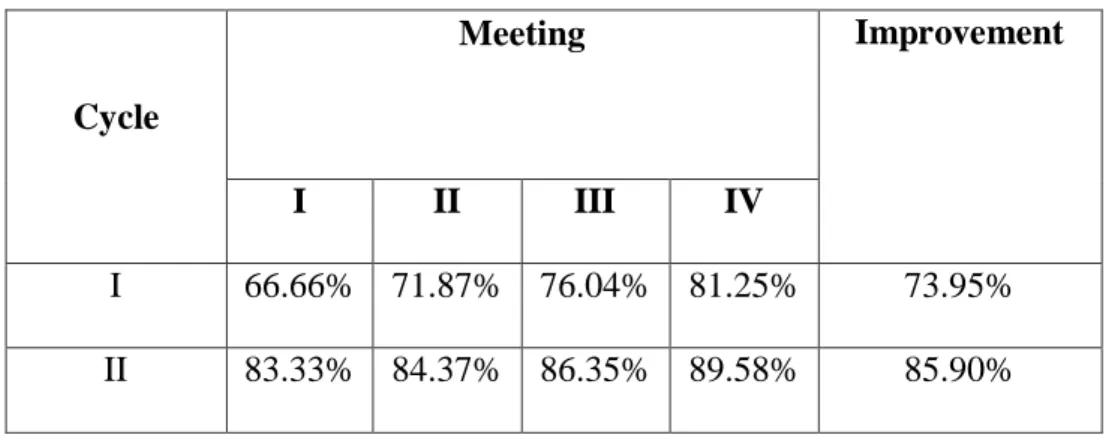
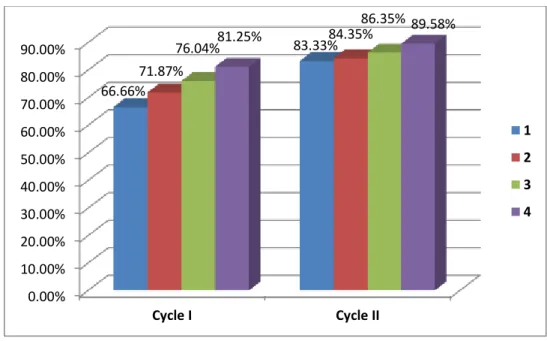
4.4 The Observation Result of The Students in Learning Speaking in Cycle I and Cycle II……… 43
2.1 Conceptual Framework ... 26
4.1 The Percentage of the Students’Score Improvement in Speaking Accuracy ... 38
4.2 The Percentage the Students’Pronunciation of Speaking Accuracy... 40
4.3 The Percentage the Students’Vocabulary of Speaking Accuracy... 42
4.4 The Improvement of the Students’Observation in Cycle I and Cycle II ……….. 43
2.1 Conceptual Framework ... 26
4.1 The Percentage of the Students’ Score Improvement in Speaking Accuracy... 38
4.2 The Percentagethe Students’ Pronunciation of Speaking Accuracy... 40
4.3 The Percentage the Students’ Vocabulary of Speaking Accuracy... 42
4.4 The Improvement of the Students’ Observation in Cycle I and Cycle II ……….. 43
1
CHAPTER I
INTRODUCTION
A.Background
Speaking or oral communication has a very important role in human’s life. By speaking people communicated one another. We express our ideas, opinion, and feeling and also shared our experiences through speaking. In other words, speaking exists in every aspect of human’s life. It is a kind of two-way process between speaker and listener and involves the productive skill of speaking and receptive skill of understanding (Harmer, 1991: 41,).But right now to mastered speaking skill is one of the difficulties in learning English.There many in realities indicated that the students sometimes have many problems in speaking,for instance they were shy to speak, lessmotivation,self-confidence,afraid to making mistakes and so on.
Without knowing how to speak, the students cannot do nothing and they were become passive students in the classroom. In learning speaking, teacher was need to motivated the students to improve their ability in speaking, so that they could be active in speaking class. Speaking, in the class activity can gave someone a high degree of self satisfaction.
In indonesia speaking was a problem for most of the students. As the fact the researcher were observe that students’ achievement in speaking of SMA Perguruan Islam Makassar at the classroom the students’ was score 4.
This score is a category poor, while the standard speaking in curriculum were
2
7. The students sometimes want to develop their ability, but they accounter some difficulties because they are many factors influencing them. Probably it caused by their lack of vocabulary and practice.
Other factors that influenced them are many English teachers still spend the majority of class time on reading and writing practice almost ignoring speaking and listening skill. Therefore, teacher should give students numerous speaking opportunities to develop their ability in speaking. In English teaching and learning process, speaking is one of the important aspects can influence the students who are lazy to speak and speaking class tends to be boring.
Owing to the difficulties of speaking, teacher should give more attention in teaching speaking to make students more familiar with speaking itself. One of the ways to increase the students’ attention in speaking is to provide good techniques which are interesting for them. By presenting the lesson in such ways, the students are expected to be more successful in learning English, especially in improving their oral skill. To enhance an interesting classroom, the teacher should not stop trying to discover techniques that are suitable to different learning tasks. In this occasion, the researcher will try to apply odd-one-out quiz in improving the students’ speaking proficiency. Using quiz is very important to improve the students speaking proficiency, besides it can make the students enjoy the teaching and learning process.
Nowadays, the development of science and technology along with social culture development, caused the teachers role become increasing. The duty and responsibility of the teacher more include the function of the teachers
3
as the designer of instruction, manager of instructor, to motivate the students in learning and as teacher. Teacher help every students and effectively using various study opportunity especially in learning speaking English and various sources and audiovisual to increase the students ability until they can learn affectively.
In the rules as a teacher, should always try to arise, keep, and increase the students’ ability in speaking in order that can speak actively, fluently, and clearly. A few researcher show that the motives of achievement have positive and significant correlation that high or low motive of achievement. In relation to the case above, the teachers have function as motivator in all learning activities.
So quiz in improving the students’ speaking proficiency is a power, capacity and help given to the students so that they can overcome the difficulties that are faced in learning speaking and finally the students can improve their ability in learning maximally.
Based on the explanation above, the researcher was interested in conducting a research under the title: Improving the Students’ Speaking Proficiency in Learning English through Odd-One-Out Quiz (At the second year of SMA Perguruan Islam Makassar).
A.Problem Statement
Based on the background, the researcher formulates the research questions as follows:
4
1. How is the improvement of the students’ speaking accuracy in terms of pronunciation by using Odd-One-Out Quiz at the eleventh grade students of SMA Perguruan Islam Makassar?.
2. How is the improvement of the students’ speaking accuracy in terms of vocabulary by using Odd-One-Out Quiz at the eleventh grade students of SMA Perguruan Islam Makassar?.
C.Objective of the Study
Related to the problem statements above, the researcher states the following objectives:
1. The improvement of the students’ speaking accuracy in terms of pronunciation by using Odd-One-Out Quiz at The Eleventh Grade Students of SMA Perguruan Islam Makassar.
2. The improvement of the students’ speaking accuracy in terms of vocabulary by using Odd-One-Out Quiz at The Eleventh Grade Students of SMA Perguruan Islam Makassar.
D.Significance of the Study
The result of the study is expected to be a very useful reference for:
1. Students: In order they can improve their ability in speaking English and easily to understanding of the subject, and also by using this method,the students enjoyable and it help given to the students so that they can overcome the difficulties that faced in learning speaking and finally the students can improve their ability in learning maximally.
5
2. Teacher: It is expected to be a very useful for English teacher in general in order they can improve knowledge and method in the teaching English, and also to overcome the weekness of students in speaking proficiency,to give imformation for all reader, to improve their communicative ability by using this method.
3. Others researcher: Hopefully the other researcher try to arise, keep, and increase the students’ ability in speaking in order that can speak actively, fluently, and clearly.The other researcher should be provide good techniques which are interesting for the students.And as a function of teacher as a designer, manager of instructor, to motivate the students in learning English and improve or to find out another method for applying in the classroom.
E.Scope of the Study
This research was limited to the odd-one-out quiz to improve the students’ speaking proficiency, It is focused on the students’ speaking accuracy that covers (pronunciation and vocabulary). The researcher was taken those items because it is very important to be indentify by the teacher to improve the role of guider in motivating and overcoming the students’ problems in learning English, especially in speaking.
6
CHAPTER II
REVIEW OF RELATED LITERATURE
A.The Concept of Odd-One-Out Quiz 1. What is Odd-One-Out Quiz?
According to Sarkis (2012:4) Odd-One-Out means that something or someone in a group that is different or exceptional, that does not fit. In other words, Odd-One-Out is a visual puzzle where the guesser has to choose which word/picture/symbol/etc does not fit with the others.
For example: gentle-genre-giant-gather. The word gather is the odd-one-out because it starts with a hard /g/ sound while the others start with a soft /g/
sound.
And also Junkin (1992:8) assumes that the object of Odd One Out is to guess which one of four items does not belong & why it doesn't belong. After the player has successfully identifyied the odd one out, he/she can either guess the explanation or challenge his/her opponents to guess.
Choosing the correct item is worth two points, and figuring out why it doesn't belong by guessing the common bond of the other three is worth three points more, for a total of five points. Six contestants appeared each week with 3 contestants playing in the first half and the other 3 playing in
7
the second half of the programme. The leader at the end of each game won a chance to play a bonus game for a nice prize.
The use of quiz can improve the students’ motivation in learning English. The quiz helps the students for the final exam. The ability to answer the questions and receive immediate feedback on in incorrect allows the students to learn from their mistakes as well as providing a useful gauge of the current knowledge level. Odd-One-Out is one of some quizzes that can be use in improving the students’ speaking proficiency in learning English.
And another opinions from the researchers concern with Odd One Out quiz to improve speaking ability are presented below:
Marry (2005) found that the enhancement of Odd One Out Quiz permit the students to eventually learn how to learn English well and better in speaking.
Martin (2006) found that Odd One Out Quiz used by the teacher resulted in increasing students’ speaking ability on the exam. In the study, the researcher found that method is effective in stimulating students speaking ability.
Handayani (2007) found that Odd One Out Quiz is effective to improve the students` speaking proficiency at SMA Negeri 3 Bulukumba. It was proved by the mean score of posttest of experimental group is greater
8
than control group.through Odd One Out Quiz, the students their great participation in speaking class.
Based on the findings above, it can be concluded that the students must be given something different in teaching English to help them developing their speaking ability. In this case, the teacher can provide interesting game for students and create a pleasant learning situation in the classroom.
2. The Advantages of Odd-One-Out
L.Atkins (2005:5), the „Odd One Out’ exercises further develop classification and thinking skills. „Odd One Out’ exercises get pupils thinking about similarities and differences which is important for establishing an understanding of concepts, whatever these concepts may be and in whatever curricular subject.
The exercise can be used at the beginning of a topic, as a starting point to see what pupils know, or at the end point to revise and assess. As a group or pair exercise, it is good fun and makes pupils think and work out strategies together. It also improves their talk facility, as they are working collaboratively with each other and learning about communication with each other. For bilingual pupils and new arrivals to school, this is a key learning strategy.
Pupils are encouraged to see the similarities and differences between key terms, rather than seeing them as a collection of disconnected
9
words. As a result they get a bigger picture of the topic and a greater understanding of concepts.
It is another strategy which helps to move pupils towards independent learning – if they master this exercise in geography they will be able to transfer their learned skills to other areas of the curriculum.
The exercise develops thinking skills in relation to a subject and helps pupils to understand that it is their relationship with a subject which develops – geography is not the end in itself, but a view of the world which is changing. Helping pupils to develop their own thinking skills will equip them to make sense of the subject and to understand the world around them.
3. Odd-One-Out Lesson
L.Atkins (2005:8) states that the resources needed in Odd-One-Out lesson are as follows:
Simple example of “odd one out” task.
General classification exercise (on school subjects)
List of relevant words/ phrases (on worksheet).
Worksheet to process the information
He also divides the class activities into two terms; Group and individually.
a. Group
In small groups (2 - 4), pupils are to:
Show understanding of the words /phrases in the list.
Decide which word is the “odd one out” - i.e. does not fit into the list. This involves working out what the other words/phrases have in
10
common, and then deciding which word does not fit in the group of words.
Some can be ambiguous; but the pupil can be told that as long as the selection of the “odd one out” can be justified, it is acceptable.
b. Individually
Pupils are then to write a note on each of the categories, ticking off each statement as it is used to ensure their report is accurate and detailed.
c. Differentiation
Number of words to study - the first tasks requires the pupils to choose the “oddone out” from a choice of 3 words/phrases. The less able could be given these only and a reduced list of words/phrases to choose from.
The more able should:
- Identify if there is more than 1 “odd one out” and also identify the different ways of grouping the words accordingly.
- Select more than 1 word/phrase to add to the group.
This can be recorded by awarding marks for each extra “odd one out” identified and each extra word added to the identified grouping of words.
4. Odd-One-Out Process
Koretsky (2007:28) in her book “The Mavericks Guide to Adult ADD” describes the simple activity practices vocabulary and to some
11
extent speaking. Make a list of four or five words, all but one of which has something in common. Ask the students to find the "odd-one-out"
then give a reason.
Do not be surprised if they come up with some surprising answers.
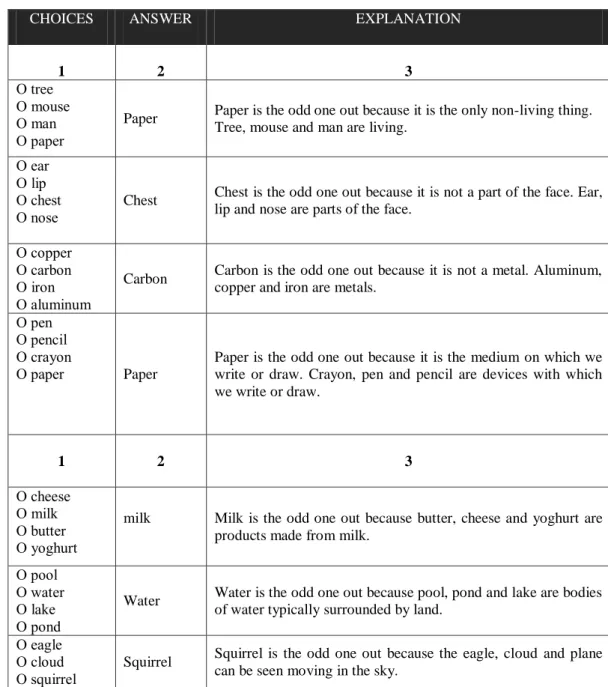
Just ask them to justify their choice. You may well find it logical. Take, for example:
Table 2.1 Table of Odd-Out-Proccess
CHOICES ANSWER EXPLANATION
1 2 3
Ο tree Ο mouse Ο man Ο paper
Paper Paper is the odd one out because it is the only non-living thing.
Tree, mouse and man are living.
Ο ear Ο lip Ο chest
Ο nose Chest Chest is the odd one out because it is not a part of the face. Ear, lip and nose are parts of the face.
Ο copper Ο carbon Ο iron Ο aluminum
Carbon Carbon is the odd one out because it is not a metal. Aluminum, copper and iron are metals.
Ο pen Ο pencil Ο crayon
Ο paper Paper
Paper is the odd one out because it is the medium on which we write or draw. Crayon, pen and pencil are devices with which we write or draw.
1 2 3
Ο cheese Ο milk Ο butter Ο yoghurt
milk Milk is the odd one out because butter, cheese and yoghurt are products made from milk.
Ο pool Ο water Ο lake Ο pond
Water Water is the odd one out because pool, pond and lake are bodies of water typically surrounded by land.
Ο eagle Ο cloud
Ο squirrel Squirrel Squirrel is the odd one out because the eagle, cloud and plane can be seen moving in the sky.
12 Ο plane
Ο now Ο cow Ο how Ο low
Low Low is the odd one out because it is pronounced differently from now, cow and how.
Ο November Ο August Ο December Ο January
November November is the odd one out because it has only 30 days. The months of August, December and January have 31 days each.
Ο 29th February 2000 Ο 29th April 1998
Ο 31st August 1997
Ο 31st June 1999
3 1st June 1999
31st June 1999 is the odd one out because such a date did not exist in the calendar. June has only 30 days.
Ο jacket Ο cloth Ο shirt Ο trousers
Cloth Cloth is the odd one out because shirt, trousers and jacket are garments made from cloth.
(L.Atkins: 2007:8)
13 B. The Concept of Speaking
1. What is Speaking
Speaking means oral activity that play essential role in human interaction and communication when people communicate their ideas, mind and feeling to others. To deal with concepts of oral, there are some definitions given by linguistic as in following.
Speaking is an interactive process of constructing meaning that involves producing and receiving and processing information (Brown, 1994;
Burns & Joyce, 1997). While speaking is also a two way process between the speaker and the listener, and involves the productive skill of speaking and receptive skill of listening which needs understanding. According to Byrne (1976: 8), it is important to understand that receptive does not imply passive both listening and reading, language user are actively involved in the process of interpreting and listener have a positive function to perform.
Donoghue (1971) described that speaking skills necessary for effective oral communication must be learn through developmental process. According to those statements, it can be inferred that speaking is to be able to use a language orally or say things that cannot go back and change.
Harmer (1991:5) states that speaking is two people engaged in talking each other we can be fairly sure that they in general way to suggest a speaker makes a definite a decision to address someone. Speaking also can practice the students to think about what they want to say. But in speaking sometimes the students do not have bravery to speaking because they are
14
less vocabulary, confidence, bad pronunciation and so on to out what there is in their think until most of the whishes from the students cannot be reach.
And finally the students sometimes less motivation more to speak the result of it.
Harmer in Isnani (2002) described that when two people engage in talking to each other, we can be fairly sure that they are doing so for reasons and probably they make the following generalization:
a. They want to speak; what is used here in general way to suggest that a speaker makes a define decision to address someone. Speaking maybe forced on them in some way but we can still say that they want or intend to speak, otherwise they would keep silent.
b. They have some communicative purposes; speakers say things because they want something to happen as a result of what they said.
c. They select from their language stores the speaker has an infinitive capacity to create new sentences if they are native speaker.
In relation to the statement above, speaking is way of conveying message from one person to others in order to make interaction one another. It is the most essential way in which the speaker can express themselves through language.
Widowson (1985: 57) states that speaking is a means of oral comunication that gives information involves two elements, namely the speaker who gives the messages and the listener who receives the messages. While Chasten (1967) pointed out that learning to speak is
15
obviously more difficult than learning to understand the spoken language.
However it can be achieved by doing many practices in real situation.
2. The Characteristics of Successful in Speaking
According to Hikma (1961:19) that there are four characteristic to successful in speaking namely:
a. Learner talks a lot
As much as possible the period allotted to the activity is in fact occupied by learner talk. This way seems obviously but often most time is taken up the teacher talk.
b. Participant is event
Classroom discussion is not dominated by minority if talkative participant, all get change to speak, and contribution are evenly distributed.
c. Motivation is high
Learner are to eager to speak, because they are interested to the topic and have something new to say about it, or because they want to contribute and to achieve talk objective.
d. Language is an acceptable
Learner express themselves in utterance that are relevant easily comprehensible to each, and of acceptable level of long accuracy.
3. Some Strategies of improving Speaking Ability
According to Maslow in (2003:3) there are four strategies to improve speaking ability are:
16 a. Recording yourself
Recording your speaking, either on your own, or with the other people.
Later you can review the recording, listen for problems such as saying turn “too” and research anything that you didn’t know how to say.
b. Conversation
It is strategy that can be done by the learners to develop their speaking ability to converse in a foreign is developing by frequent practice in that language.
c. Imagine
Imagine that you art in situation where you need to speak English. Try to what you would say. If you are not sure, you can research it in.
d. Making the meeting club
Form group of group of people to practice speaking English. You can join English the big mouth corner for speaking ability.
4. Elements of Speaking A. Accuracy
Marcel (1987:15) states that accuracy is a manner of people in using appropriate word and the pattern of sentences. In this case accuracy is devided into two elements. They are pronunciation, and vocabulary.
According to Harmer (1991 : 15), aspect of speaking can be devided as follows:
a. Pronunciation
Pronunciation is an act or result of production the sound of speech including articulation vowel formation, accent and inflection. Often
17
with reference to some standard of contents or accept proficiency. The concept of “pronunciation” may be said to include:
1) The sound of the language
One their own the sound of language may well meaningless.
If you said /t/ (the line show that this is phonetic script) a few times, e.g. to, it will not mean very much English. Neither will be sounds /k/, /a/, or /s/ but if we put all these are sound together a certain order we and up the word catch and does mean something.
2) Stress
Native speaker of language unconsciously about the stress and how it works, they know which syllables of words are stress and they know how to use stress, to change the meaning of phrase, sentences and question.
3) Intonation
Intonation is clearly important item and component user of language recognize what meaning it has and can change the meaning of word the through using it in different ways, when we thought English language, student’s need it use rhythms and stress correctly if they are to be understood.
b. Vocabulary
1).What is vocabulary?
According to Webster’s near world print dictionary (Webster:
1983: 2946), vocabularies are list of word etc as dictionary or glossary and all of words used a language or by a person group etc.
18
According to Longman dictionary of contemporary English (Longman 1995:240) vocabulary are all words someone knows, learner or user the words in particularly language a list of words with explanation of their meaning, in a book for learning foreign language.
2). Types of vocabulary
Harmer (1991:159) distinguishes two types of vocabulary namely active vocabulary and passive vocabulary. According to him active vocabulary is that students are learn and which they are expected to be able to use. On the other hand, passive vocabulary refers to words which the students will recognize when they met but will probably not be divided in to four kinds as follows:
a) Oral vocabulary consist of words actively used in speech. There are the words that come readily to one’s conversation. The more often a person utters words the more readily it will come to his tongue.
b) Writing vocabulary is the words that come readily to one’s finger vocabulary.
c) Listening vocabulary is the stock of words to which one responds with meaning and understood in speaking of other.
d) Reading vocabulary is the words that one response in writing of others.
19
5. The Importance of Pronunciation in the Speaking Skill
Good pronunciation is very important in speaking English. It is obvious that without knowing the pronunciation or without having pronunciation proficiency, one can not speak English well. The pronunciation also determines the meanings or ideas that are expressed.
And of course, bad pronunciation sometimes causes miscommunication. In this case speaking also plays the important role in studying English pronunciation; we can not speak it without listening to its words and its pronunciation. (Nawir, 1981: 10)
Pronunciation is the manner of which the English language is spoken. It refers to the person’s way of speaking English, and also refers to the way of which an English word is pronounced or uttered. For this, the following statements can be an emphasis: “Pronunciation is:
a. the way in which a language is spoken b. person’s way of speaking a language, and
c. the way in which a word is pronounced”. (Hornby, 1974:681)
It seems that the low ability of the students in speaking English is due to that fact that they do not have pronunciation proficiency sufficiently. Gaffer (1992:59) concludes that one of the causes of the students’ failure in speaking is that they have the lack of knowledge of pronunciation. This is true that the lack of pronunciation makes the students feel lazy to speak English, because they are ashamed to pronounce the words, or they are afraid of making mistakes in pronouncing the words.
20
One aspect that underlies the importance of pronunciation is that the language is vocal or sound. The vocal here reveals to the primary medium of language. Wardaugh (1972: 6) states that language is vocal.
The term “vocal” in the definition refers to the fact that the primary medium of language is sound, and it is sound for all languages, no matter how well developed are their writing systems. All the evidence we have, from the continued existence of preliterate societies, through the knowledge we have of language acquisition by children, to the existence of historical records, confirm that fact that writing is based on speaking.
Writing systems are attempts to capture sounds and meanings on paper.
The statements above mean that the language is composed of vocal or sounds; the sounds need to be uttered and pronounced. This is because we involve sounds very dominantly in speaking; and speaking is made up with sounds.
The fact shows in our everyday English speaking habit that most of the students or laymen can not speak English or feel lazy to speak English because they do not know how to pronounce the words properly.
Sometimes, the students wish to express their ideas in English; however they do not get to express them simultaneously because of the lack of pronunciation proficiency. Even if they have learned structures and vocabulary for many years, they can no speak English naturally if they do not have pronunciation ability sufficiently. (Wardaugh 1972: 6)
21
6. The Importance of Structure Knowledge to the Speaking Skill.
It can not be avoid that the structure of grammar mastery has valuable contributions to the speaking skill. The grammar refers to the study of the systems and patterns that are used in English language to express meanings in speech or speaking. The importance of grammar can be seen in the following statement:
Grammar is the study of those systems and patterns that operate in a language to give meaning to an utterance. (Encyclopedia Americana;
Vol. 13: 151)
The grammatical structure is crucial to the four language skills in English (listening, speaking, reading, and writing). The four skills above are difficultly acquired without having sufficient grammatical structure mastery. In this connection, let us think over the following quotation:
(Baharuddin, 1992: 17)
The grammatical structure is very important to the four language skills. Without knowing the grammatical structure, the main aspect of the English language can not be mastered, and of course, reading and writing can not be achieved well. (Baharuddin, 1992: 17)
In “Pacific College Dictionary”, the importance of grammar is explained. It is stated that grammar refers to the language study dealing with word forms (morphology); word order in sentence (syntax); and language sounds (phonology); the system of word forms and word orders of a given language at a given time. It is clear above that one of the
22
important factors of the grammar concerns with the sounds or the phonology. The phonology here entails the production of sounds.
In relation to this case, Gaffar (1992: 9) also stresses the importance of structure in speaking ability. He says that one of the in ability of the students in speaking English is the lack of structure mastery.
If the students do not master the grammar, they can not speak English grammatically. Samad (1989: 55) also emphasizes that one of the primary causes of the low achievements of the students in speaking English is that the low structure mastery, including the low mastery of the English tenses.
In addition, Rukmini (1982: 58) also points out that the students are expected to master good structure mastery (besides pronunciation and vocabulary) in order to increase their speaking skill. Thus, good structure mastery can increase the students’ speaking skill.
In relation to the importance of the structure mastery in increasing the speaking skill, the writer believes that there is no reason for neglecting the structure or grammar in learning English. Therefore, the grammar should be taught as well as possible in order to support the speaking skill.
Rukmini (1982: 58)
7. The Importance of Vocabulary Mastery in Speaking English
In addition to the pronunciation and structure, the vocabulary also has valuable contributions to the speaking skill. This is evident in our daily conversation in English that we cannot speak English like all languages, if we do not master the vocabulary. This is caused by the fact that in
23
speaking. Vocabulary is automatically used. It is impossible to speak English without involving words while the English language is made up with words, and of course the mastery of words are quietly demanded.
Sometimes the students complain in speaking English because they cannot speak it fluently as a result of the low mastery of vocabulary.
There are three aspects that must be mastered by the students in learning to speak English. They are: pronunciation, structure, and vocabulary. This is the same with Rukmini’s statement “there are aspects which students master in learning to speak. They are: pronunciation, structure, and vocabulary (1982; 15)
With reference to the quotation above, it is stated that one of the aspects that must be mastered well by the students in learning to speak English is vocabulary. Therefore, the students should learn vocabulary effectively in order to support their ability to speak English.
The importance of vocabulary is also stated by Syafei (1988: 1).
He stresses that to master the speaking skill; the teacher must train and equip the students with certain degree of lexis, including vocabulary and idiom, (in addition to pronunciation and grammar). The mastering of speaking skills, the competence in understanding, responding, and expressing themselves in the language in speech is much affected by all aspects of the language (vocabulary, pronunciation, and grammar) In relation to this view. Wilkins similarly emphasizes that the mastery of English of the students can be categorized completely if they have mastered the grammar in equal degree.
24
8. The Importance of Speaking Skill in Communication
Among the four skills in English, speaking is the most commonly used as a communication. It is the chief means of communication. Oral language (speaking) occupies the first place as a current communication which is the most frequently used. In this case, Northon (1980:88) states speech is our chief means of human communication. Linguists emphasize the need for classroom instruction that encourage oral language development.
Writing and speaking are equally important communication, but speaking is primary to writing. This is because it is an important means of communication in modern society of today. Rukmini (1982: 1) says that in fact both written as spoken English are important in communication, but speak language is primary to written language, because it plays a very important role in our modern society as means of oral communication.
Actually, there have been considerable people, experts, and authors have stressed the importance of oral language (speaking). In this section, the writer just puts forwards some of them in order to save the space of this thesis.
The importance of speaking not only exists in English, but also in all language in this world. We can possibly say that writing as a communication is existing because there is a distance between the message sender and message receiver. Supposing there is no such distance, it would be the best to express the message orally. Rukmini (1982:10).
25
Having realize the importance of speaking skill, the writer thinks that the students’ problems in learning and speaking English are to be described or identified by the teacher for the purpose of increasing the teaching method of it, and a result the students can speak English grammatically with great Accuracy. Rukmini (1982:1).
9. The Problem of Speaking
There are some characteristics can make speaking difficult. As brown demonstrate some characteristics of spoken language can make oral performance easy as well as, in some cases difficult.
a. Clustering
Fluent speech is phrasal, not words by words. Learners can organize their output both cognitively and physically ( in breath group ) through such clustering.
b. Reduce forms
Contraction, elisions, reduced vowel, etc, all form special problems in teaching spoken english.
c. Performance variables
On of the advantages of speak langunge is that the process of thingking as you speak allows you manifest a certain number of performance, hesitations, pauses, backtracking and corrections.Stress, rhythm and intonation. The most important characteristic of english pronunciation as well be explained below. The stress time’s rhythm of spoken english and its intonation pattern convey important messages.
26 d. Interaction
Learning to produce moves of language in a vacuum – without interlocutorwould speaking skill of it richest component : the creativity of conversational negosiation
10.CONCEPTUAL FRAMEWORK
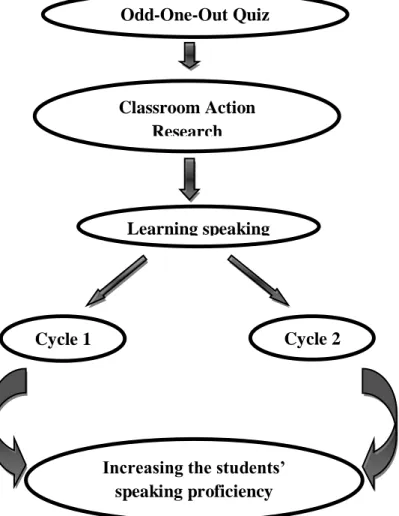
The conceptual frame work underline this research presented in this following diagram :
Figure 2.1: The Conceptual Framework
Odd-One-Out Quiz
Increasing the students’
speaking proficiency Learning speaking
Cycle 1 Cycle 2
Classroom Action Research
27
The conceptual above shows the process of the research to increase the students’ speaking proficiency through Odd-One-Out Quiz. In English learning process as input or as English materials will be measure the students’ speaking proficiency and the process of strategy as independent variable (Odd-One-Out Quiz). The independent variable (Odd-One-Out Quiz) will be used in classroom action research consist of some cycles, the steps have planned to use cycle 1 and cycle 2, the teacher makes planning, action and observation and prepares teaching material, then the teacher should give the topic contains some speaking; they are accuracy and fluency as dependent variable in learning speaking and the students should the master the material. The teacher observer the student’s response, participation and the last do reflection process for analyzing, understanding and making conclusion activity in the first action cycle. As a result a strategy can increase the students’ speaking proficiency.
28
CHAPTER III
RESEARCH METHOD
A. Research Design
In this research, the researcher used classroom action research (CAR).
Classroom action research consisted of four step namely planning, action, observation, and reflecting, the teacher were collaborate with the researcher in teaching and learning process. The purpose of this research is to find out the students accuracy of Odd-One-Out Quiz.
This research action procedure consisted of two cycles namely the first of meeting held four times consisting of three times the learning process and once the test cycle I and cycle II at meetings held four meetings consisting of three times the learning process and once test cycle II. In accordance with the nature of Tick-class research, the research on the second circle conducts of the lack to improve in cycle I. Each cycle of four stages namely: Planning, Action, Observation, Evaluation and reflection. The model of action research that the researcher was used as follows:
1. Planning
a. In this section, the teacher prepared the material which gave to the students.
29
b. The teacher maked lesson planning based on the curriculum and arranged material of lesson planning and it should based on the Odd-One-Out strategy in learning speaking.
c. The teacher arranged the test as an instrument to know the students’
increased of the study result after they study through Odd-One-Out Quiz 2. Action
a. The teacher gave simple example of “odd one out” task.
b. The teacher decided the lesson planning based on the general classification exercise (on school subjects)
c. The teacher prepared list of relevant words/phrases based on the material
d. The teacher shown understanding of the words /phrases in the list.
e. The teacher asked the students to decided which word is the “odd one out” which does not fit into the list, because some of word can be ambiguous.
f. In this section, the students were work by their selves but did not apart from the teacher’s guidance.
g. After choosen the odd-one-out from the words, the students then gave their reason why they choosen that word.
3. Observation
a. The teacher observed the students’ activity in learning process by using checklist observation to know the students’ attitude (active or not active).
30
b. The teacher gave evaluation which was used as the result of the study to know the students’ speaking profisiency in cycle I.
c. The teacher gave chance to the students for giving suggestions in action research.
4. Reflection
After collecting the data, the researcher was evaluate the teaching and learning process. Then, the researcher were reflect herself by seeing the result of the observation, whether the teaching and learning process of speaking through Odd-One-Out quiz to improve the students’ speaking proficiency. If the second plan is successful the researcher will make the next plan to get the result.
B.Research Variables and Indicators
In this research used two variables,they were : 1. Independent variabels
The independent variable was implementation of Odd-One-Out Quiz. It is as the method used by the teacher when teaching the material.
2. Dependent variables
The dependent variable was the students’ speaking proficiency two in accuracy with the indicators were as follows:
a. Pronounciation b. Vocabulary.
31 C.Research Subjects
The subjecst of the research was the students at the eleventh grade students of SMA Perguruan Islam Makassar in 2013/2014 Academic year which consists of two classes namely IPA and IPS, but in this research the researcher takes only one class (IPA). The class consist of 24 students. Those consist of 13 woman and 11 men.
D.Research Instrument
In this research, the researcher used two instruments for collecting data:
1. Observation Sheet
It is used to collect data about the students’ activties in teaching learning process through Odd-One-Out Quiz Method for each cycle.
2. Test
The test is used in the last item of every cycle to measure the students’ pronunciation and vocabulary in speaking based on its accuracy and language use. From that last test, the researcher was known the improvement of students’ speaking skill.
E.The Procedure of Collecting Data 1. The data source
The data source in this research are the students of SMA Perguruan Islam Makassar.
2. The data analysis
The type of the data which is received consists of:
32
a. The result of the study as quantitative data b. The result of observation as qualitative 3. The way in taking data
a. The result of data students is taken by giving the test to the students for each cycle.
b. The activity of data students in the class in action research is takes from observation of teaching and learning situation with observation checklist and field note.
F.Data Analysis
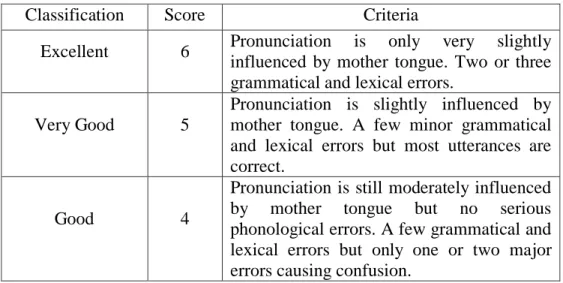
There are two components that concerns of the researcher in this research to measure. Those are Pronunciation and Vocabulary used which use criteria as follows:
1. The assessment of speaking accuracy divided in two pronunciation and vocabulary.
a. Pronunciation
Table 3.1 The assessment of pronunciation.
Classification Score Criteria
Excellent 6 Pronunciation is only very slightly influenced by mother tongue. Two or three grammatical and lexical errors.
Very Good 5
Pronunciation is slightly influenced by mother tongue. A few minor grammatical and lexical errors but most utterances are correct.
Good 4
Pronunciation is still moderately influenced by mother tongue but no serious phonological errors. A few grammatical and lexical errors but only one or two major errors causing confusion.
33
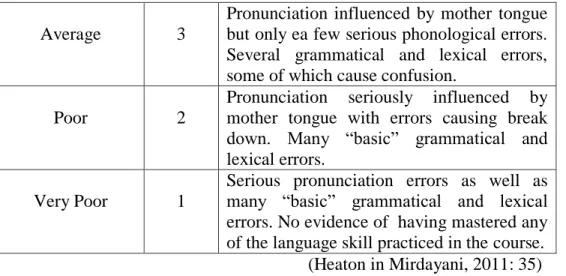
Average 3
Pronunciation influenced by mother tongue but only ea few serious phonological errors.
Several grammatical and lexical errors, some of which cause confusion.
Poor 2
Pronunciation seriously influenced by mother tongue with errors causing break down. Many “basic” grammatical and lexical errors.
Very Poor 1
Serious pronunciation errors as well as many “basic” grammatical and lexical errors. No evidence of having mastered any of the language skill practiced in the course.
(Heaton in Mirdayani, 2011: 35)
b. Vocabulary
Table 3.2 The assessment of Vocabulary
Classification Score Criteria
Excellent 6
Speak without too great an effort with a fairly wide range of expression. Searches for words occasionally but only or two unnatural pauses.
Very Good 5 Has to make an effort at time to search fro words. Nevertheless, smooth delivery on the whole and only a few unnatural.
Good 4
Although he has to make an effort and search for words. There are not too many unnatural pauses fairly smooth delivery mostly. Occasionally fragmentary but success in conveying the general meaning fair range of expression.
Average 3
Has to make an effort for much of the time.
Often has to search for the desired meaning. Rather halting delivery and fragmentary. Range of expression often limited.
Poor 2
Long pause while he searched for the desired meaning. Frequently and halting delivery. Almost gives up making the effort at times limited range of expression.
Very Poor 1 Full of long and unnatural pauses. Very halting and fragmentary delivery. At times gives up making the effort very limited
34
range of expression.
(Heaton in Mirdayani, 2011: 35)
G. The Data Analysis Technique
The data from cycle I and cycle II is analyzed through the following steps:
1. To calculating the scores using the following simple formula:
(Heaton, 1989-146) 2. Calculating the mean score of the students’ speaking test by using the
following formula:
Notes:
X = ∑
N
X = Mean Score
∑ = The sum of all score N = the total number of sample
(Gay, 1981)
3. To calculate the percentage of the students’ achievement, the formula which is used as follows:
F
P = --- x 100 4xN
Notation: P : Rate Percentage The gain score
A Student's Score = --- X 10 The maximal score
35
F : Frequency of the students’ achievement N : The Total Number of Students
( Sudjana, 1999)
4. To know the improvement of the students’ speaking skill, the researcher will use percentage technique as follows:
Where:
P : percentage of the students X : the first mean score X : the second mean score
(Hasan in Arief, 2011)
36 CHAPTER IV
FINDING AND DISCUSSION
This chapter consists of findings of the research and discussion. The findings of the research present the result of the improvement of the students’
accuracy in speaking. And the students’ attitude toward the application of Odd- One-Out Method, and discussion of the research covers further explanation of findings.
A. The Findings
The finding of this classroom action research deals with the answer of the problem statement which was aimed to improve the students’ speaking skill cover accuracy. The findings consisted of the improvement of the students’
accuracy in speaking skill and the students’ activeness in teaching and learning process. The findings of the research detected that the use of speaking accuracy by using odd-one-out method.
1. Implementation of odd-one-out method
In implementation of the students’ speaking accuracy,the teacher ask the students to finding out the word that does not fit that relation of the material,the students wrote their answer first,and then they explain the reason why they choose it. So the teacher can observed the students’
speaking accuracy.
37
2. The Improvement of The Students’ Speaking Accuracy
Improving the students’ speaking accuracy dealing with vocabulary and pronunciation through Odd-one-out Method can be seen clearly based on the following table, the table below shows that the significant increase of the speaking accuracy dealing with vocabulary and pronunciation, after applying the Odd-one-out Method:
Table 4.1: The table of the students speaking accuracy Indicators
The Students Speaking Accuracy
Cycle I Cycle II
Pronunciation 5.75 8.65
Vocabulary 6.06 8.68
∑× 11.81 17.33
X 5.90 8.66
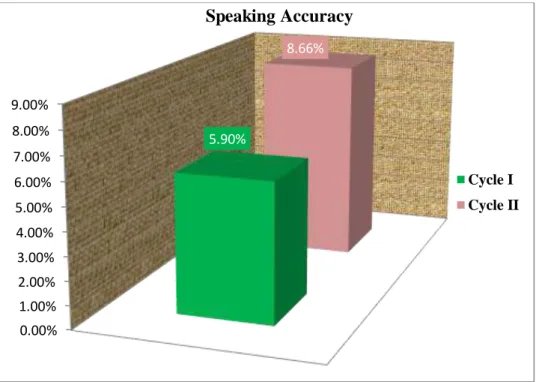
The table above shows that the significant increase of the speaking accuracy dealing with pronunciation and vocabulary. The students’ mean score after applied those method in cycle I, the assessment of their speaking accuracy increased became 5.90 Classified into average. It was mean score of cycle I but it’s not significant from the target expected based on criteria of minimum completeness (KKM) was 7.0. therefore, the researcher decided to organize cycle II, the mean score of cycle II was 8.66 and classified into very good. To see the significant increase of the students’ speaking accuracy clearly, a chart was presented as follows:
38
figure 4.1: The Percentage Of the students’ score improvement in speaking accuracy.
The chart above indicates that the improvement of the students’
speaking accuracy from cycle I 5.90, the improvement of the students’
speaking accuracy from cycle I to cycle II was 8.66. It indicates that there was significant increase for the students’ speaking accuracy dealing with Pronunciation and vocabulary in applying Odd-One-Out method at the Second Grade of SMA Perguruan Islam Makassar.
3. The Classification of the students’ score in Speaking Accuracy
The classification of the students’ score in speaking accuracy dealing with pronunciation and vocabulary by using Teams Odd-One-Out Quiz Method in cycle I and cycle II.
0.00%
1.00%
2.00%
3.00%
4.00%
5.00%
6.00%
7.00%
8.00%
9.00%
5.90%
8.66%
Speaking Accuracy
Cycle I Cycle II
39
a. The classification of the students’ score in Pronunciation
Table 4.2: The Classification Of The Students’ Score In Pronunciation No
.
Classification Range
The Result of Odd-Odd-Out Quiz Cycle I Cycle II
Freq % Freq %
1 Excellent 6 0 0 5 20.83
2 Very Good 5 2 8.33 19 79.16
3 Good 4 10 41.66 0 0
4 average 3 10 41.66 0 0
5 Poor 2 2 8.33 0 0
6 Very Poor 1 0 0 0 0
Total 24 100 24 100
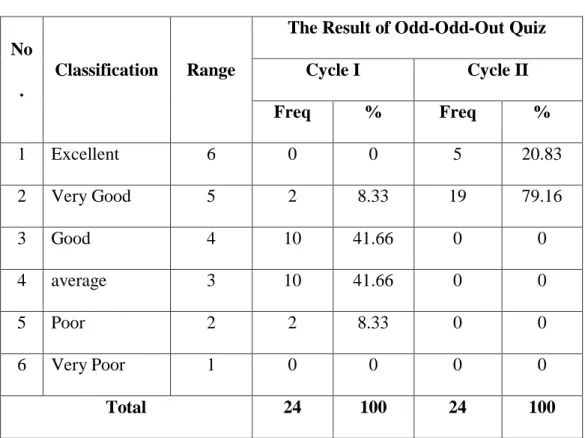
The table above shows the classification of the students’ score in pronunciation. The classification of the students’ score in cycle I, 2 (8.33% ) students got very good score, 10 (41.66% ) students got good score, 10 (41.66%) students got average score, 2 (8.33%) students got poor score . In cycle II, 5(20.83% ) students got excellent score, 19 (79.16%) students got very good score.
To see clearly the improvement of the students’ pronunciation in speaking accuracy:
40
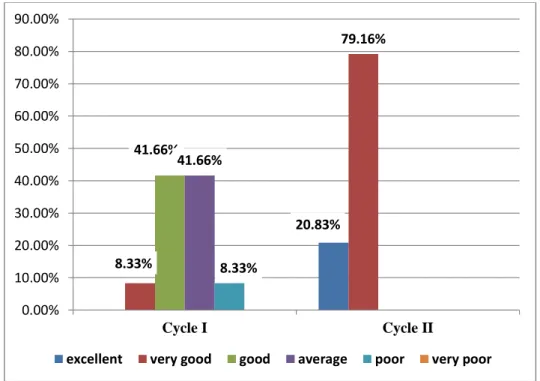
Figure 4.2: the percentage the students’ pronunciation of speaking accuracy in the following chart.
The chart shows that the percentage of the students’ classification score in pronunciation from the result cycle I was lower than in cycle II where the students’ pronunciation in cycle I was (8.33%) categorized as poor score, (41.66%) categorized as average score, (41.66%) categorized as good score, (8.33%) categorized as very good score. While in cycle II the students got very significant score, (79.16%) categorized as very good score, (20.83%) categorized as excellent. Based on the classification score above indicates that there was the improvement of the students score in pronunciation.
20.83%
8.33%
79.16%
41.66%
41.66%
8.33%
0.00%
10.00%
20.00%
30.00%
40.00%
50.00%
60.00%
70.00%
80.00%
90.00%
Cycle I Cycle II
excellent very good good average poor very poor
41
a. The classification of the students’ score in Vocabulary Table 4.3: The classification of the students’ Score in vocabulary
No. Classification Range
The Result of Odd-One-Out Quiz Cycle I Cycle II
Freq % Freq %
1 Excellent 6 0 0 8 33.33
2 Very Good 5 2 8.33 16 66.66
3 Good 4 12 50. 0 0
4 average 3 10 41.66 0 0
5 poor 2 0 0 0 0
6 Very Poor 1 0 0 0 0
Total 24 100 24 100
The table above shows the classification of the students’ score in vocabulary. The classification of the students’ score in diagnostic test was 3 (12.5%) students got average score, 18 (75%) students got poor score, 3 (12.5%) students got very poor score , while in cycle I the students’ score of vocabulary was 10 (41.66%) students got average score, 12 ( 50%) students got good score, 2 (8.33% ) students got very good score, In cycle II, 8(33.33% ) students got excellent score, 18(75.00%) students got very good score.
42
To see clearly the improvement of the students’ vocabulary in speaking accuracy:
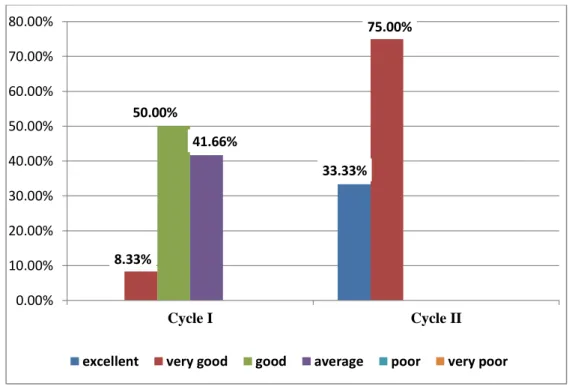
Figure 4.3: the percentage the students’ vocabulary of speaking accuracy in the following chart:
The chart shows that the percentage of the students’ classification score in vocabulary from the result in cycle I was lower than in cycle II where the students’ vocabulary in cycle I was (41.66%) categorized as average score, (50.%) categorized as good score, (8.33%) categorized as very good score. While in cycle II the students got very significant score, (66.66%) categorized as very good score, (33.33%) categorized as excellent.
Based on the classification score above indicates that there was the improvement of the students score in vocabulary.
33.33%
8.33%
75.00%
50.00%
41.66%
0.00%
10.00%
20.00%
30.00%
40.00%
50.00%
60.00%
70.00%
80.00%
Cycle I Cycle II
excellent very good good average poor very poor