i
THE USE OF ANIMATION VIDEO TO IMPROVE THE STUDENTS SPEAKING SKILL
(Pre-Experimental Study at the Seventh Grade Students of SMPN 1 Sungguminasa, Gowa)
A THESIS
Submit to the Faculty of Teacher Training of Education Muhammadiyah University of Makassasr in partial Fulfillment of the Requirement for the
Degree of Education English Department
SATRIANI SAPPE 10535604614
ENGLISH DEPARTMENT
FACULTY OF TRAINING TEACHER AND EDUCATION MAKASSAR MUHAMMADIYAH UNIVERSITY
2020
ii
iii
vi
UNIVERSITAS MUHAMMADIYAH MAKASSAR FAKULTAS KEGURUAN DAN ILMU PENDIDIKAN Jl. Sultan Alauddin No.259. Telp.(0411)-860 132 Makassar 90221
SURAT PERNYATAAN Saya yang bertanda di bawah ini:
Nama : Satriani Sappe Nim : 10535 6046 14
Jurusan : Pendidikan Bahasa Inggris
Judul Skripsi : The Use of Animation Video to Improve Students Speaking Skill (Pre-Experimental Study at The Seventh Grade Students of SMP Negeri 1 Sungguminasa Gowa)
Dengan ini menyatakan:
Skripsi yang saya ajukan di depan tim penguji adalah hasil karya saya sendiri bukan hasil ciplakan dan tidak dibuatkan oleh siapapun.
Demikian pernyataan ini saya buat dengan penuh kesadaran.
Makassar, 2020 Yang membuat pernyataan
Satriani Sappe
vii
UNIVERSITAS MUHAMMADIYAH MAKASSAR FAKULTAS KEGURUAN DAN ILMU PENDIDIKAN Jl. Sultan Alauddin No.259. Telp.(0411)-860 132 Makassar 90221
SURAT PERJANJIAN Saya yang bertanda tangan di bawah ini:
Nama : Satriani Sappe Nim : 10535 6046 14
Jurusan : Pendidikan Bahasa Inggris
Judul Skripsi : The Use of Animation Video to Improve Students Speaking Skill (Pre-Experimental Study at The Seventh Grade Students of SMP Negeri 1 Sungguminasa Gowa)
Dengan ini menyatakan perjanjian sebagai berikut:
1. Mulai dari penyusunan proposal sampai dengan selesainya skripsi saya, saya akan menyusun sendiri skripsi saya, tidak dibuatkan oleh siapapun.
2. Dalam penyusunan skripsi, saya akan selalu melakukan konsultasi dengann pembmbing
3. Saya tidak akan melakukan penjiplakan (plagiat) dalam menyusun skripsi ini.
4. Apabila saya melanggar perjanjian saya seperti yang terteras pada butiran 1, 2 dan 3 maka saya bersedi menerima sanksi sesuai dengan aturan yang berlaku.
Demikian perjanjian ini saya buat dengan penuh kesadaran.
Makassar, 2020 Yang membuat pernyataan
Satriani Sappe
viii
MOTTO AND DEDICATION
Motto:
“Verily never will Allah change the condition of a people until they change it themselves (with their own souls).”
(QS Ar-Ra’d:11)
”
“Whoever is taking seriously, he will be successful”
Dedication:
I dedicated this thesis to:
My beloved father & mother (Sappe &
Ica)
My brothers & sister (Sapri, Resna, Jain, Syabir and Andhy),
My beloved husband (Muhammad Arsyad),
And all of my friends.
ix ABSTRACT
Satriani Sappe. 2020. The Use of Animation Video to Improve the Students Speaking Ability (A Pre-Experimental Research at the Seventh grade Students of SMPN 1 Sungguminasa, Gowa). A thesis guided by Syamsiarna Nappu and Amar Ma‟ruf.
The objective of this research is whether or not the use of animation video improve the students speaking skill in term of pronunciation and vocabulary at the seventh grade of SMP Negeri 1 Sungguminasa Gowa.”
This research used pre-experimental method with pre-test and post-test design. The population of the research was the seventh grade students of SMP Negeri 1 Sungguminasa. Which were purposively choosen. The number of the sample was 20 students. The research variables were teaching Speaking skill through Animation Video as independent variable and students‟ Speaking Skill in term of pronunciation and vocabulary as dependent variable.
The result of the data analysis shows that the mean score of the students in pronunciation is proved by post-test 77.2 was higher than the mean score of the students in pre-test 59.9. Mean score of the students vocabulary is proved by pre test 61.25 and post test 77.95, and the hypothesis t-test value was 4.09. It meant that H1 was accepted. and t-table 2.09. Based on the findings that there was significate difference between the result of pre-test and post-test. In other words, using Animation Video was very good in enhancing the students' Speaking Skill especially in pronunciation and vocabulary.
Keywords: Animation video, Speaking skill, Pronunciation, Vocabulary.
x ABSTRAK
Satriani Sappe. 2020. Penggunaan Video Animasi untuk Meningkatkan Keterempilan Berbicara Siswa (Penelitian Pra-Eksperimental di Kelas Tujuh SMP Negeri 1 Sungguminasa Gowa). Skripsi, Jurusan Pendidikan Bahasa Inggris, Fakultas Keguruan dan Ilmu Pendidikan, Universitas Muhammadiyah Makassar (dipandu oleh Syamsiarna Nappu andAmar Ma‟ruf).
Penelitian ini bertujuan untuk mengetahui peningkatan keterampilan berbicara siswa setelah diajarkan melalui video animasi di kelas tujuh SMP Negeri 1 Sungguminasa Gowa. Peneliti menerapkan metode pra-eksperimen dengan satu kelompok pretest posttest design, dan data dikumpulkan dengan memberikan pretest, treatment dan posttest. Sampel penelitian adalah Kelas VII SMP Negeri 1 Sungguminasa Gowa yang terdiri dari 20 siswa.
Metode yang digunakan dalam penelitian ini adalah kuantitatif. Populasi penelitian ini adalah siswa kelas VII SMP Negeri 1 Sungguminasa Gowa pada tahun akademik 2018/2019. Peneliti menggunakan teknik purposive sampling untuk memilih sampel penelitian. Teknik yang digunakan untuk memperoleh data adalah pertama, mengumpulkan data dari pre-test, kedua dari post-test, dan terakhir menarik kesimpulan berdasarkan data yang didapatkan.
Hasil analisis data menunjukkan bahwa skor rata-rata siswa dalam pengucapan adalah 59.9 untuk pre-test dan 77.2 untuk post-test. Skor rata-rata untuk kosa kata adalah 61.25 untuk pre-test dan 77.95 untuk post-test. Dan skor tes signifikan 4.09 ini berarti bahwa setelah perawatan dengan menggunakan animasi video menunjukkan hasil positif yang signifikan dalam pengajaran berbicara.
Kata kunci: animasi video, keterampilan berbicara, pengucapan, kosa kata
xi
ACKNOWLEDGEMENT
The thanks for Allah SWT. the beneficent and the merciful. Praise to the Allah, the Lord of the universe. By the whole modest heart, the researcher would like to express the thankfulness to Allah SWT who has given the healthy and safety, so that the Thesis which is entitled: “The Use of Animation Video to Improve the Students Speaking Skill (A Pre-Experimental Study at the Seventh Grade Students of SMPN 1 Sungguminasa, Gowa)” has been finished. Peace be upon the Prophet Muhammad saw, the glorious teacher of teachers who came in the time of despair to save human kind from the Jahiliyah era to the Islamic era.
This thesis was written as a partial to fulfillment of the requirement for the undergraduate program degree for Faculty of Training Teacher and Education in English Department of Makassar Muhammadiyah University.
In completing this thesis the researcher has encountered some difficulties, especially in collecting and analyzing data. The researcher also realizing that without much help from numerous people, this thesis would have not been completed as it is. In this opportunity, the researcher would like to express the sincere gratitude to:
1. Prof. Dr. H. Rahman Rahim, SE. MM. as the Rector of Makassar Muhammadiyah University (UNISMUH).
2. Erwin Akib, M.Pd., Ph.D. as the Dean of Faculty of Training Teacher and Education Makassar Muhammadiyah University
xii
3. Ummi Khaerati Syam, S.Pd., M.Pd. as the Head of English Education Department of Makassar Muhammadiyah University
4. Dr. Syamsiarna Nappu, M.Pd. as the first consultant and the second consultant Amar Ma‟ruf, S.Pd., M.Hum., Ph.D. Who gave the researcher guidance, correction and overall support since the preliminary stage of manuscript until the complection of this thesis.
5. Baharu, S.Pd. as the headmaster of SMP Negeri 1 Sungguminasa.
6. Hj. Nasrah Ridwan, S.Pd. as the tutor and English Teacher in SMP Negeri 1 Makassar.
7. The researcher parents, Sappe (father) and Ica (mother) and who always ready to give sacrifice, moral and financial and pray for the researcher success. Who always give attention to their children and their strong motivation both material and spiritual until the completing of this thesis.
8. The researcher husband, Muhammad Arsyad S.Pd who always give support, understanding, love and pray for never give up to finish this thesis.
9. The researcher brother and sister for their patient, motivation and support during the researcher.
10. The researcher friends, Sri Hastiani, Umi Masroh, Siskayani who have given much contribution and mental support during the writing of this thesis and thanks for the laughter, tears, stories, understanding, and for all the moments.
xiii
11. The Atmosphere of Gorgeous Class without exception, thanks for all our togetherness during this time, and all of the students in seventh grade of SMP Negeri 1 Sungguminasa.
The researcher realizes that this thesis is still the simplest ones remaining errors are the research‟s own; therefore, constructive criticism and suggestion will be highly appreciated.
Finally, willingly the researcher prays may all our efforts be blessed Allah SWT. Amin.
Makassar, February 2020 The Researcher,
SATRIANI SAPPE
xiv
LIST OF CONTENTS
Page
LEGALIZATION SHEET ... ii
APPROVAL SHEET ... iii
COUNSELING SHEET ... iv
LETTER OF ENGAGEMENT ... vi
LETTER OF AUTHENTICITY ... vii
MOTTO AND DEDICATION ... viii
ABSTRACT ... xi
ACKNOWLEDGEMENT ... x
TABLE OF CONTENTS ... xiii
LIST OF TABLES ... xv
LIST IF FIGURE ... xvi
LIST OF APPENDICES ... xvii
LIST OF LETTERS ... xviii
Chapter I Introduction A. Background ... 1
B. Problem Statement ... 4
C. Objective of the Research ... 5
D. Significant of the Research ... 5
E. Scope of the Research ... 6
Chapter II Literature of Related Review A. Previous of Related Findings ... 7
B. Some Pertinent Ideas ... 8
1. Speaking ... 8
a. Definition of Speaking ... 8
b. The Elements of Speaking ... 10
c. Teaching Speaking ... 13
2. Animation Video ... 14
a. Definition of Animation Video ... 14
b. The advantages of using Animation Video ... 14
c. The Disadvantages of Using Animation Video ... 14
d. Techniques of Using Video ... 15
C. Conceptual Framework ... 17
D. Hypothesis ... 18
Chapter III Research Method A. Research Design ... 19
B. Variables ... 20
xv
1. Variable ... 20
2. Indicators ... 20
C. Population and Sample ... 21
1. Population ... 21
2. Sample ... 21
D. Instrument of the Research ... 21
E. Research Procedure ... 22
1. Pre-Test ... 22
2. Treatment ... 22
3. Post-Test ... 23
F. Technique of Collecting Data ... 24
Chapter IV Findings And Discussion A. Findings ... 26
1. The Students‟ Speaking Accuracy by Using Animation Video ... 26
2. The Improvement Students‟ Pronunciation and Vocabulary in Speaking Skill ... 27
3. Hypothesis Testing ... 29
B. Discussion ... 30
Chapter V Conclusion and Suggestion A. Conclusion ... 34
B. Suggestion ... 35
BIBLIOGRAPHY ... 36
APPENDICES ... 39 CURRICULUM VITAE ...
xvi
LIST OF TABLES
Table 3.1. The Research Design ... 18
Table 3.2. Table of Speaking ... 23
Table 4.1. The Improvement of Students Vocabulary in Speaking Skill ... 27
Table 4.4. The T-test of the Students Improvement... 28
xvii
LIST OF FIGURE
Figure 2.1 Conceptual Framework ... 29
xviii
LIST OF APPENDICES
APPENDIX I The Students‟ Total Score in Pre-test ... 40
APPENDIX II The Students‟ Total Score in Post-test ... 40
APPENDIX III The Students‟ Rating Score in Pre-test and Post-test ... 43
APPENDIX IV Data Analysis of The Students‟ Score ... 45
APPENDIX V The Distribution of T-Table ... 46
APPENDIX VI Attendance List of VII A SMP Negeri 1 Sungguminasa Gowa .. 47
APPENDIX VII Lesson Plan ... 49
APPENDIX VIII Documentation ... 98
xix
LIST OF LETTERS
Surat Pernyataan ... v Surat perjanjian ... vi Surat Pengajuan Judul ...
Surat Persetujuan Pembimbing ...
Surat Pengantar LP3M ...
Surat Permohonan Meneliti ...
Surat Izin Meneliti ...
Surat Persetujuan Meneliti ...
Kartu Kontrol Meneliti ...
Surat Keterangan Selesai Meneliti ...
Berita Acara Ujian Proposal ...
Kontrol Perbaikan Proposal ...
1 CHAPTER I INTRODUCTION
A. Background
Language is an important thing which used as a tool of communication to communicate each other. Language takes an important role in our daily activities.
It can be said that language and human beings cannot be separated because whoever, whenever and wherever they are, language always accompanies them. In society, languages have many functions to the society include the followings expression of thoughts, politic, education, administration, religions, and so on.
There are many languages in the world. English is one of the languages most people used. English is used to make explanation, analyzing situation or discussing something. The fact shows us the importance of English. Therefore, English as a language in international communication is clearly needed by many students to deliver their thought and interact in a variety of situation. In English lesson, there are four skills should be mastered, they are listening, speaking, reading and writing.
Speaking is one of the important skills that should be mastered by the students besides three other skills, listening, reading, and writing, in learning a language. Speaking is quite different from other language skills, because speaking requires the ability to perform in public. Through speaking people could express and deliver feeling and ideas directly. If the right speaking activities are taught in
2
the classroom, speaking can raise general learners' motivation and make the English language classroom a fun and dynamic place to be (Nunan,1992).
Speaking is like the first assessment for each learner who is studying English and each learner has to speak. This statement means an obligation, duty, task, fact, implementation, process, and it can be learning, although the researcher still find some students are speaking little or even passive in the classroom, and it can be caused of many things include the students, the class situation, Environment, teaching method, technique, approach or even from the teachers who cannot deliver their material successfully.
Teaching students to master in English speaking ability especially in vocabulary and pronunciation needs a lot of things including the teachers„
learning strategies in the class, learning methodologies, and so on. But, there are many teachers often faced problems when guiding the students in mastering English especially speaking.
There are several language components that should be mastered to improve speaking skill, one of them is pronunciation. When the students speak, they should focus on pronunciation. Because pronunciations is one of the important aspects on speaking. Second is vocabulary, students can speak English well when students have many vocabularies.
Furthermore, the teachers got difficulties to solve those problems. For instance, the teachers of English Subject at SMP Negeri 1 Sungguminasa have many problems in teaching English especially in speaking. Based on the
3
3
preliminary research observation, the researcher occasionally found 3 problem areas as follows:
First, the students are not confident to speak in front of the class and difficult to deliver their ideas. The cause is the students still poor of vocabulary.
So, the students feel confused to express the ideas on their mind even not active enough on their speaking class. Second, the students„ pronunciation uncorrect.
There are some students still difficult to read the text well. Third, the students feel bored to study English in the classroom. This method only emphasized the students to keep silent in the class and giving the students task on module without explanation, as a result it was hard for the students to begin speak. Finally, the students cannot improve their ideas and imagination.
Grounded from the facts above, the researcher learned that it is important for the teachers to improve their students speaking ability by applies some good strategies. One of the good strategies is by used cartoon movie as a media.
Cartoon movie is one of the media that can be used in teaching speaking.
According to Canning and Wilson (2000), cartoon movie can stimulate and motivate students‟ interest. They could attract students‟ attention since they provide two styles of learning which are audio and visual. This media could help the students interpret the message spoken by watching visual performance of the speakers, and listening to the speaker‟s voices.
Therefore, the students can adjust the spoken language to the pictures that are animated. It will make them easy to catch and remember the spoken language.
4
In line with this, Lonergan (1985) explains that using cartoon movie in language teaching have some advantages in the classroom, in which the students can increase their vocabulary and pronunciation. The other advantage of using the cartoon movie is that visual images stimulate students‟ perceptions directly, while written words can do this indirectly. Cartoon movie provides more sensory experience than reading besides verbal language, there is also color, movement, and sound.
There are two researchers investigate about animation video as a strategy in teaching English (Kurniati, 2016 and Yulianti, 2017). However, they only focus on the implementation and the effectiveness of animation video to improve students vocabulary mastery. Therefore, the researcher conducts this study to find out the improvement of the animation video in teaching speaking ability especially vocabulary and pronunciation.
Based on the short explanation above, the researcher is interested to formulate the research title “The Use of Animation Video to Improve Students Speaking ability‟‟.
B. Problem of the Research
Based on the background, the researcher formulates the problem statements of the research as follows:
“Does the use of animation video improve the students speaking skill in term of pronunciation and vocabulary at the seventh grade of SMP Negeri 1 Sungguminasa Gowa?”
5
5 C. Objective of the Research
Based on the problem statements above, the aims of the research is to find out Whether or not:
“The use of animation video improve the students speaking skill in term of pronunciation and vocabulary at the seventh grade of SMP Negeri 1 Sungguminasa Gowa.”
D. Significance of the Research
The researcher hoped this study can give some positive contributions in teaching speaking skill. The output of this research was highly expected to carry out some significance of teaching and learning English such as theoretical significance and practical significance. In the theoretical significance, this research was enrich the study on teaching speaking especially use animation video. The result of the research can be a useful input in teaching speaking skill in terms of pronunciation and vocabulary.
On the other hand, there were many practical significances of the research It helps the teacher increase the students speaking comprehension and help the students in increasing their speaking skill. The teacher can adopt the technique to be implemented in their speaking class. The students can expect to have more attentions and interest to learning speaking because the students have an interesting way in learning and the students have a chance to practice their English skill.
6 E. Scope of the Research
In this study, it is important to make the scope to obtain relevant data. This study is restricted to use of animation video in improve students speaking skill in terms of pronunciation and vocabulary.
7 CHAPTER II
LITERATURE OF RELATED REVIEW
A. Previous Related Research Findings
There are some previous researches that related to this research. The researcher takes some previous research to be compared with this research. The first study conducted by Farizawati (2017). In her research aimed to find that if the application of animation video will give better result on students‟ speaking skill. And the result showed that animation video as media helpful teaching and learning process and made the students motivated and actively involved in speaking activity.
The second study conducted by Sari (2014) showed that using videos in the teaching and learning of speaking was proved to improve the students‟
speaking skills in five aspects: vocabulary, pronunciation, grammar, fluency, and comprehension. The students were more enthusiastic in learning speaking. They could actively involve in the speaking learning process. Moreover, the students were more confident and fluent in speaking practices.
The last study conducted by Amalia (2012) in her research aimed to know providing required information about the advantages of animation videos and how to use them in the teaching and learning English activity. Animation videos can help the students more understand because they present visual context aids that assist the students comprehend and improve their learning skills.
Based on the reviews of previous research above, the researcher concludes that the use of animation video useful in fact on learning speaking ability.
8
Animation video was proved to improve the students‟ speaking skills in students vocabulary, pronunciation, and grammar. As we know that from the some findings above there are a significant improve to the students speaking ability.
Moreover, by using animation video this strategy can make the students more enthusiastic and enjoy the learning process.
Based on the definition above, the similarities of the research with previous findings is this research equally aim to whether the use of English animation video can improve the students speaking ability. While the difference is in the research that the researcher investigated more focus on the vocabulary and pronunciation of students by using media animation video that are different from previous related research. And the material will be presented is expresing feelings.
B. Some Pertinent Ideas 1. Speaking
a) Definition of Speaking
Speaking is one of language skill which is very important to be mastered by students in order to be a good communicator. Speaking is the verbal use of language to communicate with others Fulcher (2003).
Speech is about making choices. Students must choose how to interact in expressing themselves and forming social relationship through speech.
Speaking is defined as a way to express or communicate opinions, feelings, ideas, etc., by or as talking and it involves the activities in the part of the speaker as psychological, physiological (articulator) and
9
9
physical (acoustic) stage Hornby (1998). It a tool of communication that involves activities such as the speaker expresses his/her opinions, feelings, or ideas.
In addition, Chaney and Burk (1998) explain that speaking is the process of building and sharing meaning through the use of verbal and nonverbal symbols, in a variety of contexts. Speaking is further defined as an interactive process of constructing meaning that involves producing, receiving and processing information. Its form and meaning are dependent on the context in which it occurs, the participants, and the purposes of speaking Burns and Joyce (1997).
Speaking is defined operationally in this study as the secondary stage of students' ability to express orally, coherently, fluently and appropriately in a given meaningful context to serve both transactional and interactional purposed using correct pronunciation, grammar and vocabulary and adopting the pragmatic and discourse rules of the spoken language.
b) The Elements of Speaking
Harmer (2003) states that the ability to speak English presupposes the elements necessary for spoken production as follows:
1) Language features; The elements necessary for spoken production, are the following:
10
a. Connected speech: in connected speech sounds are modified (assimilation), omitted (elision), added (linking r), or weakened (through contractions and stress patterning). It is for this reason that we should involve students in activities designed specifically to improve their connected speech
b. Expressive devices: native speakers of English change the pitch and stress of particular parts of utterances, vary volume and speed, and show by other physical and non-verbal (paralinguistic) means how they are feeling (especially in face to face interaction). The use of these devices contributes to the ability to convey meanings.
c. Lexis and grammar: teachers should therefore supply a variety of phrases for different functions such as agreeing or disagreeing, expressing surprise, shock, or approval.
d. Negotiation language: effective speaking benefits from the negotiators language we use to seek clarification and show the structure of what we are saying. We often need to ask for clarification when we are listening to someone else talks and it is very crucial for students.
2) Mental / social processing
Success of speaker‟s productivity is also dependent upon the rapid processing skills that talking necessitates such as:
11
11
a. Language processing: Language processing involves the retrieval of words and their assembly into syntactically and propositionally appropriate sequence.
b. Interacting with others: effective speaking also involves a good deal of listening, an understanding of how the other participants are feeling, and knowledge of how linguistically to take turns or allow others to do so.
c. (On the spot) information processing: quite apart from our response to other‟s feelings, we also need to be able to process the information they tell us the moment we get it. The term speaking will be used to refer to a skill related tolanguage teaching and learning by Liao (2009) there are some elements of speaking skill.
a. Accuracy
Recognizably, accuracy is one of the most important criteria to measure one‟s linguistic ability and to shelter language users from communication break downs. According to Richards in Ayu (2007), accuracy concerns “the ability to produce grammatically correct sentence.” In other words, accuracy in language means grammatical accuracy only. Nevertheless, in Thornbury in Ayu (2000), the termsaccuracy seems to cover more than that. Specifically, speaking English accurately means doing without or with few errors on not only grammar but vocabulary and pronunciation, as well. He also set the clear scale for assessment of accuracy.
12 b. Grammar
Students use correct words order, tenses, tense agreement, etc.
Students do not leave out articles, prepositions, or difficult tenses.
c. Vocabulary
Students have a range of vocabulary that corresponds to the syllabus year list and uses words you have taught.
d. Pronunciation
Students speak and most people understand. Even broader than that, Liao (2009) defined accuracy as “the ability to use correct forms in which utterances do not contain errors affecting phonological, syntactic, semantic and discourse features of the language.”
e. Fluency
Fluency is also used as a criterion to measure one‟s speaking competence. Speaking fluently means being able to communicate one‟s ideas without having to stop and think too much about what one is saying.
c) Teaching Speaking
Teaching speaking is started at teaching the students how to speak in English as their foreign language, for then ask the students to be able to pronunce the new language accurately. It is continued then to guide students to a point where they can begin to judge whether their sound productions are correct or not. At this point, teacher is no longer primarily to correct, but he or she is suposed to encourage students to practice speaking the target language. Meanwhile, teacher should be able
13
13
to encourage students speaking some sounds, repeating, and imitating the students. Finally, the students are required to bee used to practice and do oral language.
According Nunan (2013) teaching speaking sometimes considered a simple process. Although speaking is totally natural, speaking in language in other than our own is anything but simple, It means even though speaking is natural, the teacher are suggested to simplify the way they teach speaking, because it is not our native language.
Taught speaking by having students repeat sentences and recite memorized textbooks dialoguesit was done by people for many years. And also teaching speaking involved providing students with components of language, hoping that they would eventually put them all together and speak. So the students might spend several times repeating after the teacher, studying grammar rules, reciting dialogues, and learning vocabulary.
2. Animation Videos
a) Definition of Animation Video
There are several definitions concerning animation videos.
Animations are a form of dynamic representation that display processes that change over time by Ainsworth (2008). According to Heinich, Molenda, &
Russell (1982) animation is a technique in which the film maker gives motion to otherwise inanimate objects. Video is becoming a more and more
14
popular tool in teaching English. Movies, videos, and cartoons can be used in listening activities in the EFL classroom.
b) The Advantages of Using Animation Videos
The main advantage of using animation videos is that animations can help learners come to understand complex ideas more easily Ainsworth (2008). Moreover, Oddone (2011) states that the advantages of using videos in the language classroom are: 1). they provide instances of authentic language and can be fully exploited with the teacher‟s control. (2). Videos give access to things, places, people‟s behavior and events. (3). Authentic material usually proves to be particularly motivating as people find it interesting to understand “real things”.
c) The Disadvantages of Using Animation Videos
On the contrary to the advantages mentioned above, Arsyad (2011) also stated some disadvantages of using video:
1. Particularly, using film and video need much time and money.
2. When the film is being shown, the pictures are moving continuously that make some students cannot get the information from the film.
3. Film and video sometimes do not meet the need of the learning goal, unless the film and video are designed and produced specifically for certain need.
From the explanation above, it can be concluded that using animation video in the language classroom has some advantages and
15
15
disadvantages too. It depends on how the teacher uses it as the media in teaching. When the video is used appropriately, by choosing the suitable ones and use them at the right time and the right place, the video can give some contributions or advantages to the language learning.
d) Techniques in Using Video
According to Cakir (2006) there are some practical techniques for video implication in the classroom:
a. Active viewing
In active viewing activity, the teacher shows the video and let the students watch it from the beginning to the end. This activity helps the teacher know how far the students‟ understanding of the video shown.
b. Freeze framing and prediction
Freeze framing and prediction activity, while the video is being played, the teacher stops the video which showing the pictures of characters‟
body language, facial expression, emotions, reactions, and responses.
This activity helps the students understand about what expression should be shown when we say something in English especially.
c. Silent viewing
Silent viewing, the video is played with the sound off and let the students guess what are the characters are talking about. This activity needs the students to remember the dialogues in the video.
16 d. Sound on and vision off activity
The sound on and vision off activity, the students only can hear the dialogue but unable to see the action. This activity helps the students to improve their listening skill.
e. Repetition and role play
Repetition and role play activity, a scene on video is replayed with certain pauses. When the students have understood the presentation, they are asked to act out the scene as much as they remember.
f. Reproduction activity
Reproduction activity, the students are showed a section in the video and are asked to retell what is happening. This activity can improve the students‟ speaking skill.
g. Dubbing activity
In dubbing activity, the students are asked to fill in the missing dialogues orally when the video is being played with the sound off
h. Follow-up activity
Follow-up activity, the teacher make a discussion with the students about the content of the video in order the students understand what is the video about. By applying those techniques, will help the teachers enable to teach English by using animation videos easily.
17
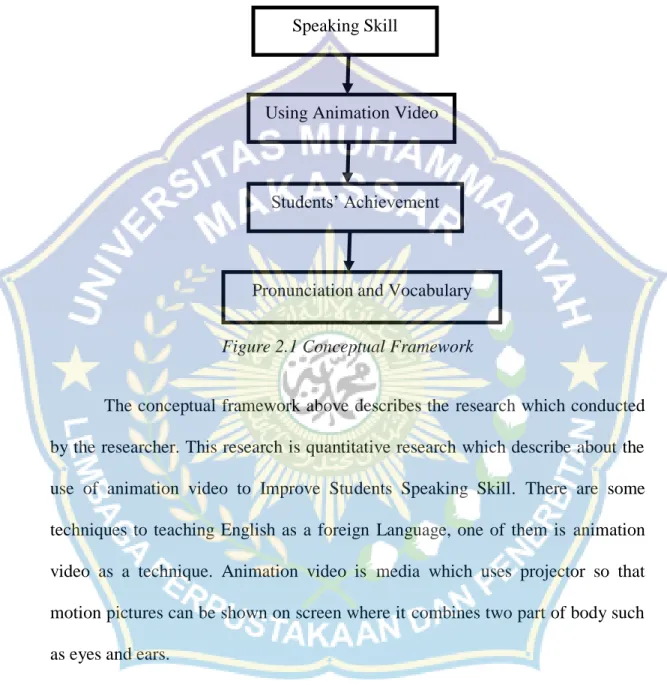
17 C. Conceptual Framework
The framework of this research can be illustrated as follows:
Figure 2.1 Conceptual Framework
The conceptual framework above describes the research which conducted by the researcher. This research is quantitative research which describe about the use of animation video to Improve Students Speaking Skill. There are some techniques to teaching English as a foreign Language, one of them is animation video as a technique. Animation video is media which uses projector so that motion pictures can be shown on screen where it combines two part of body such as eyes and ears.
In this study the researcher was be using pre-test, treatment, and post-test to test students' speaking that animation video can enhance their pronunciation and vocabulary. In the pre-test the researcher ask the students use expressing feelings and ask the students to answer the question of spring from their
Using Animation Video
Pronunciation and Vocabulary Speaking Skill
Students‟ Achievement
18
performances to find out the students‟ basic speaking skill. And post-test distributes to find out the students progress. In this post-test the students make a dialogue/conversations with their partners by using expressions of feelings that students feel when something happens in their daily lives for 2 minutes/person.
D. Hyphothesis
a) Null hypothesis (H0) the use of animation video does not improve the students speaking skill.
b) Alternative hypothesis (H1) the use of animation improves the students speaking skill.
19 CHAPTER III RESEARCH METHOD
A. Research Design
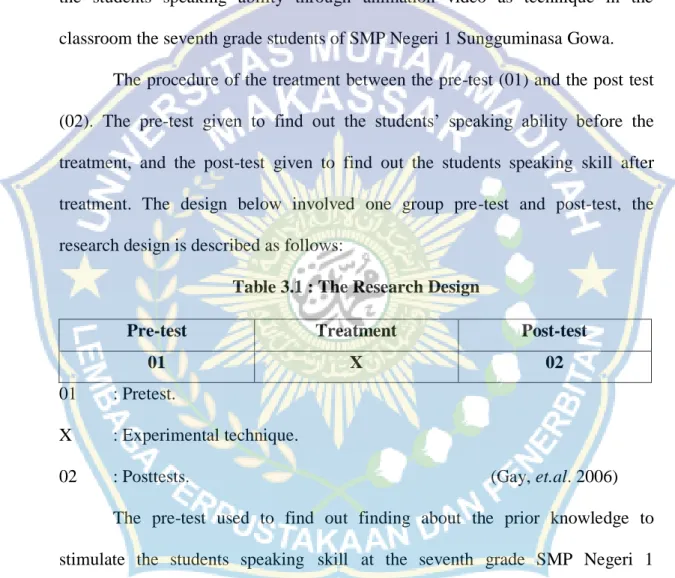
In this research the researcher applied pre experimental design to improve the students speaking ability through animation video as technique in the classroom the seventh grade students of SMP Negeri 1 Sungguminasa Gowa.
The procedure of the treatment between the pre-test (01) and the post test (02). The pre-test given to find out the students‟ speaking ability before the treatment, and the post-test given to find out the students speaking skill after treatment. The design below involved one group pre-test and post-test, the research design is described as follows:
Table 3.1 : The Research Design
01 : Pretest.
X : Experimental technique.
02 : Posttests. (Gay, et.al. 2006)
The pre-test used to find out finding about the prior knowledge to stimulate the students speaking skill at the seventh grade SMP Negeri 1 Sungguminasa. The pre-test has given to know students‟ knowledge. In the treatment, where the animation video applied as technique in the class after implementing the treatment, the researcher applied the post-test in same from as in the pre-test.
Pre-test Treatment Post-test
01 X 02
20 B. Variables
The kinds of variable related to the research, consisted of independent and dependent variable. According to Arikunto in Misagi (2017), independent variable is the variable that is influenced by another variable to achieve what was expected by researcher; whereas, the dependent variable is the result that is expected through the implementation of the independent variable. There are two variables in this research:
1. Independent
1. Independent Variable
The Independent variable (X) in this research is animation video 2. Dependent Variable
The dependent variable (Y) in this research is speaking skill
C. Population and Sample 1. Population
The population of this research was the seventh grade students of SMP Negeri 1 Sungguminasa. The number of population was 110 students ( SMP Negeri 1 Sungguminasa Gowa)
2. Sample
According to Hajar (1996) sample is a part of population. In carrying out a research, it is impossible for the researcher to research all the population because it is large number. Therefore, the researcher was use only one class which consist of 20 students by using purposive sampling technique.
21
21 D. Instrument of the Research
1. Test, the researcher used a test that consisted of pre-test (mention the things and animals in front of class one by one), and post-test (complete the table about animals and things, then the students pronounce the words in the table).
After give the pre-test to know the basic speaking ability of students, the researcher applied the animation video to the students in treatment.
2. Recorder to record the students‟ pronunciation
Recorder is equipment for making record. It also takes important thing in recording visual and non visual activity. The type of recorder that will be used by the researcher is voice recorder. Using voice recorder enables the researcher to observe the students‟ oral test and learning process.
E. Research Procedure
The procedure of collecting data in this research covered the following steps as follows
1. Pre-test
The researcher asked the students to mention the things and animals in front of class one by one.
2. Treatment
After gave the pre-test to know the basic speaking ability of students, the researcher applied the animation video to the students; the treatment is was conduct in 6 times (meeting1-6) in a month.
Meeting 1-6 : The researcher explained about things and animals. Then the researcher asked the students to watch an animation video about
22
“things around the class”. The researcher gave a task, the students must fill in a table that contains pronunciation and vocabulary of “things around the class”. After that the students make sentences and dialogues from existing words.
3. Post-test
The researcher asked the students to complete the table about animals and things, then the students pronounce the words in the table.
F. Technique of Collecting Data
The data from the pre-test and post-test were analyzed by using these formula as follow:
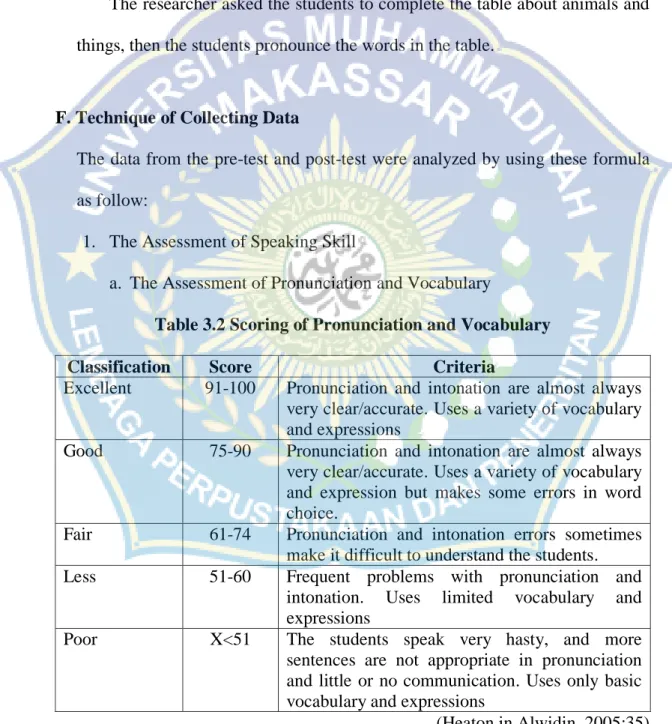
1. The Assessment of Speaking Skill
a. The Assessment of Pronunciation and Vocabulary
Table 3.2 Scoring of Pronunciation and Vocabulary
Classification Score Criteria
Excellent 91-100 Pronunciation and intonation are almost always very clear/accurate. Uses a variety of vocabulary and expressions
Good 75-90 Pronunciation and intonation are almost always very clear/accurate. Uses a variety of vocabulary and expression but makes some errors in word choice.
Fair 61-74 Pronunciation and intonation errors sometimes make it difficult to understand the students.
Less 51-60 Frequent problems with pronunciation and intonation. Uses limited vocabulary and expressions
Poor X<51 The students speak very hasty, and more sentences are not appropriate in pronunciation and little or no communication. Uses only basic vocabulary and expressions
(Heaton in Alwidin. 2005:35)
23
23
1. Calculating mean score and of the students test by using the formula : ̅ ∑
Where : X = Mean score
∑X = The sum of all scores N = The total number of sample
(Gay, 2006 :320) 2. Finding out the significant Difference between the pretest and posttest by
calculating the value of the test.
̅ ∑
Where : D = Deviation
∑ D = Standard Deviation N = The number of subject
1
2 2
n N
N D D
T D
Where : T = Test of significant
D = Different between the matcher pairs
D 2 = The square of ∑D∑D2 = The sum of D squares N = The number of samples
(Gay, 2006 : 331)
24 CHAPTER IV
FINDINGS AND DISCUSSION
This chapter particularly consist the findings and discussion. The findings of the research consisted of the result from the data collection through a speaking test deals vocabulary pre-test and post-test. Then, the discussion was described further signification and improvement of the relation of the findings with the previous research.
A. Findings
1. The Improvement of the Students’ Pronunciation and Vocabulary in Speaking Skill by Using Animation Video
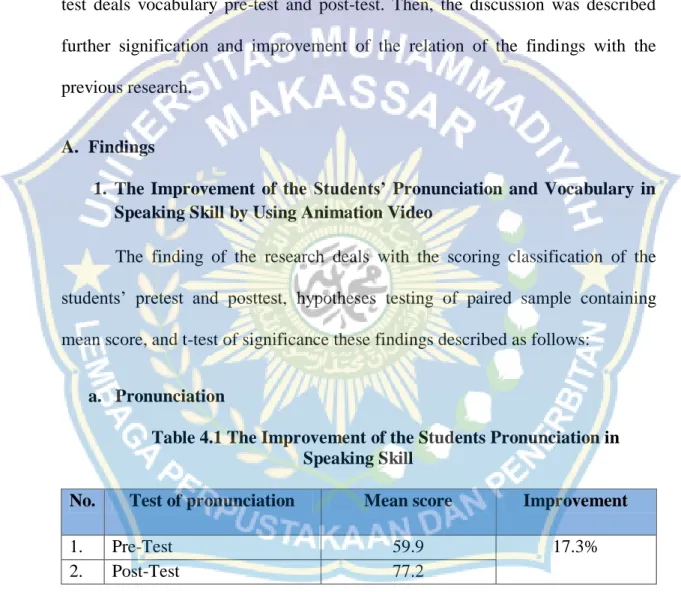
The finding of the research deals with the scoring classification of the students‟ pretest and posttest, hypotheses testing of paired sample containing mean score, and t-test of significance these findings described as follows:
a. Pronunciation
Table 4.1 The Improvement of the Students Pronunciation in Speaking Skill
No. Test of pronunciation Mean score Improvement
1. Pre-Test 59.9 17.3%
2. Post-Test 77.2
The implementation of video animation is effective to improve students‟
speaking skill. It is proved by the mean score of pre-test 59.9 to 77.2 in post-test with the improvement at 17.3%
25
25 b. Vocabulary
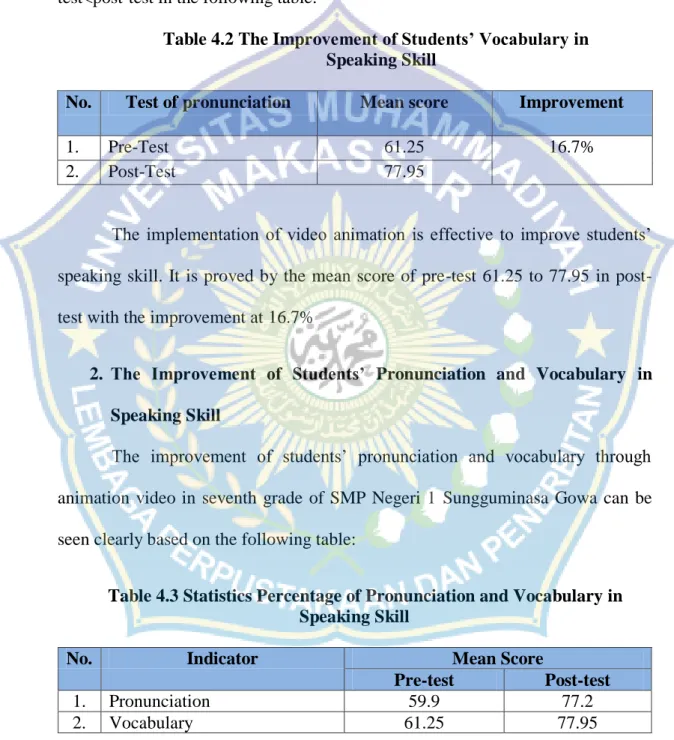
The use of animation video in form of teaching strategy improved speaking skill in term of vocabulary. It is proved by the mean score of pre- test<post-test in the following table:
Table 4.2 The Improvement of Students’ Vocabulary in Speaking Skill
No. Test of pronunciation Mean score Improvement
1. Pre-Test 61.25 16.7%
2. Post-Test 77.95
The implementation of video animation is effective to improve students‟
speaking skill. It is proved by the mean score of pre-test 61.25 to 77.95 in post- test with the improvement at 16.7%
2. The Improvement of Students’ Pronunciation and Vocabulary in Speaking Skill
The improvement of students‟ pronunciation and vocabulary through animation video in seventh grade of SMP Negeri 1 Sungguminasa Gowa can be seen clearly based on the following table:
Table 4.3 Statistics Percentage of Pronunciation and Vocabulary in Speaking Skill
No. Indicator Mean Score
Pre-test Post-test
1. Pronunciation 59.9 77.2
2. Vocabulary 61.25 77.95
Data descriptive statistics percentage of pronunciation and vocabulary, in speaking showed in pronunciation improve from the post-test score was 77.2 and
26
pre-test was 59.9. The data in speaking of vocabulary improve from the post-test was 77.95 and pre-test was 61.25. Based on the data it can conclude that learning by using of animation video in teaching speaking in term of pronunciation and vocabulary is significantly improve.
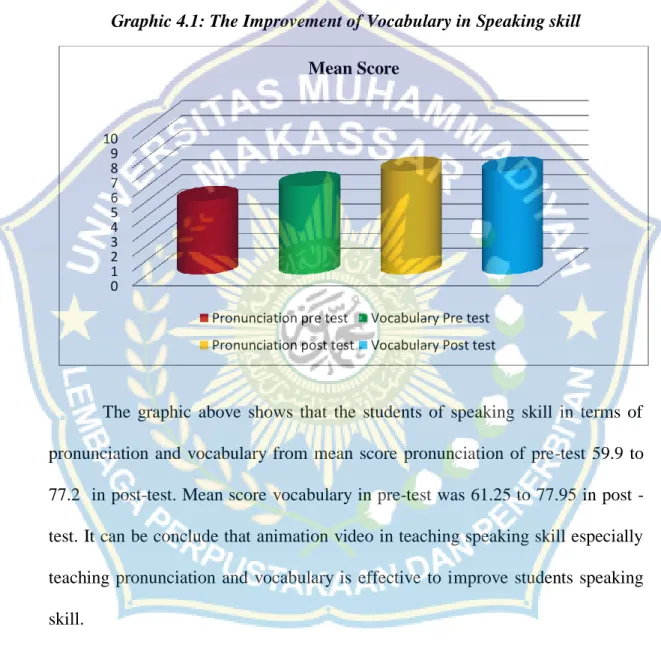
Graphic 4.1: The Improvement of Vocabulary in Speaking skill
The graphic above shows that the students of speaking skill in terms of pronunciation and vocabulary from mean score pronunciation of pre-test 59.9 to 77.2 in post-test. Mean score vocabulary in pre-test was 61.25 to 77.95 in post - test. It can be conclude that animation video in teaching speaking skill especially teaching pronunciation and vocabulary is effective to improve students speaking skill.
3. Hypothesis Testing
To know the level of significance value of the pre-test and post-test, the researcher used t-test analysis on the level of significance (p) = 0.05 with the degree of freedom (df) = N-1,where N= Number of subject (20 students) then the
0 12 3 4 56 7 8 109
Mean Score
Pronunciation pre test Vocabulary Pre test Pronunciation post test Vocabulary Post test
27
27
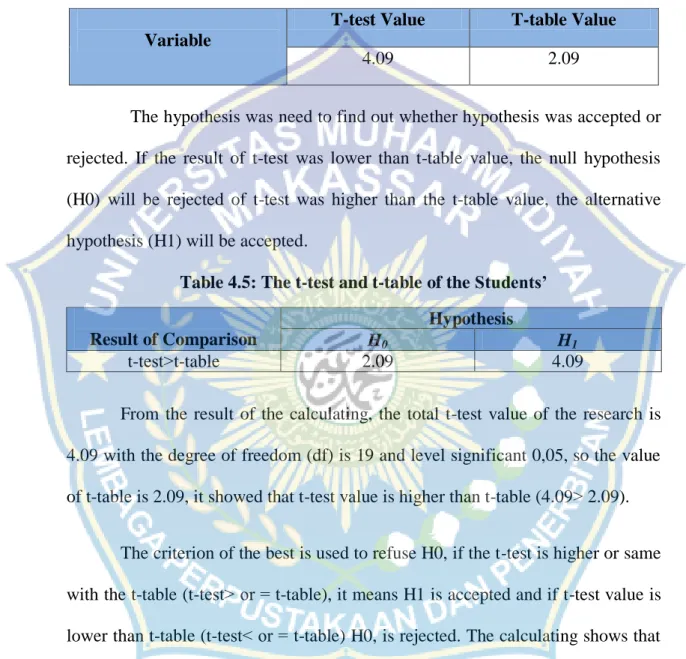
value of t-table is 2.09. The t-test statistical, analysis for independent sample was applied. The following table shows the result of t-test calculation:
Table 4.4: The Improvement of Students’ in Speaking Skill
Variable
T-test Value T-table Value
4.09 2.09
The hypothesis was need to find out whether hypothesis was accepted or rejected. If the result of t-test was lower than t-table value, the null hypothesis (H0) will be rejected of t-test was higher than the t-table value, the alternative hypothesis (H1) will be accepted.
Table 4.5: The t-test and t-table of the Students’
Result of Comparison
Hypothesis
H0 H1
t-test˃t-table 2.09 4.09
From the result of the calculating, the total t-test value of the research is 4.09 with the degree of freedom (df) is 19 and level significant 0,05, so the value of t-table is 2.09, it showed that t-test value is higher than t-table (4.09˃ 2.09).
The criterion of the best is used to refuse H0, if the t-test is higher or same with the t-table (t-test˃ or = t-table), it means H1 is accepted and if t-test value is lower than t-table (t-test˂ or = t-table) H0, is rejected. The calculating shows that the t-test value higher than t-table. It means that the students achievement in speaking was better after taught by used animation video communicative so, H1 is accepted.
28 B. Discussion
The discussion section deals with the interpretation of the findings derived from the result of statistically analysis through speaking skill.
1. The Improvement of the Students Pronunciation in Speaking Skill
The goal of using videos as the main media to provide English speaking model was successfully achieved. The students could easily identify some expression in the video and understand the content of the video. They also could use the expression in the real context. Moreover, they became more active in doing any activities. Some of them were very confident in presenting their answers and dialogues. They often raised their hand to perform their works. The students seemed enjoy the lesson since they were always enthusiastic and excited in watching and listening to the video as the speaking model.
2. The Improvement of the Students Vocabulary in Speaking Skill
Animation videos have advantages of achieving the important goals of motivating students‟ interest, providing realistic listening practice, stimulating language use, and increasing students‟ awareness of particular language points or other aspects of communication. In line with this, Harmer (2001) mentions that there are many advantages in using videos in the teaching and learning process such as seeing language-in-use. It means that the students do not just hear the language but they can also see it. The students can understand the general meaning of language used that are conveyed through expressions, gesture, and other visual clues. The second advantage is motivation. The students will be
29
29
interested when they have a chance to see language in use as hear it and it will be better if this is combined with communicative tasks.
According to Ainsworth (2008) one of the reasons animations are now found so widely is that many people believe that animations can help learners come to understand complex ideas more easily.
The result of the data analysis through the speaking pronunciation showed that the students‟‟ skill was increased 17.3%. It is indicated by the means score of the students‟ result is significant from pre-test 59.9 < 77.2 in post-test. It can be concluded that animations video can be used in teaching speaking.
The result of the data analysis through the speaking vocabulary show that the students‟‟ skill was increased 16.7%. It is indicated by the means score of the students‟ result is significant from pre-test 61.25 < 77.95 in post-test. It can be concluded that animations video can be used in teaching speaking.
Based on the result of the t-test, the researcher found that there was a significant difference between the result of pre-test before post-test. It means that there was significant difference result of the pre-test before and after teaching and learning processed by used animation video in the classroom. It was because the students learned and practiced their English through animation video that could enlarge their new experience and knowledge. Based on the data, it can be concluded that the students speaking skill of the seventh grade students of SMP Sungguminasa Gowa was improved.
30
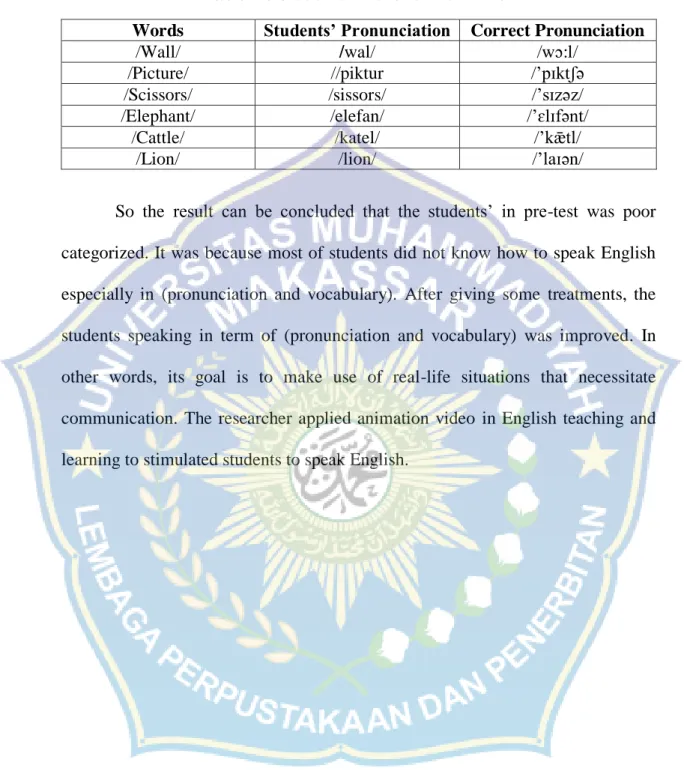
Table 4.6 Students’ Pronunciation Error
Words Students’ Pronunciation Correct Pronunciation
/Wall/ /wal/ /wɔ:l/
/Picture/ //piktur /‟pɪktʃǝ
/Scissors/ /sissors/ /‟sɪzǝz/
/Elephant/ /elefan/ /‟ɛlɪfǝnt/
/Cattle/ /katel/ /‟kǣtl/
/Lion/ /lion/ /‟laɪǝn/
So the result can be concluded that the students‟ in pre-test was poor categorized. It was because most of students did not know how to speak English especially in (pronunciation and vocabulary). After giving some treatments, the students speaking in term of (pronunciation and vocabulary) was improved. In other words, its goal is to make use of real-life situations that necessitate communication. The researcher applied animation video in English teaching and learning to stimulated students to speak English.
31 CHAPTER V
CONCLUSION AND SUGGESTION A. Conclusion
Based on the research findings and discussion in the previous chapter the researcher concluded that the use of animation video improve the students‟
speaking skill in term of pronunciation and vocabulary. Pronunciation is increased from 59.9 the mean score of pre-test to 77.2 in post-test and vocabulary is increased from 61.25 to 77.95 in post-test, so the students‟ pronunciation and vocabulary of the use of animation video is improved.
B. Suggestion
There were a lot of learning strategies or methods to be used in teaching learning progress. But, using Animation video was an alternative way of teaching speaking, especially, vocabulary. There are some suggestions to as follows:
1. Animation video was suggested to use for teacher as an alternative strategy or method in teaching English especially speaking skill.
2. The teacher should provide the students with more chance to speak so that the students get more speaking practice in class. The teacher should facilitate the students if they are getting difficulties in learning English.
3. The further researchers are suggested to find out much reference about animation video.
4. Animation video is not only used for the beginning but also for advance itself.
5. Using information gap technique depends on the weather. This strategy is good to use in entire seasons, except in rainy season.
6. Finally, the researcher expected that this thesis would bring new views for all the readers and the English teachers. Hopefully, there would be other advantages of using Animation video in teaching and learning process not only in writing, but also in the other skills.
33
BIBLIOGRAPHY
Ainsworth, Shaaron. 2008. How do Animation Video Influence Learning?. School of Psychology and Learning Sciencs Research Institute, University of Nottingham.
Ainsworth. 2008. The Educational Value of Multiple-Representations When Learning Complex Scientific Concepts. Springer. U.K.
Arsyad. 2011. Media Pembelajaran. Jakarta: PT. Raja Grafindo Persada.
Amalia, Risza. 2012. Improving Listening and Speaking Skills by Using Animation Video and Discussion Method. Palembang
Asrul, Asri. 2010. Thesis. Improving Students’ Speaking Ability Through the Use of Suggestopedia Method. Makassar. FKIP Unismuh
Burns and Joyce. 1997. Focus on Speaking. Sydney: National Center for EnglishnLanguage Teaching and Research.
Chaney and Burk. 1998. Teaching oral comunication in grades k-8. Needham Heights: MA: Allyn & Bacon.
Chaney.1998. Heinemann English Language Teaching. New York. Needham Heights: MA: Allyn & Bacon.
Cakir. 2006. The use of Video as an Audio-Visual Material in Foreign Language Teaching Classroom. The Turkish Online Journal of Educational Technology.
Canning, C, and Wilson. 2000. The Center of Excellence for Research and Training, Higher Colleges of Technology. Abu Dhabi The Internet TESL Journal.
Farizwati. 2017. Improving Students’ Speaking Skill by Using Animation video.
Faculty of Teacher Training and Education of English Depar tment. Jabal Ghafur University.
Fulcher, G. 2003. Practical Language Testing. Hodder Education: Google Scholar Gate Liao. 2009. Language teaching speaking skills. New York. Edinburgh:
Longman
Gay, L.R. 2006. Educational Research Competences for Analysis and Applications. Charles E. Meril Publishing Company A Bell and Howell Company.
Hajar, I. 1996. Dasar-Dasar Metodologi Penelitian Kuantitatif dalam Pendidika.
Jakarta.
Hallows, Richard. 2007. Better Speaking-A guide to improve your spoken English.
Heaton, Janet. 2005. Reworking Qualitative Data. London : Educational Research and Evaluation Program Area, College of Education.
Harmer, Jeremy. 2003. How to Teach English. Edinburgh: Pearson Education Limited.
Harmer, J. 2001. The Practice of English Language Teaching (3rd Edition).
London: Longman Group Ltd.
Hornby, A. S. 1995. Oxford Advanced Learners Dictionary. New York: Oxford University Press.
Hornby, A. S. 1998. Oxford Advanced Dictionary. New York: Oxford University Press.
Liao Guaqiang, 2009. Improvement of Speaking Ability through Interrelated Skills. China. Sichuan University of Science & Engineering.
Lonergan, J. 1985. Video in Language Teaching. New York: Cambridge University Press.
Longman. 2005. World view level 1-4 : video/DVD Speaking Rubric for Fluency Activies. Pearson Education, Inc.
Nunan, D. 1992. Collaborative Language Learning And Teaching. Cambridge:
Cambridge University Press.
Nunan, D. 1992. Language Teaching Methodology: A Text Book for Teacher.
New York: Prentice Hall.
Nunan, D. 1991/2003. Language Teaching Methodology. Hemel Hempstead:
Prentice Hall.
Misagi, T. 2017. The Effectiveness Of Outdoor Classroom Activity In Teaching Writing Descriptive Text At Seventh Grade Of Smpn 18 Purworejo in the Academic Year 2016/2017.
35
Oddone, C. 2011. Using Videos from Youtube and Websites in the Classroom.
Studies About Languages: English Educational journal.
Rice, A. M. 1993. Teaching with Video. New York: Macmilan, Inc.
Sinta Prasetia Trias Sari. 2014. The Use of Videos to Improve the Students’
Speaking Skills. Yogyakarta: English Education Department, Faculty of languages and arts.
Thornbury,Scott. 2000. How to teach speaking third edition.New York: Pearson Longman Inc.
A
P
P
E
N
D
I
C
E
S
APPENDIX 1
THE RESULT OF STUDENTS’ SPEAKING PRONUNCIATION IN PRE – TEST AND POST-TEST
N O
Name Pre-test Post-test
Pronunciation Vocabulary Pronunciation Vocabulary
1. S-1 60 60 75 78
2. S-2 60 60 76 78
3. S-3 60 60 75 70
4. S-4 60 60 80 75
5. S-5 51 60 75 78
6. S-6 60 60 82 75
7. S-7 60 60 75 78
8. S-8 60 60 75 75
9. S-9 60 60 80 78
10. S-10 60 65 80 80
11. S-11 60 62 80 78
12. S-12 60 63 78 79
13. S-13 60 60 75 76
14. S-14 60 60 75 80
15. S-15 60 64 75 78
16. S-16 60 60 80 80
17. S-17 65 60 75 75
18. S-18 60 60 76 78
19. S-19 62 60 78 75
20. S-20 60 65 79 80
Total 1198 1219 1544 1559
Mean 59.9 61.25 77.2 77.95
APPENDIX 2
THE SCORE OF PRE-TEST PRONUNCIATION AND VOCABULARY IN SPEAKING
N O
Name Pre-test
Pronunciation Vocabulary Score
1. S-1 60 60 60
2. S-2 60 60 60
3. S-3 60 60 60
4. S-4 60 60 60
5. S-5 51 60 55.5
6. S-6 60 60 60
7. S-7 60 60 60
8. S-8 60 60 60
9. S-9 60 60 60
10. S-10 60 65 62.5
11. S-11 60 62 61
12. S-12 60 63 61.5
13. S-13 60 60 60
14. S-14 60 60 60
15. S-15 60 64 62
16. S-16 60 60 60
17. S-17 65 60 62.5
18. S-18 60 60 60
19. S-19 62 60 61
20. S-20 60 65 62.5
Total 1198 1219 1208.5
APPENDIX 3
THE SCORE OF POST-TEST PRONUNCIATION AND VOCABULARY IN SPEAKING
N O
Name Post-test
Pronunciation Vocabulary Score
1. S-1 75 78 76.5
2. S-2 76 80 78
3. S-3 75 80 77.5
4. S-4 80 75 77.5
5. S-5 75 78 76.5
6. S-6 82 78 80
7. S-7 75 78 76.5
8. S-8 75 75 75
9. S-9 80 78 79
10. S-10 80 80 80
11. S-11 80 78 79
12. S-12 78 79 78.5
13. S-13 75 76 75.5
14. S-14 75 80 77.5
15. S-15 75 78 76.5
16. S-16 80 80 80
17. S-17 75 75 75
18. S-18 76 78 77
19. S-19 78 75 76.5
20. S-20 79 80 79.5
Total 1544 1559 1551.5
APPENDIX 4
TESTING THE HYPOTHESIS TO FIND OUT THE DIFFERENCE BETWEEN THE STUDENTS’PRE-TEST AND POST-TEST, THE
RESEARCH CALCULATED WITH THE FORMULA USED
N O
Name
Speaking
Pre-test Post-test D D2
1. S-1 60 76.5 16 256
2. S-2 60 78 18 324
3. S-3 60 77.5 17.5 306.25
4. S-4 60 77.5 17.5 306.25
5. S-5 55.5 76.5 21 441
6. S-6 60 80 20 400
7. S-7 60 76.5 16.5 272.25
8. S-8 60 75 15 225
9. S-9 60 79 19 361
10. S-10 62.5 80 17.5 306.25
11. S-11 61 79 18 324
12. S-12 61.5 78.5 17 289
13. S-13 60 75.5 15.5 306.25
14. S-14 60 77.5 17.5 306.25
15. S-15 62 76.5 14.5 210.25
16. S-16 60 80 20 400
17. S-17 62.5 75 12.5 156.25
18. S-18 60 77 17 289
19. S-19 61 76.5 15.5 240.25
20. S-20 62.5 79.5 17 289
Total 1208.5 1551.5 325.5 6008.25
Mean 60.42 77.57 16.27 300.41
APPENDIX
THE MEAN SCORE OF STUDENTS’ PRE-TEST & POST-TEST
A. PRE-TEST
1. Students‟ vocabulary 2.Students‟
pronunciation
̅ ∑ ̅ ∑
̅
̅
B. POSTEST
1. Students‟ vocabulary 2.Students‟
pronunciation
̅ ∑ ̅ ∑
̅
̅
APPENDIX
TESTING THE HYPOTHESIS TO FIND OUT THE DIFFERENCE BETWEEN THE STUDENTS’ PRE-TEST AND POST-TEST
̅̅̅
∑=
= 16,27
1
2 2
n N
N D D
T D
T
√ ( )
T =
√
T =
√
T =