Fermentation of phytic acid from lamtoro gung seeds (Leucaena leucocephala) to
produce inositol and tannin as pharmaceutical commodity
I.A.Rivai Bakti
Abstrak
Penelitian mengenai pengaruh berbagai konsentrasi ragi tempe terhadap kandungan inositol dan tanin biji lamtoro gung (Leucaena leucocephala) yang difermentasi telah dilakukan untuk menentukan konsentrasi ragi tempe yang terbaik. Penelitian ini menggunakan rancang acak lengkap (RAL) dengan empat perlakuan dosis ragi tempe masing-masing 0 %, 5 %, 10 %, dan 15 %. Tiap perlakuan diulang empat kali. Data dianalisis dengan analisis varians. Perbedaan nyata diuji dengan uji beda nyata terkecil. Kandungan tanin dianalisis dengan metoda Lowenthal-Procter. Hasil penelitian menunjukkan perlakuan berpengaruh nyata (P<0,05) terhadap parameter yang diukur. Kandungan inositol tertinggi dengan tanin terendah diperoleh pada perlakuan dengan menggunakan ragi tempe dengan dosis 15 % dan waktu fermentasi 96 jam yaitu sebesar 0,2631 %. (Med J Indones 2003; 12: 236-42)
Abstract
The research was done to define the effect of tempe yeast concentration on inositol and tannin contents of fermented lamtoro gung seeds (Leucaena leucocephala). This is a research with completely randomized design using four doses of tempe yeast, i.e. 0 %, 5 %, 10 %, and 15 %. Each treatment was replicated 4 times. The resulted data were analyzed by analysis of variance and the significant differences were tested by least significantly difference test. Tannin was analyzed by Lowenthal-Procter method. The result of the research showed that the treatment had significant effects (P<0.05) on the parameter measured. The highest inositol with lowest tannin contents were found by using 15 % tempe yeast and duration of fermentation 96 hours, that is 0.2631 %. (Med J Indones 2003; 12: 236-42) Keywords: tempe yeast
The increasing number of population in Indonesia resulted in lack of food and medicine stock material. Therefore, man tries to find alternatives in the form of non conventional materials which have not been fully developed, are easy to obtain, to be processed, and are economically beneficial. One of them is lamtoro gung seed (Leucaena leucocephala).1,2 Lamtoro gung seeds content phytic acid and tannin. Lamtoro gung is a multi-function plant. It growths faster than other plants within a year. It begins to bear flowers at the age of 5 to 6 months and the fruit can be harvested every day. The harvest usually reaches 310 to 800 kilograms per acre.1, 3
This lamtoro gung is actually in one group with lamtoro which is more popular as petai cina. This plant is originated from Latin America. The shape of the seed is oval and flat. The smell is just like petai cina. The mature seeds are brown-black in colour, hard and waxy.1
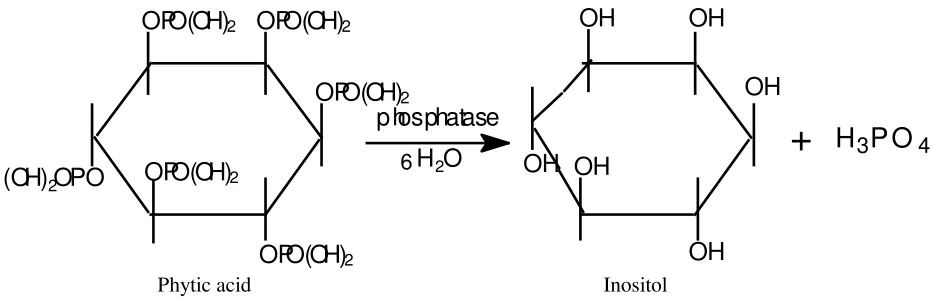
Lamtoro gung seeds contain equal amount of protein to soya beans. The seed is an energy source and contains mainly phosphor an inositol in the form of phytic acid. The contents depend on the plant species (around 0.82-5.3%), and found in the form of K, Ca, Mg and other metal salts.4 Fermentation is one of the ways to increase the inositol contents (Figure 1).
This research aims to know the best dose of tempe yeast in producing inositol from lamtoro gung seeds (Leucaena leucocephala), and to know the best dose of tempe yeast that can reduce the tannin content of lamtoro gung seeds (Leucaena leucocephala).
METHODS
Materials
Lamtoro gung seeds, tempe yeast, sodium-oxalate, aquadest, acidic salt solution, kaolin powder, 12 N HCl, indigocarmin, gelatin solution, 3% trichlor acetic acid, 80% and 90% H2SO4, K2Cr2O7.2H2O, KMnO4, FeCl3 solution (1N), L(+) arabinose, inositol standard solutions, CrCl3.6H2O, phytic acid standard solutions, tannin, betaglucosidase and tempe yeast.
Experiment
Fermentation time used is 96 hours. Tempe yeast doses were 0%, 5%, 10%, and 15% of the sample weight. Each condition was repeated 4 times.
Lamtoro gung seeds fermentation process
Lamtoro gung seeds (600 grams) were boiled for 2 hours. The boiled seeds were separated from the shells by floating the seeds in water. Then they were soaked in water a night long. After that, they were washed until they were not mucinous anymore, and steamed for 15 minutes. The seeds were dried and refined. We took samples of 10 grams of the refined lamtoro gung seeds, put them into bottles and added yeast to each bottle (0%, 5%, 10%, and 15% of the
sample’s weight) and pourred 20 mL of aquadest,
then stirred them well. The bottles were closed and kept at room temperature for 96 hours of fermentation.
Reagents used in inositol amount determination
Solution 1: 0.149 g K2Cr2O7.2H2O and CrCl3.6H2O solved in aquadest to 25 mL.
Solution 2: 1 g L(+) arabinose heated at 100o C and diluted to 100 mL in a tube.
Inositol amount determination
We put 2 grams of fermented refined lamtoro gung seeds into an Erlenmayer flask, added 40 mL of 3% trichlor acetic acid, shaked it up with electric shaker for 45 minutes, and then centrifuged it for 40 minutes. We took 10 mL of the supernatant and put it to a centrifugation tube and then added 5 mL of FeCl3 solution, and boiled it for an hour. We centrifuged it for 15 minutes, and took the supernatan out. The sediment was hydrolyzed with 12 N HCL at 100o C for 6 hours, and then was cooled down. We took 2.5 mL of the hydrolyzed sediment, put it in a reaction in a water bath for 20 minutes. After cooling down, its absorbance was measured at inositol maximum absorbance wave length.
Tannin amount determination(Lowenthal – Procter Method)5
aquadest, and boiled it for 30 minutes. After cooling it, we poured it into 500 mL scaleflask, added aquadest over mark line, and filtered it to make filtrate I. Ten mL of filtrate I was poured in to Erlenmayer flask. Then 25 mL of indigocarmyne, 25 mL of liquid H2SO4 (12.5 gH2SO4 in 250 mL of aquadest) and 750 mL of aquadest was added, and titrated with 0.1 N KMnO4 solution until the color is yellowish-gold. We needed A mL of KmnO4 solution.
One hundred mL of filtrate I was mixed to 50 ml gelatin, 100 mL acidic salt, and 10 gr kaolin powder. We shaked it up as strong as possible for a minute and filtered it to make filtrate II. We took 25 mL of filtrate II, added 25 mL of indigocarmyne solution, 25 mL of liquid H2SO4 (12.5 gH2SO4 in 250 mL aquadest) and 750 mL of aquadest, and titrated with 0.1 N KMnO4 solution until the color is Yellowish-gold. We needed B mL of KMnO4 solution (KMnO4 solution was standardized by sodium oxalate).
Calculation of tannin content :
1 mL KMnO4 (0.1 N) = 0.00416 tannin. (50A – 50B) x N/0.1 x 0.00416 The content of tannin = x 100%
5 N = The normality of KMnO4
A = amount of KMnO4 used for titration I (ml) B = amount of KMnO4 used for titration II (ml)
RESULTS
Inositol
The analysis results of inositol content in base material are shown in Table 1.
Table 1. Inositol content in base material
Repetition Absorbance Inositol (%) X
I 0.089 0.0232
II 0.087 0.0223 0.0230
III 0.088 0.0228
IV 0.090 0.0237
The highest inositol content after fermentation was obtained in experiment R3 (experiment dose 15%). The increase of inositol content in lamtoro gung seeds after fermentation is shown in Table 2.
The analysis results of crude material powder of Lamtoro gung seeds is shown in Table 3.
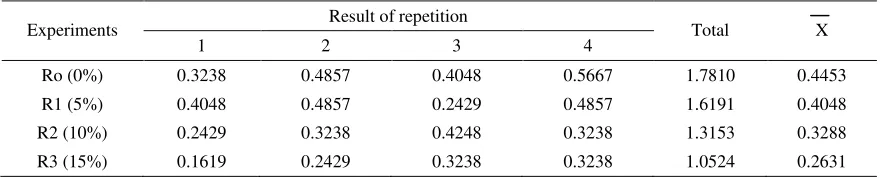
The results of analysis of tannin content after fermentation is shown in Table 4.
Table 2. Inositol content after fermentation
Experiment Result of repetition Total X
1 2 3 4
R0 0.0241 0.0228 0.0282 0.0209 0.0960 0.0240
R1 0.0300 0.0295 0.0277 0.0282 0.1154 0.0289
R2 0.0542 0.0569 0.0676 0.0636 0.2423 0.0606
R3 0.0890 0.0909 0.0905 0.0932 0.3636 0.0909
Table 3. Tannin content in base material
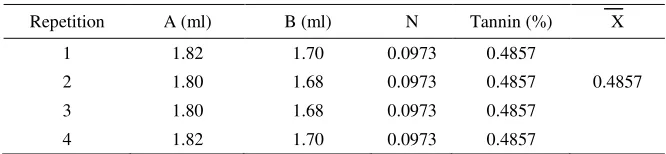
Repetition A (ml) B (ml) N Tannin (%) X
1 1.82 1.70 0.0973 0.4857
2 1.80 1.68 0.0973 0.4857 0.4857
3 1.80 1.68 0.0973 0.4857
Tabel 4. Tannin content after fermentation
Experiments Result of repetition Total X
1 2 3 4
The highest inositol content after fermentation was obtained in experiment R3 (experiment dose 15 %).
This content increase was caused by the bigger tempe yeast amount that was added to the sample substrate of Lamtoro gung seeds, causing the more enzymes secreted by Rhyzopus sp mold, and the forming of inositol from glucose. This fact suits with Charalapous’6 statement stating that inositol can be formed from glucose based on enzymatic reaction. Phytic acid is a form of phosphorous and inositol saving in seeds. Phytase is one of the enzymes which is able to let inorganic phosphorous free from phosphate compound through hydrolisation. It can cause the hydrolisation of phytic acid to inositol and free phosphate (orthophosphate or inorganic phosphate) to run faster. Fermentation process can affect the increase of inositol because the existence of Rhyzopus sp in tempe yeast that is able to produce phytase.7
Therefore, the high inositol amount in this experiment was caused by Rhyzopus sp that can synthesize phytase
in its metabolism. Our result suits Kasmidjo’s8 statement that Rhyzopus sp mold is the most dominant mold in tempe yeast. Therefore, more phytase is produced. Moreover, lamtoro gung seed is a good substrate for tempe yeast.4 Phosphatase can hydrolyze phytic acid in lamtoro gung seeds into inositol.
Inositol
Inositol is a hexahydroxy siclohexane which can be found in fruits, vegetables, seeds, beans, and milk.9 It is stable to heat, acid and alkali. It has a sugar-taste, and is non-hygroscopic. It forms crystal in water or acetic acid above 80oC. It is non optic-active, and soluble in ether and other organic solvents.10
According to Kleiner,9 inositol in nature exists in three forms: free inositol, inositol hexaphosphate, and phosphatidil inositol.
Inositol hexaphosphate (phytic acid) in seeds exists in a large concentration due to catalytic hydrogenation of free inositol. As a nutrient, it functions in metabolism as energy source, and plays a role in fat and lipoprotein metabolism and transportation.10
Inositol deficiency can cause growth disorder, body swelling and hair thinning. Furthermore, inositol can prevent fat and cholesterol accumulation, and diabetic disease. It is a good subtrate for the growth of microbe, mainly, the digestive system microbe.11 Another names of inositol are myo-inositol, meso-inositol, l-meso-inositol, hexahydroxycyclohexane, cyclo-hexanehexol, cyclohexitol, meat sugar, inosite, mesoinosite, phaseomannite, dambose, nucite, and bios I.
Inositol (C6H12O6, molecular weight 180.16) is anhydrous, and forms non-hygroscopic crystals in water or acetic acid above 80o C. It is widely distributed in plants and animals. It acts as growth factor for animals and microorgaisms and can be isolated from heart muscle, and liver. It can be obtained commercially in the form of corn syrup liquor, since inositol is present as phytic acid in corn. It has a sweet taste, and is lipotropic.
Inositol is a significant part of vitamin B 12.11 The high concentration of rachitogenic phytic acid in food can be used as inositol derived source of energy for diabetic relief.11
Tannin
The analysis results of crude material powder of Lamtoro gung seeds is shown in Table 3. They showed that tannin content was 0.4857 %. So each acre yielded 0.4857 x (310 to 800 kg) = 1.506 to 3.89 kg tannin.
Tannin has many synonims, i.e. tannic acid, aretannic acid, gallotannin, gallotannic acid, and incorrectly
“digallic acid”. Tannic acid of commercial use usually contains about 10% H2O. Tannic acid occurs in the bark and fruit of many plants, notably in the bark of the oak species, in sumac and myrobalan. It is produced from Turkish or Chinese nutgall, the former contains 50-60%, the latter about 70%. For the commercial tannic acid, whose specifications follow, the chemical formula is usually given as C76H52O46. Table 3 showed that the fermentation process can decrease tannin content. The color of the fermentation result changes into brown, and the fermentation result has a specific stinging smell.
Tannin is a natural compound which is one of the polyphenol found in plant. It has a lot of hidroxy phenolic group (1-2 for each 100 units’s molecule weight), and can build up a stabilizing cross compound with protein and other biopolimers, for example cellulose and pectin.13 Based on the structure
and it’s chemical properties, it is divided into 2
groups: i.e. hydrolyzable tannin (the more important group) and unhydrolyzable tannin (thick tannin, or condensed tannin, or derivative of flavonol).
The hydrolyzable tannins are spread out in the plant tissues. It is amorphous, hygroscopic, yellowish-brown in colour, water soluble (especially in hot water) and forms a colloidal solution.13 It is an ester with glycosidic bonds to a monosaccharide, especially D-glucose. The D-glucose is bound to one or more trihydroxybenzencarboxylic acids (its hydroxils are tied with gallic acid, digallic acid and hydroxy di-phenic acid). It produces aromatic acid and carbohydrate units, by adding mineralic acid or its salts.14 Hydrolyzable tannin is divided into gallotannine resulting gallic acid after hydrolyzation, and elagitannine resulting elagate acid after hydrolyzation.15
According to Sjostrom (cited from Fengel, 1995),15 condensed tannin is a flavonoid polimer. Its components are catechin (flavan-3-ol) and leucoantocyanidin (flavan-3,4-diol).15 The ability of tannin to react with protein can reduce the activities of proteases.
The structure in Figure 2 is that of a tannin named
corilagin. The chemical formula of corilagin is C27H24O18. Tannin named corilagin will be broken into gallic acid and hexadihydroxy-diphenate by betaglucosidase.13
OH
Figure 2. Breaking glucosidic bond of tannin by beta glucosidase
Tempe Yeast
Tempe yeast consists of various species from Rhizopus, Aspergillus, and Mucor genus. In tempe yeast exists some enzymes produced by Rhizopus sp,
Aspergillus sp. and Mucor sp.16 Kasmijo8 stated that
Rhizopus sp can produce cellulose hydrolyzing enzyme, meanwhile Aspergillus sp produce protease, betaglucosidase, glucoaminase, phytase and lipase. In fermentation, usually the yeast grows well in carbohydrate-containing substrate. Mold from Rhizopus species is the most important microorganism in tempe fermentation. Frequently met in tempe are Rhizopus oryzae, Rhizopus oligosporus, Rhizopus stolonifer and
Rhizopus arrhizus. Among the species, Rhizopus orizae, and Rhizopus oligosporus have the main role in tempe fermentation.17 Rhizopus is also called bread mold or black mold.
Our results is in line with the result of Marlina et al. Marlina et al indicated that the highest inositol and the lowest tanin contents were obtained by fermentation for 96 hours using tempe yeast.18
Phytic acid
Phytic acid or myo-inositol hexaphosphate exists largely in plants, especially in cereal and leguminaceae.4 Phytic acid molecule formula is C6H12O24P6 or C6H6 OPO(OH)2 with a molecular weight of 660.08. The chemical name is myo-inositol 1,2,3,4,5,6,- hexosis (dihydrogen phosphate) or myo-inositol hexaphosphate. It is the highest analog to a serial of inositol phosphate that is wide spread in nature.4 Phytic acid can affect the process of carbohydrate digestion catalyzed by amylase. It can react with protein to form a complex compound that causes a decrease in the speed of protein hydrolysis done by prosthethic enzymes in the digestive system due to a change in protein configuration.19 Phytic acid can be hydrolyzed by phytase to inositol and phosphoric acid. Enzymatic hydrolisis of phytic acid can be done using two kinds of enzymes: first, using phytase in early decomposition to inositol phosphate and inositol diphosphate, and second, using phosphatase in inositol triphosphate dephosphorilation process to inositol monophosphate.
CONCLUSION
1. In fermentation, yeast increased lamtoro gung seeds inositol content. The best inositol con-centration resulted in fermentation was 0.0909 %.
2. In the fermentation process of lamtoro gung seeds, tempe yeast concentration was proportionate with the effect of enzyme activities. If the yeast concentration is increased, the enzyme’s effect will be higher.
3. In fermentation, yeast decreased lamtoro gung seeds tannin content. The tannin concentration resulted in Ro (0%) was 0.4453 %, and R1 (5%) was 0.4048 %.
4. The concentration of tempe yeast was proportional with the effect of enzyme activities. If the concentration of tempe yeast was increased the influence of the enzyme was also increased. 5. If we want just phytic acid compound, then we
should isolate the raw material of lamtoro gung seeds without using tempe yeast.
Acknowledgments
We wish to acknowledge Prof. Dr.K.M. Arsyad, DABK, Sp.And, Dean of Medical Faculty, Dr.Fachmi Idris M.Kes., Medical Faculty, and DR.Zulkifli Dahlan MSc. Dean of Mathematics and Natural Science Faculty, Sriwijaya University, Palembang, South Sumatra, Indonesia. The laboratory work and sample collection would not have been possible without their support. Moreover, our deepest gratitude was addressed to local residents at each study area, for conducting the field and laboratory work, and sample collection.
REFERENCES
1. Suprayitno. Lamtoro gung dan manfaatnya. Jakarta: Bharata Karya Aksara; 1981.
2. Slamet DS. Penelitian pengembangan makanan murah bergizi dari hasil olahan lamtoro gung (Leucaena leucocephala). Bogor: Puslitbang Gizi; 1985.
3. Soerodjotanojo S. Membina usaha perkebunan lamtoro gung. Jakarta: Balai Pustaka; 1983.
4. Noor Z. Senyawa Antigizi. PAU pangan dan gizi. Yogyakarta: UGM; 1992.
5. Sudarrmadji. Analisa bahan makanan dan pertanian. Yogyakarta: Liberty; 1989.p.108.
6. Charalapous F. Encyclopedia of science and technology. New York: McGraw Hill; 1987.
7. Sarwono. Membuat tempe dan oncom. Jakarta: Penebar Swadaya; 1988.
8. Kasmidjo. Tempe-microbiology and biochemstry processing and its benefit. UGM; Yogyakarta: 1990.
9. Kleiner IS. Human of biochemistry. New York: Mosby; 1954.
11. West ES. Textbooks of biochemistry. New York: Mac Millan Co; 1966.
12. Tan, Kirana R. Obat-obat penting, khasiat dan peng-gunaannya. 3rd ed. Jakarta: Schiedam; 1978.
13. Manitto P. Biosintesa produk alami. Semarang: IKIP Semarang Press; 1992.
14. Robinson T, Padmawinata K. Kandungan tumbuhan tinggi. Bandung: ITB; 1995.
15. Fengel D, Wegener G. Kayu, kimia ultra struktur reaksi-reaksi. Yogyakarta: UGM Press; 1995.
16. Dwidjoseputro. Dasar-dasar mikrobiologi. 7th ed. Jakarta: Djambatan; 1980.
17. Rahman A. Technology of fermentation. Bogor: Arcan press; 1992.
18. Marlina P, Raudati E, Yudono B. Pengaruh lama fermentasi terhadap kandungan inositol dan tanin biji lamtoro gung (Leucaena leucocephala) [Tesis]. Indralaya: Sriwijaya Univ; 1999.
Corilagen (Tannin) gallic acid Hexadihydroxyphenic acid
Figure 2. Breaking glucosidic bond of tannin by beta glucosidase
OH OH
OH
HOCO
+
COO
O
COO HO
HO
HO HO
HO
HO
COOCH HO
HO HO
HO HO HO
COOCH
COOCH HO
HO HO
HCOH
HCOH HCO
2