A STUDY OF SUNFLOWER OIL PERFORMANCE AS A GEAR LUBRICANT
SITI SAKINAH MUNIRAH BINTI ISHAK
SUPERVISOR DECLARATION
“I hereby declare that I have read this report and in my opinion this report is sufficient in terms of scope and quality for the award of the degree of
Bachelor of Mechanical Engineering
(Design & Innovation)”
Signature : ...
Supervisor : ...
A STUDY OF SUNFLOWER OIL PERFORMANCE AS A GEAR LUBRICANT
SITI SAKINAH MUNIRAH BINTI ISHAK
This thesis is submitted in partial fulfilment of the requirement for the award of a Bachelor Mechanical Engineering (Design & Innovation)
Faculty of Mechanical Engineering Universiti Teknikal Malaysia Melaka
DECLARATION
“I hereby declare that the work for this whole project and report is on my ideas except for quotations and summaries which have dully acknowledged.”
Signature : ...
Author : ...
iii
ACKNOWLEDGEMENT
This research project would not have been possible without the support of many
people. First and foremost, a special thanks to my beloved parents for giving their full
support during the period to accomplish this project. Very high appreciation and million
thank to my supervisor, Puan Asriana Ibrahim who was abundantly helpful and offered
invaluable assistance, support and guidance. Furthermore, she had been very kind and
patient while correcting my doubts.
In addition, I am also felt so grateful that I have a very kind cooperation among
my classmates who helping me finding a solution at related field.
I am indebted to all technicians that involve for their open-handedness in this
project. Last but not least, I am gratified to the Head of Department of Mechanical
Engineering (Design & Innovation) and the members of the staff of University Teknikal
Malaysia Melaka for the constant encouragement and the valuable inputs from time to
ABSTRACT
In manufacturing and automotive industry, gears are the most crucial character in
those fields. A set of gears is used to provide a method to change the torque from
rotating object in order to move a certain load. Continuous metal to metal contact will
cause rapid wear without sufficient lubrication provided. Lubricant must give protection
to the gear in against corrosion. Gear lubrication is not an easy matter. Proper selection
of good lubricant properties can prolong gear life and enhance the reliability of gearbox.
Instead of synthetic lubricant, vegetable based oil has large potential in replacing other
lubricant especially synthetic type lubricant. Vegetable oil is highly recommended,
though it gives no harm effect towards our nature as it exhibit a biodegradable and
renewability properties. Many study has prove that vegetable oil chemical structure has
a great influences towards its behavior, especially physical properties. In this study,
sunflower oil is used in the gearbox. Its composition has affected the temperature ability
where vegetable oils have poor low temperature behavior. Triglycerides structure and
fatty acids composed in vegetable oils give instability in oxidation. When selecting
lubricant, temperature at the contact area and ambient temperature are important factors
to be considered. Besides, VI plays an important character in gear lubrication. By using
experimental method and lubrication analysis, vegetable oil is found to have high VI up to 241 and has poor oxidation stability. It‟s also has poor low temperature behavior. These two disadvantages concluded that sunflower oil has low performances as a gear
v
ABSTRAK
Di dalam industri pembuatan dan automotif, gear merupakan bahagian paling
kritikal. Satu set gear adalah kaedah yang digunakan bagi mengubah daya kilas lalu
memutarkan gear tersebut bagi mengerakkan sesuatu beban. Dua bahan logam yang
yang sentiasa bergeseran akan menyebabkan permukaan tersebut cepat haus sekiranya
tidak diberikan kadar pelinciran yang secukupnya. Pelincir mesti memberi perlindungan
kepada gear supaya tidak terdedah kepada hakisan. Pelinciran gear bukanlah suatu
perkara yang mudah. Pemilihan pelincir yang betul boleh memanjangkan jangka hayat
peralatan dan meningkatkan kebolehpercayaan kotak gear. Minyak berasaskan
sayur-sayuran mempunyai potensi yang besar untuk menggantikan minyak pelincir jenis lain
terutamanya pelincir sintetik. Minyak sayur-sayuran adalah sangat disyorkan, kerana ia
tidak memberi kesan bahaya kepada alam semula jadi dan berupaya untu menjadi bahan
yang boleh diperbaharui. Banyak kajian telah membuktikan bahawa struktur kimia
minyak mempunyai pengaruh yang besar terhadap tingkah sifat fizikalnya. Komposisi
minyak sayuran sendiri telah menjejaskan keupayaannya ketika di paras suhu rendah.
Struktur trigliserida dan asid lemak yang terdapat dalam minyak sayur-sayuran
menyebabkan ketidakstabilan dalam pengoksidaan. Apabila memilih minyak pelincir,
suhu di kawasan ‘contact’ gear dan suhu persekitaran adalah faktor penting yang perlu
dipertimbangkan. Selain itu, indeks kelikatan, memainkan peranan yang penting dalam
pelinciran gear. Dengan menggunakan kaedah eksperimen dan analisis pelinciran,
minyak sayur-sayuran didapati mempunyai index kelikatan yang tinggi sehingga 241
dan mempunyai ketidakstabilan pengoksidaan dan paras suhu rendah yang tidak
TABLE OF CONTENTS
CHAPTER TITLE PAGES
DECLARATION ii
ACKNOWLEDGEMENT iii
ABSTRACT iv
ABSTRAK v
TABLE OF CONTENTS vi
LIST OF TABLES ix
LIST OF FIGURES x
LIST OF SYMBOLS xii
LIST OF ABBREVIATIONS xiii
CHAPTER 1
LIST OF APPENDICES
INTRODUCTION
xiv
1
1.1 Introduction 1
1.2 Objective 2
1.3 Scope of Works 3
1.4 Problem Statement 3
1.5 Conclusion 3
CHAPTER 2 LITERATURE REVIEW 4
2.1 Introduction 4
2.2 The Importance of Lubricant in Gearbox 4
2.3 Classifications of Lubricant 6
vii
2.4.1 Advantages and Disadvantages of Vegetable Oils as Lubricant
9
2.5 Composition of Vegetable Oil 10
2.6 Lubricant Properties 14
2.6.1 Viscosity 14
2.6.2 Temperature 15
2.6.3 Viscosity Index 16
2.6.4 Determining Viscosity Index 19
2.7 Sunflower Oil 19
2.8 Synthetic Lubricant 20
2.9 Oil Grading System 22
2.10 Helical Gear 24
2.11 Gear Test Rig 26
2.12 Conclusion 28
CHAPTER 3 METHODOLOGY 29
3.1 Introduction 29
3.2 Experimental Details 29
3.2.1 Apparatus 30
3.2.2 Test Oil 33
3.3 Test Description 34
3.4 Data Types Collected 36
3.5 Measuring Oil‟s Density 37
3.6 Conclusion 37
CHAPTER 4 RESULTS 38
4.1 Introduction 38
4.2 Dynamic Viscosity 38
4.3 Kinematic Viscosity 39
4.4 Viscosity Index 40
4.6 Physical Properties of Sunflower Oil 44
4.7 Conclusion 44
CHAPTER 5 ANALYSIS AND DISCUSSIONS 45
5.1 Introduction 45
5.2 Kinematic Viscosity 45
5.3 Viscosity Index 48
5.4 Temperature 50
5.5 Oil Grading System 51
CHAPTER 6 CONCLUSION AND RECOMMENDATION 53
6.1 Introduction 53
6.2 Conclusion 53
6.3 Recommendation 54
REFERENCES 55
ix
LIST OF TABLES
NO TITLE PAGES
2.1 Biodegradable level of selective oil 8
2.2 Properties of sunflower oil 20
2.3 Properties of synthetic oil 22
4.1 Dynamic Viscosity 39
4.2 Kinematic Viscosity of oil at 40˚C and 100˚C 40
4.3 Viscosity Index 42
4.4 Temperature of oil 43
LIST OF FIGURES
NO TITLE PAGES
2.1 Three dimensional representation of a triglyceride
molecule
12
2.2 Triglycerides structure in carbon chain 13
2.3 Determination of viscosity index related to kinematic
viscosity
18
2.4 Viscosity Grade Chart 24
2.5 Helical Gear for right hand and left hand 25
2.6 Sample of gear test rig facility at Design Unit, Newcastle
University.
27
2.7 Schematic diagram of test rig 28
3.1 Gear test rig 30
3.2 Gear wheel 31
3.3 Oil filter and rounded area is the valve 31
3.4 Infrared hand measuring device 32
3.5 Tachometer 33
xi
3.7 Gear shafts 35
3.8 Oil samples 36
5.1 Graph of kinematic viscosity against running hours 46
5.2 Graph of viscosity index against running hours 48
5.3 Viscosity index comparison chart 50
LIST OF SYMBOLS
� = Kinematic Viscosity
η = Dynamic Viscosity
� = Dwensity
m = Mass of Oil
g = Gram
l = Litre
V = Volume of Oil
% = Percent
xiii
LIST OF ABBREVIATIONS
AC Alternating Current
AGMA American Gear Manufacture Association
API American Petroleum Institute
ASTM American Society of Testing and Material
BC Before Century
cP Centipoise
cSt Centistoke
EP Extreme Pressure
FZG Forschungsstelle fur Zahnrander und getriebebau
OEM Original Equipment Manufacturer
R&C Rust and Oxidation
SAE Society of Automotive Engineering
STLE Society of Tribologists and Lubrication Engineers
VI Viscosity Index
LIST OF APPENDICES
NO TITLE PAGES
A Flow Chart 59
B Gantt Chart 60
C Summary Journal 61
D Schematic Drawing for Gear Test Rig 63
E H Value 64
F Test Rig 65
CHAPTER 1
INTRODUCTION
1.1 INTRODUCTION
For the past several years vegetable oil has been identified to be used as gear
lubricant. It has same potential as common synthetics lubricant. These oils propose
important environmental benefits with regard to resource renewability and
biodegradability, as well as provide adequate performance in a broad range of
application. Besides, the range price for vegetable oil is lower than synthetics oil.
Biodegradable means a substance that is able of being decomposed by bacteria
and other living organism. Vegetable oil waste gives no harm effect to environment
especially soil where in a particular time the fluid is converted to a lower molecular
weight component.
Environmentally reconcilable lubricants oil is progressively being used, for
example in motor vehicle and equipment in water protection areas and in hydraulic
engineering, in vehicle for agriculture and forestry. This oil is overtly degradable, non
toxicity and the water hazard is low (Antonsson, 2009).
Application of vegetable oils in industry is to support world concern towards
into lubricants for industrial and transportation application where scientists, engineers
and inventors should know that green invention and technologies are good to our mother
earth and can reduce energy bill, indeed offer safer and healthier products. Based on
Condition Based Maintenance that has been implemented in nowadays industry,
lubricant analysis is one of the ways to show that equipment is going to work well or fail
in term of performance. Advance inspection can help engineer and maintenance team to
identify the performance of vegetables oil as gear lubricants. The importance of good
lubrication usually was not really been stress until a failure happen and has lead to
equipment failure and profit loss as the production was suspended. Bad maintenance
practice was one of the main reasons that caused the problem. Therefore, lubricant
analysis is beneficial to promote a good lubrication practices. The main purpose of the
lubricant analysis in this study is to evaluate the performance of a sunflower oils which
is a vegetable based oil is either have a potential in substituting synthetic lubricants
which not readily biodegradable and expensive.
The primary function of lubrication is to help preventing excessive friction.
Maintenance team must hold the responsibility in purchasing lubricants where it should
be purchased on specification not because a matter of price. With the trend toward
higher appreciation on earth has lead to many case studies on performance of vegetable
oils and its chemical structure shows that it has superior benefits. Performance of
vegetable oil has its constraint where its base stock have poor oxidative stability and low
temperature solidification.
1.2 OBJECTIVE
The purpose of this research experiment is to evaluate sunflower oil as a gear
3
1.3 SCOPE OF WORKS
This experiment used gear test rig approached which is personally fabricated to
investigate performance of sunflower oil as gear lubricant. Helical gear is used in the test
rig and will be run for hours and sample of lubricant will be analyzed. The test will be
held at Faculty of Mechanical Engineering Workshop at Mars Campus.
1.4 PROBLEM STATEMENT
Common synthetics lubricant show low biodegradability of 70% to 95%
compare to vegetable oil which is 80% to 95%. For century, synthetic oils have
predominant lubrication and today the environmental issue start to arise as synthetic oil
is not readily biodegradable. Vegetable oil composes good physical properties to replace
synthetics oil but its performance is questionable. At the end of semester, a full report
will be submitted. All these step of methodology is illustrated as a flow chart shown in
Appendix A. In addition, Gantt charts for the research are shown in Appendix B.
1.5 CONCLUSION
The objectives and scope are the important criteria that will be set as a guideline
to achieve the study according to the flow chart as shown in Appendix A. Gantt chart
CHAPTER 2
LITERATURE REVIEW
2.1 INTRODUCTION
In this chapter a brief and deep explanation which is engaged to the study
including the classifications of lubricant, the importance of lubricant, composition of
vegetable oil, parameter involved such as VI, temperature and kinematic viscosity which
is essential to determine VI. This chapter has key concepts like the advantageous and
inherent limitations of vegetable oils and the system use to identify the grade of oil and
synthetic lubricant explanation which is used as a reference in evaluating the
performance of vegetable oil.
2.2 THE IMPORTANCE OF LUBRICANT IN GEARBOX
In minimizing friction of mating parts the use of lubricant is necessary.
Generally, proper use lubricants prolong the life of equipment and also minimized
unpredicted failures. Lubricant is often used in gearbox where two sliding gears are in it.
Sliding metal usually will have friction. Without lubricant, sliding part creates extreme
friction and requires a great amount of energy to rotate the gears. The application of
5
1. To lubricate the teeth and to remove heat generated from the gear operation
2. To reduce friction and wear in sliding components to prevent premature failure
3. To ensure a good cushioning for gear operation.
4. Reduction of operating noise.
5. Improvement in heat transfer.
6. Corrosion prevention.
A good selection of gear lubricant will provide slip-free for gear transmission, spare a
good reliability gearbox, low maintenance and long-life.
Lubrication fully or half distinct the surfaces of the friction bodies by selectively
introducing an interfacial medium which is lubricant that reduces friction. It is proven
that the minimum lubrication film thickness increases as the entraining velocity
increases and the viscosity becomes greater, and that it decreases as the loads increase,
although only with an exponent of 0.5 inch each case. The minimum lubrication film
thickness is normally greater than 1�m (Antonsson, 2009).
Appropriate lubrication is essential to avoid premature wear of gear tooth
surfaces because gear shift greatly in their design and lubrication type. When choosing
lubrication for gear application the following terms must be considered which are type
and materials, operating conditions, speed, load and temperature, environment and type
of service.
Enhance test and experiment in determining the performance of gear lubricants
have lot of beneficial outcome especially for maintenance material planning and control
teams. It is often said that the test rig practice is significant and satisfied the standard
regulated by registered society. The importance of advance test can avoid repetitive
breakdowns in nature. Careless selection of lubricant can lead to a failure called
Some constraint of vegetable oil performance such as anti-wear protection, load
carrying capacity, rust prevention, foaming and demulsibility are mostly
additive-dependent. The base stock dependent of vegetable oil must be initially evaluated when a
specific type of vegetable oil is acceptable as a contingent base stock for industrial or
automotive application (Erhan and Perez, 2002).
2.3 CLASSIFICATIONS OF LUBRICANT
Lubricant can be classified to four categories which are mineral lubricants,
synthetic lubricants, vegetable lubricants and animal lubricant.
1. Mineral fluid lubricants are based on mineral oils. Mineral oils or known as
petroleum oils are products of refining crude oil.
2. Synthetic lubricants are lubricant fluid which built up with chemical structure
and properties.
3. Vegetable lubricants are based on soybean, corn, castor, canola, cotton seed, and
rape seed oils. Vegetable lubricants type is environmentally friendly alternative
to mineral oils since they are biodegradable.
4. Animal lubricants are produced from animals‟ fat. There are two main animal
fats: hard fats also called as stearin and soft fats. Animal fats are mainly used for
manufacturing greases.
In this experiment, the lubricants that will be used are a natural vegetable based
lubricant which is sunflower oil. This type of lubricants were widely used in industry
plus it is easy to get and cheaper than synthetics lubricants. It is also non-toxic where
fatty acids composed in vegetable oil generally non toxic to aquatic and terrestrial
environments. Vegetable oils based lubricant has greatly more capable in diminishing
7
Vegetable oils can be classified into two categories which are edible vegetable
oils and non edible oil. Edible oil is produced in great amounts worldwide and is mainly
used for edible purposes. Palm oil, sunflower oil, olive oil and coconut oil are the
example of edible oils. Non edible oils are mainly used for commercial purposes instead
for edible purpose. The oils are castor oil, jojoba oil and jatropa oil (Chatra et al. 2012).
2.4 VEGETABLE OIL AS A LUBRICANT
Lubricants can be in liquid or solid. Liquid lubricant consists of a mixture of base
oil and additives which are blended to a specific viscosity and it is designed to meet the
performance needs of particular type of service (Eugene et al. 2006).
The idea of using vegetable oil in industry is not new since it‟s has been used in engine. The original diesel engine that Rudolph Diesel designed ran with vegetable. He
used peanut oil to fuel one of his engines at the Paris Exposition in 1900 (Bassam,
2010). Vegetable oils is said to be biodegradable and this behavior has become one of
the more important design parameters both in the selection of the base fluid and in the
overall formulation of the finished lubricant. This type of lubricant product gives no
environmental impact where in a specified time the fluids are converted to lower
molecular weight components so it is safe to our nature indeed. Vegetable oils waste is
rapidly removed from the environment by natural process in the event of a leak or spill,
and low eco toxicity. Biodegradable is related to its chemical structure where its affect
their properties. It is identify through various test carried by chemical experts.
Biodegradability of vegetable oil was tested in Finland by pouring 10 l of the oils
on the soil. After six to seven weeks, the oil sample is entirely disappeared (Chatra et al.
2012). Vegetable oils are used in the stable and meta stable emulsions and may contain
lower friction coefficients (Perez et al. 2013). The use of vegetable oils as lubricants is
not surprising because they naturally possess good natural lubricity.
The vegetable oil has been used by human since ancient time. Olive oil was used
as a lubricant as long ago as 1650 BC (Gawrilow, 2003) . In Europe there have been
quite a lot of developments on the environmentally acceptable lubricants. There are
guidelines and legislation books such as Blue Angel Guideline of Germany and The
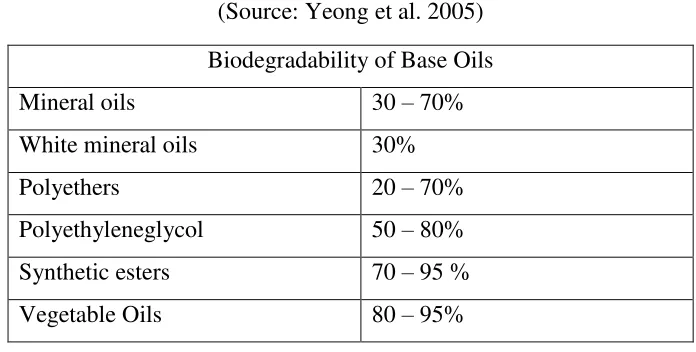
Austrian water protection regulation books. Table 2.1 shows the biodegradability level
of various base oils. Vegetable oil and synthetic ester show good biodegradability
[image:24.612.152.500.357.533.2](Yeong et al. 2005).
Table 2.1: Biodegradable level of selective oil
(Source: Yeong et al. 2005)
Biodegradability of Base Oils
Mineral oils 30 – 70%
White mineral oils 30%
Polyethers 20 – 70%
Polyethyleneglycol 50 – 80%
Synthetic esters 70 – 95 %
Vegetable Oils 80 – 95%
The enormous demand will be in Europe and Canada. This country has become
strongly concern about their environmental problem. The increment of environment
awareness among them had leaded them toward a keen investigation about the
production of vegetable oil as lubricant. It is seen as a potential source of
environmentally favorable lubricants due to combination of biodegradability,