Path Analysis on the Biopsychosocial Determinants of
Type 2 Diabetes Mellitus and Depression
at Dr. Moewardi Hospital, Surakarta
Esty Budiarti1), Didik Gunawan Tamtomo2), Rita Benya Adriani3)
1)Masters Program in Public Health, Universitas Sebelas Maret 2)Faculty of Medicine, Sebelas Maret University
3)Diploma Program in Speech Therapy, School of Health Politechnics Surakarta ABSTRACT
Background: Diabetes Mellitus (DM) is a a major disease that is threatening global population health. This disease ranks third by global public health priority. The incidence of type 2 DM in 2014 was 442 million patients worldwide. Indonesia is one of 10 countries with high DM incidence. The incidence of type 2 DM in Indonesia in 2014 was 10 million patients. This study aimed to examine the biopsychosocial determinants of type 2 Diabetes Melitus and depression at Dr. Moewardi Hospital, Surakarta, using path analysis.
Subjects and Method: This was an analytic and observational study with case control design. The study was conducted at Dr. Moewardi Hospital, Surakarta, from August to October, 2017. Sample consisting of 100 patients type 2 DM and 100 non DM patients were selected for this study by fixed disease sampling. The dependent variable was type 2 DM. The independent variables were body age, mass index, education level, occupation, stres, family income, comorbidity, activity, and family history of type 2 DM. The data were collected using medical record and questionnaire. The data were analyzed by path analysis.
Results: The risk of type 2 DM increased with higher body mass index(b= 2.66; 95% CI= 1.41 to 3.91; p<0.001), higher income (b=-0.93; 95% CI= -1.90 to 0.045; p=0.062), older age (b= 2.88; 95% CI= 0.62 to 5.15; p= 0.013), presence of DM family history (b= 2.56; 95% CI= 1.45 to 3.68; p <0.001), and comorbidity (b= 3.25; 95% CI= 2.07 to 4.43; p<0.001). The risk of depression increased by type 2 DM (b= 1.032; 95% CI= 0.42 to 1.63; p= 0.001). Body mass index increased with higher physical activity (b= -1.41; 95% CI= -2.03 to -0.79; p<0.001). Income increased with high education level (b= 2.58; 95% CI= 1.83 to 3.33; p<0.001). High physical activity increased with occupation (b=0.96; 95% CI= 0.38 to 1.53;p= 0.001).
Conclusion: The risk of type 2 DM increased with higher body mass index, higher income, older age, presence of DM family history, and comorbidity.
Keyword: biopsychosocial determinants, type 2 DM, depression
Correspondence:
Esty Budiarti. Masters Program in Public Health, Universitas Sebelas Maret, Jl. Ir. Sutami 36 A, Surakarta 57126, Central Java. Email:[email protected].
BACKGROUND
Diabetes Mellitus is a serious chronic disease. It ranks third out of non commu-nicable diseases that becomes global public health priority that consists of coronary heart disease, cancer disease, diabetes and chronic respiratory disease. Prevalence of diabetes in global adult population (≥18 year) keeps on increasing from year to year,
it doubled from 108 million patients (4.7%) in 1980 into 422 million patients (8.5%) in 2014 (WHO, 2016). There were more than 30% up to 40% undiagnosed diabetes cases found (Leong et al., 2014).
in 2040 and at the second rank are Sount East Asian countries with 78.3 million sufferers. Diabetes is the most leading cause of death in global adult population that causes 5 million deaths (IDF, 2015). More than 77% of morbidity rate and 88% of mortality rate occur in low and middle income country (Habtewold et al., 2016).
Indonesia is included into the 10 leading countries with diabetics. With 10 million diabetics of adult age between 20-79 years old, Indonesia ranks seventh after Mexico (IDF, 2015). Diabetes prevalence is increasing from 1.1% in 2007 into 2.1% in 2013. The prevalence of diagnosed diabetes occurs in Special Region of Yogyakarta Province (2.6%), Special Capital Region of Jakarta Province (2.5%), and Central Java ranks ninth (1.6%) per population (age ≥15 years old) (Riskesdas, 2013).
In Central Java Province, Diabetes ranks second among non communicable diseases, which is increasing from 15.77% in 2015 to 22.1% in 2016, number of type 2 diabetics (second trimester) of 2016 was 10,569 people and type 1 diabetics was 2,566 people per population (Dinas Kesehatan, 2016). The city of Surakarta ranked seventeenth in the prevalence of type 2 diabetes following Brebes with 2,363 cases in 2015 (Dinas Kesehatan Jawa Tengah, 2015).
Diabetes cases in Surakarta is included into the top 10 of non commu-nicable diseases (Profil Kota Surakarta, 2014). One of the biggest referral hospitals in southern part of Surakarta is Dr. Moewardi hospital and type 2 diabetes belonged to the top 4 of outpatient care diseases in 2016 following hypertension, breast cancer, and outpatient care (RSUD Dr. Moewardi, 2016).
Biological determinant of diabetes is related to the increasing risk of diabetes. Family history increases the possibility of
contracting diabetes (Leong et al., 2014). Diabetes is related to the increasing psychological pressure because of the increasing risk of complication (Raymond and Lovell, 2016). People with high psy-chological pressure are likely to contract diabetes by 33% (Mommersteeg et al., 2012). Depression on diabetes patients is twice higher with 15% up to 30% of diabetes patients who meet depression criteria. Depression is found among dia-betics groups (Setyani, 2012).
People with diabetes have higher incidence of depression compare to general people and depression often precedes diabetes diagnosis. Depression probably is is an independent risk factor for diabetes however mechanism that relates diabetes and depression, whether depression precedes diabetes or diabetes that causes depression, is not yet definite (Dunning, 2013).
The remain high number of diabetes incidences in Surakarta and the occurrence of interaction among determinants that influence diabetes incidence, therefore the researchers was interested to conduct a study on “Analysis on the Biopsychosocial Determinants of Type 2 Diabetes Mellitus and Depression at Dr. Moewardi Hospital Surakarta", with biological determinants (BMI, age, family history, and comorbi-dity), social determinants (income, edu-cation, occupation), and psychological determinants (depression).
population was all patients who visited internal medicine polyclinic of Dr. Moewardi Hospital Surakarta. The inclu-sion criterion was subject of the study was able to answer the questionnaires well, whereas the exclusion criteria were patients with other type of DM, patients who were not able to answer the questions, dead or having psychiatric disorder.
The study employed fixed disease sampling with a total of 200 subjects, by using comparison 1:1. There were a total of 100 diabetes mellitus patients as the case sample and 100 patients as the control sample. Independent variables of the study were BMI, income, age, history, comor-bidity, activity, education, and occupation. Meanwhile dependent variables were type 2 DM and depression.
Operational definition of diabetes is a disease generated by endocrine system impairment indicated by the increasing level of blood glucose (hyperglycemia), which is measured by Biorad d-10. Depress-ion is an emotDepress-ional disorder in patient in which patient undergoes the feeling of anguish, quick temper, losing passion, and measured by using The Geriatric Depress-ion Scale (GDS) questDepress-ionnaires.
BMI is measuring body mass index based on body weight and height, by using Stature meter and body scale as the measuring instruments. Income is the maximal salary received by the respondents after working in one month period, it was measured by using questionnaires. Age is the age of the study subjects from birth up to the time of the study, it was measured by using questionnaires. Family history is problems suffered by direct relatives of the patients which are passed down, it was measured with questionnaires.
Comorbidity is the disease correlated with type 2 DM, it was measured by using checklist from medical record data.
Physical activity is each body movement resulted by muscle for energy expenditure, it was measured by using Physical Activity Questionnaire for Diabetic Patients (PAQ-DP). Education is the highest level of education achieved by a study subject, it was measured by using questionnaires. Occupation is the job that takes respon-dents’ most time or the job that gives the biggest income, it was measured by questionnaires.
Data analysis of the study was by using path analysis to identify how significant the determinants influence, both directly and indirectly. The path analysis steps in the study were model specification, model identification, model fit, parameter estimation and model re-specification. Research ethics among others were infor-med consent, anonimity, confidentiality ethical clearance. Ethical clearance of the study was conducted in Dr. Moewardi Hospital Surakarta.
RESULTS
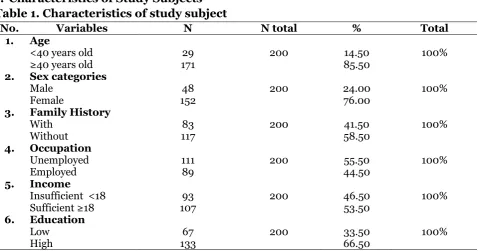
1. Characteristics of Study Subjects Table 1. Characteristics of study subject
No. Variables N N total % Total were model specification, model identifi-cation, parameter estimation, and model re-specification. The number of measured variables was 10, endogenous variables were 5 and exogenous variables were 5. Thus, it obtained degree of freedom (df): 36. Therefore it concluded that df was over identified which meant path analysis was possible to conduct.
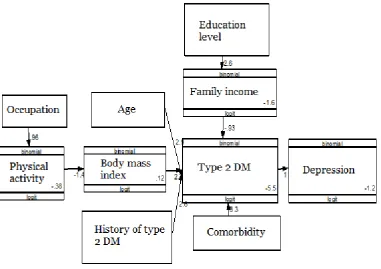
Structural model with estimation was showed in figure 2 and the result of path analysis on type 2 DM showed in Table 3. Model in the study was appropriate with the sample data showed by saturation model and also regression coefficient which was worth more than zero and statistically significant, therefore it did not need a remake.
Table 3 showed that there was an association between type 2 DM and depression and statistically significant. Patients with type 2 DM who had logit
score 1.032 were more at risk to suffer from depression than non type 2 DM (b= 1.032; CI 95%= 0.42 up to 1.63; p= 0.001). There was an association between BMI and the increasing logit of type 2 DM risk and statistically significant. Patients with higher BMI who had logit score 2.66 unit were more at risk to suffer from type 2 DM than those with normal BMI (b= 2.66; CI 95%= 1.41 to 3.91; p<0.001).
Table 2. Result of path analysis on determinants associated with type 2 DM Dependent Variable Independent
Variables Coeff.
E95% CI
p Lower Limit Upper Limit
Direct Effect
Depression Type 2 DM 1.03 0.42 1.63 0.001
Type 2 DM BMI 2.66 1.41 3.91 <0.001
Income -0.93 -1.90 0.04 0.062
Age 2.88 0.62 5.15 0.013
History 2.56 1.45 3.68 <0.001
Comorbidity 3.25 2.07 4.43 <0.001
Indirect
BMI Activity -1.41 -2.03 -0.79 <0.001
Income Education 2.58 1.83 3.33 <0.001
Activity Occupation 0.96 0.38 1.53 0.001
Number of obs = 200 Log likelihood =-544.48542
There was an association between family history and the increasing logit of type 2 DM risk and it was statistically significant. Patients with DM in their family history who had logit score 2.56 unit were more at risk to suffer from type 2 DM than those without DM in the family history (b=2.56; CI 95%= 1.45 to 3.68; p<0.001). There was an association between comor-bidity and the increasing logit of type 2 DM
risk and it was statistically significant. Patients with comorbidity who had logit score 3.25 were more at risk to suffer from type 2 DM than those without comorbidity (b= 3.25; CI 95%= 2.07 to 4.43; p<0.001)
activities (b= -1.41; CI 95%=-2.03 to -0.79; p<0.001). There was an association between education and income and it was statistically significant. Patients with high level of education who had logit score 2.58 were more likely to have sufficient income than those with low level of education (b=2.58; CI 95%= 1.83 to 3.33; p<0.001). There as an association between occupation and activity and it was statistically signi-ficant. Patients with outdoor occupation who had logit score 0.96 were more likely to have sufficient activity than those who were unemployed (b=0.96; CI 95%= 0.38 up to 1.53; p=0.001).
DISCUSSION
1. The association of type 2 DM and depression
The result of the study showed that type 2 DM increased the risk of depression. Ell et al. (2015) mentioned that depression increases the risk of type 2 diabetes deve-lopment for about 60% and diabetes increases the risk of depression for about 15%, there is also an evidence that depress-ion with diabetes is associated with the increasing risk of morbidity, mortality and medical utilization and high cost of health.
Depression is closely associated with type 2 DM, depression proportion on type 2 DM is (61.8%) higher than non type 2 DM patients (30%) (Mirghani and Elbadawi, 2016). In line with a study by Isworo and Saryono (2010) that showed as many as 85 (78%) DM patients who were depressed had poor blood glucose level, DM patients who were depressed were 18.89 times likely to have poor blood glucose level. Depress-ion can be a component of insulin resist-ance syndrome. People with diabetes are becoming depressed because of the burden of serious disease, family, medicines espe-cially insulin, stigmas related to diabetes in the family and society, uncertainty of the
future (Dunning, 2013).
The result of a study by Setyani (2012) showed that the Pearson’s corre -lation coefficient= 0.42 and p= 0.003. It indicated the existence of significant posi-tive correlation between depression and blood glucose level on patients of type 2 diabetes mellitus with moderate correlation power. It was in accordance with a study by Adillah (2016) showed that there was an association between depression and blood glucose level on patients of type 2 DM. depression was associated with the increasing level of casual blood glucose (CBG), fasting blood glucose (FBG) and postprandial blood glucose (PPG) with the significance value (p= 0.001).
A study by Hutama dan Rochmawati (2015) found that there were a total of 27.8% diabetes mellitus patients suffered from depression, with the result of 72.2%, mild depression 16.7%, moderate depress-ion 8.3% and heavy depressdepress-ion 2.8%, in which demography factors were not related to depression.
2. The association of BMI and Type 2 DM
The result of the study showed that BMI increased the risk of contracting type 2 DM, it was supported by Trisnawati and Setyo-rogo (2013) with variable related to type 2 DM incidences was Body Mass Index. A study by Asamsama et al. (2015) showed indirect effect type 2 DM toward depression through BMI.
BMI plays as the screening for type 2 DM disease or as the marker factor of pre-diabetes, risk factor such as overweight may reduce the number of diabetes and well as pre-diabetes cases and reduce the type 2 diabetes-related complications
BMI >85 percentile which means over-weight is at risk for type 2 DM or which will develop type 2 DM in the future.
Unlike a study conducted by Nur et al. (2016), the result of the study showed that BMI did not give any effect toward type 2 DM, similar to a study conducted by Setyaningrum dan Sugiyanto (2015) in which the result showed that there was no association between obesity and type 2 DM incidences. A study conducted by. Rahayu et al. (2011) showed that there was no significant association between obesity and Diabetes Mellitus incidences.
3. The association of income and type 2 DM
The result of the study showed that income decrease the risk of contracting type 2 DM. Januszewska et al. (2017) states that type 2 diabetes inflicts gap on economy health. Low social economy status may be related to less frequent in using healthcare service and it worsens health status. According to WHO (2011) social determinants such as income indirectly affects type diabetes.
The result of a study by Arumsari (2017) stated that Minimum Regional Wage significantly negatively effects poverty level. The higher the received wage is, the poverty level is likely to sag. With the increasing wage at the intended work place, the urge to get the job for the the applicants is getting higher, thus will be able to lower down the significance of poverty level. Accordingly, the poverty level is affected by the level of regional minimum wage per capita.
The result of a study by Mongisidi (2014) for the association between the level of income and type DM incidences indi-cated that there was a significant asso-ciation between income and type 2 DM. In accordance with a study by Sukmaningsih (2016) that showed that there was a significant association between low income
with the quality of life of type 2 DM patients. Low income might affect the already existing DM. Financial constraints would limit the respondents to seek for information, treatments, and medications for themselves.
The result of a study by Bird et al.
(2015) showed household income is
strong-ly and independentstrong-ly related to type 2 diabetes prevalence. Income is an import-ant factor, however it is often ignored for type 2 diabetes and it is feasible for further investigation, appropriate public debate and timely policy intervention.
Unlike a study Isworo dan Saryono
(2010) that showed the result that there
was no significant association between economy status and blood glucose level of type 2 DM patients.
4.The association of age and type 2 DM
The result of the study showed that age ≥40 years old increased the risk of contracting type 2 DM. It is supported by a study conducted by Trisnawati and Setyorogo (2013) which showed that there was a significant association. Age group of <45 years old is a group which is less at risk for suffering from type 2 DM. Mommersteeg et al. (2012) stated that age affects the occurrence of diabetes, Heryana (2006) stated that the function of beta cell in pancreas will be decreasing along with the addition of age. In the age of 40 years old, human in general undergo physiology degradation more rapidly.
intolerance toward glucose which occurs at those ages.
A study by Ramadhan and Marissa (2015) mentioned that age group of 41-64 years possessed the risk of Diabetes Mellitus 3.3 times higher than age group of 25 – 40 years. The result of a study by Muflikhatin and Fahrudini (2013) showed that there was an association between age and type 2 DM incidences. A study by Rahayu et al. (2011) showed that there was a significant association between age and Diabetes Mellitus incidences.
It was nothing like a study by Nur et al. (2016) which showed that there was no significant association between age and blood glucose level. It was supported by a study by Faridah and Dewintasari (2016) that there was no significant association between age and quality of life (p= 0.096). 5.The association between family
history and type 2 DM
The result of the study showed that family history increased the risk of contracting type 2 DM, it was similar with a study conducted by Frankilawati (2013) which statistically significant in showing that respondents with DM family history were 5 times at higher risk for type 2 DM. It was in accordance with a study conducted by Muflikhatin and Fahrudini (2013) which showed that the result of statistical test obtained result that respondents with type 2 DM descendant were 23.1 times at higher risk for suffering from type 2 DM than those without history of type 2 DM des-cendant. Children whose parents suffered from type 2 Diabetes Mellitus have bigger risk to suffer from type 2 DM than those whose parents did not suffer from type 2 DM.
A study conducted by Palimbunga et al. (2016) showed that there was a significant association between DM inci-dences and family history. Respondents
with DM family history were 4.33 times at higher risk for suffering from type 2 DM. It was different from Chandra and Ani (2013) which showed that there were more respondents with no DM history than respondents with DM history that was 28 out of 50 respondents (56%).
Diabetes usually is descended through family history that is suffering from diabetes, it is possible to happen since the descended DNA by family members with diabetes will be transformed through genes or (Alsahli and Gerich, 2012)
6.The association of co-morbidity and type 2 DM
The result of the study showed that co-mor-bidity increased the risk of contracting type 2 DM. prevalence of DM co-morbodity and hypertension is 4.5% of general adult population in India. DM, hypertension and dyslipidemia (Tripathy et al., 2017).
In all hospitals in Canada all patients being treated with diabetes also had hyper-tension co-morbidity (59.6%), glomerular abnormality (59.8%), peripheral angiopa-thy (68.2%), acute kidney failure (60.7%), dehydration (54.5%) congestive heart failure (57.4%) (Wielgosz et al., 2016).
there was no significant association between co-morbidities and quality of life with significance value was 0.17.
7. The association between physical activities and type 2 DM through BMI
The result of the study showed that physical activities decrease BMI. The result of the study by Da Silva et al. (2015) showed that there was a significant association between body mass index and physical activities with the risk of type 2 DM development.
The result of a study conducted by
Cloostermans et al. (2015) showed that
individuals who underwent obesity and had low physical activities were 7.4 times at higher risk of type 2 diabetes than people with normal weight, and active high physical activity.
Exercise and physical activities are beneficial to control blood glucose level and lose weight for patients of diabetes mellitus, it is supported by a study conducted by Rondonuwu et al. (2016) which showed that that there was an association between sport behavior and blood glucose level of Diabetes Mellitus patients. It is different from the result of a study conducted by Hellen et al. (2015) that the effect of physical activities toward BMI was not significant, however physical activities brought metabolism advantage and minimized the risk factors of type 2 DM. The result of a study conducted by Vidal-Perachoet al. (2014) showed that daily activities of diabetes patients was affected by the level of HbA1c and obesity that gave disturbance on daily activities such sleeping disorder and others.
8.The association of education and type 2 DM through income
The result of the study showed that education increased income. Education may affect income, with high education someone will be able to get the opportunity
to get a job and consequently will be followed by better income (Matias, 2012). Education is one of the factors that affect knowledge. The higher the education is, the better the knowledge will be (Sukmaningsih et al., 2016).
Education plays an important role in reducing poverty rate since education positively affects income. Income will be increasing when the quality of human resources is increasing, thus it may help the society to be free from poverty. In bottom line, people with high education are likely to have better rate of income, because they obtain bigger opportunity to get a job with higher minimum wage rate (Arumsari, 2017). However there are also people who state that people with higher income will tend to have unhealthy eating pattern, they are likely to often consume excessive sugar and fat and also have less activities (Riyadi dan Sukarmin, 2008).
The increasing diabetes incidence was also encouraged by education level factor and it gives influence toward DM incidence. People with high level of education usually will have a lot of knowledge on health, have an awareness to maintain health and it influences the physical activities to be carried out. Society’s lack of knowledge on diabetes mellitus, leads to unawareness toward their own health, and realize that they suffer from DM after they get severely ill (Ramadhan dan Marissa, 2015).
The association of education level and blood glucose level is observed on the statistical analysis that there is a significant association between education level and blood glucose level also DM patients with low education level are 2.4 times more likely to have poor blood glucose level than those who have high education level (Isworo, 2008)
showed there was no association between education level and type 2 DM incidence (p= 0,914). It is in line with the result of a study conducted by (Palimbunga et al., 2016) which showed that there was no association between type 2 DM and education level. It is also in accordance with a study by Nur et al. (2016) that there was no association between education and DM incidences.
9.The association between occupa-tion and type 2 DM through activity The result of the study showed that occupation increase activity. Lack of activity may significantly increase the risk of micro-vascular complications on type 2 diabetes patients (Khanam et al., 2017). A study conducted by Sukmaningsih (2016) showed that type of occupation may contribute in the emergence of diseases through the occurrence or absence of phy-sical activity in the occupation, therefore it can be said that one’s occupation affects the level of physical activity. Physical activity is a dominant risk factor for type 2 DM incidence. One with low physical activity possesses 14.92 times bigger risk of type 2 DM than one with high physical activity.
The result of bivariate test obtained from the study conducted by Palimbunga et al. (2016) showed that there was an association between occupation and type 2 DM incidence type 2 DM (OR= 2.72; 95% CI= 1.27 to 5.81; p = 0.015), it is in accord-ance with a study by Mongisidi (2014) which showed that there was an association between occupation and type 2 DM.
It is different from a study by Nur et al. (2016) which stated that there was no significant association between physical activity also occupation and blood glucose level of type 2 DM patients.
Based on the result of the study it can be concluded that there is a direct and positive association between depression,
BMI, age, DM family history also comor-bidity and type 2 DM. There is an indirect and positive association between education through income also occupation through activity and type 2 DM. There is an indirect and negative association between activity through BMI and type 2 DM.
REFERENCES
Adillah FN (2016). Hubungan Depresi Dengan Kontrol Glikemik Pada Lansia Penderita DM Tipe 2. Uni-versitas Muhammadiyah Semarang. Alsahli M, Gerich JE (2012). Atlas of
Diabetes. Editor: Skyler JS. USA: Springer
Arumsari (2017). Analisis Pengaruh Per-tumbuhan Ekonomi, Pengangguran, Pendidikan, UMR Dan Pengeluaran Pemerintah Terhadap Tingkat Kemis-kinan Di Provinsi Jawa Tengah Tahun 2011-2014. Universitas Muhammadi-yah Surakarta.
Asamsama OH, Lee JW, Morton KR, Tonstad S (2015). Bidirectional Longi-tudinal Study of Type 2 Diabetes and Depression Symptoms In Black and White Church Going Adults Bidirec-tional Longitudinal Study of Type 2 Diabetes and Depression Symptoms in Black and White Church Going Adults. Journal of Diabetes & Meta-bolic Disorders, 14:25. doi: 10.11-86/s40200-015-0150-5.
Bertalina A (2013). Hubungan Pengetahuan Terapi Diet dengan Indeks Glikemik Bahan Makanan yang Dikonsumsi Pasien Diabetes Mellitus. Jurnal Kesehatan, 7(3):377-387.
popu-lation-based study in Saskatchewan, Canada. International Journal for Equity in Health, 14(1), pp. 1–8. doi: 10.1186/s12939-015-0237-0.
Chandra AP, Ani L (2013). Gambaran Riwayat Diabetes Mellitus Keluarga, Indeks Massa Tubuh Dan Aktivitas Fisik pada Penderita Diabetes Mel-litus Tipe 2 di Wilayah Kerja Pus-kesmas Manggis 1 Tahun 2013. Uni-versitas Udayana.
Cloostermans L, Wendel-vos W, Doornbos G, Howard B, Craig CL, Kivimaki M, Tabak AG, et al. (2015). Independent and combined effects of physical activity and body mass index on the development of Type 2 Diabetes–a meta-analysis of 9 prospective cohort studies, International Journal of Behavioral Nutrition and Physical Activity. doi: 10.1186/s12966-015-0304-3.
Da silva A, Gomes R, Carvalho LA, Mayra A, Silva L, Luísa A, Santos B, Maria T, Moreira M (2015). Association of body mass index and physical activity with the risk of developing type 2 diabetes mellitus in the next decade. Diabetology & Metabolic Syndrome. doi: 10.1186/1758-5996-7-S1-A155. Dinas Kesehatan Profinsi Jawa Tengah
(2015). Profil Kesehatan Provinsi Jawa Tengah. Semarang: Dinas Kese-hatan.
Dinas Kesehatan (2016). Buku Saku Kese-hatan KeseKese-hatan Triwulan Dua Tahun 2016. Semarang: Dinas Kesehatan. Dunning T (2013). Care of People with
Diabetes A Manual of Nursing Prac-tice Fourth Edition. UK: Wiley Blackwell.
Egan B, Yumin Z, Walter Ab (2013) Epi-demiology Of Hypertension In Dia-betes. Editor: Samy I. Mcfarlane. Brooklyn , Ny, USA.
Ell K, Katon W, Lee PJ, Guterman J, Wu S (2015). Demographic, Clinical And Psychosocial Factors Identify A High-Risk Group for Depression Screening Among Predominantly Hispanic Patients With Type 2 Diabetes In Safety Net Care. General Hospital Psychiatry, 37: 414-419. doi: 10.101-6/j.genhosppsych. 2015.05.010. Faridah IN, Dewintasari V (2016).
Hubung-an Usia dHubung-an Penyakit Penyerta ter-hadap Kualitas Hidup Pasien Dia-betes Mellitus Tipe 2 di Puskesmas Kotagede 1 Yogyakarta. Prosiding Rakernas dan Pertemuan Ilmiah Tahunan, pp. 123–126.
Frankilawati (2013). Hubungan Antara Pola Makan, Genetic Dan Kebiasaan Olahraga Terhadap Kejadian Dm Tipe 2 Di Wilayah Kerja Puskesmas Nusukan Surakarta. Fakultas Ilmu Keseatan Universitas Muhammadiyah Surakarta.
Habtewold TD, Islam A, Radie YT, Tegegne BS (2016). Comorbidity of Depression and Diabetes: an Application of Biopsychosocial Model, International Journal of Mental Health Systems. BioMed Central, 1–9. doi: 10.1186/-s13033-016-0106-2.
Hellen C, Alves R, Aparecida S, Souza FD, Caroline N, Azevedo VD (2015). Com-paring the Level of Physical Activity in Women With Type 2 Diabetes. Diabe-tology & Metabolic Syndrome. doi: 10.1186/1758-5996-7-S1-A236.
Heryana OA (2006). Faktor Risiko Diabetes Melitus tipe 2. Universitas Esa Unggul.
International Diabetes Federation (2015). IDF Diabetes Atlas Seventh Edition 2015. UK: International Diabetes Federation.
Isworo A (2008). Hubungan Depresi Dan Dukungan Keluarga Terhadap Kadar Gula Darah Pada Pasien Diabetes Mellitus Tipe 2 Di RSUD Sragen. Universitas Indonesia, Depok.
Isworo A, Saryono (2010). Hubungan De-presi dan Dukungan Keluarga Ter-hadap Kadar Gula Darah pada Pasien Diabetes Mellitus Tipe 2 di Rsud Sragen. Jurnal Keperawatan Soedir-man, 5:1.
Januszewska AG, Lindström J, Tuomilehto J, SolskaBP, Mądry RT, Szybinski Z, Peltonen M, Schwarz PEH, Windak A,Dydejczyk AH (2017). Sustained Diabetes Risk Reduction After Real Life And Primary Health Care Setting Implementation Of The Diabetes In Europe Prevention Using Lifestyle, Physical Activity And Nutritional Intervention (DE-PLAN) Project. BMC Public Health, 17:198, doi: 10.1186/s12889-017-4104-3.
Khanam PA, Hoque S, Begum T, Habib SH, Latif ZA (2017). Microvascular Complications and Their Associated Risk Factors in Type 2 Diabetes Mellitus, Diabetes & Metabolic Syn-drome: Clinical Research & Reviews. Diabetes India, 11: S577–S581. doi: 10.1016/j.dsx.2017.04.007.
Leong, A, Rahme E, Dasgupta K (2014). Spousal Diabetes As A Diabetes Risk Factor: A Systematic Review and Meta-Analysis. BMC Medicine, 12:12. Lukacs A, Toth EK, Csordas A, Sasvari P,
Barkai L (2017). Screening Risk Factors For Type 2 Diabetes in Overweight and Obese Adolescents in School Settings of Hungary: A Popu-lation-Based Study. Journal of King
Saud University–Science, 1018-3647. doi: org/10.1016/j.jksus. 2017.01.006. Matias S (2012). Kemiskinan dan Solusi.
Medan: Grasindo.
Mirghani HO, Elbadawi AS (2016). De-pression, Anxiety, and Daytime Sleep-iness Among Type 2 Diabetic Patients and Their Correlation With the Dia-betes Control: A Case-Control Study. Journal of Taibah University Medical Sciences, Elsevier Ltd, 11(4) :374- 379.doi:10.1016/j.jtumed.2016.05.0-09.
Mommersteeg PMC, Herr R, Zijlstra WP, Schneider S, Pouwer F (2012). Higher Levels of Psychological Distress Are Associated with a Higher Risk of Incident Diabetes During 18 Year Follow-Up: Results from The British Household Panel Survey. BMC Public Health, 12:1109. doi: 10.1186/1471-2458-12-1109.
Mongisidi G (2014). Hubungan Antara Status Sosio-Ekonomi dengan Keja-dian Diabetes Mellitus Tipe 2 di Poliklinik Interna Blu RSUP Prof. Dr. R. D. Kandou Manado. FKM Sam Ratulangi.
Muflikhatin SK, Fahrudin. (2013). Hu-bungan Antara Usia, Riwayat Ketu-runan dan Pola Makan Dengan Ke-jadian Diabetes Mellitus Tipe 2 Di Ruang Flamboyan RSUD Abdul Wahab Sjahranie Samarinda. Sama-rinda.
Nur A, Fitria E, Zulhaida A, Hanum S (2016). Hubungan Pola Konsumsi Dengan Diabetes Melitus Tipe 2 pada Pasien Rawat Jalan di RSUD Dr. Fauziah Bireuen Provinsi Aceh. Media Litbangkes, 26: 3: 145-150.
Pan-caran Kasih Manado. Universitas Sam Ratulangi Manado.
Profil Kesehatan Kota Surakarta (2014). Profil Kesehatan Kota Surakarta Tahun 2014. Surakarta: Jawa Tengah. Rahayu P, Utomo M, Setiawan R (2011).
Hubungan Antara Faktor Karakteris-tik, Hipertensi Dan Obesitas Dengan Kejadian Diabetes Mellitus Di Rumah Sakit Umum Daerah Dr. H. Soewondo Kendal. Universitas Muhammadiyah Semarang.
Ramadhan N, Marissa N (2015). Karak-teristik Penderita Diabetes Mellitus Tipe 2 Berdasarkan Kadar Hba1c Di Puskesmas Jayabaru Kota Banda Aceh. Media of Health Research and Development, 2(2): 49-56.
Raymond K, Lovell GP (2016). Journal of Diabetes and its Complications Food addiction Associations with Psycho-logical Distress among People with Type 2 Diabetes. Journal of Diabetes and Its Complications. Elsevier Inc, 30(4): 651–656. doi: 10.1016/j.jdia-comp.2016.01.020.
Riset Kesehatan Dasar (2013). Hasil Ris-kesdas 2013. Jakarta: Riset Kesehatan Dasar .
Riyadi S, Sukarmin (2013). Asuhan Kepe-rawatan pada Pasien dengan Ganggu-an Eksokrin dGanggu-an Endokrin Pada PGanggu-an- Pan-kreas. Yogyakarta: Graha Ilmu.
Rondonuwu RG, Rompas S, Bataha Y (2016). Hubungan Antara Perilaku Olahraga Dengan Kadar Gula Darah Penderita Diabetes Mellitus di Wila-yah Kerja Puskesmas Wolaang Keca-matan Langowan Timur. Ejournal Keperawatan, 4:1.
RSUD Dr. Moewardi (2016). Laporan Kinerja RSUD Dr. Moewardi. Su-rakarta.
Setyani T (2012). Hubungan Tingkat Depresi Dengan Kadar Gula Darah
Pada Penderita Diabetes Melitus Tipe 2 Di Rumah Sakit Umum Daerah Karanganyar. Universitas Muham-madiyah Surakarta.
Setyaningrum DE, Sugiyanto Z (2015). Faktor Risiko yang Berhubungan Dengan Kejadian Diabetes Melitus Tipe II pada Usia Kurang Dari 45 Tahun di RSUD Tugurejo Semarang. Universitas Dian Nuswantoro.
Spurr S, Bally J, Bullin C, Trinder K (2017). Type 2 Diabetes in Canadian Abo-riginal Adolescents: Risk Factors and Prevalence. Journal of Pediatric Nursing. Elsevier Inc, 36: 111–117. Sukmaningsih W (2016). Faktor Risiko
Kejadian Diabetes Mellitus Tipe IIdi Wilayah Kerja Puskesmas Purwo-diningratan Surakarta. Fakultas Ilmu Kesehatan Universitas Muhamma-diyah, Surakarta.
Tripathy JP, Thakur JS, Jeet G, Jain S (2017). Prevalence and Determinants of Comorbid Diabetes and Hyper-tension: Evidence from Non Commu-nicable Disease Risk Factor STEPS survey, India, Diabetes and Metabolic Syndrome: Clinical Research and Reviews. 11: S459–S465.doi: 10.1016-/j.dsx.2017.03.036.
Trisnawati SK, Setyorogo S (2013). Faktor Risiko Kejadian Diabetes Melitus Tipe II di Puskesmas Kecamatan Ceng-kareng Jakarta Barat Tahun 2012. Jurnal Ilmiah Kesehatan 5(1): 6–11. Vidal PC, Lucha LMO, Lucha LAC, Tricas
MJM, Miguel E, Bernues VL (2014). A Descriptive Study of Health Status And Health Related Quality of Life In Selected Outpatients With Type 2 Diabetes, Pathological Body Mass Index And Cardiovascular Risk In Spain. Journal of Diabetology & Metabolic Syndrome, 6:35.
Celebican E (2016) Comorbid Condi-tions in Canadians Hospitalized Be-cause of Diabetes, Canadian Journal of Diabetes. Elsevier Inc, 1–6. doi: 10.1016/j.jcjd.2017.03.004.
WHO (2011). World Health Statistic 2011. Switzerland: WHO press.