Burt Beckwith
Programming Grails by Burt Beckwith
Copyright © 2013 Burt Beckwith. All rights reserved.
Printed in the United States of America.
Published by O’Reilly Media, Inc., 1005 Gravenstein Highway North, Sebastopol, CA 95472.
O’Reilly books may be purchased for educational, business, or sales promotional use. Online editions are also available for most titles (http://my.safaribooksonline.com). For more information, contact our corporate/ institutional sales department: 800-998-9938 or [email protected].
Editors: Mike Loukides and Meghan Blanchette Production Editor: Kristen Borg
Copyeditor: Absolute Services, Inc Proofreader: Linley Dolby
Indexer: Judy McConville Cover Designer: Karen Montgomery Interior Designer: David Futato Illustrator: Robert Romano
May 2013: First Edition
Revision History for the First Edition: 2013-04-22: First release
See http://oreilly.com/catalog/errata.csp?isbn=9781449323936 for release details.
Nutshell Handbook, the Nutshell Handbook logo, and the O’Reilly logo are registered trademarks of O’Reilly Media, Inc. Programming Grails, the image of an Antarctic giant petrel, and related trade dress are trademarks of O’Reilly Media, Inc.
Many of the designations used by manufacturers and sellers to distinguish their products are claimed as trademarks. Where those designations appear in this book, and O’Reilly Media, Inc., was aware of a trade‐ mark claim, the designations have been printed in caps or initial caps.
While every precaution has been taken in the preparation of this book, the publisher and author assume no responsibility for errors or omissions, or for damages resulting from the use of the information contained herein.
ISBN: 978-1-449-32393-6
Table of Contents
Preface. . . xi
1. Introduction to Groovy. . . 1
Installing Groovy 1
Groovy Console 2
Optional Typing 3
Collections and Maps 4
Properties 5
Using the AST Browser 7
Decompiling with JD-GUI 8
Decompiling with javap 8
Closures 8
Interface Coercion 11
Programmatic Closures 11
Owner, Delegate, and this 12
Groovy’s Contributions in the War Against Verbosity 13
Constructors 14
Checked Exceptions 15
Groovy Truth 15
Semicolons 16
Optional Return 16
Scope 16
Parentheses 16
Default Imports 16
Differences Between Java and Groovy 17
Array Initialization 17
in and def Keywords 17
do/while Loops 17
Annotations 18
Groovy Equality 18
Multimethod Dispatch 18
Groovy Strings 19
Static this 20
The Groovy JDK (GDK) 21
DefaultGroovyMethods and InvokerHelper 21
Metaprogramming and the MOP 21
Adding Methods 22
Intercepting Method Calls 23
Operators 26
Null-Safe Dereference 26
Elvis 26
Spread 27
Spaceship 27
Field Access 28
as 28
in 28
Method Reference 29
Overload Your Operators 29
Being Too Groovy 31
def Considered Harmful 31
Closures Versus Methods 32
TypeChecked, CompileStatic, and invokedynamic 33
2. Grails Internals. . . 35
Installing Grails 38
Creating an Application 38
The Grails Command Line 39
IDE Support 41
Plugins 42
Optional Plugins 43
Core Plugins 45
Conventions 57
Controller and View Conventions 57
Service Conventions 60
Domain Class Conventions 61
More Information 65
3. Persistence. . . 67
Data Mapping 67
Data Validation 69
Custom Validation 72
Extreme Custom Validation 74
Validation Plugins 75
Friendly Error Messages 75
Blanks Versus Nulls 76
Transients 77
Mapping Collections 78
Querying 80
Saving, Updating, and Deleting 82
NoSQL Support 84
4. Spring. . . 85
Inversion of Control and Dependency Injection 85
Complex Dependency Configuration Using Spring SpEL 86
Manually Injecting Dependencies at Runtime 87
Bean Scopes 87
Transactional Services 88
@Transactional 89
Transaction Proxies 90
Transaction Utility Methods 93
Bean Life Cycles and Interfaces 94
Bean Postprocessors 95
A Groovier Way 96
Bean Aliases 97
Internationalization 98
Resources 98
Resource Dependency Injection 99
ResourceLocator 100
Data Binding and Validation 101
Data Binding 101
Validation 102
Database Persistence 102
Thread-Local Holders 103
JdbcTemplate 103
Other Database Support 104
Spring MVC 104
Filters 105
Using Spring MVC Controllers 106
Remoting 107
Client Access 108
EJBs 110
JMX 110
Email 111
Cache Abstraction 111
5. Hibernate. . . 113
Mapping Domain Classes 113
Dialects 115
Dialect Autodetection 116
Dialect Customization 116
Hibernate Without GORM 118
hibernate.cfg.xml 118
HibernateUtil 119
Author 120
Book 120
Experimenting with the APIs 121
The Session 123
withSession 124
withNewSession 124
Open Session in View 124
Disabling OSIV 125
Custom User Types 126
Optimistic and Pessimistic Locking 129
Accessing the Session’s Connection 130
schema-export 130
SQL Logging 131
Proxies 133
equals, hashCode, and compareTo 134
Caching 135
Examples 136
Caching API 139
Query Caching Considered Harmful? 140
HQL 141
executeQuery 141
Query Syntax 142
Report Queries 143
Aggregate Functions 144
Expressions 145
Collections 145
Collections Performance 145
The Solution 146
Custom Configurations 148
Mapping Views and Subselect Classes 150
Subselect Domain Classes 152
Selecting with a POGO 153
get(), load(), and read() 154
get() 154
load() 154
read() 156
Performance 156
Caching 156
Lazy Loading 157
Transactional Write-Behind 158
6. Integration. . . 159
JMS 159
XA Support with the Atomikos Plugin 163
Mail 167
Sending Email 168
Sending Email Asynchronously 171
Sending Email from Log4j 172
Testing 174
SOAP Web Services 174
The Server Application 175
The Client Application 176
TCPMon 179
REST 180
TCPMon 187
JMX 188
7. Configuration. . . 191
External config Files 191
Loading the Configuration 193
Partitioning Config Files 194
Splitting resources.groovy 195
Modularizing Within resources.groovy 196
Environment-Specific Spring Beans 198
Beans Closures in Config.groovy 201
Options for BuildConfig.groovy 201
Adding Additional Source Folders 202
Extra Folders Under grails-app 203
Creating a Plugin 205
Initial Steps 206
The Plugin Descriptor 209
Metadata 209
Life Cycle Callbacks 213
Splitting Applications into Plugins 218
Inline Plugins 218
Building and Releasing 219
Automated Testing 219
Running the Tests 224
Custom Plugin Repositories 224
Plugin Documentation 226
Custom Artifacts 227
Some Notes on Plugin Development Workflow 232
9. Security. . . 235
OWASP 235
A1: Injection 235
A2: Cross-Site Scripting (XSS) 238
A3: Broken Authentication and Session Management 241
A4: Insecure Direct Object References 242
A5: Cross-Site Request Forgery 244
A6: Security Misconfiguration 245
A7: Insecure Cryptographic Storage 246
A8: Failure to Restrict URL Access 248
A9: Insufficient Transport Layer Protection 248
A10: Unvalidated Redirects and Forwards 249
Security Plugins 250
spring-security-core 250
Other Plugins and Libraries 254
AntiSamy 254
ESAPI 254
HDIV 254
General Best Practices 255
10. The Cloud. . . 261
Cost Savings 262
What You Give Up 262
Cloud Foundry 263
Database Applications 263
Scaling 269
Monitoring and the Cloud Foundry UI Plugin 271
Heroku 275
Database Applications 275
Scaling 280
Build Packs 281
Other Providers 282
Other Uses for Cloud Services 282
11. AOP. . . 283
Grails Filters 284
HTTP Filters 286
Groovy AOP 287
Registering Metaclass Interceptors 290
Error Code URL Mappings 291
Spring AOP 291
Enabling Spring AOP 293
Defining AspectJ-Annotated Aspects 294
Compile-Time Weaving 297
12. Upgrading Applications and Plugins. . . 305
Why Doesn’t the Upgrade Script Do More? 308
A General Approach to Upgrading 310
Upgrading Petclinic: A Case Study 311
A Short History of Grails 320
Grails 1.2 320
Grails 1.2.2 321
Grails 1.2.4 321
Grails 1.3 322
Grails 1.3.1 323
Grails 1.3.2 323
Grails 1.3.4 323
Grails 1.3.6 324
Grails 1.3.7 324
Grails 1.3.8 324
Grails 1.3.9 324
Grails 2.0 325
Grails 2.0.2 331
Grails 2.1.x 331
Grails 2.2.x 331
Notes on Upgrading 331
Preface
I started using Grails in early 2008, about a month before the 1.0 release. Much has changed since then, but many aspects are still very much the same. Grails continues to be the fastest way to develop an application on the JVM and, as an added bonus, is a lot of fun. Grails saves you a tremendous amount of time by handling the plumbing work that you would ordinarily have to do yourself if you were using another framework, and you can save even more time by using some of the hundreds of plugins that are available. Plus, because you are targeting the JVM, the whole JVM ecosystem is available, and you can use any library that isn’t already included by Grails or a plugin.
I have always had a need to know how things work. Open source software makes that possible, because you can read the code, and it is particularly helpful when debugging since you can step into library and framework code from your IDE. But Grails adds a layer of opacity by providing so much dynamic behavior. All that magic is great when everything works, but when you have problems, it can be hard to know where to even start looking. When I started using Grails, I spent many hours exploring the internals, not only to understand how what I was seeing was possible, but also to determine whether the problems I was seeing were Grails issues or problems in my code. That experience was a large part of the motivation behind writing this book; I hope that by shining a light on some of the inner workings and motivations behind Grails features, your path will be easier.
Who This Book Is For
This should not be your first Grails book, since it presumes a good deal of previous experience and understanding, so be sure to read a more comprehensive Grails book first.
Other Resources
There are many resources available if you would like to find out more about Grails and Groovy.
There is a significant amount of information at the Grails site, in particular the reference documentation. Likewise, the Groovy site has years of collective information available. For a more general overview of Grails, there are two books available that cover Grails 2: The Definitive Guide to Grails 2 by Jeff Brown and Graeme Rocher (Apress), and Grails in Action, Second Edition by Glen Smith and Peter Ledbrook (Manning). Pro‐ gramming Groovy, Second Edition by Venkat Subramaniam (Pragmatic Programmers) is an excellent resource for Groovy, and the second edition covers Groovy 2, and Groovy in Action, Second Edition by Dierk König et al. (Manning), when finished, will be a comprehensive reference for all things Groovy.
There are several conferences around the world that feature Grails and other Groovy-based technologies:
Spring One 2GX
This is the largest and is held in the fall; it includes five tracks on Spring Framework technologies and four Groovy and Grails tracks
Groovy and Grails Exchange
Held in London each year in December
GR8Conf US
Held in Minneapolis each spring
GR8Conf Europe
Held in Copenhagen each spring
Greach
Held in Madrid each winter
All of these conferences have a significant amount of content on a wide range of tech‐ nologies in the Groovy ecosystem, and they attract the top experts in the field as speakers.
“This Week in Grails” blog series that lists Grails- and Groovy-related blog posts, tweets, job postings, and upcoming conferences and user group meetings each week.
Conventions Used in This Book
The following typographical conventions are used in this book:
Italic
Indicates new terms, URLs, email addresses, filenames, and file extensions.
Constant width
Used for program listings, as well as within paragraphs to refer to program elements such as variable or function names, databases, data types, environment variables, statements, and keywords.
Constant width bold
Shows commands or other text that should be typed literally by the user.
Constant width italic
Shows text that should be replaced with user-supplied values or by values deter‐ mined by context.
This icon signifies a tip, suggestion, or general note.
This icon indicates a warning or caution.
Using Code Examples
We appreciate, but do not require, attribution. An attribution usually includes the title, author, publisher, and ISBN. For example: "Programming Grails by Burt Beckwith (O’Reilly). Copyright 2013 Burt Beckwith, 978-1-44932-393-6.”
If you feel your use of code examples falls outside fair use or the permission given above, feel free to contact us at [email protected].
Safari® Books Online
Safari Books Online is an on-demand digital library that delivers ex‐ pert content in both book and video form from the world’s leading authors in technology and business.
Technology professionals, software developers, web designers, and business and crea‐ tive professionals use Safari Books Online as their primary resource for research, prob‐ lem solving, learning, and certification training.
Safari Books Online offers a range of product mixes and pricing programs for organi‐ zations, government agencies, and individuals. Subscribers have access to thousands of books, training videos, and prepublication manuscripts in one fully searchable database from publishers like O’Reilly Media, Prentice Hall Professional, Addison-Wesley Pro‐ fessional, Microsoft Press, Sams, Que, Peachpit Press, Focal Press, Cisco Press, John Wiley & Sons, Syngress, Morgan Kaufmann, IBM Redbooks, Packt, Adobe Press, FT Press, Apress, Manning, New Riders, McGraw-Hill, Jones & Bartlett, Course Technol‐ ogy, and dozens more. For more information about Safari Books Online, please visit us online.
How to Contact Us
Please address comments and questions concerning this book to the publisher:
O’Reilly Media, Inc.
1005 Gravenstein Highway North Sebastopol, CA 95472
800-998-9938 (in the United States or Canada) 707-829-0515 (international or local)
707-829-0104 (fax)
We have a web page for this book, where we list errata, examples, and any additional information. You can access this page at http://oreil.ly/programming-grails.
For more information about our books, courses, conferences, and news, see our website at http://www.oreilly.com.
Find us on Facebook: http://facebook.com/oreilly
Follow us on Twitter: http://twitter.com/oreillymedia
Watch us on YouTube: http://www.youtube.com/oreillymedia
Acknowledgments
Several people helped to make this book what it is today. Thank you to Peter Ledbrook for suggesting the idea at SpringOne 2GX 2011. My initial response was no, that there was no way that I would have the time to devote to a book. That was true, but I did it anyway, and it seems to have worked out okay. I would also like to thank Mike Loukides for supporting Grails at O’Reilly; I am hopeful this will be the first of many O’Reilly Grails and Groovy books.
I was fortunate having Meghan Blanchette as the book’s editor. Thank you for your patience, advice, and for keeping everything on schedule.
Graeme Rocher and Tomas Lin were the technical reviewers. They carefully read the book and found numerous mistakes and omissions, and made extensive suggestions. Andrew Eisenberg also provided valuable feedback on the AOP chapter. Thank you all for making this a better book than I could have alone.
Many thanks to the Grails, Groovy, and tools teams at SpringSource for creating these amazing technologies.
CHAPTER 1
Introduction to Groovy
We can’t talk much about Grails without a solid understanding of Groovy, because it’s so integral to how Grails works.
Groovy is a JVM language with a primary goal of extending Java. By adding a Meta Object Protocol (MOP) to enable metaprogramming, Groovy adds powerful capabili‐ ties that enable dynamic programming (changing and adding behavior at runtime), domain-specific languages (DSLs), and a huge number of convenience methods and approaches that simplify your code and make it more powerful.
Groovy compiles to bytecode just like Java does (although it creates different bytecode). As Java developers, we tend to think that only javac can compile source code to cre‐ ate .class files, but there are many JVM languages that do as well (including Groovy, JRuby, Jython, and hundreds more). There are also libraries such as BCEL that you can use to programmatically create bytecode. As a result, Groovy and Java interoperate well; you can call Java methods from Groovy and vice versa, a Java class can extend a Groovy class or implement a Groovy interface, and in general, you don’t need to even think about interoperability because it “just works.”
The Groovy equivalent of javac is groovyc, and because it compiles both Groovy and Java code, it’s simple to use for your project code. Of course in Grails applications, we rarely even think about this process (except when it fails) because Grails scripts handle that, but if you’re manually compiling code (e.g., in a Gradle build or with Gant), it’s about as simple as working with Java code.
Installing Groovy
standalone utility applications. Just download the version you want, unpack the ZIP file to your desired location, set the GROOVY_HOME environment variable point at the location you chose, and add the $GROOVY_HOME/bin (or %GROOVY_HOME%\bin in Windows) di‐ rectory to the PATH environment variable. That’s all you need to do; run groovy -v from a command prompt to verify that everything is working.
If you’re using Windows, the download page has installers that will install the distribu‐ tion and configure the environment.
There is also a new tool, GVM (Groovy enVironment Manager). It was inspired by the Ruby RVM and rbenv tools, and it will install one or more versions of Groovy, as well as Grails, Griffon, Gradle, and vert.x. It uses the bash shell, so it works in Linux, OS X, and Windows, if you have Cygwin installed. It’s very simple to use, and if you have projects that require different versions of Groovy, it’s easy to switch between them. See the GVM site for usage information.
Groovy Console
The Groovy console is a great way to prototype code. It doesn’t have many text editor or IDE features, but you can run arbitrary Groovy code and inspect the results. You can run it in debug mode and attach to it from a debugger (e.g., your IDE) to dig deeper and look at the call stack. It’s convenient to test an algorithm or a fix, or to do what-if experiments. And you don’t need to create a class or a main() method—you can execute any valid code snippet. If Groovy is installed and in your PATH, run the console by executing groovyConsole from the command line. I encourage you to test out the code examples as they’re shown to make sure you understand how everything works.
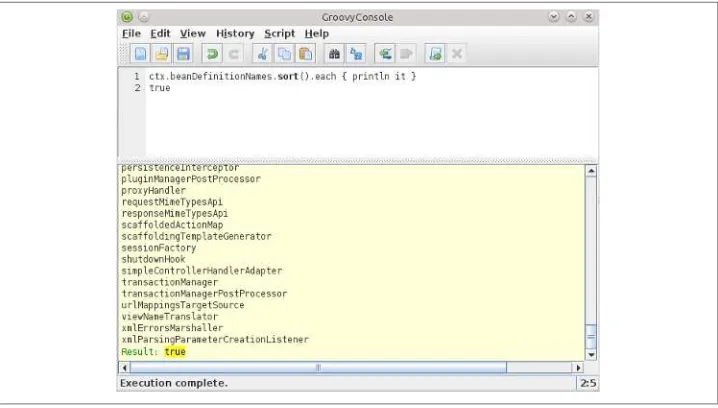
The Groovy console is also a part of Grails—you can run grails console from the command line and start the Grails version of the console. It’s the same application, but it also has Grails-specific hooks like easy access to the Spring ApplicationContext and automatic application of the PersistenceContextInterceptors. You can use it to call Grails object relational mapping (GORM) methods, services, and pretty much anything in your application that isn’t related to an HTTP request. As a plugin author, I often troubleshoot bean definition issues by running the following (as shown in Figure 1-1):
ctx.beanDefinitionNames.sort().each { println it }
true
Figure 1-1. Grails console
Optional Typing
One of Groovy’s strengths comes from its support of optional typing. You can define the types of variables, method parameters, method return values, and so on, like you do in Java, but you often don’t need to. Groovy determines the actual type at runtime and invokes the methods on the objects if they exist (or if you’ve added support to the metaclass; more on this later). The approach used is often called duck typing; i.e., if it walks and talks like a duck, consider it a duck.
This isn’t the same as weak typing. The objects themselves have a concrete type (unlike JavaScript, C, Perl, and so on), but you’re not restricted by the compiler to only invoke methods defined in the specified type of the object. If the object supports the call, it will work.
In fact, you’re not even restricted to hardcoding the method or property names. You can dynamically invoke a method or access a property value by name:
def person = ...
String methodName = ...
def value = person."$methodName"(1, 2)
String propertyName = ...
Collections and Maps
Creating and populating Java collections might not seem that bad if you haven’t seen how it’s done in Groovy, but once you have, you won’t want to go back. Here’s some code to add a few elements to an ArrayList in Java:
List<String> things = new ArrayList<String>();
things.add("Hello");
things.add("Groovy");
things.add("World");
And here’s the equivalent code in Groovy:
List<String> things = ["Hello", "Groovy", "World"]
The difference is rather stark, and using more idiomatic Groovy (there’s not much need for generics in Groovy), it’s even cleaner:
def things = ['Hello', 'Groovy', 'World']
Note that here I’m taking advantage of Groovy’s support for declaring strings using single or double quotes; this is described in more detail later in the chapter.
There isn’t a separate syntax for a Set, but you can use type coercion for that. Either:
Set things = ['Hello', 'Groovy', 'World']
or:
def things = ['Hello', 'Groovy', 'World'] as Set
The syntax for a Map is similar, although a bit larger, because we need to be able to specify keys and values delimited with colons:
def colors = ['red': 1, 'green': 2, 'blue': 3]
We can make that even more compact because, when using strings as keys that have no spaces, we can omit the quotes:
def colors = [red: 1, green: 2, blue: 3]
Lists and Maps support array-like subscript notation:
def things = ['Hello', 'Groovy', 'World']
assert things[1] == 'Groovy' assert things[-1] == 'World'
def colors = [red: 1, green: 2, blue: 3]
assert colors['red'] == 1
Maps go further and let you access a value using a key directly as long as there are no spaces:
def colors = [red: 1, green: 2, blue: 3]
assert colors.green == 2
Properties
You’ve heard of POJOs—Plain Old Java Objects—and JavaBeans. These are simple classes without a lot of extra functionality and, in the case of JavaBeans, they follow conventions such as having a zero-argument constructor and having getters and setters for their attributes. In Groovy, we create POGOs—Plain Old Groovy Objects—that are analogous and work the same way, although they’re more compact.
Consider a POJO that represents a person in your application. People have names, so this Person class should have firstName, initial, and lastName attributes to store the person’s full name. In Java, we represent those as private String fields with getter meth‐ ods, and setter methods if we’re allowing the attributes to be mutable. But often we don’t do any work when setting or getting these values—we just store them and retrieve them. But dropping this encapsulation and replacing each private field, getter, and setter with a public field would be limiting in the future because, at some point, there might be a reason to manipulate the value before storing or retrieving it. So we end up with a lot of repetetive boilerplate in these POJOs. Sure, our IDEs and other tools can autogenerate the code and we can ignore it and pretend that it’s not there, but it is, and it unnecessarily bulks up our codebase.
Groovy fixes this mess for us by automatically generating getters and setters for public properties during compilation. But that’s only the case if they’re not already there; so this gives you the flexibility of defining attributes as public fields while retaining the ability to override the behavior when setting or getting the values. Groovy converts the public field to a private field but pretends the public field is still there. When you read the value, it calls the getter; and when you set the value, it calls the setter.
Consider this POGO:
class Thing {
String name
int count
The default scope for classes, fields, and methods is public (more on this later), so this is a public class and the two fields are public. The compiler, however, will convert these to private fields and add getName(), setName(), getCount(), and setCount() methods. This is most clear if you access this class from Java; if you try to access the name or count fields, your code won’t compile.
Although Groovy generates getters and setters for you, you can define your own:
class Thing {
String name
int count
void setName(String name) {
// do some work before setting the value this.name= name
// do some work after setting the value }
}
and in this case, only the setName(), getCount(), and setCount() methods will be added.
You can also have read-only and write-only properties. You can create an immutable read-only property by making the field final and setting it in a parameterized constructor:
class Thing {
final String name
int count
Thing(String name) {
this.name = name
} }
Because it’s final, the compiler doesn’t even generate a setter method, so it cannot be updated. If you want to retain the ability to update it internally, make the field private and create a getter method. Because it’s private, the compiler won’t generate the setter:
class Thing {
private String name
int count
String getName() { name } }
You’ll need a parameterized constructor to set the value, or set it in another method. Creating a write-only property is similar; use a private field and create only the setter:
class Thing {
private String name
void setName(String name) { this.name = name } }
In general, it is safe to replace getter and setter method calls with prop‐ erty access; for example, person.firstName is a lot more compact than person.getFirstName() and equivalent. One case where it’s not safe is with the getClass() method and Maps. If you try to determine the class of a Map instance using the .class property form of the getClass() method, Groovy will look up the value stored under the "class" key and probably return null. I always use getClass() even when I know the object isn’t a Map just to be on the safe side.
Using the AST Browser
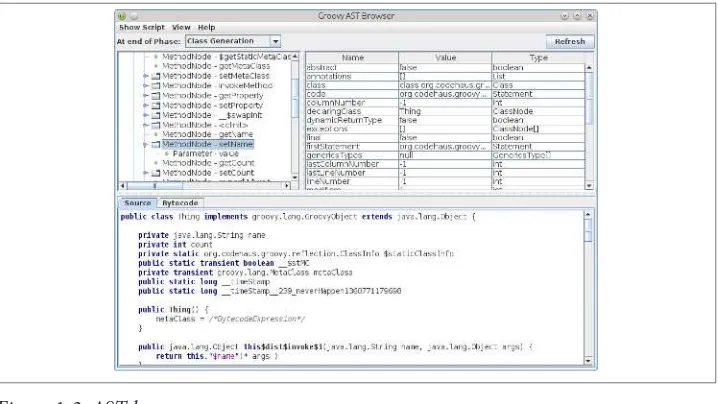
During compilation, Groovy represents your code in memory as an Abstract Syntax Tree (AST). The Groovy console’s AST browser is one way to see what is going on under the hood. There are several compilation phases (parsing, conversion, semantic analysis, and so on), and the AST browser will show you graphically what the structure looks like at each phase. This can help to diagnose issues, and is particularly helpful when you write your own AST transformations, where you can hook into the bytecode generation process and add your own programmatically. Figure 1-2 shows the state at the Class Generation phase.
Decompiling with JD-GUI
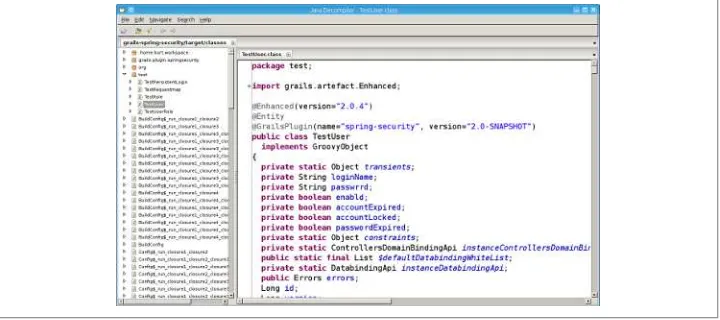
I highly recommend decompiling Groovy .class files to get a sense of what is added during the compilation process. It’s one thing to believe that getters and setters are added for you, but it’s another to actually see them. And there can be a lot of generated code in some of your classes; for example (jumping ahead a bit here), Grails uses several AST transformations to add compile-time metaprogramming methods to controllers, do‐ main classes, and other artifacts. JD-GUI is an excellent free decompiler that I’ve had a lot of success with. Figure 1-3 shows an example class.
Figure 1-3. JD-GUI
Decompiling with javap
Another option that doesn’t require third-party software is javap, which is part of the JDK install. Running it with no switches will display the method signatures, e.g., javap target/classes/com.foo.Bar, and passing the -c switch will decompile the code into a readable form of the bytecode, not the Groovy or analogous Java source; e.g., javap -c target/classes/com.foo.Bar. The output isn’t anywhere near as readable as what you get with a decompiler like JD-GUI, but it can be more convenient for a quick look.
Closures
A closure is a block of code enclosed in braces. Closures are similar to function pointers in C and C++ in that you can assign them to a variable and pass them as method pa‐ rameters and invoke them inside the methods. They’re also similar to anonymous inner classes, although they don’t implement an interface or (at least explicitly) extend a base class (but they can be used to implement interfaces—more on that later).
A closure can be as simple as:
def hello = { println "hello" }
A closure can be invoked by calling its call method:
def hello = { println "hello" }
hello.call()
but Groovy lets you use a more natural method call syntax (it invokes the call method for you):
def hello = { println "hello" }
hello()
Like methods, closures can have parameters, and there are three variants. In the hel lo example, because there’s nothing declared, there is one parameter with the default name it. So a modified closure that prints what it’s sent would be:
def printTheParam = { println it }
and you could call it like this:
printTheParam('hello')
You can omit parentheses like you can with method calls:
printTheParam 'hello'
Named arguments use -> to delimit the parameters from the code:
def printTheParam = { whatToPrint -> println whatToPrint }
and, like method arguments, they can be typed:
def add = { int x, int y -> x + y }
If the closure has no arguments, use the -> delimiter and the it parameter will not be available:
def printCurrentDate = { -> println new Date() }
You can determine the number of parameters that a closure accepts with the getMaxi mumNumberOfParameters() method and get the parameter types (a Class[] array) with getParameterTypes().
println hello.getClass().superclass.name
The class itself will have a name like ConsoleScript14$_run_closure1. Nested closures extend this naming convention; for example, if you look in the classes directory of a Grails application, you’ll see names like BuildConfig$_run_closure1_closure2.class, which are the result of having repositories, dependencies, and plugins closures de‐ fined within the top-level grails.project.dependency.resolution closure.
The dollar sign in the class and filename will look familiar if you’ve used anonymous inner classes before. In fact, that’s how they’re implemented. They’re different from anonymous inner classes in that they can access nonfinal variables outside of their scope. This is the “close” part of closure—they enclose their scope, making all of the variables in the scope the closure is in available inside the closure. This can be emulated by an inner class by using a final variable with mutable state, although it’s cumbersome. For example, this Java code doesn’t compile, because i isn’t final, and making it final defeats the purpose, because it needs to be changed inside the onClick method:
interface Clickable {
void onClick() }
int i = 0;
Clickable c = new Clickable() {
public void onClick() {
System.out.println("i: " + i);
i++;
} };
We can fix it with a final 1-element array (because the array values are still mutable):
final int[] i = { 0 };
Clickable c = new Clickable() {
public void onClick() {
System.out.println("i: " + i[0]);
i[0]++;
} };
but it’s an unnatural coding approach. The Groovy equivalent with a closure is a lot cleaner:
int i = 0
def c = { ->
println "i: $i"
i++ } as Clickable
able values are stored in final Reference instances, and Groovy transparently makes the values available for you. The only time you’ll see this occurring is when you’re stepping through code in debug mode in an IDE.
Interface Coercion
The previous example demonstrates interface coercion; because the Clickable interface has only one method, the closure can implement that method if it has the same param‐ eter type(s). The as keyword tells the Groovy compiler to create a JDK dynamic proxy implementing the interface. This is the simple version, but it also works for interfaces with multiple methods.
To implement an interface with more than one method, create a Map with method names as keys and closures with the corresponding parameter types as values:
import java.sql.Connection
def conn = [
close: { -> println "closed" },
setAutoCommit: { boolean autoCommit -> println "autocommit: $autoCommit" } ] as Connection
One useful aspect of this approach is that you aren’t required to implement every meth‐ od. Calling close or setAutoCommit will invoke the associated closures as if they were methods, but calling an unimplemented method (e.g., createStatement()) will throw an UnsupportedOperationException. This technique was more common before anonymous inner class support was added to Groovy in version 1.7, but it’s still very useful for creating mock objects when testing. You can implement just the methods that will be called and configure them to work appropriately for the test environment (e.g., to avoid making a remote call or doing database access) and switch out the mock im‐ plementation in place of the real one.
Programmatic Closures
Although it’s rare to do so, you can create a closure programmatically (most likely from Java). You might do this if you have some reason to implement some code in Java but need to pass a closure as a parameter to a Groovy method. The Closure class is abstract but doesn’t have any abstract methods. Instead, you declare one or more doCall meth‐ ods with the supported call signatures:
Closure<String> closure = new Closure<String>(this, this) {
public String doCall(int x) {
return String.valueOf(x);
}
public String doCall(int x, int y) {
} };
This can be invoked from Groovy just like one created the typical way:
closure(6) // prints "6"
closure(6, 2) // prints "12"
closure(1, 2, 3) // throws a groovy.lang.MissingMethodException // since there's no 3-param doCall()
Owner, Delegate, and this
this inside a closure is probably not what you expect. Intuitively, it seems like it should be the closure itself, but it turns out that it’s actually the class instance where the closure is defined. As such, it’s probably not of much use—the owner and delegate are much more useful.
The owner of a closure is the surrounding object that contains the closure. It functions as the target of method invocations inside the closure, and if the method isn’t defined, then a MissingMethodException will be thrown. In this example, if we create a new class instance and call the callClosure method (new SomeClass().callClosure()), it will print Woof!, because the dogAndCat closure calls the existing woof method, but it will then fail on the meow call because it doesn’t exist:
class SomeClass {
void callClosure() {
def dogAndCat = {
woof()
meow()
}
dogAndCat()
}
void woof() {
println "Woof!"
} }
You can assign a delegate for a closure to handle method calls. By default, the delegate is the owner, but you can change it with the setDelegate method. This is frequently used when parsing DSLs. The DSL can be implemented as a closure, and inner method calls and property access can be routed to a helper (i.e., the DSL builder), which im‐ plements the logic required when a method or property is called that’s not locally defined but is valid in the DSL.
class User {
String username
String password
static mapping = {
version false table 'users'
password column: 'passwd' }
}
If you were to invoke the mapping closure (User.mapping()), you would get a Missing MethodException for each of the three lines in the closure, because the owner of the closure is the User class and there’s no version, table, or password methods (and none added to the metaclass). It’s more clear that these are method calls if we add in the optional parentheses that were omitted:
static mapping = {
version(false)
table('users')
password(column: 'passwd') }
Now we see that it’s expected that there’s a version method that takes a boolean pa‐ rameter, a table method that takes a String, and a password method that takes a Map. Grails sets the delegate of the closure to an instance of org.codehaus.groo vy.grails.orm.hibernate.cfg.HibernateMappingBuilder, if you’re using Hiber‐ nate; otherwise, it’ll be an analogous NoSQL implementation if you’re using a different persistence provider, and that does have a version and a table method as expected. There’s no password method though. But there’s missing-method handling that looks for a field of the same name as the missing method, and when it finds a match and the parameter is a map, it uses the map data to configure the corresponding column.
So this lets us use an intuitive syntax composed of regular method calls that are handled by a delegate, usually doing a lot of work behind the scenes with a small amount of actual code.
Groovy’s Contributions in the War Against Verbosity
You’ve already seen how property access and the compact syntax for collections and maps can help condense your code, but there are a lot more ways.
Constructors
It’s rare to see constructors in Groovy classes. This is because the Groovy compiler adds a constructor that takes a Map and sets field values to map values where the key corre‐ sponds to a field name. This gives you named parameters for this constructor syntax, so it’s both more convenient and clearer which values are which. For example, a simple POGO like this:
class Person {
String firstName
String initial
String lastName
Integer age
}
can be constructed by setting some or all of the field values:
def author = new Person(firstName: 'Hunter', initial: 's', lastName: 'Thompson')
def illustrator = new Person(firstName: 'Ralph', lastName: 'Steadman', age: 76)
def someoneElse = new Person()
In the examples, I’m taking advantage of Groovy letting me omit the [ and ] map characters, because it makes the invocations cleaner.
This is especially useful for classes with many fields; in Java, you have to either define multiple constructors with various signatures or pass lots of nulls where you don’t have a value.
However, note that the Map constructor relies on the default constructor that’s added to all classes that don’t define any explicit constructors. It calls that constructor, then sets properties from the provided Map (this is defined in MetaClassImpl.invokeConstruc tor(), if you’re curious). But if you declare one or more parameterized constructors, the compiler doesn’t generate an empty one for you, and the Map constructor will fail.
Also, because it’s not a real constructor that’s added to the bytecode, you can use this with Java classes that have a default constructor, too. So you could replace this code:
MutablePropertyValues propertyValues = ...
def beanDef = new GenericBeanDefinition()
beanDef.setBeanClassName('com.foo.bar.ClassName')
beanDef.setAutowireMode(AbstractBeanDefinition.AUTOWIRE_BY_TYPE)
beanDef.setPropertyValues(propertyValues)
with this:
MutablePropertyValues propertyValues = ...
def beanDef = new GenericBeanDefinition(
autowireMode: AbstractBeanDefinition.AUTOWIRE_BY_TYPE,
propertyValues: propertyValues)
Checked Exceptions
Groovy also relaxes the requirement to catch and declare checked exceptions. Checked exceptions are widely regarded as a failure in the Java language, and a lot of the time, there isn’t much you can do once you catch one. So in Groovy, you don’t have to wrap calls to methods that throw checked exceptions in try/catch blocks, and you don’t have to declare checked exceptions in method signatures.
For example, consider java.sql.SQLException. A lot of the time, a SQLException will be caused by one of two things: temporary connectivity issues with the database and errors in your SQL. If you can’t connect to the database, you probably just have to punt and show an error page, and bad SQL is usually a development-time problem that you’ll fix. But you’re forced to wrap all JDBC code in try/catch blocks, thereby polluting your code.
You can still catch checked (and unchecked) exceptions in Groovy, and when you can handle an exception and retry or perform some action after catching it, you certainly should. It’s a good idea to also declare thrown exceptions in your method signatures, both for use by Java and also as a self-documenting code technique.
Groovy Truth
In Java, only boolean variables and expressions (including unboxed Boolean variables) can evaluate to true or false, for example, with if checks or as the argument to assert. But Groovy extends this in convenient ways. null object references evaluate to false. Nonempty collections, arrays, and maps; iterators and enumerations with more elements; matching regex patterns; Strings and GStrings (and other implementations of CharSequence) with nonzero length; and nonzero numbers and Characters will all evaluate to true.
This is especially helpful with strings as well as with collections and maps. So, for ex‐ ample, you can replace:
def someCollection = someMethod(...)
if (someCollection != null && !someCollection.isEmpty()) { ... }
with:
def someCollection = someMethod(...)
if (someCollection) { ... }
and:
String s = someMethod(...)
with:
String s = someMethod(...)
if (s) { ... }
Semicolons
Semicolons are for the most part unnecessary in Groovy, the exception being the tra‐ ditional for loop (although you’ll most likely prefer the semicolon-free Groovy for/in version). Also, if you want to have multiple statements on one line, you still need to delimit them with semicolons.
Optional Return
You can omit the return keyword in a method or closure, because Groovy treats the last expression value as the return value if you don’t use return.
Scope
Scope modifiers are often omitted in Groovy because the default scope is public. You can still define private or protected fields and methods. Because package scope is the default in Java and there’s no keyword for that, Groovy added the groovy.trans form.PackageScope annotation in version 1.8 for classes, methods, and fields.
Parentheses
You can often omit parentheses in method calls. This is only true if the method has arguments, because otherwise the call would look like property access. So, for example, all but the last of these are valid:
println("Using parentheses because I can")
println "Omitting parentheses because I can"
println()
println // not valid; looks like property access // for a nonexistent getPrintln() method
You can’t omit parentheses from the right side of an assignment, however:
int sum = MathUtils.add(2, 2) // ok
int product = MathUtils.multiply 2, 2 // invalid, doesn't compile
Default Imports
Differences Between Java and Groovy
In general, you can rename a .java source file to .groovy and it will still be valid, although there are a few exceptions.
Array Initialization
Because Groovy uses braces to declare closures, you cannot initialize an array the stan‐ dard Java way:
int[] oddUnderTen = { 1, 3, 5, 7, 9 };
Instead, we create the array using List syntax and cast it to the correct array type:
int[] oddUnderTen = [1, 3, 5, 7, 9]
or:
def oddUnderTen = [1, 3, 5, 7, 9] as int[]
in and def Keywords
One other gotcha is that in is a keyword, used by the Groovy for loop, (e.g., for (bar in bars) { ... }); def is also a keyword. So Java code that uses either of these as a variable name will need to be updated.
do/while Loops
There is also no do/while loop in Groovy, so any code like this will need to be reworked:
do {
// stuff
}
while (<truth expression>);
for Loops
Another small difference is that you can’t initialize more than one variable in the first part of a for loop, so this is invalid:
for (int count = someCalculation(), i = 0; i < count; i++) {
... }
and you’ll need to initialize the count variable outside the loop (a rare case where Groovy is more verbose than Java!):
int count = someCalculation()
for (int i = 0; i < count; i++) {
or you could just skip the whole for loop and use times:
someCalculation().times {
... }
or a range with a loop, if you need access to the loop variable:
for (i in 0..someCalculation()-1) {
... }
Annotations
Annotation values that have array types use a different syntax in Groovy than Java. In Java, you use { and } to define multivalued attributes:
@Secured({'ROLE_ADMIN', 'ROLE_FINANCE_ADMIN', 'ROLE_SUPERADMIN'})
but because these are used to define closures in Groovy, you must use [ and ] instead:
@Secured(['ROLE_ADMIN', 'ROLE_FINANCE_ADMIN', 'ROLE_SUPERADMIN'])
Groovy Equality
The previous examples will cause compilation errors if you rename a .java class to .groovy and try to compile it, or copy/paste Java code into an existing Groovy class. But checking for object equality actually works differently in Groovy.
In Java, == is mostly used for comparing numbers and other primitives, because com‐ paring objects with == just compares object references but not the data in the instances. We use the equals method to test if two objects are equivalent and can be considered equal even though they’re not the same instances. But it’s rare to need the == object comparison, so Groovy overloads it to call equals (or compareTo, if the objects imple‐ ment Comparable). And, if you do need to check that two references are the same object, use the is method—e.g., foo.is(bar).
Groovy’s == overload is convenient and avoids having to check for null values, but be‐ cause it works differently than the Java operator, you might want to consider not using it. It’s simple enough to replace x == y with x?.equals(y), which isn’t that many more characters and is still null-safe. Working with both Java and Groovy will keep you from introducing subtle bugs in your Java code. (I’m speaking from experience here….)
Multimethod Dispatch
which method to call, whereas Groovy uses the runtime type, because it’s dynamically checking all method invocations for metamethods, invokeMethod interception, etc.
So, for example, consider a few versions of a close utility method:
void close(Closeable c) {
try { c.close() }
catch (e) { println "Error closing Closeable" } }
void close(Connection c) {
try { c.close() }
catch (e) { println "Error closing Connection" } }
void close(Object o) {
try { o.close() }
catch (e) { println "Error closing Object" } }
In Java, this code will invoke the close(Object) variant, because the compiler only knows the compile-time type of the connection variable:
Object connection = createConnection(); // a method that returns a Connection // work with the connection
close(connection);
But, if this were Groovy, the close(Connection) method would be chosen, because it’s resolved at runtime and is based not on the compile type but the actual runtime type of the connection. This is arguably a better approach, but because it’s different from the Java behavior, it’s something that you should be aware of.
Groovy Strings
There are multiple ways to express string literals in Groovy. The approach used in Java —double-quoted strings—is supported of course, but Groovy also lets you use single quotes if you prefer. Multiline strings (sometimes called heredocs in other languages) are also supported, using triple quotes (either single or double). GStrings make things a lot more interesting, though.
The biggest benefit of GStrings is avoiding the clumsy string concatenation that’s re‐ quired in Java:
String fullName = person.getFirstName() + " ";
if (person.getInitial() != null) {
fullName += person.getInitial() + " "; }
Using a StringBuilder (the preferred approach when concatenating in a loop) wouldn’t be much better in this case. But using a GString (along with property syntax), we can join the data in a single line of code:
def fullName = "$person.firstName ${person.initial ? person.initial + ' ' : ''}$person.lastName"
GStrings also work with multiline strings as long as you use three double quotes; this is convenient for tasks such as filling in templates for emails:
def template = """\ Dear $name,
Thanks for signing up for the Ralph's Bait and Tackle online store! We appreciate your business and look forward to blah blah blah …
Ralph """
Here, I’m using the backslash character at the beginning of the string to avoid having an initial blank line. You can use three single quotes to create multiline strings, but they behave like regular strings that use single quotes, in that they do not support expression replacement.
Using the subscript operator lets you conveniently access substrings:
String str = 'Groovy Strings are groovy'
assert str[4] == 'v' // a String of length 1, not a char assert str[0..5] == 'Groovy' // the first 6 chars assert str[19..-1] == 'groovy' // the last 6 chars assert str[15..17] == 'are' // a substring in the middle
assert str[17..15] == 'era' // a substring in the middle, reversed
Static this
Unlike Java where the this keyword only makes sense in instance scope, this resolves to the class in static scope. One use of this feature is when defining static loggers. In Log4j and SLF4J, you can define a logger with a class or the class name (or any string you like), but in Java, there’s no way (no convenient one anyway) to get the class name in static scope. This can lead to copy/paste problems. For example:
private static final Logger LOG = Logger.getLogger(Foo.class);
has the class hardcoded, so if you forget to change it and copy that to a different class, you’ll be logging as the wrong category. Instead, in Groovy, you can use:
private static final Logger LOG = Logger.getLogger(this)
The Groovy JDK (GDK)
The Groovy JDK (GDK) is a Javadoc-style set of pages that describe methods added to the metaclass of JDK classes to extend them with extra functionality and make them easier to work with. There are currently over 1,000 methods listed. I strongly encourage you to check out the information there and familiarize yourself with what’s available. You may find that you’ve coded something that was already available and, in general, will probably realize that you’re working harder than you need to by not taking advan‐ tage of these built-in methods and features.
DefaultGroovyMethods and InvokerHelper
Many of the methods added to JDK metaclasses are implemented in the org.code haus.groovy.runtime.DefaultGroovyMethods class. At its largest, this was a gigantic class (over 18,000 lines) with around 1,000 methods. In recent versions of Groovy, this large class is being refactored into several more focused classes, including Resource GroovyMethods, IOGroovyMethods, StringGroovyMethods, and others. Many of the convenience methods that you use on a regular basis are implemented here, for example, the sort method that’s added to the Collection interface (it sorts lists and creates sorted lists from nonlist collections) is implemented by the public static <T> List<T> sort(Collection<T> self) method. It’s interesting to browse this class to see how things work under the covers, and you can use these methods yourself (although this is an internal class, so there may be some risk using it directly, because it’s not a public API class).
org.codehaus.groovy.runtime.InvokerHelper is another utility class with a lot of interesting functionality that you should check out.
Metaprogramming and the MOP
Groovy’s Meta Object Protocol (MOP) is the key to Groovy’s power and it’s what enables most of its coolest features. Every class gets a metaclass, which intercepts all method calls and enables customization of how methods are invoked, and also enables adding or removing methods. This is what makes Groovy a dynamic language; unlike Java, which compiles methods into class bytecode and doesn’t allow changes at runtime. Be‐ cause Groovy’s MOP is intercepting all method calls, it can simulate adding a method as if it had been compiled in at startup. This makes JVM classes open classes that can be modified at any time.
Every Groovy class implements the groovy.lang.GroovyObject interface (it’s added by the compiler) that includes these methods:
Object invokeMethod(String name, Object args)
Object getProperty(String property)
void setProperty(String property, Object newValue)
MetaClass getMetaClass()
void setMetaClass(MetaClass metaClass)
Java classes can also implement GroovyObject to add Groovy-like behavior. The most convenient approach for this is to subclass the groovy.lang.GroovyObjectSupport adapter class, which implements the interface and provides sensible default implementations of the methods that can be overridden as needed.
When you invoke a method in Groovy (including accessing a property, because that calls the corresponding getter method), it’s actually dispatched to the object’s metaclass. This provides an AOP-like interception layer. The calls are implemented with reflection, which is slower than direct method invocation. But each new release of Java adds re‐ flection speed improvements, and Groovy has several optimizations to reduce the cost of this overhead, the most significant being call site caching. Early versions of Groovy were quite slow, but modern Groovy has seen huge performance boosts and is often nearly as fast as Java. And because network latency and database access tend to con‐ tribute most to total web request time, the small increase in invocation time that Groovy can add tends to be insignificant, because it’s such a small percentage of the total time.
Adding Methods
The syntax for adding a method at runtime is essentially just one that registers a closure in the metaclass that’s associated with the specified method name and signature:
List.metaClass.removeRight = { int index ->
delegate.remove(delegate.size() - 1 - index) }
The List interface has a remove method, but this addition removes the item considering the position from the right instead of the left like remove:
assert 3 == [1, 2, 3].removeRight(0)
assert 2 == [1, 2, 3].removeRight(1)
assert 1 == [1, 2, 3].removeRight(2)
Intercepting Method Calls
Because all Groovy objects implement GroovyObject, you can override the invokeMe thod method in your class to handle method invocations. There are a few variants of behavior though. By default, it’s only called for methods that don’t exist (analogous to methodMissing, which we’ll see in a bit), so for example:
class MathUtils {
int add(int i, int j) { i + j }
def invokeMethod(String name, args) {
println "You called $name with args $args"
} }
def mu = new MathUtils()
println mu.add(2, 3)
println mu.multiply(2, 3)
will generate this output:
5
You called multiply with args [2, 3]
because there is an add method but no multiply. If we change the class to implement the GroovyInterceptable marker interface (which extends GroovyObject):
class MathUtils implements GroovyInterceptable { ...
}
then the result is a java.lang.StackOverflowError. Hmmm. What’s up there? We tend to think of println as just an alias for System.out.println, but it’s actually a metamethod added to the Object class that calls System.out.println, so it will be intercepted along with the calls to add and multiply. So the fix is to use Sys tem.out.println directly:
class MathUtils implements GroovyInterceptable {
int add(int i, int j) { i + j }
def invokeMethod(String name, args) {
System.out.println "You called $name with args $args"
} }
def mu = new MathUtils()
println mu.add(2, 3)
println mu.multiply(2, 3)
You called add with args [2, 3]
null
You called multiply with args [2, 3]
null
getProperty and setProperty
Overriding getProperty and/or setProperty always intercepts the property gets and sets, so the output of:
class Person {
private String name
def getProperty(String propName) {
println "getProperty $propName"
if ('name'.equals(propName)) {
return this.name }
}
void setProperty(String propName, value) {
println "setProperty $propName -> $value"
if ('name'.equals(propName)) {
this.name = value
}
} }
def p = new Person(name: 'me')
println p.name will be:
getProperty name me
You might have expected to see output indicating that setProperty was called, since the map constructor is used and it sets property values from the map, in this case the name property to 'me'. But the implementation of this feature bypasses setProperty (this seems like a bug). But if you explicitly set the property:
p.name = 'you' it works as expected:
setProperty name -> you
methodMissing and propertyMissing
class Person {
String name
def propertyMissing(String propName) {
if ('eman'.equals(propName)) {
return name.reverse()
}
throw new MissingPropertyException(propName, getClass())
}
def methodMissing(String methodName, args) {
if ('knight'.equals(methodName)) {
name = 'Sir ' + name
return }
throw new MissingMethodException(methodName, getClass(), args)
} }
def p = new Person(name: 'Ralph')
println p.name
println p.eman
p.knight()
println p.name
which results in the output:
Ralph hplaR Sir Ralph
and, if you try to access a property or method that doesn’t exist or have special handling (e.g., println p.firstName or p.king()), then you’ll get the standard MissingProper tyException or MissingMethodException.
There are also static versions of methodMissing and propertyMissing, $static_meth odMissing and $static_propertyMissing.
class Person {
String name
static $static_propertyMissing(String propName) {
println "static_propertyMissing $propName"
}
static $static_methodMissing(String methodName, args) {
println "static_methodMissing $methodName"
} }
println Person.foo()
The output from the above code is:
static_propertyMissing foo static_methodMissing foo
null
static_propertyMissing bar
null
$static_methodMissing works slightly differently from methodMissing in that if there’s no method with the specified name, it looks for a closure property with that name to invoke as if it were a method. This results in a message about a missing foo property and a missing foo method.
Operators
Groovy adds several operators to the standard set of Java operators.
Null-Safe Dereference
The most commonly used is the null-safe dereference operator, ?., which lets you avoid a NullPointerException when calling a method or accessing a property on a null object. It’s especially useful in a chain of such accesses where a null value could occur at some point in the chain.
For example, you can safely call:
String name = person?.organization?.parent?.name
and if person, person.organization, or organization.parent are null, then null is returned as the expression value. The Java alternative is a lot more verbose:
String name = null;
if (person != null) {
if (person.getOrganization() != null) {
if (person.getOrganization().getParent() != null) {
name = person.getOrganization().getParent().getName();
}
} }
Elvis
The Elvis operator, ?:, lets you condense ternary expressions; these two are equivalent:
String name = person.name ?: defaultName
and:
They both assign the value of person.name to the name variable if it is “Groovy true” (in this case, not null and has nonzero length, because it’s a string), but using the Elvis operator is more DRY.
Spread
The spread operator, *., is convenient when accessing a property or calling a method on a collection of items and collecting the results. It’s essentially a shortcut for the collect GDK method, although it’s limited to accessing one property or calling one method, for example:
def numbers = [1.41421356, 2.71828183, 3.14159265]
assert [1, 2, 3] == numbers*.intValue()
Spaceship
The spaceship operator <=> is useful when comparing values; for example, when im‐ plementing the compareTo method of the Comparable interface. For example, given a POGO where you want to sort by two properties, the spaceship operator makes the implementation very compact:
class Person implements Comparable<Person> {
String firstName
String lastName
int compareTo(Person p) {
lastName <=> p?.lastName ?: firstName <=> p?.firstName }
String toString() { "$firstName $lastName" } }
def zakJones = new Person(firstName: 'Zak', lastName: 'Jones')
def jedSmith = new Person(firstName: 'Jed', lastName: 'Smith')
def alJones = new Person(firstName: 'Al', lastName: 'Jones')
def persons = [zakJones, jedSmith, alJones]
assert [alJones, zakJones, jedSmith] == persons.sort(false)
because the operator returns –1 if the left is less than the right, 0 if they’re equal, and 1 if the right is more than the left. So when the first expression (lastName <=> p?.last Name) is nonzero, its value is used as the return value and the sort is done by last Name. If the last names match, then the Elvis operator kicks in and the second expression (firstName <=> p?.firstName) is used to do a secondary sort by firstName.
assert [alJones, jedSmith, zakJones] == persons.sort(
false, { a, b -> a?.firstName <=> b?.firstName })
which sorts just by firstName. Of course Groovy being Groovy, there’s a shorter way of doing that:
assert [alJones, jedSmith, zakJones] == persons.sort(false, { it.firstName })
Field Access
If you have a need to bypass a getter method (or if there is none) and directly access a field, you can use the .@ operator. For example, this class uses some simple logic to return a default value if none is specified, but if you want to know if the value is un‐ specified, you still can:
class Thing {
private static final String DEF_NAME = 'foo' String name
String getName() { name == null ? DEF_NAME : name} }
assert 'bar' == new Thing(name: 'bar').name assert 'foo' == new Thing().name
assert null == new Thing().@name
Note, however, that this operator only works on the current class; if the field is in a subclass, the operator cannot access it, and you have to use standard reflection.
as
The as operator is very useful, because it can perform many type coercions. For example, there’s no native syntax for a Set like there is for a List, but you can use as with List syntax to create a Set:
def things = ['a', 'b', 'b', 'c'] as Set
assert things.getClass().simpleName == 'HashSet' assert things.size() == 3
in
The in operator is a convenient shortcut for the contains method in a collection:
assert 1 in [1, 2, 5]
Method Reference
The .& operator lets you get a reference to a method and treat it like a closure. This might be useful if you’re working with higher order methods where you pass a closure as a parameter and want the option to pass a method; the .& operator creates an instance of org.codehaus.groovy.runtime.MethodClosure that invokes your method when it’s invoked.
class MathUtils {
def add(x, y) { x + y } }
def doMath(x, y, Closure c) {
c(x, y) }
def add = new MathUtils().&add def multiply = { x, y -> x * y }
assert 8 == doMath(4, 2, multiply)
assert 6 == doMath(4, 2, add)
assert 2 == doMath(4, 2, { x, y -> x / y })
Overload Your Operators
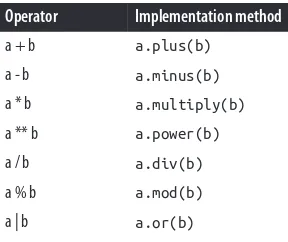
Operator overloading is a powerful technique for compressing code, ideally in an in‐ tuitive way. It’s important that if you add an operator overload that it make sense—be sure to think about how cryptic the code can get if you add an operator overload that isn’t an appropriate choice.
The general approach for creating an operator overload is to implement the method that corresponds to the operator. The method must return this (or another instance) to work correctly. So, for example, if we have a Person class that has a collection of children:
class Person {
String name
List children = [] }
Adding a child to a Person instance is simple enough:
def parent = new Person(...)
def child = new Person(...)
parent.children.add child // or parent.children << child But we can use the left-shift operator here to add a child:
class Person {
String name