Advanced Web
Services
Athman Bouguettaya
Quan Z. Sheng
Athman Bouguettaya
•Quan Z. Sheng
Florian Daniel
Editors
Advanced Web Services
Foreword by Michael P. Papazoglou
Editors
Athman Bouguettaya School of Computer Science
and Information Technology RMIT University
Melbourne, VIC Australia Quan Z. Sheng
School of Computer Science University of Adelaide Adelaide, SA
Australia
Florian Daniel
Dipartimento di Ingegneria e Scienza dell’Informazione
Università di Trento Povo, Trento Italy
ISBN 978-1-4614-7534-7 ISBN 978-1-4614-7535-4 (eBook) DOI 10.1007/978-1-4614-7535-4
Springer New York Heidelberg Dordrecht London
Library of Congress Control Number: 2013942479
ÓSpringer Science+Business Media New York 2014
This work is subject to copyright. All rights are reserved by the Publisher, whether the whole or part of the material is concerned, specifically the rights of translation, reprinting, reuse of illustrations, recitation, broadcasting, reproduction on microfilms or in any other physical way, and transmission or information storage and retrieval, electronic adaptation, computer software, or by similar or dissimilar methodology now known or hereafter developed. Exempted from this legal reservation are brief excerpts in connection with reviews or scholarly analysis or material supplied specifically for the purpose of being entered and executed on a computer system, for exclusive use by the purchaser of the work. Duplication of this publication or parts thereof is permitted only under the provisions of the Copyright Law of the Publisher’s location, in its current version, and permission for use must always be obtained from Springer. Permissions for use may be obtained through RightsLink at the Copyright Clearance Center. Violations are liable to prosecution under the respective Copyright Law. The use of general descriptive names, registered names, trademarks, service marks, etc. in this publication does not imply, even in the absence of a specific statement, that such names are exempt from the relevant protective laws and regulations and therefore free for general use.
While the advice and information in this book are believed to be true and accurate at the date of publication, neither the authors nor the editors nor the publisher can accept any legal responsibility for any errors or omissions that may be made. The publisher makes no warranty, express or implied, with respect to the material contained herein.
Printed on acid-free paper
To my parents, Horia and Mahmoud,
and my wife Malika
Athman Bouguettaya
To my parents Shuilian and Jianwu,
my brothers Guanzheng and Xinzheng,
my wife Yaping and my daughters Fiona
and Phoebe
Quan Z. Sheng
To Cinzia, my family, my friends
Foreword
Service-Oriented Computing (SOC) is the computing paradigm that utilizes soft-ware services as fundamental elements for developing and deploying distributed software applications. Services are self-describing, platform-agnostic computa-tional elements that support rapid, low-cost composition of distributed applica-tions. They perform functions, which can be anything from simple requests to complicated business processes. Services allow organizations to expose their core competencies programmatically via a self-describing interface based on open standards over the Internet (or intra-net) using standard (XML-based) languages and protocols. Because services provide a uniform and ubiquitous information distributor for wide range of computing devices (such as handheld computers, PDAs, cellular telephones, or appliances) and software platforms (e.g., UNIX or Windows), they constitute a major transition in distributed computing.
A Web service is a specific kind of service that is identified by a URI that exposes its features programmatically over the Internet using standard Internet languages and protocols, and can be implemented via a self-describing interface based on open Internet standards (e.g., XML interfaces which are published in network-based repositories).
Understanding the conceptual underpinnings and mastering the technical intricacies of Web services is anything but trivial and is absolutely necessary to construct a well-functioning service-based system or application. Web service technology is undergoing continuous, rapid evolution, thanks to both standardi-zation efforts pushed forward by the industry and the research efforts of the sci-entific community.
Web services standards are still evolving. However, they seem to converge today on a handful of standards: the Simple Object Access Protocol (SOAP) for service communication, Web Services Description Language (WSDL) for service description, Universal Description, Discovery, and Integration Infrastructure (UDDI) for registering and discovering services, and the Business Process Exe-cution Language (BPEL) for service composition. A plethora of WS-* specifica-tions also exists to describe the full spectrum of activities related to Web services in topics such as reliable messaging, security, privacy, policies, event processing, and coordination, to name but a few.
Leading international conferences, such as the International Conference on Service Oriented Computing (ICSOC), the International Conference on Web Services (ICWS), the International Conference on Service Computing (SCC), and others, have spearheaded groundbreaking research efforts. This has led to the emergence of novel topics such as semantic Web services, automated Web service composition, Web service recommendations, quality of service, trust, and a range of other interesting themes. Related conference series such as Web Engineering, Cloud Computing, Business Process Management, HCI, and Database-related conferences have all been strongly influenced by the emergence of Web services and consistently feature Web service-related topics in their calls for papers. These conferences contribute to the wealth of knowledge that is growing exponentially around Web services.
The content of this book and that of its companion bookWeb Services Foun-dations (Springer, 2013) reflect such activities. It is a testimonial of the leading role of its editors and their highly influential work in the area of Web services. Together, both books cover an enormous wealth of important topics and tech-nologies that mirror the evolution of Web services. They provide an exhaustive overview of the challenges and solutions of all major achievements pertaining to Web services. Each chapter is an authoritative piece of work that synthesizes all the pertinent literature and highlights important accomplishments and advances in its subject matter.
To my knowledge, this is the first attempt of its kind, providing complete coverage of the key subjects in Web services. I am not aware of any other book that is as thorough, comprehensive and ambitious in explaining the current state of the art of scientific research and in synthesizing the perspectives and know-how of so many experts in the field. Both books are a must-read for everyone interested in the field. They cater for the needs of both novices to the field as well as seasoned researchers and practitioners. They are a major step in this field’s maturation and will serve to unify, advance, and challenge the scientific community in many important ways.
It is a real pleasure to have been asked to provide the foreword for this book collection. I am happy to commend the editors and authors on their accomplish-ment, and to inform the readers that they are looking at a landmark in the development of the Web services field. Anybody serious about Web services ought to have handy a copy ofWeb Services FoundationsandAdvanced Web Servicesin their private library!
Tilburg, The Netherlands, December 2012 Michael P. Papazoglou
Preface
Web Service technology is undeniably the preferred delivery method for the Service-Oriented Computing (SOC) paradigm. It has evolved over the years to be a comprehensive, interdisciplinary approach to modern software development. Web services have gone beyond software componentization technology to embody and express the software manifestation of a general trend transforming our modern society from an industrial, production-centric economy into a digital, service-centric economy. Web services aim to provide the missing conceptual links that unify a variety of different disciplines, such as networking, distributed systems, cloud computing, autonomic computing, data and knowledge management, knowledge-based systems, and business process management. Web services are the technological proxies of services that power much of the developed and increasingly developing economies. In this respect, Web services play a central role in enabling and sustaining the growth of service-centric economies and help modernizing organizations, companies, and institutions also from an IT perspective.
Over the last decade, Web services have become a thriving area of research and academic endeavors. Yet, despite a substantial body of research and scientific publications, the Web services community has been hitherto missing a one stop-shop that would provide a consolidated understanding of the scientific and tech-nical progress of this important subject. This book (the second of a two-book collection) is a serious attempt to fill this gap and serve as a primary point of reference reflecting the pervasive nature of Web services.
This book is the second installment of a two-book collection (we discuss the foundational topics in the first book,Web Services Foundations, Springer, 2013). Together, they comprise approximately 1,400 pages covering state-of-the-art theoretical and practical aspects as well as experience using and deploying Web services. The collection offers a comprehensive overview of the scientific and technical progress in Web services technologies, design, architectures, applica-tions, and performance. The second book of the collection consists of three major parts:
I Advanced Services Engineering and Management(11 chapters)—It explores advanced engineering problems, such as Web service transactions and recovery, security and identity management, trust and contracts, and Web service evolution and management;
II Web Service Applications and Case Studies(5 chapters)—It covers concrete scenarios of the use of Web service technology and reports on empirical studies of real-world Web service ecosystems;
III Novel Perspectives and Future Directions(10 chapters)—It surveys approaches of the applications on how the Web service paradigm can be applied to novel contexts, such as human-centric computing, human work, and the Internet of Things, and discusses the value of Web services in the context of mobile and cloud computing.
The first book (Web Services Foundations, Springer, 2013) consists of two major parts:
I Foundations of Web Services(12 chapters)—It explores the most represen-tative theoretical and practical approaches to Web services, with a special focus on the general state-of-the-art approaches to Web service composition; II Service Selection and Assisted Composition(16 chapters)—It focuses on
other aspects of Web service composition problem, specifically takes a deep look at non-functional aspects (e.g., quality of service), Web service rec-ommendations, and how Web service composition is made easy for less expert developers.
The topics covered in the collection are reflective of their intent: they aim to become the primary source for all pertinent information regarding Web service technologies, research, deployment, and future directions. The purpose of the two books is to serve as a trusted and valuable reference point to researchers and educators who are working in the area of Web services, to students who wish to learn about this important research and development area, and to practitioners who are using Web services and the service paradigm daily in their software devel-opment projects.
This collection is the result of an enormous community effort, and their pro-duction involved more than 100 authors, consisting of the world’s leading experts in this field. We would like to thank the authors for their high-quality contributions and the reviewers for their time and professional expertise. All contributions have undergone a rigorous review process, involving three independent experts in two rounds of review. We are also very grateful to Springer for their continuous help and assistance.
Melbourne, Australia, December 2012 Athman Bouguettaya
Adelaide, Australia Quan Z. Sheng
Trento, Italy Florian Daniel
Contents
Part I Advanced Services Engineering and Management
1 Design and Management of Web Service Transactions
with Forward Recovery . . . 3
Peter Dolog, Michael Schäfer and Wolfgang Nejdl
2 A Generic Framework for Testing the Web
Services Transactions. . . 29
Rubén Casado, Muhammad Younas and Javier Tuya
3 Universal Identity Management Based on Delegation
in SOA. . . 51
Yang Zhang and Jun-Liang Chen
4 The Roadmap of Trust and Trust Evaluation in Web
Applications and Web Services. . . 75
Lei Li and Yan Wang
5 Web Service-Based Trust Management
in Cloud Environments. . . 101
Talal H. Noor and Quan Z. Sheng
6 Web Service Contracts: Specification and Matchmaking . . . 121
Marco Comerio, Flavio De Paoli, Matteo Palmonari and Luca Panziera
7 A Certification-Aware Service-Oriented Architecture. . . 147
Marco Anisetti, Claudio A. Ardagna, Michele Bezzi,
Ernesto Damiani, Samuel Paul Kaluvuri and Antonino Sabetta
8 A Test Automation Framework for Collaborative Testing
of Web Service Dynamic Compositions. . . 171
Hong Zhu and Yufeng Zhang
9 WSDARWIN: Studying the Evolution of Web
Service Systems . . . 199
Marios Fokaefs and Eleni Stroulia
10 SCML: A Change Management Language for Adaptive
Long Term Composed Services. . . 225
Xumin Liu and Athman Bouguettaya
11 A Semantic-Based Approach to Generate Abstract Services
for Service Organization. . . 253
Xumin Liu and Hua Liu
Part II Web Service Applications and Case Studies
12 Exploring Service Networks of Biological Processes
on the Web . . . 279
George Zheng and Athman Bouguettaya
13 Automating Tendering Processes with Web Services:
A Case Study on Building Construction Tendering
in Hong Kong . . . 311
Dickson K. W. Chiu, Nick L. L. NG, Sau Chan Lai, Matthias Farwick and Patrick C. K. Hung
14 Service Trust Management for E-Government Applications. . . 339
Surya Nepal, Wanita Sherchan and Athman Bouguettaya
15 Trust-Oriented Service Provider Selection in Complex
Online Social Networks. . . 363
Guanfeng Liu and Yan Wang
16 Analyzing Web Services Networks: Theory and Practice. . . 381
Peep Küngas, Marlon Dumas, Shahab Mokarizadeh and Mihhail Matskin
Part III Novel Perspectives and Future Directions
17 Work as a Service . . . 409
Daniel V. Oppenheim, Lav R. Varshney and Yi-Min Chee
18 Virtualizing Software and Human for Elastic
Hybrid Services. . . 431
Muhammad Z. C. Candra, Rostyslav Zabolotnyi, Hong-Linh Truong and Schahram Dustdar
19 Realizing a Social Ecosystem of Web Services. . . 455
Zakaria Maamar, Youakim Badr, Noura Faci and Quan Z. Sheng
20 ubiREST: A RESTful Service-Oriented Middleware
for Ubiquitous Networking. . . 475
Mauro Caporuscio, Marco Funaro, Carlo Ghezzi and Valérie Issarny
21 Mobile Web and Cloud Services. . . 501
Satish Narayana Srirama
22 TOSCA: Portable Automated Deployment and Management
of Cloud Applications. . . 527
Tobias Binz, Uwe Breitenbücher, Oliver Kopp and Frank Leymann
23 A V-Model Approach for Business Process Requirements
Elicitation in Cloud Design. . . 551
Nuno Ferreira, Nuno Santos, Ricardo J. Machado, José Eduardo Fernandes and Dragan Gasevic´
24 Cloud-Based Systems Need Multi-Level Management . . . 579
Luciano Baresi, Domenico Bianculli and Sam Guinea
25 Web Services for Things. . . 605
Guangyan Huang, Jing He and Yanchun Zhang
Index . . . 631
Contributors
Marco Anisetti Dipartimento di Informatica, Università degli Studi di Milano,
Bramante 65, Crema 26013, Italy, e-mail: [email protected]
Claudio A. Ardagna Dipartimento di Informatica, Università degli Studi di
Milano, Bramante 65, Crema 26013, Italy, e-mail: [email protected]
Youakim Badr INSA de Lyon, Villeurbanne 69621, France, e-mail: youakim.
Luciano Baresi Deep-SE Group, Dipartimento di Elettronica e Informazione,
Politecnico di Milano, Piazza L. da Vinci 32, Milan I-20133, Italy, e-mail: [email protected]
Michele Bezzi SAP Research Sophia-Antipolis, 805, Av. du Docteur Maurice
Donat, Mougins 06254 Mougins Cedex, France, e-mail: [email protected]
Domenico Bianculli SnT Centre, University of Luxembourg, 4 rue Alphonse
Weicker, Luxembourg, Luxembourg, e-mail: [email protected]
Tobias Binz IAAS, University of Stuttgart, Universitätsstr. 38, 70569 Stuttgart,
Germany, e-mail: [email protected]
Athman Bouguettaya School of Computer Science and Information Technology,
RMIT, Melbourne, Australia, e-mail: [email protected]
Uwe Breitenbücher IAAS, University of Stuttgart, Universitätsstr. 38, Stuttgart
70569, Germany, e-mail: [email protected]
Muhammad Z. C. Candra Distributed Systems Group, Vienna University of
Technology, Argentinierstrasse 8/184-1, Vienna 1040, Austria, e-mail: m.candra@ dsg.tuwien.ac.at
Mauro Caporuscio Dipartimento di Elettronica e Informazione, Politecnico di
Milano, Piazza L. da Vinci 32, 20133 Milan, Italy, e-mail: mauro.caporuscio@ polimi.it
Rubén Casado Department of Computing, University of Oviedo, Asturias, Spain,
Yi-Min Chee IBM Thomas J. Watson Research Center, Hawthorne, NY, USA, e-mail: [email protected]
Jun-Liang Chen State Key Laboratory of Networking and Switching
Technol-ogy, Beijing University of Posts and Telecommunications, Beijing, China, e-mail: [email protected]
Dickson K. W. Chiu Dickson Computer Systems, 7 Victory Avenue, Kowloon,
Hong Kong ; Department of Computer Science and Engineering, Hong Kong University of Science and Technology, Hong Kong, China, e-mail: dicksonchiu@ ieee.org
Marco Comerio University of Milano-Bicocca, Viale Sarca 336, 20126 Milan,
Italy, e-mail: [email protected]
Ernesto Damiani Dipartimento di Informatica, Universitaà degli Studi di Milano,
Bramante 65, 26013 Crema, Italy, e-mail: [email protected]
Flavio De Paoli University of Milano-Bicocca, Viale Sarca 336, 20126 Milan,
Italy, e-mail: [email protected]
Peter Dolog Department of Computer Science, Aalborg University, Selma
Lag-erloefs Vej 300, 9220 Aalborg, Denmark, e-mail: [email protected]
Marlon Dumas University of Tartu, Tartu, Estonia, e-mail: [email protected]
Schahram Dustdar Distributed Systems Group, Vienna University of
Technol-ogy, Argentinierstrasse 8/184-1, 1040 Vienna, Austria, e-mail: dustdar@dsg. tuwien.ac.at
Noura Faci Claude Bernard Lyon 1 University, Lyon, France, e-mail: noura.
Matthias Farwick Institute of Computer Science, University of Innsbruck,
Innsbruck, Austria, e-mail: [email protected]
José Eduardo Fernandes Bragana Polytechnic Institute, Bragana, Portugal,
e-mail: [email protected]
Nuno Ferreira I2S Informtica, Sistemas e Servios S.A., Porto, Portugal, e-mail:
Marios Fokaefs Department of Computing Science, University of Alberta,
Ed-monton, AB, Canada, e-mail: [email protected]
Marco Funaro Dipartimento di Elettronica e Informazione, Politecnico di
Mi-lano, Piazza L. da Vinci 32, 20133 Milan, Italy, e-mail: [email protected]
Dragan Gasevic´ School of Computing and Information Systems, Athabasca
University, Athabasca, Canada, e-mail: [email protected]
Carlo Ghezzi Dipartimento di Elettronica e Informazione, Politecnico di Milano, Piazza L. da Vinci 32, 20133 Milan, Italy, e-mail: [email protected]
Sam Guinea Dipartimento di Elettronica e Informazione, Politecnico di Milano,
Piazza L. da Vinci 32, 20133 Milan, Italy, e-mail: [email protected]
Jing He Victoria University, Melbourne, Australia, e-mail: [email protected]
Guangyan Huang Victoria University, Melbourne, Australia, e-mail: guangyan.
Patrick C. K. Hung Faculty of Business and Information Technology, University
of Ontario Institute of Technology, Oshawa, Canada, e-mail: patrick. [email protected]
Valérie Issarny Domaine de Voluceau, INRIA Paris-Rocquencourt, Le Chesnay
78153, France, e-mail: [email protected]
Samuel Paul Kaluvuri SAP Research Sophia-Antipolis, 805, Av. du Docteur
Maurice Donat, Mougins 06254 Mougins Cedex, France, e-mail: samuel. [email protected]
Oliver Kopp IAAS, University of Stuttgart, Universitätsstr. 38, Stuttgart 70569,
Germany, e-mail: [email protected]
Peep Küngas University of Tartu, Tartu, Estonia, e-mail: [email protected]
Sau Chan Lai Department of Computer Science and Engineering, Hong Kong
University of Science and Technology, Hong Kong, China, e-mail: chanlaze@ ust.hk
Frank Leymann IAAS, University of Stuttgart, Universitätsstr. 38, Stuttgart
70569, Germany, e-mail: [email protected]
Lei Li Department of Computing, Macquarie University, Sydney, NSW 2109,
Australia, e-mail: [email protected]
Guanfeng Liu Department of Computing, Macquarie University, North Ryde,
NSW, Australia, e-mail: [email protected]
Hua Liu Xerox Research Center at Webster, Webster, USA, e-mail: hua.liu@
xerox.com
Xumin Liu Department of Computer Science, Rochester Institute of Technology,
Rochester, USA, e-mail: [email protected]
Zakaria Maamar Zayed University, Dubai, U.A.E, e-mail: zakaria.maamar@
zu.ac.ae
Ricardo J. Machado Centro ALGORITMI, Escola de Engenharia, Universidade
do Minho, Guimares, Portugal, e-mail: [email protected]
Mihhail Matskin Royal Institute of Technology, Stockholm, Sweden, e-mail: [email protected]
Shahab Mokarizadeh Royal Institute of Technology, Stockholm, Sweden,
e-mail: [email protected]
Wolfgang Nejdl L3S Research Center, University of Hannover, Appelstr. 9a,
Hannover 30167, Germany, e-mail: [email protected]
Surya Nepal CSIRO ICT Centre, Sydney, Australia, e-mail: Surya.Nepal@
csiro.au
Nick L. L. NG Department of Computer Science and Engineering, Hong Kong
University of Science and Technology, Hong Kong, China, e-mail: nickng@ ust.hk
Talal H. Noor School of Computer Science, The University of Adelaide,
Adelaide, SA 5005, Australia, e-mail: [email protected]
Daniel V. Oppenheim IBM Thomas J. Watson Research Center, Hawthorne,
NY, USA, e-mail: [email protected]
Matteo Palmonari University of Milano-Bicocca, Viale Sarca 336, 20126 Milan,
Italy, e-mail: [email protected]
Luca Panziera University of Milano-Bicocca, Viale Sarca 336, 20126 Milan,
Italy, e-mail: [email protected]
Antonino Sabetta SAP Research Sophia-Antipolis, 805, Av. du Docteur Maurice
Donat, Mougins 06254 Mougins Cedex, France, e-mail: [email protected]
Nuno Santos CCG-Centro de Computaao Gráfica, Campus de Azurm, Guimares,
Portugal, e-mail: [email protected]
Michael Schäfer L3S Research Center, University of Hannover, Appelstr. 9a,
30167 Hannover, Germany, e-mail: [email protected]
Quan Z. Sheng School of Computer Science, The University of Adelaide,
Adelaide, SA 5005, Australia, e-mail: [email protected]
Wanita Sherchan IBM Research, Melbourne, Australia, e-mail: wanitash@
au.ibm.com
Satish Narayana Srirama Mobile Cloud Laboratory, Institute of Computer
Science, University of Tartu, J Liivi 2, Tartu 50409, Estonia, e-mail: srirama@ ut.ee
Eleni Stroulia Department of Computing Science, University of Alberta,
Edmonton, AB, Canada, e-mail: [email protected]
Hong-Linh Truong Distributed Systems Group, Vienna University of Technol-ogy, Argentinierstrasse 8/184-1, 1040 Vienna, Austria, e-mail: truong@dsg. tuwien.ac.at
Javier Tuya Department of Computing, University of Oviedo, Asturias, Spain,
e-mail: [email protected]
Lav R. Varshney IBM Thomas J. Watson Research Center, Hawthorne, NY,
USA, e-mail: [email protected]
Yan Wang Department of Computing, Macquarie University, Sydney, NSW 2109, Australia, e-mail: [email protected]
Muhammad Younas Department of Computing and Communication
Technolo-gies, Oxford Brookes University, Oxford, UK, e-mail: [email protected]
Rostyslav Zabolotnyi Distributed Systems Group, Vienna University of
Tech-nology, Argentinierstrasse 8/184-1 1040 Vienna, Austria, e-mail: rstzab@dsg. tuwien.ac.at
Yanchun Zhang Victoria University, Melbourne, Australia, e-mail: yanchun.
Yang Zhang State Key Laboratory of Networking and Switching Technology,
Beijing University of Posts and Telecommunications, Beijing, China, e-mail: [email protected]
Yufeng Zhang National Laboratory for Parallel and Distributed Processing,
School of Computer Science, The National University of Defense Technology, Changsha, China, e-mail: [email protected]
George Zheng Science Applications International Corporation, McLean, VA,
USA, e-mail: [email protected]
Hong Zhu Department of Computing and Electronics, School of Technology,
Oxford Brookes University, Oxford OX33 1HX, UK, e-mail: [email protected]
Part I
Chapter 1
Design and Management of Web Service
Transactions with Forward Recovery
Peter Dolog, Michael Schäfer and Wolfgang Nejdl
Abstract In this chapter we describe a design of compensations using forward recovery within Web service transactions. We introduce an approach to model com-pensation capabilities and requirements using feature models, which are the basis for defining compensation rules. These rules can be executed in a Web service environ-ment that we extend with the concept of an abstract service, which is a manageenviron-ment component for flexible compensation capabilities. We describe the design and also discuss advantages and disadvantages of such an approach.
1.1 Introduction
A Web service allows aproviderto encapsulate functionality and to make it available for use via a network. Aclientcan invoke such a Web service to use its functionality. By combining existing Web services from different service providers, a new and more complexdistributed applicationcan be created, which in turn can be offered as a new value-added composite service. Such a distributed application is usually created based on abusiness process, which consists of a logical sequence of actions that can include the invocation of a Web service. Accordingly, it is vitally important to control the processing of each single action and the overall process in order to be able to guarantee correct execution. This is done by usingtransactions.
P. Dolog(
B
)Department of Computer Science, Aalborg University, Selma Lagerlöefs Vej 300, 9220 Aalborg, Denmark
e-mail: [email protected]
M. Schäfer·W. Nejdl
L3S Research Center, University of Hannover, Appelstr. 9a, 30167 Hannover, Germany e-mail: [email protected]
W. Nejdl
4 P. Dolog et al.
A transaction consists of a set ofoperations(“units of work”) that are executed within a system. Before and after the transaction, this system has to be in a consistent state [6]. The concept of transaction originates from database systems, which require an effective control of operations in order to guarantee data consistency. This is achieved by requiring that transactions fulfill the ACID properties [6,7]:Atomicity,
Consistency,Isolation, andDurability.
In the context of a distributed application, adistributed transaction[6] controls the execution of operations on multiple loosely-coupled Web services (participants) from different providers. Each operation is an invocation of one of the services and executes functionality provided by the particular service that is called. Any kind of service, independent of the actual functionality it implements (e.g. reserving a flight, performing a money transfer, transforming data), can in principle participate in such a transaction. Acoordinatoris responsible for the creation of the transaction, the registration of participants, and the evaluation of the participant’s results.
Due to the fact that a distributed transaction has to include external sources via a network connection, it is usually not possible to fulfill all ACID properties, as each one imposes restrictions on the system which can be a disadvantage in such an environment. For example, in order to be able to handle long-running transactions, which take a long time until they complete, it is necessary to relax the isolation property. This means that locks on resources are removed even though the overall transaction is not yet complete, so that other transaction can access these resources and are not blocked. However, it can still happen that the transaction fails, and if this is the case it is necessary for the coordinator to initiate acompensation, which reverts all operations that were already performed in order to restore the state of the system before the transaction was started. The Web services that were already processed have to do a rollback, i.e. they have to execute a predefined set of actions that undo their original operation. This notion of rolling back the system to a previous state is known as backward recovery[16], as it reverses the operations that have been performed. Whether such rollback operations exist, and what steps they consist of, depends highly on the system and the Web services involved. A compensation protocol can only provide the orchestration of compensative activities, the developer of a rollback operation has to ensure that its result represents the consistent state before the transaction was started.
There are alternative approaches how to relax the isolation property within a Web service environment. Reference [9] describes the “Promises” pattern, which defines a “Promise Manager” that receives resource promise requests from a service. In comparison to the classic ACID isolation, this promise does not lock an individual resource but instead ensures that one from a pool of (anonymous) resources with the same properties will be available.
1 Design and Management of Web Service Transactions with Forward Recovery 5
[10] describes an approach to check already at application design time whether the distributed application will always terminate in a consistent state.
The specifications in their original form provide only limited compensation capa-bilities [8]. In most cases, the handling of a service failure is restricted to backward recovery. Subsequently, the aborted transaction will usually have to be restarted, because the failed distributed application still has to perform its tasks. Backward recovery therefore results in the loss of time and money, and additional resources are needed to restart the transaction. Moreover, the provider of the service that has encountered an error might have to pay contractual penalties because of a violated
Service Level Agreement (SLA). The rollback of the complete transaction due to the failure of one service can also have widespread consequences: Alldependent transactions on the participating Web services (i.e. transactions that have started operations on a service after the currently aborting transaction and therefore have a completion dependency [3]) have to abort and perform a rollback, which in turn can trigger the abort of other transactions and thus lead to cascading compensations. This is sometimes called thedomino effect[16].
In addition to the problematic consequences of backward recovery, current approaches do not allow any changes in a running transaction. If for example erro-neous data was used in a part of a transaction, then the only possible course of action is to cancel the transaction and to restart it with correct data.
An alternative to backward recovery is forward recovery. The goal of this approach is to proactively change the state and structure of a transaction after a service failure occurred, and thus to avoid having to perform a rollback and to enable the transaction to finish successfully.
To illustrate forward recovery in a Web service environment, consider as example a company’s monthly payroll processing. In the first step, the company has to calcu-late the salary for each employee, which can depend on a multitude of factors like overtime hours or bonuses. In the next step, the payment of the salary is performed, which comprises several operations: Transfer of the salary from the company’s to the employee’s account, transfer of the employee’s income tax to the account of the fiscal authorities, and printing and mailing of the payslip. The employee has only one task, which he has to perform each month: He transfers the monthly installment for his new car to the car dealer’s account.
The company’s and the employee’s operations are each controlled by a business process and are implemented using services from multiple providers (Fig.1.1). The two business processes use transactions in order to guarantee a consistent execution of all required operations. For simplicity, only the services of transaction T1 are shown, although of course also transaction T0 and T2 consist of several services.
6 P. Dolog et al.
• Situation 1: One of the Web services might encounter a problem during the exe-cution of its operations. For example, it could be that the service that transfers the salary fails due to an internal error.
• Situation 2: A mistake might have been made regarding the input data of one of the operations. In this scenario, it could be that the calculation of the salary is flawed and too much has been transferred to the employee’s account.
As explained above, using a backward recovery approach in such a scenario would be costly. However, using a forward recovery approach allows to handle both situations without a rollback:
• Situation 1: Although the Web service failed, it would still be possible to save the transaction by using a different service. Such areplacement of the original Web service is encouraged by the fact that usually multiple services from different providers exist that provide the same or similar capabilities.
• Situation 2: The operations with the erroneous input data have already been processed, and the transaction would have to be rolled back even if an admin-istrator notices the failure before the transaction has been finished. However, the salary transfer could be easily corrected with another money transfer operation.
This scenario is only one example where a forward recovery of transactions would be beneficial. Similarly, such an approach could help in other situations such as overloaded services, timeouts, or other errors.
1 Design and Management of Web Service Transactions with Forward Recovery 7
of this chapter is that it provides more detailed examples and explains the whole approach from design of the rules to their execution within the environment.
The main idea of the design is the introduction of a new component called an
abstract service, which does not directly implement any functionality that is pro-vided to the client, but instead functions as a management unit for flexible com-pensation capabilities [18]. As part of these capabilities, it specifies and manages potential replacements for participating Web services to be used. The compensations are performed according to predefinedrules, and are subject tocontracts[14]. An abstract service’s functional and compensation capabilities can be specified using
feature models, which allow a client to describe his requirements for a service, and a provider to specify a service’s capabilities. These individual feature models can be used to automatically find matching services for a given set of requirements.
Such a solution has the following advantages:
• Compensation strategies can be defined on both, the service provider and the client side. They utilize local knowledge (e.g. the provider of a service knows best if and how his service can be replaced in case of failure) and preferences, which increases flexibility and efficiency.
• The environment can handle internally and externally triggered compensations. • The client of a service is informed about complex compensation operations, which
makes it possible to trigger additional compensations. Compensations can thus consist of multiple operations on different levels.
• By extending the already adopted Web service specification, it is not necessary to discontinue current practices if compensations are not required.
• The separation of the compensation logic from the coordination logic allows for a generic definition of compensation strategies, independent from the coordination specification currently in use. They are therefore more flexible and can easily be reused in a different context.
The rest of the chapter is structured as follows: Sect.1.2describes how we propose to represent compensation capabilities using feature models. Section1.3describes the specification of compensation rules and possible compensation activities. Section1.4
describes the abstract service architecture where compensations can be executed according to compensation rules. Finally, Sect.1.5provides a discussion regarding advantages and shortcomings of the approach.
1.2 Compensations Design
We are introducing a compensation design approach which provides a set of models that describe both functional and compensation capabilities of a service:
• on the service provider side,mandatory features which are needed to provide at least the minimum functionality, as welloptional features which extend the capabilities or level of service;
8 P. Dolog et al.
We adopt a feature modeling approach and a methodology from [5,17]. According to that methodology, first aconceptual modelis defined which describes the main concepts and relationships between them. The configuration view on the concepts is described by means offeature modelingfor both functionality and compensation capabilities.
Subsequently, the functionality and compensation models are merged to describe the offered capabilities by a service provider, or requested functionalities and restric-tions posed on compensarestric-tions by a service consumer. Different algorithms can then be employed to match feature models of a client and a service provider. In the fol-lowing we will explain the introduced models in more detail.
1.2.1 Conceptual Model
In order to formalize different types of compensations, a conceptual model has been created that constitutes the basis for the feature models in the following sections. The result is thecompensation concept modelas seen in Fig.1.2.
<<Concept>>
Fig. 1.2 The compensation concept model
EachCompensationcontains aCompensationPlan, which in turn consists of one or moreCompensationActions. Which CompensationActions exist and how they can be implemented depends on the actual environment. Accordingly, the ones listed are not necessarily complete and can be extended in the future.
Based on this definition of compensation concepts, it is now possible to create feature models in order to define what a servicecan do,should be able to do, andis not allowed to do.
1.2.2 Compensation Feature Model
1 Design and Management of Web Service Transactions with Forward Recovery 9
Fig. 1.3 The compensation feature model
The main two features of the model are theInternalCompensationHandlingand theExternalCompensationHandlingfeatures. An internal compensation is triggered by an internal service error, while an external compensation is triggered from outside of the transaction. An example for an externally triggered compensation could be the handling of the salary transfer mistake from the scenario described in Sect.1.1
that is spotted by an administrator.
These main features structure the available compensation types as features accord-ing to their application:RepetitionandReplacementare only available for internal compensation operations, andSessionRestart,ForwardingandAdditionalActionsare only available for external compensation operations. The exception for this separa-tion is NoCompensation, which is the only common compensation feature. Only two of these features are mandatory, the InternalCompensationHandlingand the
NoCompensation feature. This is due to the fact that the elementary feature of a compensation in our context is inactivity: If no rule or compensation capabilities exist, then the service has to fail without any other operations. Accordingly, the ability to perform external compensations is only optional.
TheSessionRestartincludes as an optional feature the invocation of an additional service (AdditionalService), and requires via a variation point (AND) the Service-Abort,RequestSequenceChange, andAllRequestRepetitionfeatures. The capability to abort the service, change the request log, and resend all requests is needed to per-form the session restart, and therefore these three features are mandatory. Likewise, theAllRequestRepetitionfeature cannot work without theResultResendingfeature. Within an externally triggered compensation, it is possible to invoke additional services and to create and send additional requests to the service. That is why the
AdditionalActionsfeature includes theAdditionalServiceandAdditionalRequest fea-tures. They are connected via an OR variation point as theAdditionalActionsfeature needs at least one of these two features.
10 P. Dolog et al.
mandatory, and thePartialRequestRepetitiononly optional. Finally, theReplacement
feature requires at least one of theLastRequestRepetition,PartialRequestRepetition, orAllRequestRepetitionfeatures.
1.2.3 Capability Feature Model
TheCapability feature modelspecifies the capabilities of a service. This model can be provided in the public description of the service (e.g. in the UDDI entry), and can thus be used in the client’s search process for a suitable service.
The definition of a service’s features includes both the specification of function-ality as well as compensation capabilities. The capability feature model is realized by merging the service’s functionality feature model with its compensation feature model. Thefunctionality feature modeldescribes the features of the service that con-stitute the offered operations, e.g. the booking of a flight. The compensation feature model describes the service’s compensation capabilities. It is created by using the compensation feature model described in the previous section as a basis, and then altering it by deleting features that are not offered (e.g. a service that does not provide external compensation capabilities will delete this part of the model completely), by changing the mandatory/optional properties, or by adding features at certain parts (e.g. by specifying the additional services that can be used in the compensation process).
Fig. 1.4 Merging of the functionality and compensation models
1 Design and Management of Web Service Transactions with Forward Recovery 11
1.2.4 Requirement Feature Model
The client creates a requirement description in order to be able to initiate a search for a suitable service. The specification is being done very much like the definition of the capability feature model described in the previous section: A common model is being created that includes the required functionality and compensation features. This model is called therequirement feature model.
However, although the basic process of creating the requirement feature model is the same, the interpretation of the mandatory/optional properties differs. A mandatory feature has to be provided by the service and is thus critical for the comparison process, while an optional featurecanbe provided by the service, and is seen as a bonus in the evaluation of the available services.
In the search process, each service’s capability feature model will be compared to the client’s requirement feature model, and the client can thus decide which service is suitable for its needs.
1.2.5 Restriction Feature Model
After the client has found the necessary services that offer the required functional and compensation features, the contract negotiation with each service will be performed. A vital part of this contract is the specification of compensation features that the service is allowed to use. While it is of course possible to do this restriction by simply searching for services that only perform the allowed compensation actions, such an approach significantly reduces the available services. Moreover, it is quite possible that a client wants to use the same service in multiple applications, where each has its own rules regarding the compensation actions that are permitted. Therefore, it is beneficial to use arestriction feature modelthat can be part of the contract, and to which the service dynamically adapts its compensation actions.
The restriction feature model can be defined by using the compensation feature model described in Sect.1.2.2. By removing features from this model, the client can state that these are not allowed to be used in the compensation process. Only those features that are still in the model are permitted. Therefore, it is not necessary to distinct between mandatory and optional features.
When the service wants to invoke a specific compensation action, it will first consult the contract’s restriction feature model. If the compensation action is part of the model, then the service is allowed to use it. This way, the service can dynamically adapt to the requirements of each single client.
1.2.6 Model Comparison Algorithm
12 P. Dolog et al.
algorithm, which iteratively compares them and calculates a numericalcompatibility score:
• Using the requirement feature model as a basis, the features are compared stepwise. In this process, it is required that the same features are found in the same places, because the same feature structure is expected.
• Each mandatory feature in the requirement model has to be found in the capability feature model. If this is not the case, the comparison has failed and a negative compatibility score is returned to indicate this. However, if a mandatory feature is included in the capability model, this will not have any impact on the comparison score, as the mandatory features are the minimum this is expected.
• Each optional feature in the requirement model can exist in the capability model, but does not have to. Each one found counts as a bonus added to the compatibility score. This accounts for the fact that a service that provides more than the minimum is better, as it can more easily be used in different applications.
• Additional features in the service’s capability model, like the specification of additional services used in the compensation process, are ignored as long as they are found in the appropriate place, e.g. as a subfeature to the “AdditionalService” feature. Any other additional features will lead to a failure of the comparison.
Once the comparison is completed, the compatibility score will be returned. At the moment, a very simple score is used that does not include advanced properties like feature priorities, which could be used in the future:
• If the comparison has failed, the compatibility score will be−1.
• Each mandatory feature that is found does not increase the score. A service which provides only the mandatory features (and is thus suitable) will therefore have a compatibility score of0.
• Each optional feature in the capability model increases the score by1.
As it can be seen, every compatibility score equal to or higher than 0 classifies a service as suitable for the client’s needs. Moreover, the higher the score is, the more features a service provides. Using this simple score, it is easy to compare multiple services and their capabilities.
1.2.7 Example
The use of feature models will now be examined based on the “Transfer salary” service of the scenario described in Sect.1.1. The services in this scenario can be used in different distributed applications, and it is therefore important that their compensation capabilities can be adapted.
1 Design and Management of Web Service Transactions with Forward Recovery 13
Fig. 1.5 The SalaryTransfer capability feature model
specifies that an additional service will be used in the compensation procedures: This is defined by adding the “TelephoneCall” feature to the “AdditionalService” feature. By providing this feature model, the service can state its capabilities and informs the client about a special operation it uses for this purpose.
<<MandatoryFeature>>
Fig. 1.6 The SalaryTransfer requirement feature model
14 P. Dolog et al.
Fig. 1.7 The restriction feature model
Restriction Feature Model(Fig.1.7): After the client has found a suitable service that offers the required capabilities, he defines the permitted compensation actions. In this example, the client does not want for the new application’s service that it uses additional services in the event of a compensation. Therefore, the respective feature (“AdditionalService”) is removed from the compensation feature model. This restriction model is part of the contract that the client has with the service. When the service now encounters a situation that requires compensation, it will only execute compensation plans that are in accordance with the model’s restrictions.
1.3 Compensation Rules
Compensation rules are specifications of permitted compensations in the context of a particular Web service. The compensation activities and types that are part of these rules are adopted by a designer from the compensation and capabilities feature models. Two different kinds of compensations can be specified within these rules: Internally triggered compensations, which can be handled through a service replacement, and externally triggered compensations.
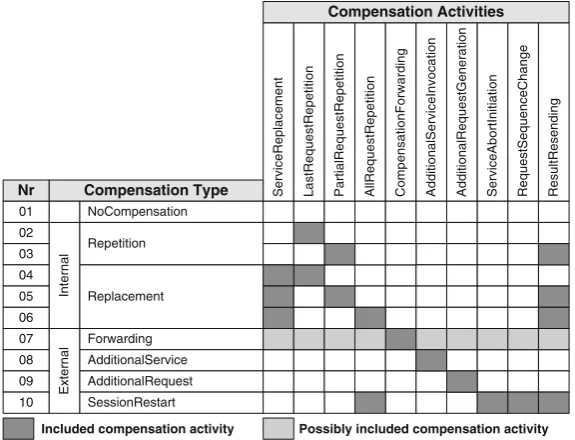
Each rule specifies the exact steps that have to be performed in the compensation process. For the purpose of defining the available compensation operations, we dis-tinguish between basiccompensation activities, which constitute the available single compensation operations, and complex compensation types, which are composed compensation processes consisting of multiple activities. This is shown in Fig.1.8.
1 Design and Management of Web Service Transactions with Forward Recovery 15
Included compensation activity Possibly included compensation activity ServiceReplacement LastRequestRepetition PartialRequestRepetition AllRequestRepetition CompensationForwarding AdditionalServiceInvocation AdditionalRequestGeneration ServiceAbortInitiation RequestSequenceChange ResultResending
Compensation Activities
Fig. 1.8 The compensation types and their included activities
Therefore, although the combination of different compensation activities allows the definition of flexible and complex rules, it is not permitted to define arbitrary compensation handling processes. Only the predefined compensation types can be used, and it is thus guaranteed that a service does not execute a process defined in a compensation rule that is not permitted or possible. At the same time, this approach allows the future extension of the environment with new compensation strategies: In order to test or include new compensation strategies, it is possible to simply define a new compensation type and extend the service to accept it.
1.3.1 Basic Compensation Activities
16 P. Dolog et al.
(e.g. the invocation of a logging service).AdditionalRequestGenerationcreates and sends an additional request to the Web service. Such a request is not influenced by the client, and the result will not be forwarded to the client.ServiceAbortInitiation can-cels the operations on the service, i.e. the service aborts and reverses all operations which have been performed so far.RequestSequenceChangeperforms changes in the sequence of requests that have already been sent to the Web service.ResultResending
sends new results for old requests, which have already returned results.
1.3.2 Compensation Types
Compensation types aggregate multiple compensation activities, and thus form com-plex compensation operations (Fig.1.8). These types are the compensation actions which can be used for internal and external compensations.
The most simple type isNoCompensation, which does not perform any operation. TheRepetitiontype is important for the internal error handling, as it repeats the last request or the lastn requests. The last request can for example be resent to a service after a response was not received within a timeout period. A partial resend ofnrequests can for instance be necessary if the request which failed was part of a sequence. A partial repetition of requests will result in the resending of results for old requests to the client, which has to be able to process them.
The compensation typeReplacementcan be used if a service fails completely. It replaces the current service with a different one, and resends either all requests, a part of the requests, or only the last one. Resending only the last request is possible if a different instance of the service that has failed can be used as replacement, which works on the same local data and can therefore simply continue with the operations.
Forwardingis special in comparison with the other types as it only indirectly uses the available activities. It forwards the handling of the compensation to a different component, which can potentially use each one of the compensation activities (which are therefore marked as “possibly included”) in the process.
In an externally triggered compensation, it is sometimes necessary to invoke additional services and send additional requests to the service. For this purpose, the compensation typesAdditionalServiceandAdditionalRequestexist.
The final compensation type isSessionRestart. This operation is required if the external compensation request cannot be handled without a restart of the complete session, i.e. the service has to be aborted and subsequently the complete request sequence has to be resent. The requested change will be realised by a change in the request sequence prior to the resending.
1.3.3 Example of a Compensation Rule
1 Design and Management of Web Service Transactions with Forward Recovery 17
Fig. 1.9 An example compensation rule
The compensation condition consists of two single condition elements:
1. RequestMethod—The rule applies to external compensation requests, which aim at changing requests that originally invoked the service’s method “trans-ferSalaryMethod”, i.e. it applies to external compensations that try to change the details of an already completed salary transfer.
2. ParticipantRequest—The second condition element specifies a request that has to be sent to the current service. The goal of the request is to check whether the account of the employee will still be in credit after the excess amount has been refunded. The condition’s request invokes the service’s method “getAccount-BalanceMethod”. The request parameters are created by the parameter factory “CheckEmployeeAccountParameterFactory”. After the request has returned the current balance, the predefined result evaluator “AccountInCreditResultEvalua-tor” is responsible for checking whether the salary refund can be performed, and thus whether the rule’s condition is fulfilled or not.
The rule’s compensation plan consists of two steps as well:
1. AdditionalRequest—An additional request is sent to perform the required changes, i.e. the money transfer back to the company’s account. It invokes the service’s method “transferSalaryMethod”. The parameters for this request are created by the parameter factory “RefundSalaryDifferenceParameterFactory”.
2. ServiceRequest—An additional external service is used as part of the compen-sation. The method “initializeTelephoneCall” has to be invoked. This external service performs a precautionary telephone call which informs the employee about the error in the salary calculation and the refund that has been performed.
18 P. Dolog et al.
1.4 Web Service Environment with Transaction Coordination
The compensation rules from the previous section can be interpreted by an envi-ronment we have designed and implemented as a prototype. The envienvi-ronment builds upon adapted Web service coordination and transaction specifications [11–13]. They provide a conceptual model and architecture for environments where business activ-ities performed by Web services are embedded in a transactional context.
A1
Fig. 1.10 Transactional environment for Web services adopted from [1]
Figure1.10depicts an excerpt of such an environment with the main components. The client runs business activities A1 to A5, which are part of a transactional context that is maintained by a transaction coordinator. Client and server stubs are responsible for getting and registering the activities and calls for Web services in the right context. The sequence of conversation messages is numbered. For clarity, we only show a conversation with a Web service provider that performs business activity A1. The coordinator is then responsible for running appropriate protocols, for example a distributed protocol for Web service environments such as [2].
We extend the architecture and the infrastructure based on the specifications [11–13] in order to enable it to handle both internally and externally triggered com-pensations as described in the previous sections.
con-1 Design and Management of Web Service Transactions with Forward Recovery 19
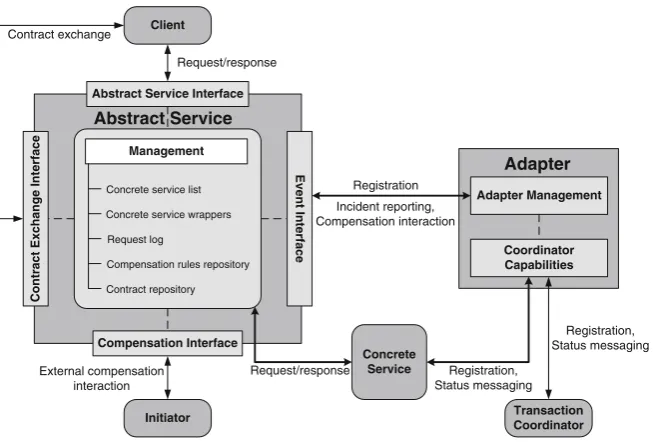
crete servicesthat offer the same functionalities and can thus replace each other. The abstract service is therefore amediator between a client and the concrete service that performs the required operations. At the same time, the adapter functions as a mediator between transaction coordinator, abstract service and concrete service to ensure proper transactional context and to provide the means to intercept failure notifications and create messages required in the compensation handling process.
Abstract Service Interface
Fig. 1.11 The abstract service and adapter transaction environment
1.4.1 Abstract Service
The central element of the extension is the notion of theabstract service. The client stub communicates with the Web service provider stub through the abstract service. An abstract service does not directly implement any operations, but rather functions as a management unit, which allows to:
• define a list of Web services which implement the required capabilities,
• invoke a service from the list in order to process requests which are sent to the abstract service,
• replace a failed service with another one from the list without a failure of the transaction, and
• process externally triggered compensations on the running transaction.
20 P. Dolog et al.
it manages a list of concrete services which provide the required capabilities. When the abstract service receives a request, it chooses one of these services and invokes it. Which concrete service is chosen depends on the abstract service’s implementation. In the simplest case, the abstract service only selects the next concrete service on the list. However, it would be possible to give the abstract service the capability to dynamically assess each concrete service and to choose the one that optimizes the client’s QoS requirements. Interface and data incompatibilities are solved by predefined wrappers.
This approach has multiple benefits:
• Usually, a client does not care which specific service handles his requests, as long as the job will be done successfully and in accordance with the contract. The abstract service design supports this notion by providing the capabilities to separate the required abilities from the actual implementation.
• The available list of concrete services enables the abstract service to provide enhanced compensation possibilities.
• The definition of an abstract service can be done independently from the business process in which it will be used. It can therefore be reused in multiple applications. If a specific service implementation is no longer usable, then the business process does not have to be changed, as this is managed in the abstract service.
Figure1.11depicts the basic structure of an abstract service. Four interfaces are supplied to the outside: The service operations for which the abstract service has been defined can be accessed via theabstract service interface. A contract can be exchanged or negotiated by using thecontract exchange interface. Execution events of a service (e.g. a failure) can be signaled via theevent interface. Compensations can be triggered from the outside using thecompensation interface.
On the inside, the main component is themanagementunit, which receives and processes requests, selects and invokes concrete services, and handles compensa-tions. In order to do so, it has several elements at its disposal:
• Concrete service list: Contains the details of all available concrete services. • Concrete service wrappers: Define the mapping of the generic abstract service
interface to the specific interface of each concrete service. • Request log: Holds all requests of the current session.
• Compensation rules repository: Manages the rules that control the compensation handling process.
• Contract repository: Contains the existing contracts with the different clients.
1.4.2 Adapter
1 Design and Management of Web Service Transactions with Forward Recovery 21
That is why the transaction specific requirements are encapsulated in a so-called
adapter (see Fig.1.11). An abstract service registers with this adapter, which in turn registers with the transaction coordinator. To the coordinator it appears as if the abstract service itself has registered and sends the status messages. When the abstract service invokes a concrete service, it forwards the information about the adapter, which functions as a coordinator for the service. The service registers accordingly at the adapter as a participant in the transaction.
As can be seen, the adapter works as a mediator between the abstract service, the concrete service, and the transaction coordinator. The adapter receives all status messages from the concrete service and is thus able to process them before they reach the actual coordinator. Normal status messages can be forwarded directly to the coordinator, while failure messages can initiate the internal compensation han-dling through the abstract service. If the adapter receives such an error message, it informs the abstract service that can then assess the possibility of compensation, which includes checking both the existing compensation rules and the restriction feature model. The adapter will be informed about the decision, and can act accord-ingly. If for example the replacement of a failed concrete service is possible, then the adapter will deregister this service and wait for the replacement to register. In this case, the failure message will not be forwarded to the transaction coordinator. The compensation assessment could of course also show that a compensation is not possi-ble (or permitted). In such a case, the adapter will simply forward the failure message to the coordinator, which will subsequently initiate the abort of the transaction.
1.4.3 Compensation Protocol
While the compensation rules specify when and how a compensation can be per-formed, the compensation protocol controls the external compensation process itself and its interaction with the different participants.
An externally triggered compensation always has the purpose of changing one particular request that has already been processed at the service. More specifically, the compensation request contains the original request with its data that has to be changed (request1(data1)), and the new request-data (data2) to which the original request has to be changed to (request1(data2)). The participants in the protocol are theabstract service, theclient which uses the abstract service in its business process, theinitiatorwhich triggers the external compensation (either the client itself, or any other authorized source like an administrator), theconcrete servicewhich is currently being utilized by the abstract service, and thetransaction coordinator. An externally triggered compensation can only be performed if the transaction in which the abstract service participates has not yet finished, as this usually has consequences for the client due to result resending.
22 P. Dolog et al.
compensation rules are being used, which consist of a compensation condition
(defines when a compensation rule can be applied) and acompensation plan(defines the compensation actions that have to be performed). The second stage of the protocol is thecompensation execution, which performs the actual compensation according to the plan. Whether this stage is actually reached depends on the initiator: After the assessment has been completed and has come to a positive conclusion, the initiator, based on this data, has to decide whether the compensation should be performed.
As the client and the initiator of an external compensation can differ, the pro-tocol contains the means to inform the client about the compensation process. It also ensures that the current concrete service and the transaction coordinator are informed about the status of the external compensation, as it is possible that the concrete service’s (and thus the abstract service’s) state changes due to the external compensation. The concrete service has to enter a specific external compensation handling procedure state for this purpose. While the concrete service is in this state, it will wait for additional requests from the abstract service, and the coordinator is not allowed to complete the transaction. While assessing the possibilities for a com-pensation, and while performing it, the abstract service cannot process additional requests (and either has to store the requests in a queue, or has to reject them with an appropriate error message).
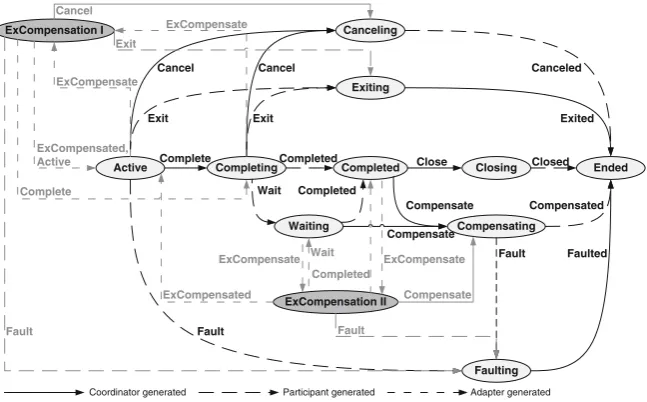
Because of the requirements of the compensation protocol, it is necessary to adapt the normal transaction protocol with additional state changes regarding the coordina-tor and participant (i.e. the concrete service). This has been done in our implementa-tion for theBusinessAgreementWithCoordinatorCompletionprotocol (refer to [11]), using an extended version introduced in [2] as a basis that uses trans-action dependency graphs in order to solve cyclic dependencies. The result of the state diagram adaptation for the compensation protocol is depicted in Fig.1.12.
Two new states have been introduced,ExCompensation IandExC
ompen-sation II. While both represent the external compensation handling procedure state which the concrete service has to enter, it is necessary to distinct between them, because depending on the former state different consequential transitions exist.
1 Design and Management of Web Service Transactions with Forward Recovery 23
Coordinator generated Participant generated Adapter generated Compensate
Fig. 1.12 The state diagram of theBusinessAgreementWithCoordinatorCompletion
protocol with extensions for the external compensation handling
has been performed, and it is possible that additional operations are required by the client as a consequence of the compensation.
In addition to these options within the ExCompensation Istate, the same transitions exist as in theActiveandCompletingstates, i.e. the coordinator can Cancelthe operations, and the participant canExitor send aFaultnotification. If the concrete service is either in the Waitingor Completedstate when receiving anExCompensatemessage, it will enter theExCompensation II
state. In principle, the state has the same meaning as ExCompensation I: The concrete service will wait for new abstract service requests, and at the same time the coordinator is not allowed to finish the transaction. The concrete service will be notified to enter the Active state through an ExCompensated mes-sage after a successful external compensation execution. However, in contrast to ExCompensation I, different consequential transitions are available, and there-fore it is necessary to separate these two states. In case of a compensation abort, the concrete service can be instructed to re-renter its former state through a Waitor Completedmessage. Moreover, aFaultmessage can be sent to signal an internal failure. Finally, the coordinator can send aCompensateinstruction while the con-crete service is in theExCompensation IIstate. The concrete service can only be instructed toCompensateif it is either in theWaitingor theCompleted
state. Therefore, it is necessary to introduceExCompensation II, as this option is not available for the Active and Completingstates and thus may not be permitted withinExCompensation I.