978-1-491-94695-4 [LSI]
OpenStack Operations Guide
by Tom Fifield, Diane Fleming, Anne Gentle, Lorin Hochstein, Jonathan Proulx, Everett Toews, and Joe Topjian
Copyright © 2014 OpenStack Foundation. All rights reserved. Printed in the United States of America.
Published by O'Reilly Media, Inc. , 1005 Gravenstein Highway North, Sebastopol, CA 95472.
O'Reilly books may be purchased for educational, business, or sales promotional use. Online editions are also available for most titles (http://my.safaribooksonline.com). For more information, contact our corpo‐ rate/institutional sales department: 800-998-9938 or [email protected] .
Editors: Andy Oram and Brian Anderson Production Editor: Kristen Brown Copyeditor: John Pierce Proofreader: Amanda Kersey
Indexer: Judith McConville Interior Designer: David Futato Cover Designer: Karen Montgomery Illustrator: Rebecca Demarest
May 2014: First Edition
Revision History for the First Edition 2014-04-21: First release
See http://oreilly.com/catalog/errata.csp?isbn=9781491946954 for release details.
Nutshell Handbook, the Nutshell Handbook logo, and the O'Reilly logo are registered trademarks of O'Reilly Media, Inc. OpenStack Operations Guide, the image of a crested agouti, and related trade dress are trademarks of O'Reilly Media, Inc.
Many of the designations used by manufacturers and sellers to distinguish their products are claimed as trademarks. Where those designations appear in this book, and O'Reilly Media, Inc., was aware of a trade‐ mark claim, the designations have been printed in caps or initial caps.
Table of Contents
Preface. . . xi
Part I. Architecture
1. Example Architectures. . . 3
Example Architecture—Legacy Networking (nova) 3
Overview 4
Detailed Description 7
Optional Extensions 9
Example Architecture—OpenStack Networking 9
Overview 9
Detailed Description 11
Example Component Configuration 19
Parting Thoughts on Architectures 23
2. Provisioning and Deployment. . . 25
Automated Deployment 25
Disk Partitioning and RAID 26
Network Configuration 28
Automated Configuration 28
Remote Management 29
Parting Thoughts for Provisioning and Deploying OpenStack 29
Conclusion 30
3. Designing for Cloud Controllers and Cloud Management. . . 31
Hardware Considerations 32
Separation of Services 33
Database 34
Message Queue 34
Conductor Services 35
Application Programming Interface (API) 35
Extensions 36
Scheduling 36
Images 37
Dashboard 37
Authentication and Authorization 37
Network Considerations 38
4. Compute Nodes. . . 39
Choosing a CPU 39
Choosing a Hypervisor 40
Instance Storage Solutions 41
Off Compute Node Storage—Shared File System 42
On Compute Node Storage—Shared File System 42
On Compute Node Storage—Nonshared File System 43
Issues with Live Migration 43
Choice of File System 44
Overcommitting 44
Logging 45
Networking 45
Conclusion 45
5. Scaling. . . 47
The Starting Point 47
Adding Cloud Controller Nodes 49
Segregating Your Cloud 50
Cells and Regions 51
Availability Zones and Host Aggregates 51
Scalable Hardware 53
Hardware Procurement 53
Capacity Planning 54
Burn-in Testing 54
6. Storage Decisions. . . 55
Ephemeral Storage 55
Persistent Storage 55
Object Storage 55
Block Storage 57
OpenStack Storage Concepts 57
Commodity Storage Backend Technologies 60
Conclusion 62
7. Network Design. . . 63
Management Network 63
Public Addressing Options 64
IP Address Planning 64
Network Topology 65
VLAN Configuration Within OpenStack VMs 67
Multi-NIC Provisioning 67
Multi-Host and Single-Host Networking 67
Services for Networking 68
NTP 68
DNS 68
Conclusion 68
Part II. Operations
8. Lay of the Land. . . 71
Using the OpenStack Dashboard for Administration 71
Command-Line Tools 71
Installing the Tools 72
Administrative Command-Line Tools 72
Getting Credentials 73
Inspecting API Calls 75
Servers and Services 76
Diagnose Your Compute Nodes 78
Network Inspection 79
Users and Projects 80
Running Instances 81
Summary 82
9. Managing Projects and Users. . . 83
Projects or Tenants? 83
Managing Projects 84
Adding Projects 84
Quotas 85
Set Image Quotas 86
Set Compute Service Quotas 86
Set Object Storage Quotas 89
Set Block Storage Quotas 90
User Management 92
Creating New Users 92
Associating Users with Projects 93
Customizing Authorization 94
Users Who Disrupt Other Users 97
Summary 97
10. User-Facing Operations. . . 99
Images 99
Adding Images 99
Sharing Images Between Projects 100
Deleting Images 100
Other CLI Options 101
The Image Service and the Database 101
Example Image Service Database Queries 101
Flavors 101
Private Flavors 103
How Do I Modify an Existing Flavor? 103
Security Groups 104
General Security Groups Configuration 104
End-User Configuration of Security Groups 104
Block Storage 106
Block Storage Creation Failures 108
Instances 108
Starting Instances 108
Instance Boot Failures 109
Using Instance-Specific Data 110
Associating Security Groups 112
Floating IPs 112
Attaching Block Storage 113
Taking Snapshots 114
Live Snapshots 115
Instances in the Database 116
Good Luck! 117
11. Maintenance, Failures, and Debugging. . . 119
Cloud Controller and Storage Proxy Failures and Maintenance 119
Planned Maintenance 119
Rebooting a Cloud Controller or Storage Proxy 119
After a Cloud Controller or Storage Proxy Reboots 120
Total Cloud Controller Failure 120
Planned Maintenance 121
After a Compute Node Reboots 121
Instances 122
Inspecting and Recovering Data from Failed Instances 122
Volumes 125
Total Compute Node Failure 125
/var/lib/nova/instances 126
Storage Node Failures and Maintenance 127
Rebooting a Storage Node 127
Shutting Down a Storage Node 127
Replacing a Swift Disk 127
Handling a Complete Failure 128
Configuration Management 129
Working with Hardware 129
Adding a Compute Node 130
Adding an Object Storage Node 130
Replacing Components 130
Databases 131
Database Connectivity 131
Performance and Optimizing 131
HDWMY 132
Hourly 132
Daily 132
Weekly 132
Monthly 132
Quarterly 132
Semiannually 133
Determining Which Component Is Broken 133
Tailing Logs 133
Running Daemons on the CLI 134
Uninstalling 135
12. Network Troubleshooting. . . 137
Using “ip a” to Check Interface States 137
Visualizing nova-network Traffic in the Cloud 138
Visualizing OpenStack Networking Service Traffic in the Cloud 139
Finding a Failure in the Path 145
tcpdump 146
iptables 147
Network Configuration in the Database for nova-network 148
Manually Deassociating a Floating IP 148
Debugging DHCP Issues with nova-network 149
Debugging DNS Issues 152
Troubleshooting Open vSwitch 153
Dealing with Network Namespaces 154
Summary 155
13. Logging and Monitoring. . . 157
Where Are the Logs? 157
Reading the Logs 158
Tracing Instance Requests 159
Adding Custom Logging Statements 160
RabbitMQ Web Management Interface or rabbitmqctl 161
Centrally Managing Logs 161
rsyslog Client Configuration 161
rsyslog Server Configuration 162
StackTach 163
Monitoring 163
Process Monitoring 164
Resource Alerting 165
Metering and Telemetry with Ceilometer 165
OpenStack-Specific Resources 166
Intelligent Alerting 167
Trending 168
Summary 169
14. Backup and Recovery. . . 171
What to Back Up 171
Database Backups 172
File System Backups 172
Compute 172
Image Catalog and Delivery 173
Identity 173
Block Storage 173
Object Storage 173
Recovering Backups 173
Summary 174
15. Customization. . . 175
Create an OpenStack Development Environment 175
Customizing Object Storage (Swift) Middleware 178
Customizing the OpenStack Compute (nova) Scheduler 184
Conclusion 189
16. Upstream OpenStack. . . 191
Getting Help 191
Reporting Bugs 192
Confirming and Prioritizing 193
Bug Fixing 194
After the Change Is Accepted 194
Join the OpenStack Community 194
How to Contribute to the Documentation 195
Security Information 195
Finding Additional Information 196
17. Advanced Configuration. . . 197
Differences Between Various Drivers 197
Implementing Periodic Tasks 198
Specific Configuration Topics 199
Security Configuration for Compute, Networking, and Storage 199
High Availability 199
Enabling IPv6 Support 199
Periodic Task Frequency for Compute 199
Geographical Considerations for Object Storage 200
18. Upgrades. . . 201
Pre-Upgrade Testing Environment 201
Preparing for a Rollback 202
Upgrades 203
How to Perform an Upgrade from Grizzly to Havana—Ubuntu 204
Impact on Users 204
Upgrade Considerations 204
Perform a Backup 204
Manage Repositories 204
Update Configuration Files 205
Upgrade Packages on the Controller Node 207
Stop Services, Update Database Schemas, and Restart Services on the Controller Node 207
Upgrade Packages and Restart Services on the Compute Nodes 208
Upgrade Packages and Restart Services on the Block Storage Nodes 209
How to Perform an Upgrade from Grizzly to Havana—Red Hat Enterprise Linux and Derivatives 210
Impact on Users 210
Upgrade Considerations 210
Perform a Backup 210
Manage Repositories 211
Update Configuration Files 211
Upgrade Packages on the Controller Node 213
Stop Services, Update Database Schemas, and Restart Services on the Controller Node 214
Upgrade Packages and Restart Services on the Compute Nodes 215
Upgrade Packages and Restart Services on the Block Storage Nodes 215
Cleaning Up and Final Configuration File Updates 216
Rolling Back a Failed Upgrade 216
A. Use Cases. . . 221
B. Tales From the Cryp^H^H^H^H Cloud. . . 225
C. Working with Roadmaps. . . 237
D. Icehouse Preview. . . 245
E. Resources. . . 255
Glossary. . . 257
Preface
OpenStack is an open source platform that lets you build an Infrastructure as a Ser‐ vice (IaaS) cloud that runs on commodity hardware.
Introduction to OpenStack
OpenStack believes in open source, open design, open development, all in an open community that encourages participation by anyone. The long-term vision for Open‐ Stack is to produce a ubiquitous open source cloud computing platform that meets the needs of public and private cloud providers regardless of size. OpenStack services control large pools of compute, storage, and networking resources throughout a data center.
The technology behind OpenStack consists of a series of interrelated projects deliver‐ ing various components for a cloud infrastructure solution. Each service provides an open API so that all of these resources can be managed through a dashboard that gives administrators control while empowering users to provision resources through a web interface, a command-line client, or software development kits that support the API. Many OpenStack APIs are extensible, meaning you can keep compatibility with a core set of calls while providing access to more resources and innovating through API extensions. The OpenStack project is a global collaboration of developers and cloud computing technologists. The project produces an open standard cloud com‐ puting platform for both public and private clouds. By focusing on ease of implemen‐ tation, massive scalability, a variety of rich features, and tremendous extensibility, the project aims to deliver a practical and reliable cloud solution for all types of organiza‐ tions.
Getting Started with OpenStack
As an open source project, one of the unique aspects of OpenStack is that it has many different levels at which you can begin to engage with it—you don’t have to do every‐ thing yourself.
Using OpenStack
You could ask, “Do I even need to build a cloud?” If you want to start using a com‐ pute or storage service by just swiping your credit card, you can go to eNovance, HP, Rackspace, or other organizations to start using their public OpenStack clouds. Using their OpenStack cloud resources is similar to accessing the publically available Ama‐ zon Web Services Elastic Compute Cloud (EC2) or Simple Storage Solution (S3).
Plug and Play OpenStack
However, the enticing part of OpenStack might be to build your own private cloud, and there are several ways to accomplish this goal. Perhaps the simplest of all is an appliance-style solution. You purchase an appliance, unpack it, plug in the power and the network, and watch it transform into an OpenStack cloud with minimal addition‐ al configuration. Few, if any, other open source cloud products have such turnkey op‐ tions. If a turnkey solution is interesting to you, take a look at Nebula One.
However, hardware choice is important for many applications, so if that applies to you, consider that there are several software distributions available that you can run on servers, storage, and network products of your choosing. Canonical (where Open‐ Stack replaced Eucalyptus as the default cloud option in 2011), Red Hat, and SUSE offer enterprise OpenStack solutions and support. You may also want to take a look at some of the specialized distributions, such as those from Rackspace, Piston, Swift‐ Stack, or Cloudscaling. Also, a hat tip to Apache CloudStack, which Citrix donated to the Apache Foundation after its $200 million purchase of Cloud.com. While not cur‐ rently packaged in any distributions, like Eucalyptus, it is an example of an alternative private cloud software developed in an open source–like manner.
Alternatively, if you want someone to help guide you through the decisions about the underlying hardware or your applications, perhaps adding in a few features or inte‐ grating components along the way, consider contacting one of the system integrators with OpenStack experience, such as Mirantis or Metacloud.
Roll Your Own OpenStack
However, this guide has a different audience—those seeking to derive the most flexi‐ bility from the OpenStack framework by conducting do-it-yourself solutions.
OpenStack is designed for scalability, so you can easily add new compute, network, and storage resources to grow your cloud over time. In addition to several massive OpenStack public clouds, a considerable number of organizations (such as Paypal, In‐ tel, and Comcast) have built large-scale private clouds. OpenStack offers much more than a typical software package because it lets you integrate a number of different technologies to construct a cloud. This approach provides great flexibility, but the number of options might be bewildering at first.
Who This Book Is For
This book is for those of you starting to run OpenStack clouds as well as those of you who were handed an operational one and want to keep it running well. Perhaps you’re on a DevOps team, perhaps you are a system administrator starting to dabble in the cloud, or maybe you want to get on the OpenStack cloud team at your compa‐ ny. This book is for all of you.
This guide assumes that you are familiar with a Linux distribution that supports OpenStack, SQL databases, and virtualization. You must be comfortable administer‐ ing and configuring multiple Linux machines for networking. You must install and maintain a MySQL database and occasionally run SQL queries against it.
One of the most complex aspects of an OpenStack cloud is the networking configura‐ tion. You should be familiar with concepts such as DHCP, Linux bridges, VLANs, and iptables. You must also have access to a network hardware expert who can configure the switches and routers required in your OpenStack cloud.
Cloud computing is a quite advanced topic, and this book requires a lot of background knowledge. However, if you are fairly new to cloud computing, we recommend that you make use of the Glossa‐ ry at the back of the book, as well as the online documentation for OpenStack and additional resources mentioned in this book in Ap‐ pendix E.
Further Reading
There are other books on the OpenStack documentation website that can help you get the job done.
OpenStack Installation Guides
Describes a manual installation process, as in, by hand, without automation, for multiple distributions based on a packaging system:
• Installation Guide for Debian 7.0
• Installation Guide for openSUSE and SUSE Linux Enterprise Server
• Installation Guide for Red Hat Enterprise Linux, CentOS, and Fedora
• Installation Guide for Ubuntu 12.04 (LTS) Server
OpenStack Configuration Reference
Contains a reference listing of all configuration options for core and integrated OpenStack services by release version
OpenStack Cloud Administrator Guide
Contains how-to information for managing an OpenStack cloud as needed for your use cases, such as storage, computing, or software-defined-networking
OpenStack High Availability Guide
Describes potential strategies for making your OpenStack services and related controllers and data stores highly available
OpenStack Security Guide
Provides best practices and conceptual information about securing an OpenStack cloud
Virtual Machine Image Guide
Shows you how to obtain, create, and modify virtual machine images that are compatible with OpenStack
OpenStack End User Guide
Shows OpenStack end users how to create and manage resources in an Open‐ Stack cloud with the OpenStack dashboard and OpenStack client commands
OpenStack Admin User Guide
Shows OpenStack administrators how to create and manage resources in an OpenStack cloud with the OpenStack dashboard and OpenStack client commands
OpenStack API Quick Start
How This Book Is Organized
This book is organized in two parts: the architecture decisions for designing Open‐ Stack clouds and the repeated operations for running OpenStack clouds.
Part I:
Chapter 1
Because of all the decisions the other chapters discuss, this chapter describes the decisions made for this particular book and much of the justification for the ex‐ ample architecture.
Chapter 2
While this book doesn’t describe installation, we do recommend automation for deployment and configuration, discussed in this chapter.
Chapter 3
The cloud controller is an invention for the sake of consolidating and describing which services run on which nodes. This chapter discusses hardware and net‐ work considerations as well as how to design the cloud controller for perfor‐ mance and separation of services.
Chapter 4
This chapter describes the compute nodes, which are dedicated to running virtu‐ al machines. Some hardware choices come into play here, as well as logging and networking descriptions.
Chapter 5
This chapter discusses the growth of your cloud resources through scaling and segregation considerations.
Chapter 6
As with other architecture decisions, storage concepts within OpenStack take a lot of consideration, and this chapter lays out the choices for you.
Chapter 7
Your OpenStack cloud networking needs to fit into your existing networks while also enabling the best design for your users and administrators, and this chapter gives you in-depth information about networking decisions.
Part II:
Chapter 8
This chapter is written to let you get your hands wrapped around your Open‐ Stack cloud through command-line tools and understanding what is already set up in your cloud.
Chapter 9
This chapter walks through user-enabling processes that all admins must face to manage users, give them quotas to parcel out resources, and so on.
Chapter 10
This chapter shows you how to use OpenStack cloud resources and train your users as well.
Chapter 11
This chapter goes into the common failures that the authors have seen while run‐ ning clouds in production, including troubleshooting.
Chapter 12
Because network troubleshooting is especially difficult with virtual resources, this chapter is chock-full of helpful tips and tricks for tracing network traffic, finding the root cause of networking failures, and debugging related services, such as DHCP and DNS.
Chapter 13
This chapter shows you where OpenStack places logs and how to best read and manage logs for monitoring purposes.
Chapter 14
This chapter describes what you need to back up within OpenStack as well as best practices for recovering backups.
Chapter 15
For readers who need to get a specialized feature into OpenStack, this chapter de‐ scribes how to use DevStack to write custom middleware or a custom scheduler to rebalance your resources.
Chapter 16
Because OpenStack is so, well, open, this chapter is dedicated to helping you nav‐ igate the community and find out where you can help and where you can get help.
Chapter 17
Much of OpenStack is driver-oriented, so you can plug in different solutions to the base set of services. This chapter describes some advanced configuration topics.
Chapter 18
Backmatter:
Appendix A
You can read a small selection of use cases from the OpenStack community with some technical details and further resources.
Appendix B
These are shared legendary tales of image disappearances, VM massacres, and crazy troubleshooting techniques to share those hard-learned lessons and wisdom.
Appendix C
Read about how to track the OpenStack roadmap through the open and trans‐ parent development processes.
Appendix D
A preview of the new features in the Icehouse release of OpenStack.
Appendix E
So many OpenStack resources are available online because of the fast-moving na‐ ture of the project, but there are also resources listed here that the authors found helpful while learning themselves.
Glossary
A list of terms used in this book is included, which is a subset of the larger Open‐ Stack glossary available online.
Why and How We Wrote This Book
We wrote this book because we have deployed and maintained OpenStack clouds for at least a year, and wanted to be able to distribute this knowledge to others. After months of being the point people for an OpenStack cloud, we also wanted to have a document to hand to our system administrators so that they’d know how to operate the cloud on a daily basis—both reactively and proactively. We wanted to provide more detailed technical information about the decisions that deployers make along the way.
We wrote this book to help you:
• Design and create an architecture for your first nontrivial OpenStack cloud. After you read this guide, you’ll know which questions to ask and how to organize your compute, networking, and storage resources and the associated software packages.
• Perform the day-to-day tasks required to administer a cloud.
We wrote this book in a book sprint, which is a facilitated, rapid development pro‐ duction method for books. For more information, see the BookSprints site. Your authors cobbled this book together in five days during February 2013, fueled by caf‐ feine and the best takeout food that Austin, Texas, could offer.
On the first day, we filled white boards with colorful sticky notes to start to shape this nebulous book about how to architect and operate clouds:
We wrote furiously from our own experiences and bounced ideas between each other. At regular intervals we reviewed the shape and organization of the book and further molded it, leading to what you see today.
The team includes:
Tom Fifield
After learning about scalability in computing from particle physics experiments, such as ATLAS at the Large Hadron Collider (LHC) at CERN, Tom worked on OpenStack clouds in production to support the Australian public research sector. Tom currently serves as an OpenStack community manager and works on Open‐ Stack documentation in his spare time.
Diane Fleming
Anne Gentle
Anne is the documentation coordinator for OpenStack and also served as an in‐ dividual contributor to the Google Documentation Summit in 2011, working with the Open Street Maps team. She has worked on book sprints in the past, with FLOSS Manuals’ Adam Hyde facilitating. Anne lives in Austin, Texas.
Lorin Hochstein
An academic turned software-developer-slash-operator, Lorin worked as the lead architect for Cloud Services at Nimbis Services, where he deploys OpenStack for technical computing applications. He has been working with OpenStack since the Cactus release. Previously, he worked on high-performance computing exten‐ sions for OpenStack at University of Southern California’s Information Sciences Institute (USC-ISI).
Adam Hyde
Adam facilitated this book sprint. He also founded the books sprint methodology and is the most experienced book-sprint facilitator around. See http://www.book sprints.net for more information. Adam founded FLOSS Manuals—a community of some 3,000 individuals developing Free Manuals about Free Software. He is also the founder and project manager for Booktype, an open source project for writing, editing, and publishing books online and in print.
Jonathan Proulx
Jon has been piloting an OpenStack cloud as a senior technical architect at the MIT Computer Science and Artificial Intelligence Lab for his researchers to have as much computing power as they need. He started contributing to OpenStack documentation and reviewing the documentation so that he could accelerate his learning.
Everett Toews
Everett is a developer advocate at Rackspace making OpenStack and the Rack‐ space Cloud easy to use. Sometimes developer, sometimes advocate, and some‐ times operator, he’s built web applications, taught workshops, given presentations around the world, and deployed OpenStack for production use by academia and business.
Joe Topjian
Joe has designed and deployed several clouds at Cybera, a nonprofit where they are building e-infrastructure to support entrepreneurs and local researchers in Alberta, Canada. He also actively maintains and operates these clouds as a sys‐ tems architect, and his experiences have generated a wealth of troubleshooting skills for cloud environments.
OpenStack community members
Many individual efforts keep a community book alive. Our community members updated content for this book year-round. Also, a year after the first sprint, Jon Proulx hosted a second two-day mini-sprint at MIT with the goal of updating the book for the latest release. Since the book’s inception, more than 30 contributors have supported this book. We have a tool chain for reviews, continuous builds, and translations. Writers and developers continuously review patches, enter doc bugs, edit content, and fix doc bugs. We want to recognize their efforts!
The following people have contributed to this book: Akihiro Motoki, Alejandro Avella, Alexandra Settle, Andreas Jaeger, Andy McCallum, Benjamin Stassart, Chandan Kumar, Chris Ricker, David Cramer, David Wittman, Denny Zhang, Emilien Macchi, Gauvain Pocentek, Ignacio Barrio, James E. Blair, Jay Clark, Jeff White, Jeremy Stanley, K Jonathan Harker, KATO Tomoyuki, Lana Brindley, Laura Alves, Lee Li, Lukasz Jernas, Mario B. Codeniera, Matthew Kassawara, Mi‐ chael Still, Monty Taylor, Nermina Miller, Nigel Williams, Phil Hopkins, Russell Bryant, Sahid Orentino Ferdjaoui, Sandy Walsh, Sascha Peilicke, Sean M. Collins, Sergey Lukjanov, Shilla Saebi, Stephen Gordon, Summer Long, Uwe Stuehler, Vaibhav Bhatkar, Veronica Musso, Ying Chun “Daisy” Guo, Zhengguang Ou, and ZhiQiang Fan.
How to Contribute to This Book
The genesis of this book was an in-person event, but now that the book is in your hands, we want you to contribute to it. OpenStack documentation follows the coding principles of iterative work, with bug logging, investigating, and fixing. We also store the source content on GitHub and invite collaborators through the OpenStack Gerrit installation, which offers reviews. For the O’Reilly edition of this book, we are using the company’s Atlas system, which also stores source content on GitHub and enables collaboration among contributors.
Learn more about how to contribute to the OpenStack docs at Documentation How To.
Conventions Used in This Book
The following typographical conventions are used in this book:
Italic
Indicates new terms, URLs, email addresses, filenames, and file extensions.
Constant width
Used for program listings, as well as within paragraphs to refer to program ele‐ ments such as variable or function names, databases, data types, environment variables, statements, and keywords.
Constant width bold
Shows commands or other text that should be typed literally by the user.
Constant width italic
Shows text that should be replaced with user-supplied values or by values deter‐ mined by context.
Command prompts
Commands prefixed with the # prompt should be executed by the root user. These examples can also be executed using the sudo command, if available. Commands prefixed with the $ prompt can be executed by any user, including
root.
This element signifies a tip or suggestion.
This element signifies a general note.
This element indicates a warning or caution.
Using Code Examples
Supplemental material (code examples, exercises, etc.) is available for download at
https://github.com/openstack/openstack-manuals.
This book is here to help you get your job done. In general, if example code is offered with this book, you may use it in your programs and documentation. You do not need to contact us for permission unless you’re reproducing a significant portion of the code. For example, writing a program that uses several chunks of code from this book does not require permission. Selling or distributing a CD-ROM of examples from O’Reilly books does require permission. Answering a question by citing this book and quoting example code does not require permission. Incorporating a signifi‐ cant amount of example code from this book into your product’s documentation does require permission.
We appreciate, but do not require, attribution. An attribution usually includes the ti‐ tle, author, publisher, and ISBN. For example: "OpenStack Operations Guide by Tom Fifield, Diane Fleming, Anne Gentle, Lorin Hochstein, Jonathan Proulx, Everett Toews, and Joe Topjian (O’Reilly). Copyright 2014 OpenStack Foundation, 978-1-491-94695-4.”
If you feel your use of code examples falls outside fair use or the permission given above, feel free to contact us at [email protected].
Safari® Books Online
Safari Books Online (www.safaribooksonline.com) is an on-demand digital library that delivers expert content in both book and video form from the world’s leading authors in technology and business.
Technology professionals, software developers, web designers, and business and crea‐ tive professionals use Safari Books Online as their primary resource for research, problem solving, learning, and certification training.
How to Contact Us
Please address comments and questions concerning this book to the publisher: O’Reilly Media, Inc.
1005 Gravenstein Highway North Sebastopol, CA 95472
800-998-9938 (in the United States or Canada) 707-829-0515 (international or local)
707-829-0104 (fax)
We have a web page for this book, where we list errata, examples, and any additional information. You can access this page at http://bit.ly/openstack-ops-guide.
To comment or ask technical questions about this book, send email to bookques‐ [email protected].
For more information about our books, courses, conferences, and news, see our web‐ site at http://www.oreilly.com.
Find us on Facebook: http://facebook.com/oreilly
Follow us on Twitter: http://twitter.com/oreillymedia
Watch us on YouTube: http://www.youtube.com/oreillymedia
Acknowledgments
The OpenStack Foundation supported the creation of this book with plane tickets to Austin, lodging (including one adventurous evening without power after a wind‐ storm), and delicious food. For about $10,000, we could collaborate intensively for a week in the same room at the Rackspace Austin office. The authors are all members of the OpenStack Foundation, which you can join. Go to the Foundation website. We want to acknowledge our excellent host, Rackers at Rackspace in Austin:
• Emma Richards of Rackspace guest relations took excellent care of our lunch or‐ ders and even set aside a pile of sticky notes that had fallen off the walls.
• Betsy Hagemeier, a fanatical executive assistant, took care of a room reshuffle and helped us settle in for the week.
• The real estate team at Rackspace in Austin, also known as “The Victors,” were super responsive.
• Adam Powell in Racker IT supplied us with bandwidth each day and second monitors for those of us needing more screens.
• On Wednesday night we had a fun happy hour with the Austin OpenStack Meet‐ up group, and Racker Katie Schmidt took great care of our group.
We also had some excellent input from outside the room:
• Tim Bell from CERN gave us feedback on the outline before we started and re‐ viewed it midweek.
• Sébastien Han has written excellent blogs and generously gave his permission for reuse.
• Oisin Feeley read the book, made some edits, and emailed feedback right when we asked.
Inside the book-sprint room with us each day was our book-sprint facilitator, Adam Hyde. Without his tireless support and encouragement, we would have thought a book of this scope was impossible in five days. Adam has proven again and again that the book-sprint method is effective. He creates both tools and faith in collaborative authoring at http://www.booksprints.net.
PART I
Architecture
Designing an OpenStack cloud is a great achievement. It requires a robust under‐ standing of the requirements and needs of the cloud’s users to determine the best pos‐ sible configuration to meet them. OpenStack provides a great deal of flexibility to achieve your needs, and this part of the book aims to shine light on many of the deci‐ sions you need to make during the process.
To design, deploy, and configure OpenStack, administrators must understand the log‐ ical architecture. A diagram can help you envision all the integrated services within OpenStack and how they interact with each other.
OpenStack modules are one of the following types:
Daemon
Runs as a background process. On Linux platforms, a daemon is usually installed as a service.
Script
Installs a virtual environment and runs tests.
Command-line interface (CLI)
CHAPTER 1
Example Architectures
To understand the possibilities OpenStack offers, it’s best to start with basic architec‐ tures that are tried-and-true and have been tested in production environments. We offer two such examples with basic pivots on the base operating system (Ubuntu and Red Hat Enterprise Linux) and the networking architectures. There are other differ‐ ences between these two examples, but you should find the considerations made for the choices in each as well as a rationale for why it worked well in a given environ‐ ment.
Because OpenStack is highly configurable, with many different backends and net‐ work configuration options, it is difficult to write documentation that covers all pos‐ sible OpenStack deployments. Therefore, this guide defines example architectures to simplify the task of documenting, as well as to provide the scope for this guide. Both of the offered architecture examples are currently running in production and serving users.
As always, refer to the Glossary if you are unclear about any of the terminology mentioned in these architectures.
Example Architecture—Legacy Networking (nova)
This particular example architecture has been upgraded from Grizzly to Havana and tested in production environments where many public IP addresses are available for assignment to multiple instances. You can find a second example architecture that uses OpenStack Networking (neutron) after this section. Each example offers high
availability, meaning that if a particular node goes down, another node with the same configuration can take over the tasks so that service continues to be available.
Overview
The simplest architecture you can build upon for Compute has a single cloud con‐ troller and multiple compute nodes. The simplest architecture for Object Storage has five nodes: one for identifying users and proxying requests to the API, then four for storage itself to provide enough replication for eventual consistency. This example ar‐ chitecture does not dictate a particular number of nodes, but shows the thinking and considerations that went into choosing this architecture including the features offered.
Components
Component Details
OpenStack release Havana
Host operating system Ubuntu 12.04 LTS or Red Hat Enterprise Linux 6.5, including derivatives such as CentOS and Scientific Linux
OpenStack package repository Ubuntu Cloud Archive or RDO* Hypervisor KVM
Database MySQL*
Message queue RabbitMQ for Ubuntu; Qpid for Red Hat Enterprise Linux and derivatives Networking service nova-network
Network manager FlatDHCP Single nova-network or multi-host? multi-host* Image Service (glance) backend file Identity Service (keystone) driver SQL Block Storage Service (cinder) backend LVM/iSCSI
An asterisk (*) indicates when the example architecture deviates from the settings of a default installation. We’ll offer explanations for those deviations next.
The following features of OpenStack are supported by the example architecture documented in this guide, but are optional:
• Dashboard: You probably want to offer a dashboard, but your users may be more interested in API access only.
• Block storage: You don’t have to offer users block storage if their use case only needs ephemeral storage on compute no‐ des, for example.
• Floating IP address: Floating IP addresses are public IP ad‐ dresses that you allocate from a predefined pool to assign to virtual machines at launch. Floating IP address ensure that the public IP address is available whenever an instance is booted. Not every organization can offer thousands of public floating IP addresses for thousands of instances, so this feature is con‐ sidered optional.
• Live migration: If you need to move running virtual machine instances from one host to another with little or no service in‐ terruption, you would enable live migration, but it is consid‐ ered optional.
• Object storage: You may choose to store machine images on a file system rather than in object storage if you do not have the extra hardware for the required replication and redundancy that OpenStack Object Storage offers.
Rationale
This example architecture has been selected based on the current default feature set of OpenStack Havana, with an emphasis on stability. We believe that many clouds that currently run OpenStack in production have made similar choices.
You must first choose the operating system that runs on all of the physical nodes. While OpenStack is supported on several distributions of Linux, we used Ubuntu 12.04 LTS (Long Term Support), which is used by the majority of the development community, has feature completeness compared with other distributions and has clear future support plans.
We recommend that you do not use the default Ubuntu OpenStack install packages and instead use the Ubuntu Cloud Archive. The Cloud Archive is a package reposito‐ ry supported by Canonical that allows you to upgrade to future OpenStack releases while remaining on Ubuntu 12.04.
KVM as a hypervisor complements the choice of Ubuntu—being a matched pair in terms of support, and also because of the significant degree of attention it garners from the OpenStack development community (including the authors, who mostly use KVM). It is also feature complete, free from licensing charges and restrictions.
MySQL follows a similar trend. Despite its recent change of ownership, this database is the most tested for use with OpenStack and is heavily documented. We deviate from the default database, SQLite, because SQLite is not an appropriate database for production usage.
The choice of RabbitMQ over other AMQP compatible options that are gaining sup‐ port in OpenStack, such as ZeroMQ and Qpid, is due to its ease of use and significant testing in production. It also is the only option that supports features such as Com‐ pute cells. We recommend clustering with RabbitMQ, as it is an integral component of the system and fairly simple to implement due to its inbuilt nature.
As discussed in previous chapters, there are several options for networking in Open‐ Stack Compute. We recommend FlatDHCP and to use Multi-Host networking mode for high availability, running one nova-network daemon per OpenStack compute host. This provides a robust mechanism for ensuring network interruptions are iso‐ lated to individual compute hosts, and allows for the direct use of hardware network gateways.
Live Migration is supported by way of shared storage, with NFS as the distributed file system.
Acknowledging that many small-scale deployments see running Object Storage just for the storage of virtual machine images as too costly, we opted for the file backend in the OpenStack Image Service (Glance). If your cloud will include Object Storage, you can easily add it as a backend.
We chose the SQL backend for Identity Service (keystone) over others, such as LDAP. This backend is simple to install and is robust. The authors acknowledge that many installations want to bind with existing directory services and caution careful under‐ standing of the array of options available.
Block Storage (cinder) is installed natively on external storage nodes and uses the
While the cloud can be run without the OpenStack Dashboard, we consider it to be indispensable, not just for user interaction with the cloud, but also as a tool for opera‐ tors. Additionally, the dashboard’s use of Django makes it a flexible framework for extension.
Why not use the OpenStack Network Service (neutron)?
This example architecture does not use the OpenStack Network Service (neutron), because it does not yet support multi-host networking and our organizations (univer‐ sity, government) have access to a large range of publicly-accessible IPv4 addresses.
Why use multi-host networking?
In a default OpenStack deployment, there is a single nova-network service that runs within the cloud (usually on the cloud controller) that provides services such as net‐ work address translation (NAT), DHCP, and DNS to the guest instances. If the single node that runs the nova-network service goes down, you cannot access your instan‐ ces, and the instances cannot access the Internet. The single node that runs the nova-network service can become a bottleneck if excessive network traffic comes in and goes out of the cloud.
Multi-host is a high-availability option for the network configura‐ tion, where the nova-network service is run on every compute node instead of running on only a single node.
Detailed Description
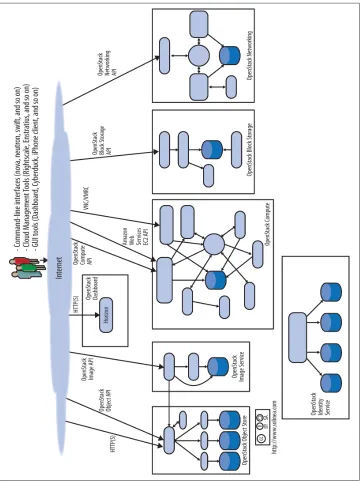
The reference architecture consists of multiple compute nodes, a cloud controller, an external NFS storage server for instance storage, and an OpenStack Block Storage server for volume storage. A network time service (Network Time Protocol, or NTP) synchronizes time on all the nodes. FlatDHCPManager in multi-host mode is used for the networking. A logical diagram for this example architecture shows which services are running on each node:
The cloud controller runs the dashboard, the API services, the database (MySQL), a message queue server (RabbitMQ), the scheduler for choosing compute resources (nova-scheduler), Identity services (keystone, nova-consoleauth), Image services (glance-api, glance-registry), services for console access of guests, and Block Storage services, including the scheduler for storage resources (cinder-api and
cinder-scheduler).
Compute nodes are where the computing resources are held, and in our example ar‐ chitecture, they run the hypervisor (KVM), libvirt (the driver for the hypervisor, which enables live migration from node to node), nova-compute, nova-api-metadata
The network consists of two switches, one for the management or private traffic, and one that covers public access, including floating IPs. To support this, the cloud con‐ troller and the compute nodes have two network cards. The OpenStack Block Storage and NFS storage servers only need to access the private network and therefore only need one network card, but multiple cards run in a bonded configuration are recom‐ mended if possible. Floating IP access is direct to the Internet, whereas Flat IP access goes through a NAT. To envision the network traffic, use this diagram:
Optional Extensions
You can extend this reference architecture as follows: • Add additional cloud controllers (see Chapter 11).
• Add an OpenStack Storage service (see the Object Storage chapter in the Open‐ Stack Installation Guide for your distribution).
• Add additional OpenStack Block Storage hosts (see Chapter 11).
Example Architecture—OpenStack Networking
This chapter provides an example architecture using OpenStack Networking, also known as the Neutron project, in a highly available environment.
Overview
A highly-available environment can be put into place if you require an environment that can scale horizontally, or want your cloud to continue to be operational in case of node failure. This example architecture has been written based on the current default feature set of OpenStack Havana, with an emphasis on high availability.
Components
Component Details
OpenStack release Havana
Host operating system Red Hat Enterprise Linux 6.5 OpenStack package repository Red Hat Distributed OpenStack (RDO)
Hypervisor KVM Database MySQL Message queue Qpid
Networking service OpenStack Networking Tenant Network Separation VLAN
Image Service (glance) backend GlusterFS Identity Service (keystone) driver SQL Block Storage Service (cinder) backend GlusterFS
Rationale
This example architecture has been selected based on the current default feature set of OpenStack Havana, with an emphasis on high availability. This architecture is cur‐ rently being deployed in an internal Red Hat OpenStack cloud and used to run hos‐ ted and shared services, which by their nature must be highly available.
This architecture’s components have been selected for the following reasons:
Red Hat Enterprise Linux
You must choose an operating system that can run on all of the physical nodes. This example architecture is based on Red Hat Enterprise Linux, which offers re‐ liability, long-term support, certified testing, and is hardened. Enterprise custom‐ ers, now moving into OpenStack usage, typically require these advantages.
RDO
KVM
KVM is the supported hypervisor of choice for Red Hat Enterprise Linux (and included in distribution). It is feature complete and free from licensing charges and restrictions.
MySQL
MySQL is used as the database backend for all databases in the OpenStack envi‐ ronment. MySQL is the supported database of choice for Red Hat Enterprise Li‐ nux (and included in distribution); the database is open source, scalable, and handles memory well.
Qpid
Apache Qpid offers 100 percent compatibility with the Advanced Message Queu‐ ing Protocol Standard, and its broker is available for both C++ and Java.
OpenStack Networking
OpenStack Networking offers sophisticated networking functionality, including Layer 2 (L2) network segregation and provider networks.
VLAN
Using a virtual local area network offers broadcast control, security, and physical layer transparency. If needed, use VXLAN to extend your address space.
GlusterFS
GlusterFS offers scalable storage. As your environment grows, you can continue to add more storage nodes (instead of being restricted, for example, by an expen‐ sive storage array).
Detailed Description
Node types
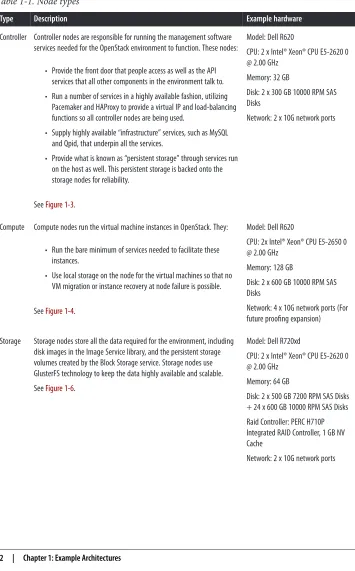
This section gives you a breakdown of the different nodes that make up the Open‐ Stack environment. A node is a physical machine that is provisioned with an operat‐ ing system, and running a defined software stack on top of it. Table 1-1 provides node descriptions and specifications.
Table 1-1. Node types
Type Description Example hardware
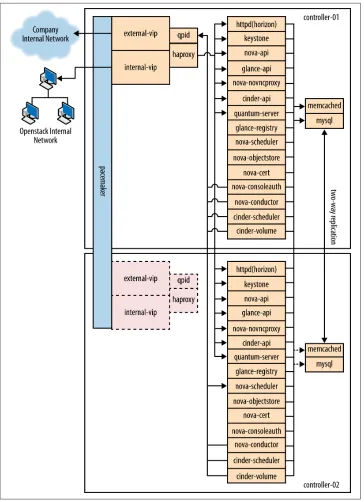
Controller Controller nodes are responsible for running the management software services needed for the OpenStack environment to function. These nodes:
• Provide the front door that people access as well as the API services that all other components in the environment talk to. • Run a number of services in a highly available fashion, utilizing
Pacemaker and HAProxy to provide a virtual IP and load-balancing functions so all controller nodes are being used.
• Supply highly available “infrastructure” services, such as MySQL and Qpid, that underpin all the services.
• Provide what is known as “persistent storage” through services run on the host as well. This persistent storage is backed onto the storage nodes for reliability.
See Figure 1-3.
Model: Dell R620
CPU: 2 x Intel® Xeon® CPU E5-2620 0 @ 2.00 GHz
Memory: 32 GB
Disk: 2 x 300 GB 10000 RPM SAS Disks
Network: 2 x 10G network ports
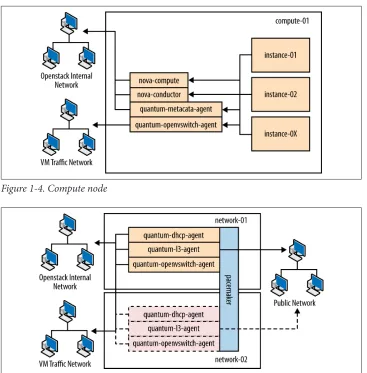
Compute Compute nodes run the virtual machine instances in OpenStack. They: • Run the bare minimum of services needed to facilitate these
instances.
• Use local storage on the node for the virtual machines so that no VM migration or instance recovery at node failure is possible. See Figure 1-4.
Model: Dell R620
CPU: 2x Intel® Xeon® CPU E5-2650 0 @ 2.00 GHz
Memory: 128 GB
Disk: 2 x 600 GB 10000 RPM SAS Disks
Network: 4 x 10G network ports (For future proofing expansion) Storage Storage nodes store all the data required for the environment, including
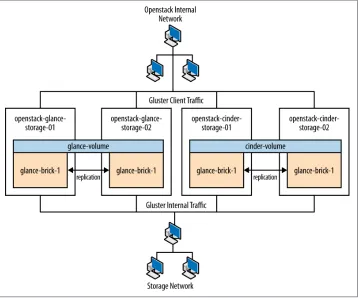
disk images in the Image Service library, and the persistent storage volumes created by the Block Storage service. Storage nodes use GlusterFS technology to keep the data highly available and scalable. See Figure 1-6.
Model: Dell R720xd
CPU: 2 x Intel® Xeon® CPU E5-2620 0 @ 2.00 GHz
Memory: 64 GB
Disk: 2 x 500 GB 7200 RPM SAS Disks + 24 x 600 GB 10000 RPM SAS Disks Raid Controller: PERC H710P Integrated RAID Controller, 1 GB NV Cache
Type Description Example hardware
Network Network nodes are responsible for doing all the virtual networking needed for people to create public or private networks and uplink their virtual machines into external networks. Network nodes:
• Form the only ingress and egress point for instances running on top of OpenStack.
• Run all of the environment’s networking services, with the exception of the networking API service (which runs on the controller node).
See Figure 1-5.
Model: Dell R620
CPU: 1 x Intel® Xeon® CPU E5-2620 0 @ 2.00 GHz
Memory: 32 GB
Disk: 2 x 300 GB 10000 RPM SAS Disks
Network: 5 x 10G network ports
Utility Utility nodes are used by internal administration staff only to provide a number of basic system administration functions needed to get the environment up and running and to maintain the hardware, OS, and software on which it runs.
These nodes run services such as provisioning, configuration management, monitoring, or GlusterFS management software. They are not required to scale, although these machines are usually backed up.
Model: Dell R620
CPU: 2x Intel® Xeon® CPU E5-2620 0 @ 2.00 GHz
Memory: 32 GB
Disk: 2 x 500 GB 7200 RPM SAS Disks Network: 2 x 10G network ports
Networking layout
The network contains all the management devices for all hardware in the environ‐ ment (for example, by including Dell iDrac7 devices for the hardware nodes, and management interfaces for network switches). The network is accessed by internal staff only when diagnosing or recovering a hardware issue.
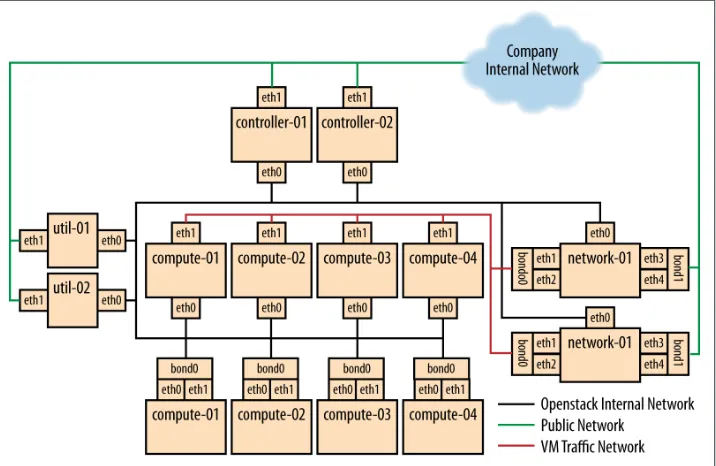
OpenStack internal network.
This network is used for OpenStack management func‐ tions and traffic, including services needed for the provisioning of physical nodes (pxe, tftp, kickstart), traffic between various OpenStack node types using Open‐ Stack APIs and messages (for example, nova-compute talking to keystone or cinder-volume talking to nova-api), and all traffic for storage data to the storage layer under‐ neath by the Gluster protocol. All physical nodes have at least one network interface (typically eth0) in this network. This network is only accessible from other VLANs on port 22 (for ssh access to manage machines).Public Network.
This network is a combination of:• IP addresses for public-facing interfaces on the controller nodes (which end users will access the OpenStack services)
• A range of publicly routable, IPv4 network addresses to be used by OpenStack Networking for floating IPs. You may be restricted in your access to IPv4 ad‐ dresses; a large range of IPv4 addresses is not necessary.
• Routers for private networks created within OpenStack.
This network is connected to the controller nodes so users can access the OpenStack interfaces, and connected to the network nodes to provide VMs with publicly routa‐ ble traffic functionality. The network is also connected to the utility machines so that any utility services that need to be made public (such as system monitoring) can be accessed.
VM traffic network.
This is a closed network that is not publicly routable and is simply used as a private, internal network for traffic between virtual machines in OpenStack, and between the virtual machines and the network nodes that provide l3 routes out to the public network (and floating IPs for connections back in to the VMs). Because this is a closed network, we are using a different address space to the others to clearly define the separation. Only Compute and OpenStack Networking nodes need to be connected to this network.Node connectivity
The following section details how the nodes are connected to the different networks (see “Networking layout”) and what other considerations need to take place (for ex‐ ample, bonding) when connecting nodes to the networks.
Figure 1-1. Basic node deployment
Connectivity for maximum performance.
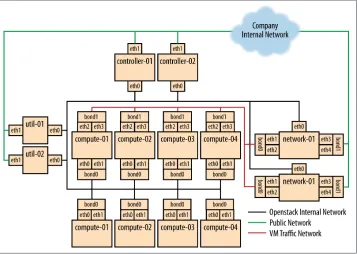
If the networking performance of the basic lay‐ out is not enough, you can move to Figure 1-2, which provides 2 x 10G network links to all instances in the environment as well as providing more network bandwidth to the storage layer.Figure 1-2. Performance node deployment
Node diagrams
Figure 1-3. Controller node
Figure 1-4. Compute node
Figure 1-6. Storage node
Example Component Configuration
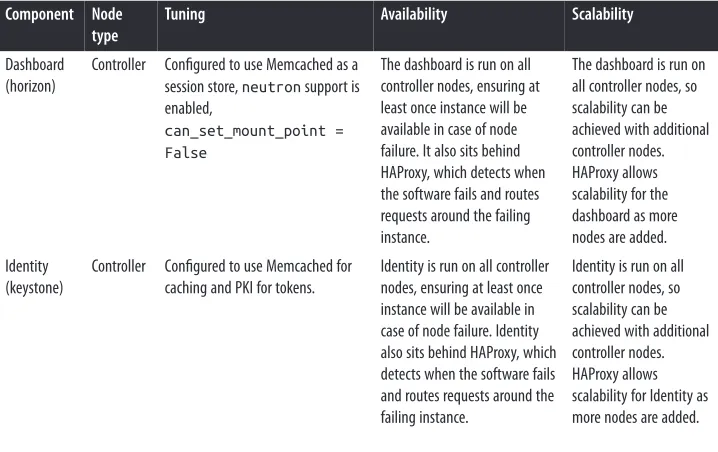
Table 1-2 and Table 1-3 include example configuration and considerations for both third-party and OpenStack components:
Table 1-2. Third-party component configuration
Component Tuning Availability Scalability
MySQL binlog-format = row
Master/master replication. However, both nodes are not used at the same time. Replication keeps all nodes as close to being up to date as possible (although the asynchronous nature of the replication means a fully consistent state is not possible). Connections to the database only happen through a Pacemaker virtual IP, ensuring that most problems that occur with master-master replication can be avoided.
Not heavily considered. Once load on the MySQL server increases enough that scalability needs to be considered, multiple masters or a master/slave setup can be used.
Component Tuning Availability Scalability
Qpid is added as a resource to the Pacemaker software that runs on Controller nodes where Qpid is situated. This ensures only one Qpid instance is running at one time, and the node with the Pacemaker virtual IP will always be the node running Qpid.
Not heavily considered. However, Qpid can be changed to run on all controller nodes for scalability and availability purposes, and removed from Pacemaker.
HAProxy maxconn 3000 HAProxy is a software layer-7 load balancer used to front door all clustered OpenStack API components and do SSL termination. HAProxy can be added as a resource to the Pacemaker software that runs on the Controller nodes where HAProxy is situated. This ensures that only one HAProxy instance is running at one time, and the node with the Pacemaker virtual IP will always be the node running HAProxy.
Not considered. HAProxy has small enough performance overheads that a single instance should scale enough for this level of workload. If extra scalability is needed, keepalived or other Layer-4 load balancing can be introduced to be placed in front of multiple copies of HAProxy. Memcached MAXCONN="8192"
CACHE SIZE="30457"
Memcached is a fast in-memory key-value cache software that is used by OpenStack components for caching data and increasing performance. Memcached runs on all controller nodes, ensuring that should one go down, another instance of Memcached is available.
Not considered. A single instance of Memcached should be able to scale to the desired workloads. If scalability is desired, HAProxy can be placed in front of Memcached (in raw
Component Tuning Availability Scalability
Pacemaker Configured to use
corosync and cman
as a cluster communication stack/ quorum manager, and as a two-node cluster.
Pacemaker is the clustering software used to ensure the availability of services running on the controller and network nodes:
• Because Pacemaker is cluster software, the software itself handles its own availability, leveraging corosync and cman underneath. • If you use the GlusterFS native client, no virtual IP is needed, since the client knows all about nodes after initial connection and automatically routes around failures on the client side.
• If you use the NFS or SMB adaptor, you will need a virtual IP on which to mount the GlusterFS volumes.
If more nodes need to be made cluster aware, Pacemaker can scale to 64 nodes.
Glusterfs is a clustered file system that is run on the storage nodes to provide persistent scalable data storage in the environment. Because all connections to gluster use the gluster native mount points, the
gluster instances themselves provide availability and failover functionality.
The scalability of GlusterFS storage can be achieved by adding in more storage volumes.
Table 1-3. OpenStack component configuration
Component Node type
Tuning Availability Scalability
Dashboard (horizon)
Controller Configured to use Memcached as a session store, neutron support is enabled,
can_set_mount_point = False
The dashboard is run on all controller nodes, ensuring at least once instance will be available in case of node failure. It also sits behind HAProxy, which detects when the software fails and routes requests around the failing instance.
The dashboard is run on all controller nodes, so
Controller Configured to use Memcached for caching and PKI for tokens.
Identity is run on all controller nodes, ensuring at least once instance will be available in case of node failure. Identity also sits behind HAProxy, which detects when the software fails and routes requests around the failing instance.
Identity is run on all controller nodes, so
Component Node a GlusterFS native mount to a Gluster volume off the storage layer.
The Image Service is run on all controller nodes, ensuring at least once instance will be available in case of node failure. It also sits behind HAProxy, which detects when the software fails and routes requests around the failing instance.
The Image Service is run on all controller nodes, configured to use Memcached for caching, configured to use
libvirt, configured to use
neutron.
Configured nova-consoleauth
to use Memcached for session management (so that it can have multiple copies and run in a load balancer).
The nova API, scheduler, objectstore, cert, consoleauth, conductor, and vncproxy services are run on all controller nodes, ensuring at least once instance will be available in case of node failure. Compute is also behind HAProxy, which detects when the software fails and routes requests around the failing instance.
Compute’s compute and conductor services, which run on the compute nodes, are only needed to run services on that node, so availability of those services is coupled tightly to the nodes that are available. As long as a compute node is up, it will have the needed services running on top of it.
The nova API, scheduler, objectstore, cert, consoleauth, conductor, and vncproxy services are run on all controller nodes, so scalability can
Controller Configured to use Qpid,
qpid_heartbeat = 10, configured to use a Gluster volume from the storage layer as the backend for Block Storage, using the Gluster native client.
Block Storage API, scheduler, and volume services are run on all controller nodes, ensuring at least once instance will be available in case of node failure. Block Storage also sits behind HAProxy, which detects if the software fails and routes requests around the failing instance.
Component Node namespace support enabled, ten ant_network_type = vlan,
allow_overlapping_ips = true, tenant_net work_type = vlan,
bridge_uplinks = br-ex:em2, bridge_mappings = physnet1:br-ex
The OpenStack Networking service is run on all controller nodes, ensuring at least one instance will be available in case of node failure. It also sits behind HAProxy, which detects if the software fails and routes requests around the failing instance.
OpenStack Networking’s ovs-agent, l3-agent-dhcp-agent, and metadata-agent services run on the network nodes, as lsb
resources inside of Pacemaker. This means that in the case of network node failure, services are kept running on another node. Finally, the ovs-agent
service is also run on all compute nodes, and in case of compute node failure, the other nodes will continue to function using the copy of the service running on them.
The OpenStack Networking server service is run on all controller nodes, so Scalability of the ovs-agent running on
With so many considerations and options available, our hope is to provide a few clearly-marked and tested paths for your OpenStack exploration. If you’re looking for additional ideas, check out Appendix A, the OpenStack Installation Guides, or the
OpenStack User Stories page.
CHAPTER 2
Provisioning and Deployment
A critical part of a cloud’s scalability is the amount of effort that it takes to run your cloud. To minimize the operational cost of running your cloud, set up and use an au‐ tomated deployment and configuration infrastructure with a configuration manage‐ ment system, such as Puppet or Chef. Combined, these systems greatly reduce man‐ ual effort and the chance for operator error.
This infrastructure includes systems to automatically install the operating system’s in‐ itial configuration and later coordinate the configuration of all services automatically and centrally, which reduces both manual effort and the chance for error. Examples include Ansible, Chef, Puppet, and Salt. You can even use OpenStack to deploy OpenStack, fondly named TripleO, for OpenStack On OpenStack.
Automated Deployment
An automated deployment system installs and configures operating systems on new servers, without intervention, after the absolute minimum amount of manual work, including physical racking, MAC-to-IP assignment, and power configuration. Typi‐ cally, solutions rely on wrappers around PXE boot and TFTP servers for the basic op‐ erating system install and then hand off to an automated configuration management system.
Both Ubuntu and Red Hat Linux include mechanisms for configuring the operating system, including preseed and kickstart, that you can use after a network boot. Typi‐ cally, these are used to bootstrap an automated configuration system. Alternatively, you can use an image-based approach for deploying the operating system, such as systemimager. You can use both approaches with a virtualized infrastructure, such as when you run VMs to separate your control services and physical infrastructure.
When you create a deployment plan, focus on a few vital areas because they are very hard to modify post deployment. The next two sections talk about configurations for:
• Disk partioning and disk array setup for scalability • Networking configuration just for PXE booting
Disk Partitioning and RAID
At the very base of any operating system are the hard drives on which the operating system (OS) is installed.
You must complete the following configurations on the server’s hard drives:
• Partitioning, which provides greater flexibility for layout of operating system and swap space, as described below.
• Adding to a RAID array (RAID stands for redundant array of independent disks), based on the number of disks you have available, so that you can add ca‐ pacity as your cloud grows. Some options are described in more detail below. The simplest option to get started is to use one hard drive with two partitions:
• File system to store files and directories, where all the data lives, including the root partition that starts and runs the system
• Swap space to free up memory for processes, as an independent area of the physi‐ cal disk used only for swapping and nothing else
RAID is not used in this simplistic one-drive setup because generally for production clouds, you want to ensure that if one disk fails, another can take its place. Instead, for production, use more than one disk. The number of disks determine what types of RAID arrays to build.
We recommend that you choose one of the following multiple disk options:
Option 1
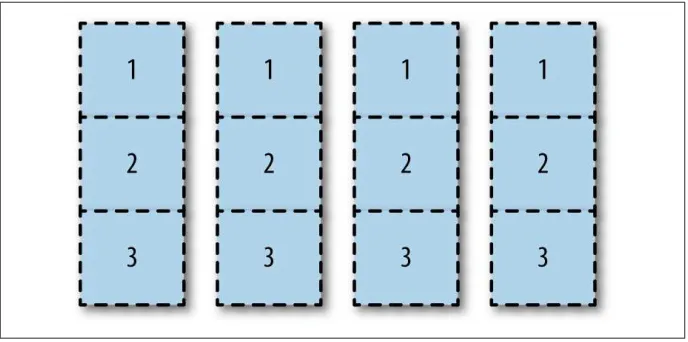
Partition all drives in the same way in a horizontal fashion, as shown in
Figure 2-1.
Figure 2-1. Partition setup of drives
While you might end up with unused partitions, such as partition 1 in disk three and four of this example, this option allows for maximum utilization of disk space. I/O performance might be an issue as a result of all disks being used for all tasks.
Option 2
Add all raw disks to one large RAID array, either hardware or software based. You can partition this large array with the boot, root, swap, and LVM areas. This option is simple to implement and uses all partitions. However, disk I/O might suffer.
Option 3
Dedicate entire disks to certain partitions. For example, you could allocate disk one and two entirely to the boot, root, and swap partitions under a RAID 1 mir‐ ror. Then, allocate disk three and four entirely to the LVM partition, also under a RAID 1 mirror. Disk I/O should be better because I/O is focused on dedicated tasks. However, the LVM partition is much smaller.
You may find that you can automate the partitioning itself. For ex‐ ample, MIT uses Fully Automatic Installation (FAI) to do the initial PXE-based partition and then install using a combination of min/max and percentage-based partitioning.
As with most architecture choices, the right answer depends on your environment. If you are using existing hardware, you know the disk density of your servers and can determine some decisions based on the options above. If you are going through a procurement process, your user’s requirements also help you determine hardware