TYPES OF CODE MIXING ON THE FACEBOOK STATUS
Sholihatul Hamidah Daulay
IAIN Sumatera Utara Medan, Indonesia
Abstract: Facebook is a popular free social networking website that allows registered users to create profiles, upload photos and video, send messages and keep in touch with friends, family and colleagues. There are many people in the facebook do code mixing when they made status. Code Mixing usually occurs in bilingual or multilingual community or society and the function (meaning) of the languages can not be clearly separated. This code mixing is used when the conversant use both languages together to the extent that they change from one language to the other in the course of a single utterance. There are three types of code mixing, they are: insertion, alternation, and congruent lexicalization. Insertion occurs when lexical items from one language are incorporated into another. Alternation occurs when structures of two languages are alternated indistinctively both at the grammatical and lexical level. Congruent lexicalization refers to the situation where two languages share grammatical structures which can be filled lexically with elements from either language.
Keywords:code mixing, Facebook, status
INTRODUCTION
Facebook is a social networking website that was originally designed for college students, but is now open to anyone 13 years of age or older. Facebook users can create and customize their own profiles with photos, videos, and information about themselves. Friends can browse the profiles of other friends and write messages on their pages. Each Facebook profile has a “wall,” where friends can post comments. Since the wall is viewable by all the user’s friends, wall postings are basically a public conversation. Therefore, it is usually best not to write personal messages on your friends’ walls. Instead, you can send a person a private message, which will show up in his or her private inbox, similar to an e-mail message. Facebook provides an easy way for friends to keep in touch and for individuals to have a presence on the Web without needing to
build a website. Since Facebook makes it easy to upload pictures and videos, nearly anyone can publish a multimedia profile. Of course, if you are a Facebook member or decide to sign up one day, remember to use discretion in what you publish or what you post on other user’s pages.
Because there are many Code Mixing happened in facebook, and to improve the paradigm of language of facebook.
Definition of Code Mixing
Wardhaugh says that code is the particular dialect or language one chooses to use on any occasion, and a system for communication between two or more parties. Poedjosoedarmono says that a code is a system of speech whose elements of language has special characteristic, and it is proper to the background of the speaker, the relation of the speaker to address and the situation. Another linguistic phenomenon in bilingual or multilingual society is code mixing. Code switching and code mixing are terms that are used to call the dependence upon aspect of language. The difference of those terms that can be found is the dependence indicating characteristics. In the phenomenon of code mixing the dependent characteristics are indicated by the relationship between the function and role of language. The role means that who uses the language and function means what will be acquired by the speaker.
Mackey in Suwito states that Code Mixing is one characteristic of language dependence. Then, He cities that the language dependence is marked by the presence of reciprocal relations between roles and language functions. According to him, the roles refer to who uses language, whereas the language functions refer to what will bed achieve by speaker in his utterances. So if a speaker mixes two different codes on language in his utterances, then it should be asked first who he is.
In this manner, the specific characteristics of the speaker are, among others, his social background, level of education and solidarity of region. However, all of these specific characteristics will often color his code mixing. On the other hand, the language unction determines how far the languages used by speaker give an opportunity to mix codes. Finally, a speaker
determined by his language choice.
Code mixing usually occurs in bilingual or multilingual community or society and the function (meaning) of the languages can not be clearly separated. This code mixing is used when the conversant use both languages together to the extent that they change from one language to the other in the course of a single utterance. In code mixing the main code or basic code has its own function and meaning, other codes, however, are only the pieces, without function and meaning as a code. Thelander explains the definition of code mixing. He says that if in the single utterance the clauses and the phrases used are hybrid clause or hybrid phrases and each clause or phrase does not support the function of clause and phrase, it is called code mixing. The special character of code mixing is that, code mixing is used in informal situation. In the formal situation it may have no exact meaning in Indonesian language. In the written language code mixing is indicated by italic writing or underline form. Another aspect of dependent relation of language in multilingual people is the phenomenon of code mixing in context of function of switch, the relevance of situation is the form of dependence identified from both sides of relationships between speakers and the function of language.
TYPES OF CODE MIXING
Code mixing also called intra-sentential code switching or intra-sentential code-alternation occurs when speakers use two or more languages below clause level within one social situation. Muysken defines three types of code mixing: insertion, alternation, and congruent lexicalization.
Insertion
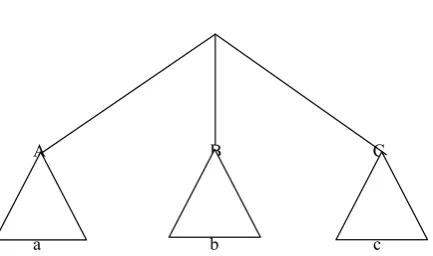
Myer-n as “embeddiMyer-ng”. Figure 1 illustrates a graphic representation of insert
A B C
a b c
e diagram “a” represents lexical items of the first language and “b” sta
In the diagram “a” represents lexical items of the first language and “b” stands for the lexical item of the second language that has been inserted in the utterance by the speaker. Instances of this category of code mixing found in the data can be seen in excerpts 2a and 2b. Excerpt 2a occurs when a Spanish speaking participant discusses a paper for one of his classes. It seems that the shared professional background with the researchers’ and the participants’ specific language are the reasons that induce him to unconsciously insert an English lexical item into a Spanish conversation. Excerpt 2b occurs when the participants talks about the factors that affect the price of a ticket of a live NBA game.
Excerpt 2a: Example of insertion (Spanish/ English)
B: Pero bueno creo que basta con que incluya la pregunta de enhanced output más todas las demás.
(Well, I think it is enough if I just include the question of enhanced output.)
Excerpt 2b: Example of insertion (Indonesian/ English)
B: Tergantung team, terus juga tergantung event.
(It depends on the team and on the event.)
Alternation
The second category, alternation, occurs when structures of two languages are alternated indistinctively both at the grammatical and lexical level. This definition is illustrated in Figure 2.
Excerpt 2a: Example of insertion (Spanish/English) B: Pero
Excerpt 2b: Example of insertion (Indonesian/English)
a... b....
a: Example of alternation (English/Spanish)
Excerpt 3b: Example of alternation (English/Indonesian)
In the diagram, A & B represent structures of the two languages that reflect the alternation that takes places in the utterances produced by the speakers. Excerpts 3a and 3b are examples of alternation. Excerpt 3a occurs when the researcher praises the picture of the new bicycle of the participant. In this excerpt the participant uses English in the first part of the sentence, but when it comes to finding a sentence to translate “pretty girl” he switches code into Spanish. Excerpt 3b occurs when the Indonesian participant talks about a paper about sentence choice that he needs to submit. He uses the expression “I mean” to introduce the rest of his utterance in his first language.
Excerpt 3a: Example of alternation (English/ Spanish)
B: I just have it in my room like a niña bonita como debe ser.
(I just have it in my room like a girl pretty as it should be.)
Excerpt 3b: Example of alternation (English/ Indonesian)
B: I mean, ganti ke kalimat laen.
(I mean, change it to another sentence.)
Congruent Lexicalization
Excerpt 2a: Example of insertion (Spanish/English) B: Pero
Excerpt 2b: Example of insertion (Indonesian/English)
a: Example of alternation (English/Spanish)
Excerpt 3b: Example of alternation (English/Indonesian)
a b a b
Excerpts 4a and 4b are examples of congruent lexicalization. Excerpt 4a occurs when the participant describes the way he uses his cell phone to connect to the Internet. In Except 4b the participant states that the software that he usually uses to convert his music file has expired.
Excerpt 4a: Congruent lexicalization (Indonesian/English)
B: Gw konek pake cellp gw. (I connected using my cell phone.)
Excerpt 4b: Congruent lexicalization (Indonesian/English)
B: Software gua buat convert file wav jadi mp3 gua uda expired.
(My software for converting wav files to mp3s has expired.)
DATA AND ANALYSIS 1.
Analysis : the word “ Please” comes from English, but in this status, he used Indonesia as the main language, so it includes in “ Code Mixing”. The type of it is insertion.
2.
Analysis : the word “ Shopping” comes from 3.
Analysis : the word “ Fine” comes from English, but in this status, he used Indonesia as the main language, so it includes in “Code Mixing”. The type of it is insertion.
4.
Analysis : the word “ Full” comes from English, but in this status, he used Indonesia as the main language, so it includes in “Code Mixing”. The type of it is insertion.
5.
Analysis : the words “ Thank’s, You, and My” come from English, but in this status, he used Indonesia as the main language, so it includes in “Code Mixing”. The type of it is insertion.
6.
7.
Analysis : the word “ with ” comes from English, but in this status, he used Indonesia as the main language, so it includes in “Code Mixing”. The type of it is insertion.
8.
Analysis : the word “ Game ” comes from English, but in this status, he used Indonesia as the main language, so it includes in “Code Mixing”. The type of it is insertion.
9.
Analysis : the word “ All ” comes from English, but in this status, he used Indonesia as the main language, so it includes in “Code Mixing”. The type of it is insertion.
10.
Analysis : the word “ Welcome ” comes from English, but in this status, he used Indonesia as the main language, so it includes in “Code Mixing”. The type of it is insertion.
11.
Analysis : the word “ Next ” comes from English, but in this status, she used Indonesia as the main language, so it includes in “Code Mixing”. The type of it is insertion.
12.
Analysis : the word “ Move on ” comes from English, but in this status, he used Indonesia as the main language, so it includes in “Code Mixing”. The type of it is insertion.
13.
Analysis : the word “ Reality and Planning ” come from English, but in this status, he used Indonesia as the main language, so it includes in “Code Mixing”. The type of it is insertion.
14.
15.
Analysis : the word “ Happy wedding ” come from English, but in this status, he used Indonesia as the main language, so it includes in “Code Mixing”. The type of it is alternation.
16.
Analysis : the sentence “ I promise it ” come from English, but in this status, he used Indonesia as the main language, so it includes in “Code Mixing”. The type of it is alternation.
17.
Analysis : the words “ Keep spirit will be finish ” come from English, but in this status, he used Indonesia as the main language, so it includes in “Code Mixing”. The type of it is alternation
18.
Analysis : the words “ Smart People.... So” come from English, but in this status, he used Indonesia as the main language, so it includes in “Code Mixing”. The type of it is alternation.
19.
Analysis : the words “Get one” come from English, but in this status, he used Indonesia as the main language, so it includes in “Code Mixing”. The type of it is alternation.
20.
Analysis : the words “I canot decid” come from English, but in this status, he used Indonesia as the main language, so it includes in “Code Mixing”. The type of it is congruent lexicalization.
includes in “Code Mixing”. The type of it is congruent lexicalization.
22.
Analysis : the words “I hop my drem” come from English, but in this status, he used Indonesia as the main language, so it includes in “Code Mixing”. The type of it is congruent lexicalization.
CONCLUSION
There are many people in the facebook do Code Mixing when they made their status. Code mixing usually occurs in bilingual or multilingual community or society and the
function (meaning) of the languages can not be clearly separated. Based on the data, we see that all code mixing used insertion, because they always use lexical items from one language are incorporated into another. This code mixing is used when the conversant use both languages together to the extent that they change from one language to the other in the course of a single utterance. There are three types of code mixing, they are : insertion, alternation, and congurent lexicalization. Insertion occurs when lexical items from one language are incorporated into another. Alternation alternation, occurs when structures of two languages are alternated indistinctively both at the grammatical and lexical level. Congurent lexicalization refers to the situation where two languages share grammatical structures which can be filled
lexically with elements from either language.
REFERENCES
Chan, H. Y. (2004). English-Cantonese code mixing among senior secondary school
students in Hong Kong. Linguistics.
Hong Kong, University of Hong Kong. Master of Arts in Applied Linguistics,
Durham, M. (2003). Language choice on a Swiss
mailing list. Journal of computer mediated
Communication, 9 (1).
Herring, S. (2003). Introduction: In: Herring, S. (ed.), Media and Language Change:
special issue. Journal of Historical
Pragmatics 4 (1).
International Journal of Bilingualism 10 (4), 429–421
from http://ijb.sagepub.com/content/ vol10/issue4/ andhttp://online.sfsu. edu/kbach/codemixing.html
Muysken, P. (2000). Bilingual speech: A typology of