Online Clearance System (OC System)
By
Zazilawati binti Zamri
Dissertation submitted in partial fulfillment of the requirement for the
Bachelor of Technology (Hons) (Information Communication Technology)
NOVEMBER 2006
Universiti Teknologi PETRONAS Bandar Seri Iskandar
31750 Tronoh Perak Darul Ridzuan
CERTIFICATION OF APPROVAL
Online Clearance System (OC System)
By
Zazilawati binti Zamri
Dissertation submitted in partial fulfillment of the requirement
tor
theBachelor of Technology (Hons) (Information Communication Technology)
UNTVERSTTT TEKNOLOGT PETRONAS TRONOH, PERAK
NOVEMBER 2006
CERTIFICATION OF ORIGINALITY
This is to certifY that I am responsible for the work submitted in the project, that the originality work is my own expect as specified in the references and acknowledgements and that the original work contain herein have not been undertaken or done unspecified sources or persons.
ZAZTLA WATT BINTI ZAMRI
ABSTRACT
The purpose of this project is to design a system for UTP Security Department, fnformation Resource Centre Department and finance Department specifically for the administration of students and staffs' administration management. The system will be web - based applications that can be executed using normal web browser for inter - platform capabilities. The project is divided into two terms, first the research on clearance system for final semester student and second development on the Online Clearance System (OC System). Research on the OC System will be based on the problem statement and objective of the project while the research for the current clearance system for fmal semester at UTP is the support idea for the project.
This document also gives further information about the system in the literature review/theory section. This section includes the features of the system, the benefits from using the system, and the data flow diagram of the intended system.
Part of the Final Year Project, student manage to get known with the business environment on how they manage their database, clearance system and the performance of the staff. In using Online Clearance System (OC System) give the best solution for the staff as the database plays an important asset for the staff. l would use distributed database in my system.A distributed database is a database that is under the control of a central database management system in which storage devices are not all attached to a common CPU. It may be stored in multiple computers located in the same physical location, or may be dispersed over a network of interconnected computers. Collections of data (eg. in a database) can be distributed across multiple physical locations. A distributed database is distributed into separate partitions/fragments. Each partition/fragment of a distributed database may be replicated (ie. redundant fail-overs, R.AlD fike).
ACKNOWLEDGEMENT
First and foremost I would like to recite my greatest gratitude to the Most Merciful Allah for giving me the opportunity in completing this manuscript on time and without much hassle or problem. Without His observance in giving me the chance in finishing the report, there might be m!\ior problem which can resulted in delay of turning in the report in the time constrain.
In completing this preliminary report, there are some people that had been the backbone of the activities done in the complete of this text. I wouldn't have been able to finish up without their assistance, encouragement, and support either in terms of material, or spirituaL With this I would like to put some credit to them who has helped me through this time duration. They are as listed as beneath:
1. Ms. Nazleeni Samiha Harun- my supervisor (for giving me the guidelines and ways in producing a good output and fulf support in terms of knowledge input along this project)
2. Mr Anang Hudaya Muhammad Amin- my supervisor Part !(for giving me the guidelines and ways in producing a good output and full support in terms ofknowledge input along this project)
3. The Backbone Of This FYP Committee -all IT/IS lecturers, (for giving full commitment in term of providing info about the final year project)
4. Universiti Teknologi PETRONAS -all UTP staff (for the full cooperation and providing me very convenient places to complete the project with the provided utilities)
5. Parents and families (for giving the full moral support in completing the report in addition to the consultation they have given during my troubled times)
6. Friends (as they have been there for me during the good and bad times as we stay together under the same varsity)
TABLE OF CONTENT
CERTIFICATE OF APPROVAL CERTiFICATE OF ORiGINALITY . ABSTRACT .
ACkNOWLEDGEMENT TABLE OF CONTENTS LIST OF FIGURE ABBREVIATIONS
CHAPTER 1: INTRODUCTION l.l Background of study 1.2 Problem Statement
{ .3 Objectives and Scope of Study 1.4 Relevancy of the project L5 Feasibility of the project
CHAPTER 2: LITERATURE REVIEW AND THEORY 2.1 Web-based application
2.2 Introduction to Relational DBMS.
2..3 Computer Security Threats
CHAPTER3:METHODOLOGY 3.l MethOdology 3.2 Project Planning :D Project Analysis 3.4 Project Design
3.5 Dser Acceptance Testing . 3.6 Delivery Phase
3. 7 Tools Required
ii iii iv
VI
viii ix
I 3 4 5
6
7 8 13
20 22 2.6 28
29
30 30
CHAPTER 4: RESULT AND DISCUSSION 4.1 Analysis Phase
4.2 Design Phase
4.3 System Testing Phase
4.4 The benefits of Online Clearance System.
CHAPTER 5: CONCLUSION & RECOMMENDATION 5.1 Coridusion
5.2 Recommendations
REFFERENCES
APPENDICES
52
32
39 49
53 55
57
59
LIST OF FIGURES
Figure 2.1: Distributed Database Management System Figure 2.2: Homogeneous Distributed Database
Figure 2.3: Hierarchical Arrangement of Networked Databases Figure 3.1: System Development Life Cycle
Figure 2.3: Hierarchical Arrangement ofNetworked Databases Figure 4.1: Process involved in the existing clearance system
Figure 4.2: Student opinion on the implementation of the Online Clearance System Figure 4.3: Feasibilities Factor Satisfied for the Online Clearance System
Figure 4.4: Trust the system in term of Data Confidentiality Figure 4.5: Main Menus for student
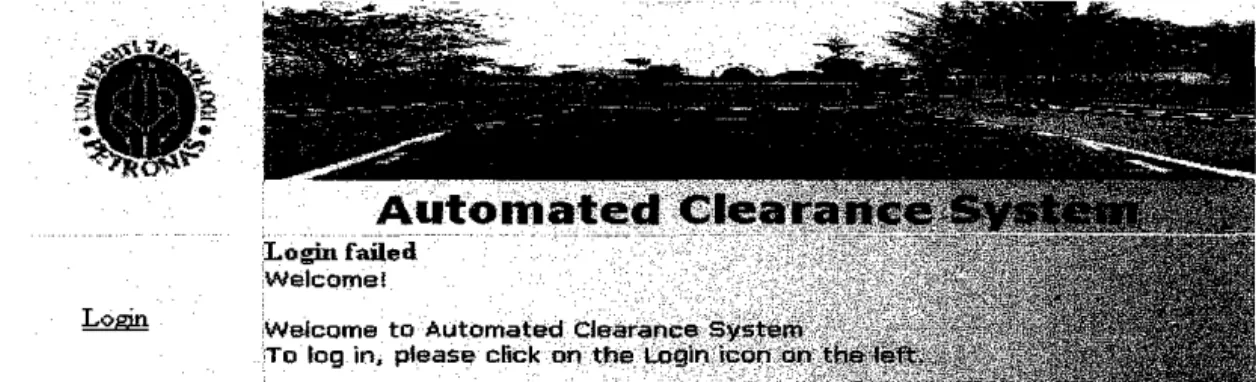
Figure 4.6: Login page
Figure 4.7: Error Message page Figure 4.8: Main page
Figure 4.9: Login t{) the system page Figure 4.10: Login Failed Page Figure 4.11: Main interface (Student)
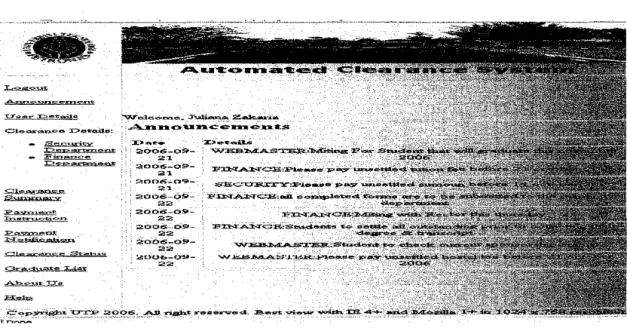
Figure 4.12: Unsettled payment page (Student) Figure 4.13: Clearance summary page (Student) Figure 4.14: Unsettled payment (Student) Figure 4.15: Unsettled payment
Figure 4.16: Payment Notification Page Figure 4.17: Post Announcement Page
Figure 4.18: Unsettled Page (Security Department)
Figure 4.19: Unsettled Payment Page (Finance Department) Figure 4.20: Clearance Status Page
Figure 4.21 : Graduation List Page Figure 4.22: Clearance Summary Page Figure 4.23: Clearance Status Page
UTP DBMS ICT
ABBREVIATIONS AND NOMENCLATURES
Universiti Teknologi PETRONAS Database Management System
Information Communication Technology
1.1 Background of study
CHAPTER I INTRODUCTION
Universiti Technologi PETRONAS (UTP) was established on January 10, 1997 when PETRONAS was invited by the Malaysian government to set up a university. UTP offers a wide range of engineering and technology programmes at undergraduate and postgraduate levels complemented with a strong focus on Research and Development.
The programmes are designed with high industry relevance to provide a dynamic learning environment.
Every year, Universiti Teknologi PETRONAS (UTP) has their Convocation Ceremony for the students that graduated in their respective fields of studies. Before the student can go for the Convocation ceremony, they need to do the clearance process at the end of the final Semester to make sure that the student is clear from any outstanding loans/debts/any other matters that need them to pay before the student can get their scroll during Convocation ceremony.
Currently, Universiti Technologi Petronas is using manual system to do the clearance that creates a few problems to the student and also to the staff. One of the main problems is, in this day, the student need to go to the every department to get signature, stamp and date from respective department to verify that the student is clear from any outstanding loans or debt. The student need to check with the department manually, and sometime they tend not to get the full information they need such as the exact amount of summon, date summon being issued and etc. It takes time to complete the clearance
fonn as they need to queue or come again the next day because UTP have a lot of student that wants to do the clearance every semester.
The purpose of this project is to design and develop an online clearance system. The growing reputation of the Internet in the early 1990s has made most people nowadays turn to utilize it for their daily operation such as on-line transaction, getting infonnation, e-mailing friends, interactive chatting and many more. The increase of their popularity has made the internet a vital part of our society. The access to the internet and interactive content of the World Wide Web (WWW) have made them great means for people to access, exchange, and process infonnation. The Internet is a modern infonnation relay system that connects hundreds of thousands of telecommunication networks and creates an "intemetworking" framework. These applications create numerous of field area to be studied and therefore, it makes Internet become more well- liked year by year
This application is mainly for the purpose of the Security Department, Finance Department and Student in UTP which help them to update and alert about the Clearance System.The systems that will be created were web based application. Web based application can be executed using nonnal web browser for inter - platfonn capabilities. The system is designed to make the student more easily doing the clearance for graduation purpose. The systems are able to produce infonnation on type of clearance status. The system also is able to update the entire data of a student and know who exactly the people who will graduate every year according to id, course and so forth.
Using this system, The Webmaster will act as the administrator for the system. The webmaster will administer the operations of the system according to the effectiveness of the system, its functionality, etc. Meanwhile, the staffs will be the person who will key in the data that needed in the system. Lastly, the student will use the system to make the Clearances. By using this system, Security Department and Finance Department can
easily update and manage the clearance system systematically. At the same time, the users that use this system will feel much easier.
1.2 Problem Statement
There are no proper or effective platform provided by the university to store and record the information, and also a there is no proper way to retrieve certain data or information immediately at one place. The system mainly used is the manual or traditional way.
Scenario 1
Students have difficulty to check their clearance status. In this day, they need to go to the each department and check with the department manually, and sometime they tend not to get the full information they need; such as the exact amount of summon, date summon being issued and etc. It takes time to complete the clearance form as they need to queue or come again the next day because UTP have a lot of student that wants to do the clearance every semester.
Scenario 2
Student have difficulty to notice their summon status or have information on the type of summon and the amount of each summon. As we can see, the security staff always put the summon receipt on the wiper of a car or at the motorcycle handle, the receipt sometime can be blown away by the wind. So, sometimes student do not get the summon receipt. So, it makes the student more difficult to make the clearance at the security department. It is because Security needs to check all the receipts manually and it takes times.
1.2.2 Significant of the Project
The system that will be developed will help the user to identify the information they need about clearance status especially for the student. It is mainly being developed in web-based application. The web-based system will guide the student to identify some
information about the Online Clearance System for the student. In this web-based system, the Webmaster will always update and maintain the information in
the
web, which they will act as the administrator.The Staff of the Finance Department and Security Department will update the particular information needed from both departments. This system will be used by Webmaster, Security Department, Finance Department and Student. It also provides easier procedure to the Webmaster, Student, Security department and Finance Department.
On the other hand the system provides more systematic approach which can easily Jearn and understand by the user
1.3 Objective and Scope of Study
Basically, there are a few problems initially that led to the idea of developing Final Year Project management system. Here, the issues will be discussed one by one:
1. To automate manual system
Most of technical work can be automated as long as it has the logic inside. But the concern is when it needs human intervention to make the process more accurate rather than too limited to
the
current configuration.2. To provide a user friendly platform
Research shows that number of click required directly affect response rate.
Therefore a platform will be designed to show function and rewards in a clear and easy to response way.
3. To migrate from manual to computerize system
To reduce paper based work, time constraint, and workload. Therefore, this system will help the staff to make the system clearance more easily and effectively.
4. To ease the clearance process
The student can do the clearance through online rather than go for every department such as security department and finance department to do the clearance. The system should be able to access from village itself.
The scope of study for this project is a full development of web based application which will make easier for student and for the administration and webmaster as well. The Online Clearance System is only for the Final Semester student in UTP. Student need to do their clearance process using this system. The entire department that involved in these clearance processes will also using this system to makes sure that the process will more easier and effectively and no miscommunication between student and staff.
The system basically serves two major functions which is one as clearance system to manage Final Year Student to do the clearance and the other one as the information based system that integrate and deliver information to the people involved in
this
system. During the development of the web based application, the research will be focused on the clearance system and distributed database itself. We need to know how the database distributes between these departments.1.4 Relevancy of the Project
It is very relevant to implement Online Clearance System (OC System) based on current UTP environment. Most of students are able to access to the system, as their hostels are equipped with Local area Network (LAN) connection. For students who did not have a computer or their hostel not equipped with the LAN connection, they can access the system from the computers labs. In addition, due to the small scope of the project, it is belief that the project is relevant to be finished in times.
1.5 Feasibility of the Project within the Scope & Time Frame
It is feasible for this project to be accomplished
within
the scope and time frame. Due to the small scope of the project, it is expected to meet the dateline, which is end of this semester.CHAPTER2
LITERATURE REVIEW
In an organization, good communication, a good database system and security system are the most critical factors in order to success in their business. This situation is also applied in our university. We know that during end of the final semester, every student need to do the clearance before they graduates. We need a good system to make sure it works well. From this, we can conclude that UTP must have a system for manage the clearance. The system must also be able to produce report on list how many students will graduate, categories by progamme type such as mechanical engineering, civil engineering and etc.
Using this system, the administration department will act as the administrator for the system. The administrator will administer the operations of the system according to the effectiveness of the system, its functionality, etc. Meanwhile, the students will be the person or organization that initiates the system
2.1 Web-based Application 2.1.1 The Web model
Defmition of the Web is a universe of network-accessible information, and I break the
"full potential" into two by looking at it first as a means of human-to-human communication, and then as a space in which software agents can, though access to
vast amount of everything which is society, science and its problems, become tools to work with us.[l]The web is a very general concept -- one universal space of information. The concepts it requires such as identifiers and information resources (documents) are as general and abstract as possible. However, there have been some design decisions made which define some interfaces, and effectively defme moduks or agents which are independent. These agents are independent in many ways.[2]
2.1.2 The Web changes work and ways people learn
In this new evolution web site is becoming one of the main medium for people to interact, communicated and worked. As we know mostly web is known as World Wide Web (WWW), and it was a transformative medium, as important as electricity [3]. The web also as been a new medium to people nowadays, and has been a placed where user/people gain knowledge. As Web helps establish a culture that honors the fluid boundaries between the production and consumption of knowledge. It recognizes that knowledge can be produced wherever serious problems are being attacked and followed to their root. Furthermore, with the Web it is easier for various experts to interact casually-in the academy or in the firm-and to mentor or advice students of any age. On top of this, the Web's great reach provides infinite access to resources beyond the region. The power of this reach comes fully into play when Web resources act to cross- pollinate and provide new points of view for a region's communities of practice. [ 4]
2.2
Introduction to Relational DBMSIn a relational database all data are represented as tables. For example all data concerning customers are kept in a table name Customer for instance. Each table is represented by a number of rows (tuples) and colunms. In a relational table, the order of rows officially is not an important issue. In other words, the order in which rows are referenced does not matter.
In each relational table, there is a primary key that acts as a unique identifier for an entity of a particular table. A primary key can be constructed from one or more than one columns. Usually, a primary is a single column. For example "owner_ no" for a table name Owner. In order for a relational database to maintain its integrity constraints, the primary keys must have the following properties:
);> It must have a not null value for each instance of the entity
);> The value of the primary key must be unique for each instance of an entity
);> The value must not change or become null during the life of each entity instance.
Sometimes it requires more than one attribute to uniquely identify an entity. A primary key that made up of more than one attribute is known as a composite key.
Besides primary key, a foreign key is a key that may or may not exist in a relational database but still play an important role in maintaining the integrity between tables in a relational database. A foreign key is an attribute that completes a relationship between two or more tables by identifying the parent entity. Foreign keys provide a method for maintaining integrity in the data (called referential integrity) and for navigating between different instances of an entity.in fact, a foreign key must support every relationship between tables in a relational database.
Primary and foreign keys are the most basic components in a relational database. Each entity or row must have an attribute or attributes, the primary key whose values uniquely identify each instance of the entity. Every child entity must have an attribute, the foreign key, which completes the association with the parent entity.
2.2.1 Why I'm using distributed database method for this system?
Database technology has taken us from a paradigm of data processing in which each application defined and maintained its own data, to one in which data is defined and administered centrally. During recent times, we have seen the rapid developments in network and data communication technology, optimized by the internet, mobile and wireless computing, and intelligent devices. Now with the combination of these two technologies, distributed database technology may change the mode of working from centralized to decentralize. This combined technology is one of the major developments in the database system area. Distributed database system allows user to access not only the data at their own site but also data stored at remote sites. There have been claims that centralized DBMSs will eventnally be an 'antique curiosity' as organizations move towards distributed DBMSs.
A Distributed Database Management System consists of a single logical database that is split into a number of fragments. Each fragment is stored on one or more computers under the control of a separate DBMS, with the computers connected by a communications network. Each site is capable of independently processing user request that require access to local data (that is, each site has some degree of local autonomy) and is also capable of processing data stored on other computers in the network.
Users access the distributed database via application. Application are classified as those that do not require data from other sites (local applications) and those that do require data from other sites(global applications).we require a DDBMS to have at least one global application. A DDBMS therefore has the following characteristics:
~ A collection oflogically related shared data
~ The data is split into a number of fragments
~ Fragments may be replicated
:>-
Fragments/replicas are allocated to sites:>-
The sites are linked by a communication network:>-
The data at each site is under the control of a DBMS:>-
The DBMS at each site can handle local application,autonomously:>-
Each DBMS participates in at least one global applicationIt is not necessary for every site in the system to have its own local database. For example:
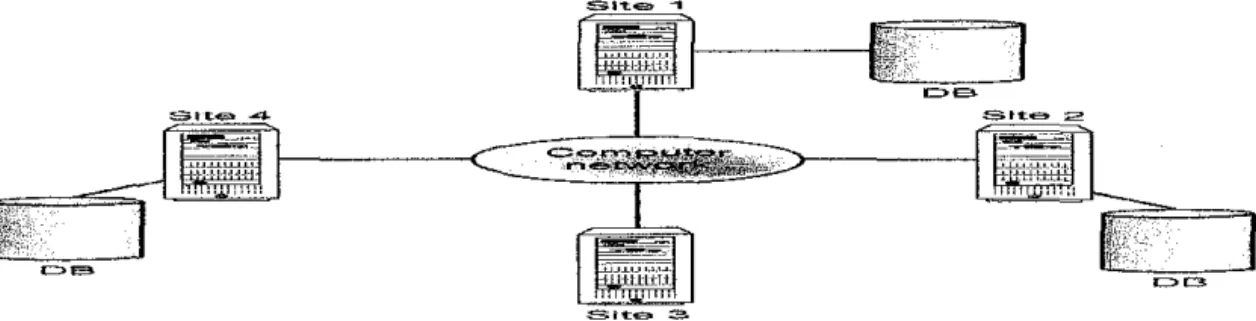
Figure 2.1: Distributed Database Management system
From this figure we can see that it is not necessary for every site in the system to have its own local database. A network linking computers will enable branches to communicate with each other and a DDBMS will enable them to access data stored at another branch office.
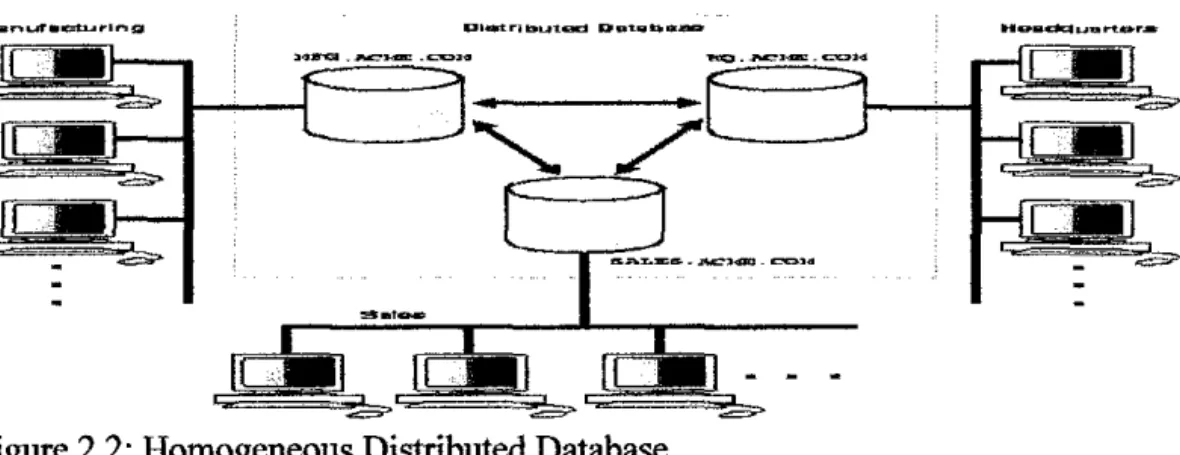
For my system, I would use Homogeneous Distributed Database system. A homogenous distributed database system is a network of two or more Oracle databases that reside on one or more machines. Figure 2.2 illustrates a distributed system that connects three databases: hq, mfg, and sales. An application can simultaneously access or modify the data in several databases in a single distributed environment. For example, a single query from a Manufacturing client on local database mfg can retrieve joined data from the products table on the local database and the dept table on the remote hq database.
For a client application, the location and platform of the databases are transparent. You can also create synonyms for remote objects in the distributed system so that users can access them with the same syntax as local objects. For example, if you are connected to database mfg but want to access data on database hq, creating a synonym on mfg for the remote dept table enables you to issue this query:
SELECT
*
FROM dept;In this way, a distributed system gives the appearance of native data access. Users on
mf g do not have to know that the data they access resides on remote databases.
M•nui'•C::U.Orlng
Figure 2.2: Homogeneous Distributed Database
An Oracle distributed database system can incorporate Oracle databases of different versions. All supported releases of Oracle can participate in a distributed database system. Nevertheless, the applications that work with the distributed database must understand the functionality that is available at each node in the system. A distributed database application cannot expect an Oracle7 database to understand the SQL extensions that are only available with Oracle9i.
Each database in a distributed database is uniquely identified by its global database name. Oracle forms a database's global database name by prefixing the database's network domain, specified by the DB DOMAIN initialization parameter at database
creation, with the individual database name, specified by the DB NAME initialization parameter.
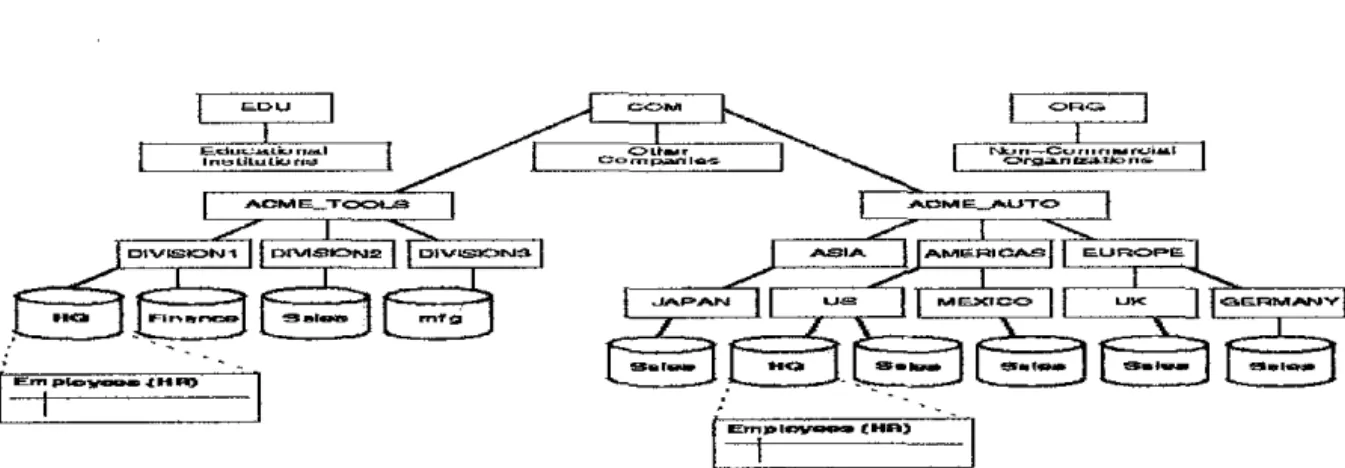
For example, Figure 2.3 illustrates a representative hierarchical arrangement of databases throughout a network.
Figure 2.3: Hierarchical Arrangement of Networked Databases
The name of a database is formed by starting at the leaf of the tree and following a path to the root. For example, the mfg database is in di vision3 of the acme tools branch of the com domain. The global database name for mfg is created by concatenating the nodes in the tree as follows:
• mfg.division3.acme~tools.com
While several databases can share an individual name, each database must have a unique global database name. For example, the network domains
us.americas.acme_auto.com and uk.europe.acme_auto.com each contain a sales
database. The global database naming system distinguishes the sales database in the
americas division from the sales database in the europe division as follows:
• sales.us.americas.acrne auto.corn
• sales.uk.europe.acme_auto.com
2.3 Computer Security Threats
According to Theriault(200 1)
Threats are those people, governments, companies or oilier organizations from which you'd like to protect your system. Threats can cause both accidental and intentional damage
According to P .Pfleeger(l997)
Circumstances that have the potential to cause lose or harm
It is clearly explain that threats were situation or environment in which can cause possible damage or lose in data values or accessing the data. The range of damage may include data being erased either intentionally or accidentally, data being changed in an undetectable manner, data being read or access by an authorized person and 1he worst is the whole system destroys.
In determining which threats to worry about, it's all depending on types of data that will be protected. If it is public information, then au1horization on accessing the data will be not as crucial as protecting private and confidential data.
In a perfect world, threats would not exist and a person should be able to trust someone halfway around the world as completely as trusting a neighbour. However this isn't a perfect worlds, and there are people from whom you need to protect your company's private information.
Threats from within
Internal threats were classified as a person who has authorized access to internal network. These personals typically have direct access to the internal network from behind a firewall. Normally those were persons which the company has put some level of trust in them. They can be employees, consultant, temps or even spies hired as valid employees. Innocent employees might overstep boundaries without intended to do wrong.
For example, an employee might granting himself as super user privilege which can be seen as a violation of security even if he does not perform any unauthorized activities while holding this privilege.
Employee might also in the form of laziness, will violate the written security policy or use poor security practices. These employees have no malicious intention but are nevertheless dangerous security threats.
Employees might share a password out of convenience and in doing so, the system being placed in a dangers situation. One way to overcome password sharing behavior is to make the process of creating new user easier, without compromising security; only administrator of a system can create such account. By doing this, then employees won't feel the need to share password.
Raising the awareness of the employees as to what constitutes a breach security can go a long way in helping company to avoid security problems, with the right attitude and some tactful user education; many potential threats can be eliminated.
Threats from administrators
Administrator is a personal which company gives full trust on them. The problem is that people change job and those administrators may be working in some other companies that might become a competitor. As people move around, situation might change. a person who previously was an honest and loyal may become dishonest and disloyal when changing job environment. Some action that can be taken to overcome this threat might be by requiring auditing of any administrative task before run the process.
procedures might be also needed in term of any scripts or procedure need to be reviewed by a second party before they can be performed. Different task can also being delegated to different administrators
Threats from end-users
Most of malicious act being done which were classified under this category were class as innocent employee. End users typically assigned a set of data with permission to view, modify, add to and possibly remove. They may have access to information about their own sales region or employee information, but of course not permitted to access other's employee records unless their job explicitly requires that level of access.
Although end users usually not malicious, but if accessing information were make to easy curious employee may be tempted to overstep their access level. Differentiate from group administrator which all of them were recognized by the management, end users can be totally outnumbered when comparing to administrator. Since computer can handle a large numbers of concurrent end users, and as those numbers increase, controlling those users behavior will become loose and loose. As total number of users become bigger, knowing a specific individual's habits or selecting specific users to watch carefully may become difficult.
External threats
In today computing environment, business normally being done with outside agencies or communities which likely outside from company's firewall. In explaining external threats lets look to defmition given by this author:
According Theriault(200 1)
An external threat is any person who does not have authorization to access your system or network. These people are typically outside of your organization.
Securitv implementation need
Usually in old days, strong computer securities being implemented at the operating system level were effective security functionality has evolved. A user who has intention to use the machine will need to enter the username and password to log in the computer.
Without both the usernarne and password, it only dreams for the user to use the machine. However in the newer client/server and intranet environment, operating system (OS) system security controls can be bypassed. user may only used SQL plus application to access oracle database from remote machine using the client PC and bypassing the user login application of the server where the oracle database were stored.
There were many challenges to the system developers to ensure that a database of the system being developed were secure (Brain Tree White Paper) clearly stated that "both functional and operational challenges that must be surmounted to implement sound security at the database level". While relational database provide basic in authentication, authorization and auditing features, the true object oriented (00) database security features were still in the cloud since it is still rarely in use. But of course those basic security features were incomplete and inflexible. Furthermore, databases were lacking easy to use, security specific management interfaces that
simplify the complex and time consuming task of administering security. Also it is hard to safely assign those to the security group without elevated privileges. Eveleted privileges is a privileges granted as highest level in security administration and can registering other users, editing and assigning passwords and manipulate users account.
Security functionality and security management tools at the database level were very important. Any lack and incomplete of both function will increase an organization's exposure to internal or external, intentional or accidental unauthorized modification, destruction, theft or temporary unavailability or mission-critical data. The impact from above incident will actually give major problem to an organization. It may decrease productivity, a loss of competitive position and customer confidence as well as increased liability.
Computer Security Principles
Although the database being mention Js the database which being deploy on client/server architecture, but of course the control mechanism on the functionality must be applied also.There were three basic security principles in computing. Those were authentication, authorization and auditing.
Authentication
Authentication principles concern on verifying that a user or entity who request for access to data or a computer resource is in fact who they represent themselves to be. It main focus is to ensure that the users were really an actual himself and not another person who may claim him or herself as that user. Usually many systems ask for user password to authenticate the user.
This method is the most cost effective and common method being used. The password being used will be personal for each user either being given by system administrator or
develop by his or herself. For more option the password should have expiry period, which is the password will be unusable after certain period. the system administrator or security personnel should determine how long the password should be used before it demolish.(Brain Tree White Paper) "This mechanism was the basis for all strong authentication mechanism" .Without a true user identifY, enforcement of authorization controls and the creation of a useful audit trail are impossible.
Authorization
Authorization procedure came after the user has been authenticated by the system. This process will check what type of data and computer resources that the user should be allowed to access. The system will also check what degree and level of access should be granted to the system. for example in using SQL Plus for Oracle 9i,after a user has been authenticated then the database server will check what type of access privileges and roles has been assigned to the user before allowing the user to access the database.
Auditing
Auditing is a process of keeping records of what particular user has done one access has been allowed by the system. Audit trails allow for the detection of security breaches which is often referred
toas intrusion detection. This procedure will ensure data integrity.
Those computer security principles must be applied at several levels in today's complex multi-vendor computing environment because there is no true "enterprises-wide"
security standard or product that has been proven to
beviable.
3.1 Methodology
CHAPTER3
MEmODOLOGY/PROJECT WORK
Research and developing the Online Clearance System need the author to adapt software engineering paradigm as a discipline that integrates the process, methods and tools in the system development. The Author used System Development Life Cycle (SDLC) to ensures consistency and reproducible in the development area. SDLC also reduce risk associates with mistakes and shortcuts and enable to produce complete and consistent documentation for the projects. Planning, Analysis (Requirement Specification), Design, User Acceptance Testing and Delivery phase are five basic terms in SDLC. These terms are used according to SDLC model such as Waterfall
Mode~ Spiral Model, Hybrid Model, or Prototyping. Each model has its advantages based on the project specification and requirement.
Building a system based on the web based application needs a repetitive model combined with prototyping. These five basic terms of SDLC is the best project development life cycle methodology. Iterative development ensures system is developed according to the module and constant review and testing are key element in the development process. Therefore these five basic terms of SDLC is suitable in the development process which allows the author to review each stage in the development process and testing procedures upon to the web environment model.
The development process begin with the author will play the role of the user and database administrator in defining problems, objective and requirement. This is achieved by soliciting the domain expert on the knowledge where knowledge is plays an important part on the development. Knowledge is both the understanding on the
main problem and the user requirement to solve it. Security Department, Finance Department, Webmaster and student's is the domain expert that will serve as the main reference in understanding the requirement and procedure.
Design and module development are the next procedures in the development process. Knowledge administrator will represent the knowledge acquired from interview and research is developed to solve problems according to the user environment. Knowledge administrator and the domain expert will review each completion of the modules and integration part will be conducted as the modules are completed based on the requirement.
To make the project become easy and successful to develop the author implement five phases that is Planning, Analysis (Requirement Specification), Design, User Acceptance Testing and Delivery for the System Development Life Cycle (SDLC). This five phase model describes a sequence of stages in which the output of each stage becomes the input for the next. These stages can be characterized and divided up in different ways.
Planning
Analysis (Requirement 1-- Specification)
Design
User Acceptance 1 - - Testing
Delivery Phase Figure 3.1.1: System Development Life Cycle
3.2 Project Planning
Tilis project plan.ning is based on the author proposed timeline that has described earlier in the project Gantt chart (refer to Appendix A). Author has to follow certain stages in the project development life cycle based on the selected hybrid methodology whlch are planning, analysis (requirement analysis), design, user acceptance testing stages and delivery phase. Besides these five stages, there are also other stages in the project development life cycle such as testing and costing whlch author has to consider in completing the project.
In project planning phase, the author has done some research in searching suitable topic for the Final Year Project. The author has discussed and finalizes the appropriate topic for the FYP. The topic is Online Clearance System (OC System). The system has been purpose to design the Online Clearance System (OC System) for the Security Department, Finance Department and the student or staff at the university. There are certain features provide by the system where the user can customize the system base on their organization structure and needs in order to 111llke the user manage the system easily.
After the topic has been approved by the FYP committee and supervisor, the author discussed the topic with the FYP coordinator for further information about FYP. Then author continue to the next step in completing the Fi.tral Year Project. After identifYing the topic, the author has done some analysis about the topic selected. The activities include search for the literature review Md supporting materials relevant with the topic.
The author also collects some material about the existing manual system related to the topics. Materials include type of fotm that involved, procedure and policy used by the system.
3.2.1. Preliminary Study
In preliminary study phase, author starts the project by doing research on the topic. This study phase will give a better and appropriate understanding of the business problem domain by analyzing the existing system. The research is done using several data gathering method such as interviewing with students and staffs, internet searching, experience from the industrial intemship, and also from the books and journals. In order to have a clear view of the existing system (process) undertaken in the Security Department and Finance Department, an infomtal interview
has
been conducted with a few staff of the department on15
April 2006. During the interview session, each of the process petfonns by Security Department staff and Finance Depmiment Staff has been explained in details. The developer task will be easier in detennining which inlormation is required by the system in later phase by using all the inforlnation given as referencesAuthor stalis collecting all relevm1t articles and literature review on the topic in order to support and become the main references for the project. The preliminary study discussed about the overview of the topic, Online Clearance System. Author only focused and identifies scope, objective, methodology to be used and constraint that will be the most impolia.J.lt part in the project. Scope a11d objective must be identified first and it must be reasonable and relevant to the topic. Methodology will be the guide in the completion of the project. Author will schedules all the phases in the project according to the methodology used. Constraint must be determined such as time and cost in order the author for not to costly for the project and the tinte is being managed effectively. Author gathers the data and information from questionnaire (refer Appendix B) and then the infonnation will be tra.J.tslated into knowledge based.
3.2.2 Survey Phase
Before undetiaking aJ.lY project, it is impmia.J.lt to ensure that the project is worth looking at. For this purpose, a survey has been conducted though the distribution of questimmaires. Titere are 100 questiommires that have distributed muong student in
UTP and 10 questiom1aires to the staffs. The questi01maire with the student and staff as the following:
Fifth year student 100 questionnaires
Staff 1 0 questionnaires
In this phase, it is just to make sure that the end user especially students who always having problem agree that this system should me develop to ease their application.
For the staff it is to confmn that they would not oppose the system proposed. Once the author confirmed that this project is beneficial, activities for the project will be plam1ed.
The Gantt chart for the plan project timeline is presented in the Appendix A.
From the survey conducted, the project scope and budget are established. The project scope is in the section 1.3.2 Scope of the Project, and the budget is available in Chapter 4, Result and Discussion. From this survey phase, author took all the information and knowledge from research and questionnaires bring it to the next phase, Feasibility Study.
3.2.3 Feasibility Study
Feasibility study is one of the important parts in the project planning. In feasibility study, the author must consider some constraints in completing the project. Three most important constraint for the project are time, scope and cost. Time is the highest priority where author must determine all the tasks must accomplished in order to complete the project. From the tasks, author must determine time needed for each of the tasks.
Gantt chart is the tool that author used in planning the time frame for the project. The time given from the FYP connnittee is fixed and author must overcome and managed effectively for successful of the project. Scope of the project has been detennined earlier at the preliminary phase. Scope is important where it can guide the author in
completing each tasks and objective of the project. Author must determined topics that related to the project and the user requirement specification.
Tile topics have been discussed with the supervisor to get more details on the FYP requirement. Cost is considered as own cost where author will used own money to overcome cost occurred during the progress of the project. From the feasibility study, author will know the feasible of the project, how to manage time which has given by the FYP committee in order to complete the project, the scope regarding project research and system development and cost that will occurred and how to manage it.
Usually there are numerous alternative ways to design the new system. So tllis phase will help to identify and analyze alternative solution as well as recommend a target system that will be designed and implemented. Tilis phase begin with the feasibilities study. There are four areas that should be feasible. They are the technical, econonlic and schedule. This study is conducted on the proposed system in order to ensure whether the systems comply with any of the following options:
• TI1e system budget Md time has to be increased as the scope has significantly expanded.
• The system scope needs to be reduced.
• Need to fmd another alternative solution for the system.
• Stop the project
3.2.4 Pmject References Research
This phase involved author in data and information gathering from various sources such as internet, interviewing, questionnaire and reference books. The finding must be related to the topic, Online Clearance System (OC System). From the finding, all these material (data and information) will be used in completing the project and to support the system development.
3.2.5 Prepare the Preliminat-y Report
Preliminary report is the final output from the project planning phase. In the preliminary report, it discussed the objective of the project, introduction of the project, scope, methodology being used for the project, literature review to support the project, discussion and recommendation for the project. To write down the report, author must follow the guidelines Which have been provided earlier by the FYP connnittee. The report submitted to the FYP supervisor for marking and other detail explanation if needed.
3.3 Project Analysis (Requirement Specification)
Project analysis phase involve analyze problem statement from the preliminary report and solve it as the project's product. Author specified cet1ain problem and aimed to solve the problem as the project objectives. The
final
outcome of this project analysis phase would be the completion of system requirement documentation which detailed about the problem analysis, requirement analysis and specification and, data process and object modeling.3.3.1 Problem analysis
Problem analysis is done in order to get well-known with the problem statement which stated earlier in the preliminary and feasibility study. The analysis shows the relevancy of the topic with the current problem. From the analysis, author divided into two parts, the research and the system development parts. Author must divide these two parts equally and time must be managed carefully as the tilne constraint is very limited.
In research part, author must identifY the overall problem and objective in business environment in term of Online Clearance System (OC System). To make the case or the problem more detail, author has selected University of Technology Petronas (UTP) as the entity of the business in the research .. The author does some research on the OC System best architecture design, perfotmances, basic requirements and system
requirement specifications. The author use intemet and seatch other related material at library, questionnaire and interview in making the research of the topic. All these fmdings will be used in completion of the System Requirement Documentation. The research will take about one month to complete the fmdings and complete literature reviews to support the project. The author only focuses on the basic requirement fot system functionality. These basic requirement will be discussed more detail in the System Requirement Documentation.
For the system development part, author identified what the functionality of the system and the requirement needed to accomplished the system. As been describing early, the system is design to make the student feel easier do the clearances. By using the system, it can eliminate the need of filling out forms and going to multiple departments when doing the clearances. Security Department and Finance Departmeilt can easily update and manage clearance process quickly and systematically.
3.3.2 Requirement Analysis and Specification
Tins is the most important phase of the lifecycle. It is sometimes called requirement analysis. At this phase, users will express what they need or want out of the system. The requirement to be analyzed includes data, process and the interface. In. addition errors and omission of data and information at this phase will result in user dissatisfaction with the new system.
TI1e objective of this phase is to gather and analyze user requirement. So, other users' expectation of the system should also be taken into consideration.
3.3.3 Data Process and Object Modeling
Data process and object modeling is used in developing the Online Clearance System (OC System). The purposes are to make sure the entity for the system and the data is smoothly functioning and the workflow for the system is correctly used. In this phase,
the author used system flow model and the system architectw·e design model to illustrate the design of the data process and object modeling. The system flow model shows the workflow of the system and how the system is integrated from one object to another object. As any changes made to the system, the system flow model also will be changed. Author used the system flow model as the workflow of the system and as the guidance if the author has a problem when coming to the development phase.
3.3.4 System Requirement Documentation Submission
The output of analysis phase would be the submission of system requirement documentation. In this documentation, author will explain more detail about the FYP than the preliminary report. The report specified more detail on system flow model, database architecture and the technical review of Online Clearance System.
3.4 Project Design
This design phase will include four main sub phases which are architecture design, interface design, database design, and testing and debugging phase. The project phase is the most important phase in project development where if the project design failed, the other phases in the project development cannot be continued. Author must keep alert in this phase and the outcome from this phase, design and requirement review will be used in the development phase later.
3.4.1 Architecture Design
Jn architecture design, author use the system flow model in designing the system. This process is to identify the process flow that will be use to design interface and module design. It is to define the interaction of all the system entity with the system . The outcome of this process is to come up with the architecture of the system which involve the process function, system database and external entity that will interact with the system. The architecture will describe on the relation between all the entities of the
system. This will include basic system requirement, hardware requirement, software requirement, tools used and also the list of system functionality.
3.4.2 Interface Design
The main guidelines for this stage would be developing story board for user interface design. This storyboard will highlight each page in the website interface with the functionality and system flow included. As for this, the main outcome for this stage would be user interface prototypes that would be the author initial interface design and outline.
3.4.3 Database Design
In database design, author prepared database architecture for the Online Clearance System. Backend design of the system will include relation database, file database and user infonnation database. The system use Oracle 9i as the database architecture.
Oracle 9i was chosen because of the availability of the software and the most suitable database tools to be integrated with Java software. All infonnation about the user will be stored in the database. The information will retrieve if the is any changes or upgrading procedures occur to the database configuration. All infonnation and process involved in the project will be depicted in the Appendix
C
Database Structure (ER Diagram).3;5 User Acceptance Testing (Testing and Debugging)
Testing and debugging procedure is done when the web interface and database architecture is completed. The purpose of this phase is to test whether the database is functioning as the author expected and to test integration between database, flow of the system and the interface. The test and debugging phase only focused on the small units of the system. This phase also sometimes called unit testing. After this phase is successful, the integration testing will be take place in order to make sure the system is function as the requirement and objectives.
3.6 Delivery Phase
The new system will be place into the operation
3.7 Tools required
3.7.1 For development Macromedia Dream weaver MX
This software
is
used to design the site page so that itcan
be more organized and appropriate. Macromedia Dream weaver is a professional visual editor for creating and managing websites and pages.Dream weaver will automatically generate the HTML code by just dragging the object onto the screen. Dream weaver is fully adaptable. The macromedia Dream weaver can develop HTML editing and also improve site management.
This software will be use tor suited for Web development and can be embedded into HTML, Flash,
XML,
ASP, JSP and other programming tools. It offers an intuitive environment tor building cross-platform sites and will be use for interface design and content layoutAdobe Photoshop
Photoshop Adobe will be used to create an attractive image to be placed in the site.
Photoshop Adobe is used to create and manipulate digital images from a variety sources. Which include importing images from another graphics application or capture images from video. To create effective artwork, some basic concepts on how to work with digital images, how to produce high-quality image, how to work with a variety of file formats, and how to adjust the resolution and size of images should be understands first,
Adobe Photoshop also included sub feature that is Adobe hnage Ready where it can provide an inclusive environment for designing complicated and good quality of web images. The tools and techniques are very useful to design web pages that include images, text and links.Another advantage of Adobe Photoshop and Adobe Image Ready is that it can supp01t variety of file f01mats including BMP, TIFF, JPEO and OIF.
Oracle 9i
Tins software will be use for the creation of the database. TI1e database will be used to store any data such as useman1e list, password, multimedia files and others. Oracle 9i were choose because of the application is the most suitable database tools to be integrated with JSP software.
Netbeans
4.1
This software will be use for build and testing the system.
Web browsers
This software will be use for testing and debugging application features
Hardwru·e: Workstation with minimwn specification to execute the above mentioned software.
3. 7.2 For client usage
Software: Compatible operating system with recommend browser to browse the application such as (Windows 98 and above with Intemet Explorer 6 or Netscape Navigator with Java supported)
Hardware: Personal computer with mlllUnwn specification to execute the abovementioned software.
CHAPTER4
RESULT AND DISCUSSION
This deliverable main desmibe how the different system component will relate to each other. The deliverable of this process will affect implementation design of the system component based on the design that is done parallel with the other design process. It is to decide the technology that will be use for the system component and the communication between all of the related components. Below is the table that shows the system component and its infrastructure design.
System Component Technology/Programming Language
Interface
HTML
Input Verification JavaScript
Database Oracle 9i
System Interface and Database JSP Commtmication
System Process JSP
System Output and Report JSP
4.1 Analysis Phase
In tlris section, there are two main parts wlrich is result and fmdings. The results and findings are prepared in such a way that is discussed by each of the methodology phases. This section will discuss the project in various points of view.
4.1.1 Research objectives
By using surveys and questionnaires, it gives an oppmtunity to study directly the characteristics of the populations and taps into construct such as beliefs, prejudices, preferences and opinion. In this survey, the population involved is UTP students, Security Department staff and Finance Department Staff. The purpose of the survey is to assess the population's opinion about the problems faced by them. Any improvement opportunity that is exists is also identified other than gathering information about the latest trends of UTP students.
Tllis collection of infonnation is analyzed to produce the prototype objectives. These objectives are then used as a basis to develop a prototyping plan that describes what requirements tl1e system should meet and the concept of tl1e system development.l 00 students and 10 staff a have been selected to fill in the Research questionnaires. These selected people are assu:med to represent UTP students, Security Depat1ment staff atld Finance Department staff as overall view.
4.1.2 Result of Finding -Questionnaire
A research to find out whether the UTP should implement an Online Clearance System for Clearat1ce Process had been conducted early in the development phase. In the Survey Phase, I 00 questionnaires had been distributed to 100 students from Final Semester student. Based on the questiotmaires distributed, the following results have been obtained.
Data Gathered:
Results:
Process involved In the existing clearance system
60%
Figure: 4.1
Ia
Extremely Many I•ManyloJust Nice
~th~Many
From Figure 4.1, it seems that only 5% of the students felt that the cuuent system is not that many process involved. 10% of the student felt that the process for the clearance system is just nice. 25% of them felt that the extremely many process involved in current system while 60% of the students felt that cuuent system involved many process to do the clearance system
Student Opinion on the Implementation of the Automated Clearance System
10%
90%
Figure: 4.2
Results:
Figure 4.2 show that majority percentage of 95% agrees while 5% disagrees with the implementation of the Online Clearance System.
Discussion:
According to the
figure
4.1 and 4.2, morethan
half of the students are not satisfied with the existing system use. Among the factors that contribute to the dissatisfaction are misplace or missing document and etc.Moreover, the current system's process taken longer time
than
it is supposed to be because the applicants need to go to the every department to do the clearance. The results in Figure 4.1 lead to the result in Figure 4.2. Due to the dissatisfaction with the current system, majority of the student agreed with the implementation of Online Clearance System. So, it can be concluded that is worth to develop the proposed system, as there is no resistance to change from the students. Besides that, the system wills fully utilized teclmology available in the UTP such as the LAN.Data Gathered:
100 90 80 70 60
50 40 30 20 10 0
Feasibilities Factor Satisfied For The Automated Clearance System
Definitely Almost Definitely
Awragely appropriate
Figure: 4.3
will not really appropriate
Results:
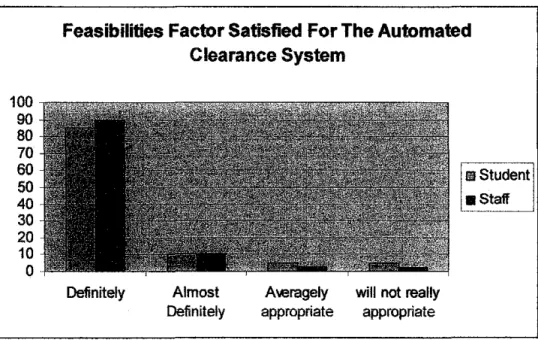
From the Figure 4.3, it seems that 85% from 100 students who participated in the questiommires agreed that the online system proposed would improve the Security Department and Finance Department management efficiency, 10% said it almost definitely, 5% said that it averagely appropriate while 5% said it will not really appropriate.90% from staffs agreed that the Department would be more efficient with the implementation of the online system. However, 2% of them said that it will not really appropriate.
Those who disagreed that the online system will increase efficiency believe that it is not the system alone that determines the level of efficiency. Efficient staffs are another factor that determines whether an organization (for this project, the Security Department, and Finance Department) is efficient or not.
Discussion:
TI1e result shows that more than three-quarter of the staffs and students believe that with the implementation of the new system, the Security Department, Information Resource Centre Department and Finance Department increase its efficiency. Efficiency here refers to the tasks in the department that are accomplished without error and on time. To hlcrease the efficiency, the new system must be technically feasibilities.
The online system is very technically feasible. First, the project scope is relatively small. The basic data (manual data) and processes (manual processes) for the system are readily available. It just that the data ·and processes need to be refmed and transformed into online system.
Besides that, the requirements for this project are easily obtained and ill structured form which make the online system less risky. Tills is because when a system fulfills busmess specification an:d user requirements, it will be very usable and highly accepted by users.
In addition, the system proposed employ commonly used ot stand technology such as pc and LAN, which are available in UTP environment. This project is also less risky as the user groups are familiar with pc and web-based application.
As a conclusion, the online system should be developed, as it satisfies technical aspect of the development. Furthermore, with the development of the online system, the efficiency of task undertaken in Security Deprutment, Finance Deprutment and lnfurmation Resource Centre department will increase.
Data Gathered:
Trust the System In Term of Data Confidentiality 90
80 70 60 50 40 30 20 10 0
Discussion:
Yes No
Figure: 4.4
m Student
•Staff
From the questimmaire distributed, majority of students ru1d staffs trust the online system in term of data confidentiality. In their opinion, they believe that the developer will include all the security conce111s in the system. For exan1ple, the administrator must login before they can access the system. The student crumot access all the pages inside