AN ANALYSIS OF EQUIVALENCE OF CULTURAL TERMS IN SOME
CULTURAL ARTICLES IN INDONESIA’S OFFICIAL TOURISM WEBSITE
A THESIS
BY:
MUHAMMAD IDRIS
REG. NO
: 080705016
DEPARTMENT OF ENGLISH
i ACKNOWLEDGEMENT
First of all, I would like to thank to Allah SWT who has given me all of the blessing, talent and time, so that I can finish my thesis entitled “An analysis of Equivalence of Culrural terms in some Cultural Articles in Indonesia’s Official Tourism Website”
I would like to thank to the dean Dr. H. Syahron Lubis, MA, as the Dean of Faculty of Cultural Studies, University of Sumatera Utara. Dr. H. Muhizar Muchtar, MS, as the Head of Department of English, University of Sumatera Utara. Dr. Hj. Nurlela M. Hum, as the Secretary of Department of English, University of Sumatera Utara. I would like to express my best and sincere thanks to my supervisor Dr. H. Syahron Lubis, MA and Rahmadsyah Rangkuti, MA. Ph.D , as my co-supervisor for having shared their valuable ideas, times, guidance and patience.
I am also grateful for supports and prayers from my family as they believe
that I can finish this thesis. They are the motivations when I write this thesis.
Without them, I would not be able to finish this thesis because they are my
inspiration too.
ii I also want to thank to our sister Sinta Ayunda Widianingrum for the joy and every things you have given to us. For my friends in Kisaran bang bedoel, kholik, ilham,awal and others thanks for the support.
Many thanks to my family in KOS BABA, Bang Coy, Bang Siep, Bang Lelek, Dedi, Yasin, Andes, Asek, and Veron. Last but not least, many thanks for the figures who had been being with me in four years my life in campus and in this city, sorry I cannot mention your names, since I cannot forget you too. See you in my better me. Thank you so much.
Last but not least, for all of my friends and people who know me. I am truly sorry because I cannot write your names but I hope you always know that you are always in my heart. Thank you very much.
Medan, August 2012
Writer,
Muhammad Idris
iii AUTHORS’S DECLARATION
I, MUHAMMAD IDRIS, DECLARE THAT I AM THE SOLE AUTHOR OF THIS THESIS EXCEPT WHERE REFERENCE IS MADE IN THE TEXT OF THIS THESIS. THIS THESIS CONTAINS NO MATERIAL PUBLISHED ELSEWHERE OR EXTRACTED IN WHOLE OR IN PART FROM A THESIS BY WHICH I HAVE QUALIFIED FOR OR AWARDED ANOTHER DEGREE. NO OTHER PERSON’S WORK HAS BEEN USED WITHOUT DUE ACKNOWLEDGEMENTS IN THE MAIN TEXT OF THIS THESIS. THIS THESIS HAS NOT BEEN SUBMITTED FOR THE AWARD OF ANOTHER DEGREE IN ANY TERTIARY EDUCATION.
Signed :………….
iv COPYRIGHT DECLARATION
NAME : MUHAMMAD IDRIS
THESIS TITLE : AN ANALYSIS OF EQUIVALENCE OF CULTURAL TERMS IN SOME CULTURAL ARTICLES IN INDONESIA’S OFFICIAL TOURISM WEBSITE
QUALIFICATION : S1/SARJANA SASTRA DEPARTMENT : ENGLISH
THE WRITER IS WILLING THAT THE WRITER’S THESIS SHOULD BE AVAILABLE FOR REPRODUCTION AT THE DISSERTATION OF THE LIBRARIAN OF UNIVERSITY OF SUMATRA UTARA, FACULTY OF LETTERS, ENGLISH LITERATURE DEPARTMENT ON THE UNDERSTANDING THAT THE USERS ARE MADE AWARE OF THEIR OBLIGATIONS UNDER LAW OF THE REPUBLIC OF INDONESIA.
Signed :
v ABSTRACT
Skripsi ini berjudul ”An Analysis of Equivalence of Cultural Terms in Some Articles in Indonesia’s Official Website ”. Tujuan dari penulisan skripsi ini adalah untuk memberi gambaran tentang istilah-istilah budaya Indonesia yang diterjemahkan ke dalam bahasa inggris sebagai bahasa target. Setelah mendapat data kemudian langkah selanjutnya adalah menganalisis untuk melihat metode yang digunakan dalam menterjemahkan istilah-istilah budaya tersebut sehingga dia tetap sejajar. Sumber data yang digunakan dalam skripsi ini berasal ini situs resmi Pariwisata Republik Indonesia sehingga melalui penelitian budaya-budaya Indonesia menjadi terpromosikan bagi rakyat Indonesia khususnya kalangan mahasiswa. Dalam menganalisis data-data tersebut, skripsi ini menggunakan metode kualitatif deskriptif dimana skripsi ini hanya menemukan kemudian menjelaskan tentang fenomena yang terjadi tanpa melibatkan perhitungan statistika. Dengan berdasar pada teori Equivalence in Translation dari Nida dan Baker hasil penelitian ini dapat digambarkan sebagai berikut: translation by cultural substitution (3 data), translation by using an idiom of similar meaning but dissimilar form (5 data), translation by using an idiom of similar meaning and form (8 data), dan translation by more general word (1 data), penelitian ini kiranya dapat merangsang para peneliti lain untuk meneliti bidang-bidang lainnya dari ilmu terjemahan karena ilmu terjemahan adalah ilmu yang memiliki prospek menjanjikan dalam kehidupan social masyarakat.
vi
TABLE OF CONTENTS
ACKNOWLEDGEMENTS
AUTHOR DECLARATION
COPYRIGHT DECLARATION
ABSTRACT
TABLE OF CONTENTS
LIST OF TABLES
CHAPTER I INTRODUCTION
1.1 Background of the analysis……….1
1.2 Problem of the analysis..………...5
1.3 Objective of the analysis……….6
1.4 Scope of the analysis………....6
1.5 Significances of the analysis………....7
CHAPTER II REVIEW OF LITERATURE 2.1 Review of Studies………...8
2.2. Definitions of Translation….………9
2.3. Some Reviews about Equivalenc………...12
2.4 Formal Equivalence………...21
2.5 Dynamic Equivalence………....22
vii 2.6.1 Equivalence Translation Strategies at Word
Level……….28
2.6.2 Equivalence Strategies at Above Word Level…...31
2.7 Language and Culture.…..……….33
2.7.1 Culture Terms……..………...33
CHAPTER III METHOD OF STUDY 3.1 Research Design………...36
3.2 Source of data………...36
3.3 Method of collecting data ………...36
3.4 Method of analyzing data………...37
CHAPTER IV DESCRIPTION AND FINDINGS 4.1 The Profile of Cultural Terms Translation and The Equivalence Strategies………...38
4.2 The Description of Equivalence Strategies in Translating Cultural Terms in Cultural Articles…………40
CHAPTER V CONCLUSIONS AND SUGGESTIONS 5.1 Conclusion………..…...…44
5.2 Suggestion……….……44
REFERENCES
viii LIST OF TABLE
v ABSTRACT
Skripsi ini berjudul ”An Analysis of Equivalence of Cultural Terms in Some Articles in Indonesia’s Official Website ”. Tujuan dari penulisan skripsi ini adalah untuk memberi gambaran tentang istilah-istilah budaya Indonesia yang diterjemahkan ke dalam bahasa inggris sebagai bahasa target. Setelah mendapat data kemudian langkah selanjutnya adalah menganalisis untuk melihat metode yang digunakan dalam menterjemahkan istilah-istilah budaya tersebut sehingga dia tetap sejajar. Sumber data yang digunakan dalam skripsi ini berasal ini situs resmi Pariwisata Republik Indonesia sehingga melalui penelitian budaya-budaya Indonesia menjadi terpromosikan bagi rakyat Indonesia khususnya kalangan mahasiswa. Dalam menganalisis data-data tersebut, skripsi ini menggunakan metode kualitatif deskriptif dimana skripsi ini hanya menemukan kemudian menjelaskan tentang fenomena yang terjadi tanpa melibatkan perhitungan statistika. Dengan berdasar pada teori Equivalence in Translation dari Nida dan Baker hasil penelitian ini dapat digambarkan sebagai berikut: translation by cultural substitution (3 data), translation by using an idiom of similar meaning but dissimilar form (5 data), translation by using an idiom of similar meaning and form (8 data), dan translation by more general word (1 data), penelitian ini kiranya dapat merangsang para peneliti lain untuk meneliti bidang-bidang lainnya dari ilmu terjemahan karena ilmu terjemahan adalah ilmu yang memiliki prospek menjanjikan dalam kehidupan social masyarakat.
1 CHAPTER I
INTRODUCTION
1.1. Background of Study.
According to Newmark (1988), translation is a process of rendering the meaning of a text into another language in the way that the author intended. When reflecting to Newmark’s perspectives of translation, it easily seen that the core of translating is the process of understanding meaning. Understanding meaning could help people to understand another language as well since whether the construction of both language is different, but similarly, both of language contain meanings.
How important meaning in a communication really? According to Husserl,” Being meaningful is essential to linguistic expression”. (Husserl 2008:12). Husserl outlines that linguistic expressions are objects due to their meanings or more precisely through the agency of a peculiar intention that bestows meaning upon them. Regarding to Husserl’s point of meaning, we may see that we absolutely read a meaning printed into books or texts or uttered by speakers. No matter how the language comes to us, but the core of men’s problem when having a conversation or reading a book is to catch the meaning, not to catch the words or the units. On this point, Husserl stresses on the importance of meaning. He describes clearly that meaning is one aspect of language. When someone is not able to catch the meaning in our language, then the language will fall to vain.
2 nothing and end in absurdity. “My reading ends when I don’t know the word means”. That short statement describes clearly that it is really essential to get the meaning in an utterance by pretending how the meaning goes to us, whether in an abstract or concrete meaning. “Being meaningful is really essential in a linguistic expression”. In linguistics, meaning is deeply studied by using semantics theories. According to Locke, semantics is a branch of linguistics that deals with the study of meaning. In studying meanings, semantics deals with prior types of expression and not focus on the properties of speakers’ utterance. It means semantics study focuses to observe a construction of each sentence and then after observing it, the meaning included in could be found. Hence, when doing a study of meaning by using semantics approach, recognizing the units of language that constructs a text is the first step that should be done. Those units could be phonemes, syllable, morphemes, and words and so on. They are some of units of language that involved in building a text.
After reviewing the critical role of meaning in understanding languages, it is easily said that people’s communication may work if the speakers could catch up the meanings contained in those language. Yet, the problem which is appeared here, how do people catch up the meaning if people cannot figure out the meaning? In solving this problem, a translation theory is proposed as a way out in bridging this gap. The translation proposes a theory to figure out a foreign language and it is started by analyzing, transferring, and ultimately reconstructing the source language into target language.
3 And the most frequently cited theorists comprise a fairly limited group. One such catalogue might include: Cicero, Horace, Quintilian, Augustin, Jerome, Dryden, Goethe, Schleiermacher, Arnold Nietzsche. Twentieth-century translation theory reveals a much a much expanded range of fields and approaches reflecting the differentiation of modern culture: not only varieties of linguistics, literary criticism, philosophical speculation, and cultural theory, but experimental studies and anthropological fieldwork, as well as translator training and translation practice.
After reviewing the old perspectives of translation in West, then, this present thesis walks on a definition from Catford in Nababan (1999: 19) “Penerjemahan sebagai proses penggantian suatu teks bahasa sumber dengan teks bahasa sasaran. Dia juga mengartikan penerjemahan sebagai penggantian materi teks bahasa bahasa sumber dengan materi teks bahasa sasaran”. Due of the opinion, it may be
concluded that translation is the process of transferring a meaning from SL to TL by regarding the style and the form of the language. Keeping the style and the form of the translation text is intended to maintain the message included in it. If the translator succeeds to maintain the meaning in the process of translating, then there will be no lost message to the readers of translation result.
4 A translation is pre-eminently a matter for discussion rather than fiat. Too often it is still being imposed as a teacher’s ‘fair copy’ or model. In fact, the simplest sentence- ‘the gorgeous girl walked gingerly through the closet’- would, in or in spite of any context, be translated variously by a dozen experts in a dozen different language).
Regarding that issue, it can be seen that it is really important to keep maintaining the transferring meanings from SL to TL. Through maintaining the meaning, the readers will not meet vagueness when reading the translation result and the original text. The vagueness appears because of misinterpreting the source text. As stated above that when the translator misinterprets the meaning intended in the SL then the translation result in TL will fall in same mistake as well.
The misinterpretation in equivalence often occurs in cultural terms. It often happens since the cultural terms are sometimes delivered in very specific language so the very specific terms could be found in target language. In avoiding this problem, the translator should know the theory of equivalence since through knowing this theory; the translator will easily find an ultimate solution in translating the very specific cultural terms.
5 offered by this site to make the visitor of this seat have many choices in reading article. This site is also enriched with updated news about something happens in our society.
Another reason that makes this site is pointed to be analyzed is this site closely stands with people. As a cultural site owned by the government this site is fully dedicated to the society. Through its existence, this site could help people to understand more about their culture. Based on the reason it can be concluded that this site is mostly read by the society. Therefore through the discussion of equivalence in translation in this analysis it hopefully gives a significant help to the readers of this site in understanding the translation of the terms.
Maintaining the culture can be started by maintaining the language. Through the analysis of translation in this thesis, people who read this thesis will love their culture and also love learning the translation theory.
1.2. Problems of Study
Regarding that background above, some questions are formulated to elaborate the analysis about the equivalence in translation. The questions which are going to be answered in this analysis are:
1. What are the profiles of cultural phrases in the articles of Indonesia’s official tourism website?
2. What equivalence strategies are used in translating cultural terms in Indonesia’s official tourism website?
6 1.3. Objectives of Study
After reviewing the problems which are going to be analyzed in this present thesis then the focus moves to the objectives of doing this analysis. Based on those problems viewed above, the objectives of this analysis are:
1. To find out the profiles of cultural phrases in the articles of Indonesia’s official tourism website.
2. To elaborate the translation techniques are used in translating cultural terms in Indonesia’s official tourism website.
1.4. Scope of the Analysis.
In doing an analysis it is essentially needed to make a limitation in discussing the cases since this limitation helps to make the focus of the problems which are intended to be revealed. This limitation is designed through considering the theory and the needs this analysis walks on.
Based on those issues, the scope of this analysis is begun with the articles of the website. There are various articles which are available in Indonesia’s official website. However, this present analysis merely focuses on selected articles dealing with cultural aspects in Indonesia so this analysis declines other articles available in this website but those are not linked with culture.
7 phrases in those articles, this then analysis tries to convey some techniques used in translating those cultural phrases.
1.5. Significance of the Analysis.
The significances of doing something could be seen theoretically and practically. Through this analysis, this present thesis hopefully gives some significance where:
1. This analysis could enrich the readers’ knowledge about equivalence translation.
8 CHAPTER II
REVIEW OF LITERATURE
2.1. Review of Studies
In doing an analysis in this proposal, some works from other researchers are viewed in an intention to use it as a guideline to finish this proposal. Those works are taken from many resources but the point is those works are dealing with translation and equivalence. Those works reflect any kind of method of study, theory of study, and how to draw a conclusion toward the motion and those things may help to finish this present study well.
The first work which is going to be reviewed is a thesis by Rahmadhani (2003) entitled “The Equivalence of Prepositional Phrase in the Translation of J.K. Rowling’s “Harry Potter and the Order of the Phoenix” Listiana Srisanti’s “Harry Potter and Orde Phoenix”. In doing this analysis she used a descriptive qualitative method which reflected on the real facts existing among society. Besides, she also laid her analysis on Nida’s theory which focuses on Formal and Dynamic equivalence.
9 differences in the culture (language is a part of culture) between the source and the target text. That is between the English and Indonesia culture.
Besides a thesis by Rahmadhani another work is reviewed here. The thesis is entitled ”The Equivalence of Passive Verbs in J.K. Rowling’s Harry Potter and The
Deathly Hallows and Its Translation into “Harry Potter dan Relikui Kematian” BY
Listiana Srisanti”written by Julkhairi Nasution (2009). This thesis was based on
quantitave method went towards Nida’s theory.
After analyzing the data both found in ST and TT, there are some conclusions that can be drawn. First, types of equivalence based on Nida’s theory can be found in the translation of passive verbs in TT. There are 712 cases where 491 cases belong to Formal Equivalence and 221 cases belong to Dynamic Equivalence. The dominant type is Formal Equivalence with the percentage 68, 97 % and the percentage for Dynamic Equivalence is 31, 03 %. Second, the passive verbs in ST sometimes translated into infinitive, adverb, adjective or active verbs due to the effort in making the translation appropriate and suitable with the culture of TT and to make it understandable for the reader of TT.
2.2. Definition of Translation.
10 structure so when that language is delivered to non native speaker of that language the problems of understanding the meaning and the culture arise to him.
This is a common problem existing when someone has a conversation to a man who speaks in a different language with him. Therefore, in an attempt to mediate different languages, values or cultures, translations "nearly always contain attempts to naturalize the different culture to make it conform more to what the reader of the translation is used to" (Lefevere, 1999: 237 in Tomoko “Is Translation a Rewriting of an Original Text?” ). As a result, translations are rarely equivalent to the original. Bassnett (1980) further argues that translated texts are so far removed from the original that they need to be considered as independent products of literature.
Translation is the action of interpretation of the meaning of a text, and subsequent production of an equivalent text, also called a translation, that communicates the same message in another language. The text to be translated is called the source text, and the language it is to be translated into is called the target language; the final product is sometimes called the "target text." (http://en.wikipedia.org/wiki/Translation). Translation typically has been used to transfer written or spoken SL texts to equivalent written or spoken TL texts. In general, the purpose of translation is to reproduce various kinds of texts—including religious, literary, scientific, and philosophical texts—in another language and thus making them available to wider readers.
11 In this regard, Culler (1976) believes that languages are not nomenclatures and the concepts of one language may differ radically from those of another, since each language articulates or organizes the world differently, and languages do not simply name categories; they articulate their own (p.21-2). The conclusion likely to be drawn from what Culler (1976) writes is that one of the troublesome problems of translation is the disparity among languages. The bigger the gap between the SL and the TL, the more difficult the transfer of message from the former to the latter will be.
The difference between an SL and a TL and the variation in their cultures makes the process of translating a real challenge. Among the problematic factors involved in translation such as form, meaning, style, proverbs, idioms, etc., the present paper is going to concentrate mainly on the procedures of translating CSCs in general and on the strategies of rendering allusions in particular.
Translation must take into account constraints that include context, the rules of grammar of the two languages, their writing conventions, and their idioms. A common misconception is that there exists a simple word-for-word correspondence between any two languages, and that translation is a straightforward mechanical process. A word-for-word translation does not take into account context, grammar, conventions, and idioms.
12 such as "Franglais" (French-English), "Spanglish" (Spanish-English), "Poglish" (Polish-English) and "Portuñol" (Portuguese-Spanish).
2.3. Some Reviews about Equivalence Translation.
Vannesa Leonardi in her scientific article (2008:2) outlines some definitions of equivalence in translation from some prominent experts. The theories which are provided by the experts much help in figuring out equivalence as unit of translation dealing to very specific words to be translated. The various opinions of equivalence from the experts show how complicated and how wide the rooms of equivalence discussion are. Some definitions which are available in this proposal presented as:
a. Vinay and Darbelnet and the definition of equivalence in translation.
Vinay and Darbelnet view equivalence-oriented translation as a procedure which 'replicates the same situation as in the original, whilst using completely different wording'. They also suggest that, if this procedure is applied during the translation process, it can maintain the stylistic impact of the SL text in the TL text. According to them, equivalence is therefore the ideal method when the translator has to deal with proverbs, idioms, clichés, nominal or adjectival phrases and the onomatopeia of animal sounds.
13 saying that 'the need for creating equivalences arises from the situation, and it is in the situation of the SL text that translators have to look for a solution'. Indeed, they argue that even if the semantic equivalent of an expression in the SL text is quoted in a dictionary or a glossary, it is not enough, and it does not guarantee a successful translation. They provide a number of examples to prove their theory, and the following expression appears in their list: Take one is a fixed expression which would have as an equivalent French translation Prenez-en un. However, if the expression appeared as a notice next to a basket of free samples in a large store, the translator would have to look for an equivalent term in a similar situation and use the expression Échantillon gratuity.
b. Jakobson and the Concept of Equivalence in Difference.
Roman Jakobson's study of equivalence gave new impetus to the theoretical analysis of translation since he introduced the notion of 'equivalence in difference'. On the basis of his semiotic approach to language and his aphorism 'there is no signatum without signum' (1959:232), he suggests three kinds of translation:
1. Intralingual (within one language, e.g. rewording or paraphrase)
2. Interlingual ( between two languages)
3. Intersemiotics (between sign systems)
14 Jakobson goes on to say that from a grammatical point of view languages may differ from one another to a greater or lesser degree, but this does not mean that a translation cannot be possible, in other words, that the translator may face the problem of not finding a translation equivalent. He acknowledges that 'whenever there is deficiency, terminology may be qualified and amplified by loanwords or loan-translations, neologisms or semantic shifts, and finally, by circumlocutions'. Jakobson provides a number of examples by comparing English and Russian language structures and explains that in such cases where there is no a literal equivalent for a particular ST word or sentence, then it is up to the translator to choose the most suitable way to render it in the TT.
There seems to be some similarity between Vinay and Darbelnet's theory of translation procedures and Jakobson's theory of translation. Both theories stress the fact that, whenever a linguistic approach is no longer suitable to carry out a translation, the translator can rely on other procedures such as loan-translations, neologisms and the like. Both theories recognize the limitations of a linguistic theory and argue that a translation can never be impossible since there are several methods that the translator can choose. The role of the translator as the person who decides how to carry out the translation is emphasized in both theories. Both Vinay and Darbelnet as well as Jakobson conceive the translation task as something which can always be carried out from one language to another, regardless of the cultural or grammatical differences between ST and TT.
15 c. Catford and the Introduction of Translation Shifts.
Catford's approach to translation equivalence clearly differs from that adopted by Nida since Catford had a preference for a more linguistic-based approach to translation and this approach is based on the linguistic work of Firth and Halliday. His main contribution in the field of translation theory is the introduction of the concepts of types and shifts of translation. Catford proposed very broad types of translation in terms of three criteria:
1. The extent of translation (full translation vs partial translation)
2. The grammatical rank at which the translation equivalence is established. (rank bound vs. unbounded translation).
3. The levels of language involved in translation (total translation vs restricted translation).
We will refer only to the second type of translation, since this is the one that concerns the concept of equivalence, and we will then move on to analyze the notion of translation shifts, as elaborated by Catford, which are based on the distinction between formal correspondence and textual equivalence. In rank-bound translation an equivalent is sought in the TL for each word, or for each morpheme encountered in the ST. In unbounded translation equivalences are not tied to a particular rank, and we may additionally find equivalences at sentence, clause and other levels.
16 languages as Catford claims they do. One of the problems with formal correspondence is that, despite being a useful tool to employ in comparative linguistics, it seems that it is not really relevant in terms of assessing translation equivalence between ST and TT. For this reason we now turn to Catford's other dimension of correspondence, namely textual equivalence which occurs when any TL text or portion of text is 'observed on a particular occasion to be the equivalent of a given SL text or portion of text'. He implements this by a process of commutation, whereby 'a competent bilingual informant or translator' is consulted on the translation of various sentences whose ST items are changed in order to observe what changes if any occur in the TL text as a consequence.
As far as translation shifts are concerned, Catford defines them as 'departures from formal correspondence in the process of going from the SL to the TL'. Catford argues that there are two main types of translation shifts, namely level shifts, where the SL item at one linguistic level (e.g. grammar) has a TL equivalent at a different level (e.g. lexis), and category shifts which are divided into four types:
1. Structure-shifts, which involve a grammatical change between the structure of the ST and that of the TT.
2. Class-shifts, when a SL item is translated with a TL item which belongs to a different grammatical class, e.g. a verb mat are translated with a noun. 3. Unit Shifts which involve changes in rank.
17 Catford was very much criticized for his linguistic theory of translation. One of the most scathing criticisms came from Snell-Hornby (1988), who argued that Catford's definition of textual equivalence is 'circular', his theory's reliance on bilingual informants 'hopelessly inadequate', and his example sentences 'isolated and even absurdly simplistic' (ibid.:19-20). She considers the concept of equivalence in translation as being an illusion. She asserts that the translation process cannot simply be reduced to a linguistic exercise, as claimed by Catford for instance, since there are also other factors, such as textual, cultural and situational aspects, which should be taken into consideration when translating. In other words, she does not believe that linguistics is the only discipline which enables people to carry out a translation, since translating involves different cultures and different situations at the same time and they do not always match from language to another.
d. Baker’s Approach to Translation Equivalence.
18
Equivalence that can appear at word level and above word level, when translating from one language into another. Baker acknowledges that, in a bottom-up approach to translation, equivalence at word level is the first element to be taken into consideration by the translator. In fact, when the translator starts analyzing the ST s/he looks at the words as single units in order to find a direct 'equivalent' term in the TL. Baker gives a definition of the term word since it should be remembered that a single word can sometimes be assigned different meanings in different languages and might be regarded as being a more complex unit or morpheme. This means that the translator should pay attention to a number of factors when considering a single word, such as number, gender and tense (ibid.:11-12).
Grammatical equivalence, when referring to the diversity of grammatical categories across languages. She notes that grammatical rules may vary across languages and this may pose some problems in terms of finding a direct correspondence in the TL. In fact, she claims that different grammatical structures in the SL and TL may cause remarkable changes in the way the information or message is carried across. These changes may induce the translator either to add or to omit information in the TT because of the lack of particular grammatical devices in the TL itself. Amongst these grammatical devices which might cause problems in translation Baker focuses on number, tense and aspects, voice, person and gender.
19 feature in translation since it provides useful guidelines for the comprehension and analysis of the ST which can help the translator in his or her attempt to produce a cohesive and coherent text for the TC audience in a specific context. It is up to the translator to decide whether or not to maintain the cohesive ties as well as the coherence of the SL text. His or her decision will be guided by three main factors, that is, the target audience, the purpose of the translation and the text type.
Pragmatic equivalence, when referring to implicatures and strategies of avoidance during the translation process. Implicature is not about what is explicitly said but what is implied. Therefore, the translator needs to work out implied meanings in translation in order to get the ST message across. The role of the translator is to recreate the author's intention in another culture in such a way that enables the TC reader to understand it clearly.
e. Nida and Taber : Formal Correspondence and Dynamic Equivalence.
Nida argued that there are two different types of equivalence, namely formal equivalence—which in the second edition by Nida and Taber (1982) is referred to as formal correspondence—and dynamic equivalence. Formal correspondence 'focuses attention on the message itself, in both form and content', unlike dynamic equivalence which is based upon 'the principle of equivalent effect' (1964:159
20 formal equivalents should be used wherever possible if the translation aims at achieving formal rather than dynamic equivalence. The use of formal equivalents might at times have serious implications in the TT since the translation will not be easily understood by the target audience (Fawcett, 1997). Nida and Taber themselves assert that 'Typically, formal correspondence distorts the grammatical and stylistic patterns of the receptor language, and hence distorts the message, so as to cause the receptor to misunderstand or to labor unduly hard”.
Dynamic equivalence is defined as a translation principle according to which a translator seeks to translate the meaning of the original in such a way that the TL wording will trigger the same impact on the TC audience as the original wording did upon the ST audience. They argue that 'Frequently, the form of the original text is changed; but as long as the change follows the rules of back transformation in the source language, of contextual consistency in the transfer, and of transformation in the receptor language, the message is preserved and the translation is faithful'.
21 Despite using a linguistic approach to translation, Nida is much more interested in the message of the text or, in other words, in its semantic quality. He therefore strives to make sure that this message remains clear in the target text.
2.4. Formal Equivalence.
Such a formal-equivalence (or F-E) translation is basically source-oriented; that is, it is designed to reveal as much as possible of the form and content of the original message. In doing so, an F-E translation attempts to reproduce several formal elements, including: (1) grammatical units, (2) consistency in word usage, and (3)meaning in term of the source context. The reproduction of grammatical units may consist in: (a) translating nouns by nouns, verbs by verbs, etc; (b) keeping all phrase and sentence intact (i.e. not splitting up and readjusting the units); and (c) preserving all formal indicators, e.g. marks of punctuation, paragraph breaks, and poetic indentation.
22 philosophical system. An F-E translation may also make use of brackets, parentheses, or even italics (as in the King James Bible) for words added to make sense in the translation, but missing in the original document.
From what has been said directly and indirectly about F-E translation in preceding sections, it might be supposed that such translations are categorically ruled out. To the contrary, they are often perfectly valid translations of certain type of message for certain types of audiences pose another question, and must not be confused with a description of the nature of various kinds of translations. At this point we are concerned only with their essential features, not with their evaluation.
2.5. Dynamic Equivalence.
In contrast with formal-equivalence translation others are toward dynamic equivalence. In such a translation the focus of attention is directed, not so much toward the source message, as toward the receptor response. A dynamic-equivalence (or D-E) translation may be described as one concerning which a bilingual and bicultural person can justifiably say ,”that is just the way we would say it.” it is important to realize, however , that a D-E translation is not merely another message which is more or less similar to that ot he source. It is a translation, and as such must clearly reflect the meaning and intent of the source
23 However, since a D-E translation is directed primarily toward equivalence of response rather than equivalence of form, it is important to define more fully the implications of the word natural as applied to such translations. Basically, the word natural is applicable to three areas of the communication process; for a natural rendering must fit (1) the receptor language and culture as a whole, (2) the context of particular message, and (3) the receptor language audience.
A natural translation involves two principal areas of adaptation, namely, grammar and lexicon. In general the grammatical modification can be made the more readily, since many grammatical changes are dictated by the obligatory structures of the receptor language. That is to say, one is obliged to make such adjustments as shifting word order, using verb in place of nouns, and substituting nouns of pronouns. The lexical structure of the source message is less readily adjusted to the semantic requirements of the receptor language, for instead of obvious rules to be followed, there are numerous alternative possibilities. There are in general three lexical levels to be considered: (1) term for which there are readily available parallels, e.g. river, tree, stone, knife, etc.; (2) term which identify culturally different objects, but with somewhat similar functions, e.g. book, which in English means an object with pages bound together into a unit, but which, in New testament times, meant a long parchment or papyrus rolled up in the form of a scroll; and (3) term which identify cultural specialties, e.g. synagogue, homer, ephah, cherubim, and jubilee, to cite only a few from a the bible. Usually the first set of terms involves no
24 formal identity. In translating term of the third class certain”foreign associations” can rarely be avoided. No translation that attempts to bridge a wide cultural gap can hope to eliminate all traces of the foreign setting. for example, in Bible translating it is quite impossible to remove such foreign ” objects” as Pharisees, Solomon’s temple, cities of refuge, or such Biblical themes as anointing, adulterous generation, living sacrifice, and lamb of god, for these expressions are deeply imbedded in the very though structure of the message.
It is inevitable also that when source and receptor languages represent very different cultures there should be many basic theme and accounts which cannot be ”naturalized” by the process of the translating. For example, the Jivaro Indian of Ecuador certainly do not understand1Corinthians 11:14, ”does not nature teach us that for a man to wear long hair is a dishonor to him?”, for in general Jivaro men let their hair grow long, while Jivaro adult women usually cut theirs rather close. Similarly, in many areas of West Africa the behavior of Jesus’ disciples in spreading leaves and branches in his way as he rode into Jerusalem is regarded as reprehensible; for in accordance with West Africa custom the path to be walked on or ridden over by a chief is scrupulously cleaned of all litter and anyone who throws a branch in such a person’s way is guilty of grievous insult. Nevertheless, these cultural discrepancies offer less difficulty than might be imagined, especially if footnotes are use to point out the basis for the cultural diversity; for all people recognize that othor peoples behave differently from themselves.
25 instead of “god is love”) ; (2) grammatical categories (in some languages so-called predicate nominatives must agree in number with the subject, so that “the two shall be one” cannot be said, and accordingly, one must say “the two persons shall act just a though they are one person”); (3) semantic classes(swear word in one language may be based upon the perverted use of divine names, but in another language may be primarily excremental and anatomical); (4) discourse type (some languages ma require direct quotation and others indirect); and (5) cultural contexts (in some societies the New Testament practice of sitting down to teach seems strange, if not unbecoming).
In addition to being appropriated to the receptor language and culture, natural translation must be accordance with the context of the particular message. The proble thus not restricted to gross grammatical and lexical features, but may also involve such detailed matters as intonation and sentence rhythm (Ezra pound 1954: 298). The trouble is that, “Fettered to mere words, the translator loses the spirit of the original author” (Manchester 1951: 68).
26 of the kiva. Rather, one must speak of Americans by means of a Zuni expression meaning, literally, “broad-hats”. For the Zunis, uttering melica in a kiva ceremony would be as out of place as bringing a radio into such a meeting.
Onomatopoetic expression are considered equivalent to slang by the speakers of some language. In some language in Africa for example, certain highly imitative expressions (sometimes called ideophones) have been ruled out as inappropriate to the dignified context of the bible. Undoubtedly the critical attitudes of some missionary translators toward such vivid, but highly colloquial, forms of expression have to the contributed to the feeling of many Africans that such words are inappropriate in Biblical contexts. In some language, however, such onomatopoetic usages are not only highly developed, but are regarded as essential and becoming in any type of discourse. For example, Waiwai, a language of British Guiana, uses such expressions with great frequency, and without them one can scarcely communicate the emotional tone of the message, for they provide the basic signals for understanding the speaker’s attitude toward the events he narrates.
Some translators are successful in avoiding vulgarism and slang but fall into the error of the making a relatively straightforward message in source language sound like a complicated legal document in the receptor language by trying too hard to be completely unambiguous; as a result such a translators spins out his definition in long, technical phrase. In such a translation little is left of the grace and naturalness of the original.
27 other hand, to translate “heavens and earth” by “universe” in genesis 1:1 is not so radical a departure as one might think, for the people of the ancient world hard a highly developed concept of an organized system comprising the “heavens and the earth,” and hence “universe” is not inappropriate. Anachronisms involve two type of errors: (1) using contemporary words which falsify life at historically different periods, e.g. translating “demon possessed” as “mentally distressed,” and (2) using old-fashioned language in the receptor language and hence giving an impression of unreality.
Appropriateness of the message within the context is not merely a matter of the referential content of the words. The total impression of a message consists not merely in the objects, events, abstractions, and relationships symbolized by the words, but also in the stylistic selection and arrangement of such symbols.
Moreover, the standards of the stylistic acceptability for various type of discourse differ radically from language. What is entirely appropriate in Spanish, for example, may return out to be quite unacceptable “purple prose” in English, and the English prose we admire as dignified and effective often seems in Spanish to be colorless, insipid, and flat. Many Spanish literary artists take delight in the flowery elegance of their language, while most English writers prefer old realism, precision, and movement.
28 element as sarcasm, irony, or whimsical interest must all be accurately reflected in a D-E translation. Furthermore, it is essential that each participant introduce into the message be accurately represented. That is to say, individuals must be properly characterized by the appropriate selection and arrangement of word, so that such features as social class or geographical dialect will be immediately evident. Moreover, each character must be permitted to have the same kind of individuality and personality as author himself gave them in the original message.
A third element in the naturalness of a D-E translation is the extent to which the message fits the receptor-language audience. This appropriateness must be judged on the basis of the level of experience and the capacity for decoding, if one is to aim at any real dynamic equivalence. One the other hand, one is not always sure how the original audience responded or was supposed to respond. Bible translators, for example, have often made quite a point of the fact that the language of the New Testament was Koine Greek, the language of “the man in the street.” And hence a translation should speak to the man in the street. The truth of the matter is that many New Testament message were not directed primarily to the man in the street, but to the man in the congregation. For this reason, such expressions as “Abba Father,” maranatha, and “baptized into Christ” could be use with reasonable expectation that they would be understood.
29 2.6. Equivalence Translation Strategies
2.6.1 Equivalence Translation Strategies at Word Level
There are seven strategies were offered by Baker in order to overcome the problems of non equivalence in doing translation. There are:
1. Translation by a more general word
This is one of the commonest strategies with many types of non-equivalence, particularly in the area of preposition meaning. It works equally well in most, if not all, languages, since the hierarchal structure of semantic fields is not language – specific. For example:
SL: I will go back to Chicago two days later (English)
TL: Saya akan kembali ke Amerika dua hari lagi. (Bahasa Indonesia)
The above example illustrates the use a general word (super ordinate) to overcome to a relative lack of specificity in TL compared to the SL. What the translators of the above extracts have done is go up in level in given semantic field to find a more general word that covers the core propositional meaning of the missing hyponym in the target language.
2. Translation by a more neutral/less expressive word
To make a clear comprehension notice the example below:.
30 TL: Kemunculan panda dalam dunia hewan adalah sebuah teka-teki (Bahasa Indonesia)
There is an equivalent for mystery in Bahasa Indonesia, but it is mostly associated with religion. The translator felt that it would be wrong to use it in a zoological context.
3. Translation by cultural substitution
One of the strategies to achieve “equivalence effect” used in the latter situation is translation by cultural substitution. This strategy is called “cultural equivalence” (Newmark, 1988:82-83). It involves “replacing a culture-specific item or expression with a target language item which does not have the same propositional meaning” (Baker, 1992: 30). The main advantage of using this strategy is that it gives the reader a concept with which s/he can identify something familiar and appealing.
4. Translation using a loan word or loan word plus explanation
This strategy is particularly common in dealing with culture-specific items modern concepts, and buzz words. As the strategy of cultural substitution, the freedom which translator uses loanwords will often depend on the norms of translation prevailing in their societies. Example:
SL: She is completely narcissistic (English)
TL: Pendeknya , kakakku itu benar-benar narcissistic (Bahasa Indonesia)
31 This strategy tends to be use when the concept expressed by the source item is lexicalized in the TL, but in a different form, and when frequency with which a certain form is used in the TL significantly higher than would be nature in the TL.
SL: He really loves it (English)
TL: Ia girang bukan main (Bahasa Indonesia)
6. Translation by paraphrase using unrelated words
If the concept was expressed by the source item is not lexicalized at all in the TL, the paraphrase strategy was still used in some contexts. Instead of related word, the paraphrase may be based on modifying a superordinate or simply on unpacking the meaning of the source item in question is semantically complex. The main advantage of this strategy is that it achieves a high level of precision in specifying proportional meaning. The disadvantage using this strategy is paraphrase does not have the status of a lexical item and therefore cannot convey expressive, evoked, or any kind of associative meaning. For instance, look at the example:
SL: Andy looked pleased as the rocky road finally engulfed the tip of his nose (English)
TL: Andy kelihatan senang, hidungnya sudah hampir tertutup es krim (Bahasa Indonesia)
7. Translation by omission
32 particular item or expression is not vital enough to the development of the text to justify distracting the reader with lengthy explanation, translator can and often do simply omit translating the word or the expression in question.
Example:
SL: That’s not exactly appropriate for luigi’s (english)
TL: Tak cocok dipakai ke luigi’s (bahasa indonesia)
2.6.2 Equivalence Strategies At Above Word Level
The non – equivalence problems of translation are not only occurred on the word level. In fact, words are combined with other words and make a new meaning. This combining words are generally known as idioms, phrase, and fixed expression. Baker (1992:65) mentions that there are two main problems of idiomatic and fixed expressions pose in translation. They are: the ability to recognize and interpret an idiom correctly; and the difficulties involved in rendering the various aspect of meaning that an idiom or fixed expression conveys into the TL. To overcome the problems above, baker mention several strategies which are working on these combining words such idioms, phrase and fixed expression. There are several strategies that baker has stated, they are:
1. This strategy involve using an idiom in the TL which roughly the same meaning as that the SL idiom and in addition consist of equivalence lexical item. This kind of match can only occasionally be achieved. Example:
33 TL: Mungkin granamyr ingin menunjukkan kepada kita bahwa sesuatu hal tidaklah selalu sama dengan apa yang kita lihat. (Bahasa Indonesia)
2. Using an idiom of similar meaning but dissimilar form
It is often possible to find idiom or fixed expression in the TL which has a meaning similar to that of source idiom or expression, but which consist of different lexical item. Example:
SL: “Those idiots are letting her get into her stride.” Said George (English)
TL: “Para idiot itu membiarkan dy menumpahkan kemarahannya.” Kata George (Bahasa Indonesia)
3. Translation of paraphrase
This strategy has the same concept with the paraphrase strategy at word level, but the difference lied on the way it translated. At the word level, paraphrase strategy translates a word in to unrelated words, but in this paraphrase at this level, the idiom was translated into related idiom. This strategy is the most common way of translating idiom (baker 1992:75). It possible find inaccurate paraphrase. Example:
SL:”It was the first week after terms ended” said Ron (English)
TL:”Terjadinya pada hari minggu pertama kita” kata Ron (Bahasa Indonesia)
4. Translation by omission:
34 2.7. Language and culture
Malinowski (in Katan 1999:72) states " Language is essentially rooted in the reality of culture...it cannot be explained without constant reference to these broader context of verbal utterance". Bronislaw Malinowski was one of the first anthropologists to realize that language could only be understood with reference to culture: a context of culture. Moreover, Franz Boas (in Katan 73) added, "The form of language will be molded by the state of that culture." Sapir on the other hand was convinced that not only importance of the social background but that future language studies would turn to a concept of culture.
In different societies, people not only speak in different language and dialect, but they are also using the language in a different way. The difference reflects the different cultural values. This statement is in accordance with the definition given by Newmark (1988:94) "the way of life and its manifestation that are peculiar to a community that uses a particular language as its means of expression" which implies that each language group have a culturally specific features.
Nababan (1984: 50) states “… Bahasa, sebagai sistem komunikasi, mempunyai makna hanya dalam kebudayaan yang menjadi wadahnya… mengerti sesuatu bahasa tertentu memerlukan sedikit banyak pengertian tentang kebudayaan”
(Language, as communication system, has meaning only in a culture in its place...understanding something specific language requires a little more cultural understanding). Therefore, any translator who wants to translate SL to TL must understand the culture of both SL and TL.
35 Word 'term' in oxforddicctinnary.com means "a word of phrase used to describe a thing or to express a concept, especially in particular kind of language or branch study." It also means language used on a particular occasion; a way of expressing oneself.
Culture is made up of many complex elements, including religious and political system, customs, languages, tools, clothing, building, and artwork. Culture is a comprehensive lifestyle. Culture is complex, abstract, and spacious. Many cultural aspects contribute to determine the behavior of communicating.
Peter Newmark categorizes the words, terms, or cultural phrases as follows: 1. Ecology
Flora, fauna, winds, plains, hills: tabuleiros (low plateau), plateau, selva (tropical rain forest), savanna.
2. Material culture (artifacts) a. Food: sake
b. Clothes: sarong (South Seas) c. Houses and towns: kampong d. Transport: bike
3. Social culture - work and leisure: reggae, rock
4. Organizations, customs, activities, procedures, concepts a. Political and administrative
b. Religious: dharma c. Artistic
36 CHAPTER III
METHOD OF STUDY 3.1 Research Design
There are some methods applied in this research. Nawawi (1995:61) state that method is conducted in other a goal.
Descrictive-qualitative methods in used in order to explain and describe the data. According to Bungin (2001:124-125), “data kualitatif diungkapkan dalam kalimat serta uraian-uraian, bahkan dapat berupa cerita pendek” (qualitative data is applied in sentence and description, even in short story).
Library research is applied. Library research is applied by consulting with some books and dictionary to collect the theories.
3.2 Source of Data
Sample is part of population. The non-probability sampling approaches used in this study is purposive sampling because only cultural terms which are trying to be found in the SL and TL. This sampling approach is practical and economical to used. The sample in this thesis is cultural term.
3.3 Method of Data collection
Data collection method used in this study is reviewing a document by reading and recording, as follows:
37 2. Contrasting both of the texts SL and TL
3. Identifying based on the characteristics of cultural terms as stated in Chapter II.
4. Listing the data.
3.4 Method of analyzing data
1. Analyzing the data based on the theory of Nida and Baker in equivalence.
2. Giving the description based on the analysis.
Example:
“Bulu’ku mupa” yang diterjemahkan masih gunung milik saya atau tetap gunung milik saya. (bahasa Indonesia)
- Bulu’ku mupa which loosely translated means still my mountain)
38 CHAPTER IV
DESCRIPTION AND FINDINGS
4.1. The Profile of Cultural Terms Translation and The Equivalence Strategies.
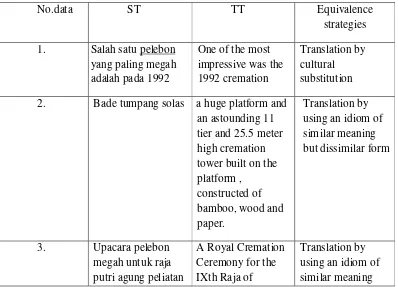
[image:51.612.129.527.403.690.2]After doing an analysis of the four articles, some data findings have been found. Those findings then are grouped into this table with the equivalence strategies which are used in translating those terms.
TABLE 1 The Profile of Cultural Terms Translation and The Equivalence Strategies.
No.data ST TT Equivalence
strategies 1. Salah satu pelebon
yang paling megah adalah pada 1992
One of the most impressive was the 1992 cremation
Translation by cultural substitution 2. Bade tumpang solas a huge platform and
an astounding 11 tier and 25.5 meter high cremation tower built on the platform ,
constructed of bamboo, wood and paper.
Translation by using an idiom of similar meaning but dissimilar form
3. Upacara pelebon megah untuk raja putri agung peliatan
A Royal Cremation Ceremony for the IXth Raja of
39
ke-IX Peliatan and form
4. Tempat pembakaran jenzah
Cremation grounds Translation by using an idiom of similar meaning and form
5. Air suci Holy water Translation by using an idiom of similar meaning and form
6. Jenazah akan dibakar oleh api
Corpse are consumed by the flames.
Translation by using an idiom of similar meanig but dissimilar form. 7. Persembahan Offering Translation by
cultural substitution 8. Berpakaian
gemerlap
Resplendent costume
Translation by using an idiom of similar meanig but dissimilar form. 9. Candi hindu Hindu temple Translation by
cultural substitution 10. Sangat sakti Powerful Translation by a
more general word. 11. Ayam terbangun
dan mulai berkokok
Rooster would wake up and begin to craw
Using an idiom or similar meaning and form 12. Mengubah roro
jangra menjadi batu.
He turned her Using an idiom or similar meaning and form. 13. Butta Panripa Lopi
atau “Bumi Pembuat Pinisi”
Butta Panrita Lopi or “the land of the phinisi schooners”
40 and form
14. Penduduk setempat Locals Translation by using an idiom of similar meanig but dissimilar form. 15. Kekuatan
supranatural
Supernatural powers
Translation by using an idiom of similar meaning and form 16. Ritual dan Upacara Ritual and
ceremonies
Translation by using an idiom of similar meaning and form 17. “Bulu’ku mupa”
yang diterjemahkan masih gunung milik saya atau tetap gunung milik saya
Bulu’ku mupa which loosely translated means still my mountain
Translation by using an idiom of similar meanig but dissimilar form.
5.2. The Description of Equivalence Strategies in Translating Cultural Terms in Cultural Articles.
a. Translation by cultural substitution
1. SL : Salah satu pelebon yang paling megah adalah pada 1992 TL : One of the most impressive was the 1992 cremation
The cultural term pelebon was translated as cremation. Pelebon according to the cultural background in Bali means an action or a ceremony of burning corpse in a very particular way. Pelebon is barely used by Indonesian people since the term merely belongs to Balinese. Since it is not familiar for Indonesian to hear that, pelebon then was translated generally by using cremation as the similar word to it.
41 2. SL : Persembahan
TL : Offering
In this case, the translator translated persembahan into offering in the Target Language. In Indonesia, it is common to know the term “persembahan” which means special giving toward somebody or something which is considered higher than the giver. While, according to Webster offering means “to sacrifice, to present something that we pray for”. Regarding those meanings it can be seen that there is an equivalence between the cultural term persembahan in the Target Language even persembahan is really technical term in Indonesia culture.
b. Translation by using an idiom of similar meanig but dissimilar form 1. SL: Bade tumpang solas
TL : a huge platform and an astounding 11 tier and 25.5 meter high cremation tower built on the platform , constructed of bamboo, wood and paper.
In translating a huge platform and an astounding 11 tier and 25.5 meter high cremation tower built on the platform , constructed of bamboo, wood and paper the
translator choosed to change the form in translating that phrase into clause in the Target Language in order to make the translation result become more natural. Since bade tumpang solas is very particular term for Balinese, then the translator should understand the culture of the Source Language and after knowing it he describes the term through giving an explanation of it. This process shows that the translator should know both of the culture of Source and Target Language.
42 Jenazah akan dibakar oleh api was translated into corpse are consumed by the flames by the translator through using the technique of translating terms by using
idiom of similar meaning but dissimilar form. In this case, the translator changed the form of Source Language in which the Source Language expresses as jenazah akan /dibakar oleh api which means that the sentence shows the future action signalled by akan. But in the result of translation the translator produced corpse are consumed by the flames which expresses the present action.
3. SL: Tempat Pembakaran jenazah TL: Cremation grounds.
In this case, the translator translated the cultural phrase into the form of phrase also in the Target Language. The decision of the translator in maintaining the form shows that both of these sentence have similar forms and meanings. Pembakaran jenazah was directly translated into cremation. In Oxford dictionary, cremation means an action of cremating somebody, a funeral which is a body is cremated. The term tempat was translated into grounds. Literally ground means a surface of soil. The translator actually could use place in replacing grounds but in this case ground is the colloquial of cremation.
c. Translation by using an idiom of similar meaning and form 1. SL: Air suci
TL : Holy water.
In this case, the translator directly gives a translation of air suci as holy water since based on Echols and Hassan Shadily Kamus Indonesia Inggris air is translated as “water” and suci is translated as “holy”.
43 1. SL: Sangat sakti
TL : Powerful
Sangat sakti is very specific term in Indonesia culture. Sakti is closely related
to kuat, perkasa in Bahasa Indonesia. By regarding its more general word then the translator decides to translate sakti becomes powerful.
5.3. The Dominant Equivalence Strategies in Translating Cultural Terms in Cultural Articles.
As an answer for ultimate problem in this thesis, it is presented below about the numbers of equivalence strategies used in translating those cultural terms in those cultural articles derived from Indonesia’s official tourism site. Through counting the numbers of strategies used in it, then this thesis shows the dominant equivalence strategies based on the method as presented in previous chapter. The result of the dominant equivalence strategies in translating cultural terms in some cultural articles in that site can be presented as:
Kinds of Translation Procedures Total Translation by Cultural
Substitution (3 Data)
3 data Translation by Using an Idiom of
Similar Meaning but Dissimilar Form
5 data
Translation by Using an Idiom of similar Meaning and Form
8 data Translation by More General
Word
1 data
TOTAL 17 data
44 and Form. Translation by Using an Idiom of similar Meaning and Form deals with the way of translating Source Language into Target Language in cultural terms through involving using an idiom in the TL which roughly the same meaning as that the SL idiom and in addition consist of equivalence lexical item. This kind of match can only occasionally be achieved. By using this equivalence strategy the translator intends to maintain the stylistic and the word order of those terms since cultural terms are very specific terms so if there is ambiguity in translating it the readers could not understand those terms any longer.
45 CHAPTER V
CONCLUSION AND SUGGESTION
5.1. Conclusion
The existence of conclusion is really essential in a scientific research since conclusion gives the ultimate description about the problems which are being analyzed or discussed. The conclusion is drawn based on the findings and the theory which is used to find the findings of a problem and to solve that problem. Based on the theory of Equivalence as stated in Chapter II, the conclusion of this thesis can be drawn as follow.
1. There are 18 findings dealing with the equivalence strategies in four cultural articles. Based on the types of equivalence strategies as explained in Chapter II the result can be grouped as: translation by cultural substitution (3 Data), translation by using an idiom of similar meaning but dissimilar form (5 Data), translation by using an idion of similar meaning and form (8 data), and translation by more general word (1 data).
46 5.2. Suggestion.
Equivalence translation is a very specific discussion about translation procedure. It is a little part of translation but it has an essential impact since it really helps when we try to understanding specific terms from a certain field. By using equivalence strategies we can understand every technical term and we can make it readable to everyone. Based on it, it will be an interesting research if the next students hold research dealing with equivalence but by taking a different object of research. It can be medical terms, economics terms, legal terms, and others. The ability of translating equivalence terms makes the capacity of that translator become sharper.