The journal homepage www.jpacr.ub.ac.id p-ISSN : 2302 – 4690 | e-ISSN : 2541 – 0733
Physical Properties and Characterization of Cassava Peel Waste
Modified by Esterification
Suci Susanti1, Denis Al Karoma1, Dian Mulyani1 and Masruri1*
1
Chemistry Department, Faculty of Mathematics and Natural Sciences, University of Brawijaya, Jl. Veteran 65145 Malang, Indonesia
*Corresponding email: [email protected]
Received 17 July 2017; Accepted 29 September 2017
ABSTRACT
Cassava starch (Manihot esculenta) is polysaccharide compound which comprises of amylose and amylopectin. This paper demonstrated the characterization result of cassava peel waste modified by esterification with acetic acid and oleic acid. The products were analyzed by FT-IR, PSA, SEM, and XRD. FT-IR results represented carbonyl compound. DS value of acetic acid and oleic acid modification is 0.63 and 0.56, respectively. Characterization by PSA found the distribution frequency was 358.19 m. SEM analysis was obtained rigid structure. From XRD result, the crystallinity of modified flour better than without modification.
Keywords : waste, cassava, chiral, separation
INTRODUCTION
Indonesia is the one of biggest country which produces cassava in the world, therefore potency of the obtained waste such as cassava peel become promising value. Cassava peel is the peeling of food product from cassava. According to Central Bureau of Statistics in 2004-2008, the production of cassava peel tend to increase annually which means the production of cassava peel also increasing[1]. Chemically, the composition of cassava peel was identic with cassava which contains most of polysaccharide and some of mineral and water. The main component of polysaccharide was amylose, amylopectin, and cellulose[2].
Starch is the polysaccharide which comprises of glucose polymer binding with glycoside bond[3]. The modification of starch can change the structure of starch, not only its amylose but also amylopectin. This modification usually conducted to produce starch which possesses certain properties and characteristic (functional starch). One of method for starch modification is esterification reaction[4].
Research of Abia et. al., 2003 [5] utilized cassava peel for metal adsorption of Cd[II], Cu[II], and Zn[II] showed the modified cassava was able to adsorb metal well. In 2010, Ismanto, et. al. [6] conducted the modification of cassava peel waste for electrode capacitor by activated with HNO3, H2SO4, and H2O2 to enlarge its surface. In 2017, Ismalia, et.al. [7]
This research was disclosed regarding physical properties of starch from cassava peel modified by acetic and oleic acid with sulfuric acid as catalyst. Moreover, the modified starch was characterized by FT-IR, SEM, PSA, and XRD.
EXPERIMENT
Chemicals and Instrumentations
The raw material used in this research such as cassava peel waste obtained from food seller of cheese cassava in Malang City, East Java. Chemical was employed such as acetic acid, oleic acid, concentrated sulfuric acid, and distilled water.
Instrumentation was employed in this research such as Infra-Red Spectrophotometer (Shimadzu FT-IR 8400S) for detecting functional group in the product, SEM was used for morphological analysis, Poly Surface Analysis (PSA), X-Ray Diffraction, vacuum pump, Buchner funnel, glassware equipment, magnetic stirrer, oven, and analytical balance.
Isolation of starch from cassava peel waste
This isolation of starch followed the procedure from Amini, et.al.[9]. Cassava peel was cleaned well then sliced and emulsified by the blender. The emulsified cassava peel was added by water and squeezed to obtain its filtrate. Afterward, the filtrate was precipitated to afford the separated filtrate and precipitate. The precipitate was dried in the oven.
Esterification of starch from cassava peel waste with acetic acid and oleic acid
The esterification procedure of starch from cassava peel waste followed Amini et.al. [9] with a little bit modification. A 25 gram of cassava peel waste in Erlenmeyer was added by 75 mL of acetic acid glacial (1.3 mmol). And then this mixture was stirred by a magnetic stirrer for 100 min at 29oC. The mixture was left for 15 h and added by 0.5 mL sulfuric acid 1 M while stirred. Afterward, the reaction mixture was ultrasonicated for 2 h at 69oC and cleaned until reached neutral pH. The obtained product was dried in the oven at 55oC until afforded constant weight. This product was cassava peel starch modified by acetic acid. The modified procedure for starch and oleic acid was similar to the above procedure with acetic acid. Oleic acid utilized was 75 mL (0.23 mmol). Analysis and characterization of the modified starch with oleic acid was conducted in the same method.
Characterization of modified starch cassava peel waste
Characterization of starch from cassava peel waste was performed by FT-IR, SEM, PSA, and XRD. Each characterization employed three kinds of starch variation such as the modified starch with acetic acid, the modified starch with oleic acid, and standard starch for comparison.
Characterization by FTIR was conducted by 5 mg of starch sample with 95 mg of KBr. The spectra obtained then calculated its DS value by following the Garcia and Vidal equation below [10] :
RESULT AND DISCUSSION
Starch isolation of cassava peel waste
The isolation was conducted by 2 kg of cassava peel obtained starch as high as 311 g. The starch gave white-brownish with average yield of 10.7%
Figure 1. (a) Standard starch, (b) The modified starch with acetic acid, and (c) The modified starch with oleic acid.
Esterification of starch from cassava peel with acetic acid and oleic acid
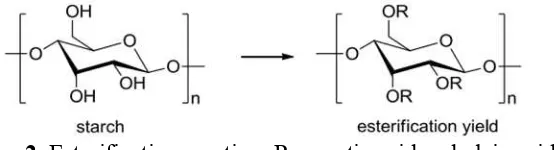
The modification of starch was conducted by two different kinds of variation such as the addition of acetic acid and oleic acid. Modification of starch was aimed to change the – OH group of starch to –OR ester group in order to separate the bioactive compound with chiral molecular structure. Generally, ester compound relative more stable and there has been no report regarding its toxicity and negative effect.
Figure 2. Esterification reaction, R = acetic acid and oleic acid[9]
The starch modification was done by 25 gram of cassava peel starch. Starch mass obtained from modification with acetic acid and oleic acid was 23.83 gram and 24.25 gram, respectively. Figure 1. showed that starch from modification with acetic acid gave darker color than oleic acid. According to its hardness, standard starch was smoother and easy to decompose when it suppressed than the modified starch. The modified starch gave rougher and harder and also not decomposed easily when given pressure.
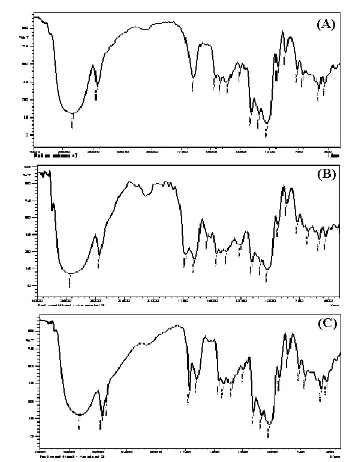
Figure 3. FT-IR result of (A) standard starch, (B) the modified starch with acetic acid and (C) oleic acid.
Figure 4. SEM characterization of standard starch, modified starch with acetic and oleic acid
Characterization by SEM investigated the surface of starch and its size. The SEM results of the standard starch in magnification of 1500x showed the most of starch particles were not agglomerated and have small structure with particle diameter as high as 14.3 m. The particle gave round shape with the biconcave surface. The SEM results of the modified starch with acetic acid in magnification of 1500x showed the starch particles were rigid and agglomerated to form strong binding. Meanwhile, the modified starch with oleic acid in the magnification of 2500x indicated the particle result was more rift than acetic acid. The diameter size of the modified starch with acetic and oleic acid as high as 15.7 and 14.6 m, respectively.
Table 1. The distribution of starch characterized by PSA
No Starch Diameter at 10% Table 1. showed the particle distribution of starch by PSA analysis which classified based on the distribution 10%, 50%, and 90%. The diameter size of modified starch has diameter size higher than standard starch.
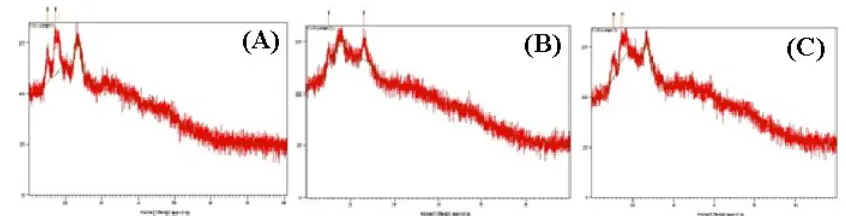
Figure 5. TheXRD characterization of (A) standard starch, (B) modified starch with acetic and (C) oleic acid
percentage than standard starch and oleic acid. It was concluded that crystallinity of starch modified by acetic acid was higher than standard starch and the modified starch with oleic acid.
CONCLUSION
The modification of starch from cassava peel waste has been successfully conducted by addition of acetic and oleic acid. The effectiveness of modification using acetic acid was higher than using oleic acid which not completely modified. The modification of starch using acetic acid gave rough and bigger particle size and darker color than using oleic acid.
ACKNOWLEDGMENT
The authors are grateful to the Organic Chemistry Laboratory and UPT analyst of chemical instrumentation, Chemistry Department, Faculty of Mathematics and Natural Sciences, University of Brawijaya, Malang.
REFERENCES
[1] Hidayat, C., Peluang penggunaan kulit singkong sebagai pakan unggas. In Seminar Nasional Teknologi Peternakan dan Veteriner, 2009, (pp. 655-657).
[2] Suhartini, M., Penyerapan Zat Warna Tekstil Menggunakan Polisakarida–G–Asam Akrilat. Jurnal Sains dan Teknologi Nuklir Indonesia, 2014, 15(1).
[3] Kuchel P. dan Ralston G. B., 2006, Biokimia, 2006, Erlangga, Jakarta.
[4] Qiang L., Understanding starches and their role in foods, 2005, Taylor and Francis, Boca Raton.
[5] Abia, A. A., Horsfall, M., & Didi, O., Bioresour Technol., 2003, 90(3), 345-348.
[6] Ismanto, A. E., Wang, S., Soetaredjo, F. E., & Ismadji, S., Bioresour Technol., 2010, 101(10), 3534-3540.
[7] Ismaila, A., Saimon, N. N., Jusoh, M., & Zakaria, Z. Y., Chem. Eng., 2017, 56. [8] Rajan, A., & Abraham, T. E., Bioprocess Biosyst Eng., 2006, 29(1), 65-71.
[9] Amini, H. W., Masruri, M., & Ulfa, S. M., Jurnal Ilmu Kimia Universitas Brawijaya,
2014, 1(1), 140.