PRELIMINARY STUDIES FOR PRODUCING CRUDE LIPASE FROM TEMPE’S MOULD
CULTIVATED IN RICE-HUSK-BASED SOLID MEDIA
Teuku Beuna Bardant*, Kiky Corneliasari Sembiring, and Achmad Hanafi Setiawan
Research Center for Chemistry – Indonesian Institute of Sciences Kawasan PUSPIPTEK Serpong, Tangerang Indonesia 15314
Received 16 April 2007; Accepted 6 June 2007
ABSTRACT
The goal of these preliminary studies is to support Indonesian program for increasing palm oil added value through independent production technology based on Indonesian natural resources. Various palm oil derivatives could be synthesized enzymatically using lipase from microbes that available in Indonesia. Tempe’s mould is available in abundance in Indonesia and had already been proved for producing lipase. This paper provides information about producing crude lipase from Tempe’s mould cultivated in rice-husk-based solid media using palm oil as carbon source. Observed variables include solid media composition, optimum fermentation time, extraction and enriching process of crude lipase. The crude lipase was analyzed its hydrolysis activity on coconut oil and palm oil. The result of these preliminary studies shows that this production process is a simple and tough process and very potential to be developed.
Keywords: lipase, Tempe’s mould, palm oil, solid fermentation, rice husk
INTRODUCTION
Indonesia is one of the biggest palm oil producer in the world, right after Malaysia. In 2005, indonesia had produced about 13 million ton of palm oil. If we use the assumption that production’s growth accelaration is same with the year before, 3.33% per annum, then in 2010 Indonesia would be the biggest palm oil producer in the world. Almost 60% of Indonesian palm oil was exported in Crude Palm Oil (CPO) with the prize US$ 365/MT (Rp 3000/kg). This could be the best reason to increase palm oil added value through independent production technology based on Indonesian natural resources. Various palm oil derivatives could be synthesized enzymatically using lipase from microbes that available in Indonesia.
Early studies demonstrated that various fungal species produces lipases. As apparent from economic and industrial standpoints, microorganism abundant in nature and they are preferable to animals and plants as enzymes sources. Further, fungi are particularly invaluable among microorganisms because enzymes produced by the majority of them are in extra cellular form and readily separable from the mycelia by filtration, centrifugation of the culture broth or the aqueous extract of a solid culture. During the last two decades, research on fungal lipases has substantially progressed. Reports on fungal lipases are numerous. There are several fungal that had been reported to be good lipases producer, for examples Aspergillus sp, Rhizhopus sp,
Geotrichum sp, Penicillum sp.
Especially for rhizopus sp, Iwai et al. had reported
production of lipase from Rhizopus delemar in
submerged culture using peptone as nitrogen sources
[1]. They also had done several research for cultivating
R. delemar in semi solid culture using wheat bran as
medium. From their research, submerged culture give better result for producing lipase while the semi solid is good for producing proteases [2]. Goodman reported that a noteable increase in lipase productions was attained with some fungi using a medium containing oil. He assumed that this occured because lipase is formed inducibly by the organism [3].
Tempe’s mould is mainly R. oligosporus and R.
oryzae and available in abundance in Indonesia. Based
on all information above, Tempe’s mould is very potential to be developed as lipase producer. Lipase extractions from Tempe had already done by Nuraida
et al using oil addition as inducer [6]. These preliminary
studies using the same mould but cultivated in rice-husk-based solid media using palm oil as inducer. Based on the hypotheses that there will be no component in rice husk consumed by the mould, the effect of palm oil as the only carbon source will be more significant. The rice-husk-based solid media used inorganic nitrogen source to reduce the production of protease that will cause lipase degradations.
EXPERIMENTAL SECTION
Microorganism
Tempe’s mould that was used in this experiment is a commercial mould with a brand name RAPRIMA, produced by PT Aneka Fermentasi Indonesia (AFI). The production process is under license of Research Center for Chemistry of Indonesian Institute of Technology. In its commercial packages, this Tempe’s
Teuku Beuna Bardant, et al.
mould had already contained rice flour as starch supply. This starch supply was recommended to initiate growth.
Culture Conditions
The microorganism was cultivated in a mixture of 50 g Tempe’s mould, inorganic nitrogen, 150 g palm oil, 300 grams rice-husk and 150 g of water. Inorganic nitrogen source was diluted in water. Inorganic nitrogen source was urea except when stated otherwise. All experiment used palm oil with low stearine content produced by local palm oil plant PT Intiboga Sejahtera (Jakarta) except when stated otherwise. This solid
medium was incubated at 28 oC for four days of
cultivation except when stated otherwise.
Purification
At the end of cultivation period, solid culture was ground and added aquadest three times the solid culture weight to extract the lipases. Sodium azide was added to the extracted lipases to a final concentration 0.02 % to prevent proteolytic degradation and microbial growth. Proteins from the extracted lipases were precipitated by addition of ammonium sulfate to the extracted lipases up to 50 % saturation in room temperature, and then the solution was allowed to rest overnight at 4 oC to get the concentrated lipases. All purification steps were carried out as previously described except when stated otherwise.
Lipase detections –hydrolysis activity assay
Lipolytic activity was determined based on acid value by titrimetrically using KOH 0.1 N as a titrant. The reaction medium contained 5 g of palm oil as a substrate, dispersed by stirring it in nine times by weight of concentrated lipases for twenty hours except when stated otherwise. The activity of concentrated lipases to hydrolyze palm oil was determined by withdrawing 1 g of hydrolyzed oils and dissolving it into 10 mL of ethanol. The solution was titrated with KOH 0.1 N using phenolphthalein as indicator. The end of the titration was marked by the alteration of its color to soft pink. Hydrolysis activity of concentrated lipases was calculated by comparing the acid value of fresh vegetable oil and hydrolyzed vegetable oil.
Determination of nitrogen source effects on Tempe’s moulds cultivation
For studying the effect of nitrogen source, ammonium sulfate and urea were used as a nitrogen source in the same amount of nitrogen mol which is 3 g nitrogen in 100 g palm oil.
Determination of palm oil source effects on Tempe’s moulds cultivation
There were three cultivation methods that had already done in order to find the most productive method. The first method used palm oil with low stearine content as substrate, while the second method used palm oil with high stearine content as substrate. Both of methods were also used for studying the effect of palm oil source and both of them were performed in batch cultivation as previously describe.
The third variation, cultivation was carried in two steps. In the first step, Tempe’s mould was cultivated in liquid media which consist of water, palm oil with low stearine content and urea with the same portion with solid medium cultivation as previously described. Fermentation broth from this step was separated from unfermented oil and went to the second step. In the second step it will be mixed with rice husk, palm oil with low stearine content and urea.
Determination the optimum cultivation time
For studying the optimum cultivation time, the microorganism was cultivated in solid medium as previously described. Samples were withdrawn at the third to the assay were done as previously describe.
The effect of precipitation methods
For studying the effect of precipitation methods, extracted lipases were precipitated in various methods. The first variation is precipitation by pH adjustment; extracted lipases went to pH adjustment step using potassium hydroxide solutions in ethanol and hydrochloric acid in ethanol. Solution acidity was adjusted at pH 10. The second variation is precipitation by ammonium sulfate addition as previously described. The third variation is precipitation by acetone addition. Extracted lipases were added by acetone up to 80% volume of total solution. The concentrated lipases from all of three variations of precipitation methods were determined their hydrolysis activity as previously described.
RESULT AND DISCUSSION
Study of Culture Conditions and Fermentation Time
For studying the best fermentation time to cultivate Tempe’s mould in rice husk based solid media, we incubated the Tempe’s mould for seven days. The performance of mould formation on rice-husk surface in the fourth day to the seventh day could be seen in Fig 1.
The targeted mould to be cultivated is the white one which is considered as R. oligosporus. Before the
(a) (b)
(c) (d)
Fig 1. Incubated Tempe’s Mould in Solid Media in (a) fourth day; (b) fifth day; (c) sixth day; and (d) seventh day
Table 1. Conversion of aerobic and anaerobic lipase extract in third until sixth day incubation
reactant product
Coconut oil enzim + water acidity (mmol)
g
total FA (mmol)
acidity (mmol)
vol (mL)
acidity (mmol)
total acidity (mmol)
oil phase
(mL)
water phase (mL)
precip itate (mL)
oil phase
water phase
precipi tate
total acidity (mmol)
Conver sion
third day
anaerob ext 5.0257 23.919 0.273 45 0.098 0.371 6.5 42 0 1.432 1.560 0 2.830 10.278
aerob ext 5.0155 23.871 0.272 45 0.098 0.371 8 42 0 1.463 1.430 0 2.821 10.265
aerob + ZA 5.0261 23.921 0.273 45 17.221 17.494 6 43 0 0.971 14.060 0 14.362 4.0573
Anerob + ZA 5.0193 23.889 0.272 45 24.094 24.366 6.5 41 0 3.869 19.423 0 21.350 16.194
fourth day
anaerob ext 5.0204 23.894 0.272 45 1.393 1.665 7 44 0 6.039 2.109 0 8.025 26.616
aerob ext 5.0214 23.899 0.273 45 1.764 2.036 9 42 0 8.735 2.903 0 11.575 39.912
aerob + ZA 5.101 24.277 0.277 45 29.346 29.623 5.5 45 0 1.675 29.020 0 29.873 6.8983
Anerob + ZA 5.0013 23.803 0.271 45 24.208 24.479 7.5 44 0 7.924 23.401 0 31.171 28.113
fifth day
anaerob ext 5.015 23.868 0.272 45 1.810 2.082 8 41 0 4.314 2.241 0 6.265 17.523
aerob ext 5.0037 23.814 0.272 45 1.810 2.082 7 43 0 4.004 2.085 0 5.940 16.200
sixth day
anaerob ext 5.0812 24.183 0.276 45 1.644 1.920 8 42 0 3.802 2.089 0 5.735 15.777
aerob ext 5.032 23.949 0.273 45 1.507 1.780 7 29 0 6.168 1.560 0 5.425 15.216
Fig 2. Comparison of anaerobic and aerobic conversion in third and fourth day incubation
fourth day of incubation, media appearance was not observed because the mycelium growth could not be observed on the media surface. In the fourth day of incubation, white mould appeared in the media surface. In the fifth day of incubation there was red mould started to grow and in the sixth day of incubation, greenish yellow mould appeared.
For analyzing extract hydrolysis activity, some samples took from incubated Tempe’s mould everyday
from the third to the sixth day of incubation. Those samples were extracted with water to get lipase extract. These extract was used to hydrolyze vegetable oil. A set of data from this experiment can be seen in Table 1.
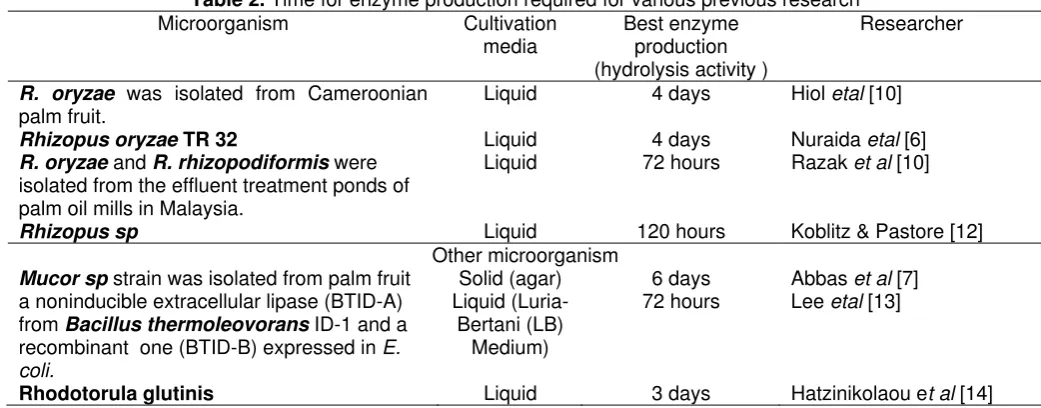
As shown in Table 1 and Fig 2, the best result of fermentation time was obtained at fourth day fermentation time. This result is quite similar with several previous researches.
All of them agreed that lipase was produced at the late logarithmic growth. That was explained lack of hydrolysis activity in the third day. Decreasing of hydrolysis activity was happened in the next following days.
The most possible reason is rhizopus growth phase had already comes to its end. Meanwhile, other colony started to grow since this experiment was not using pure isolated culture. These other colony, which appeared as the red colony and greenish yellow colony in Fig 1, was suspected only able to use organic nitrogen source. They gained the nitrogen source came from rhizopus cell lysis and all secreted enzyme, including lipase. However, this hypothetical theory need further research to proof it.
Table 2. Time for enzyme production required for various previous research Microorganism Cultivation
media
Best enzyme production (hydrolysis activity )
Researcher
R. oryzae was isolated from Cameroonian
palm fruit.
Liquid 4 days Hiol etal [10]
Rhizopus oryzae TR 32 Liquid 4 days Nuraida etal [6]
R. oryzae and R. rhizopodiformis were isolated from the effluent treatment ponds of palm oil mills in Malaysia.
Liquid 72 hours Razak et al [10]
Rhizopus sp Liquid 120 hours Koblitz & Pastore [12]
Other microorganism
Mucor spstrain was isolated from palm fruit Solid (agar) 6 days Abbas et al [7]
a noninducible extracellular lipase (BTID-A) from Bacillus thermoleovoransID-1 and a recombinant one (BTID-B) expressed in E. coli.
Liquid (Luria-Bertani (LB) Medium)
72 hours Lee etal [13]
Rhodotorula glutinis Liquid 3 days Hatzinikolaou et al [14]
Table 3. Comparison of anaerobic lipase conversion with nitrogen source variation
Reactant Product
Table 4. Physical characteristic of vegetable oil
Fatty acid Empirical Formulae Molecular
weight
Oleate CH3(CH2)6CH=CH(CH2)6 – COOH 284 2.38 38.8
Linoleate C17H32 - COOH 282 0.38 9.4
Linolenate C17H30- COOH 280 - 0.3
Stearate CH3(CH2)18 - COOH 312 0.78 4.7
Arachnidade CH3(CH2)18 - COOH 314 - 0.2
Behenate CH3(CH2)20 - COOH 342 - -
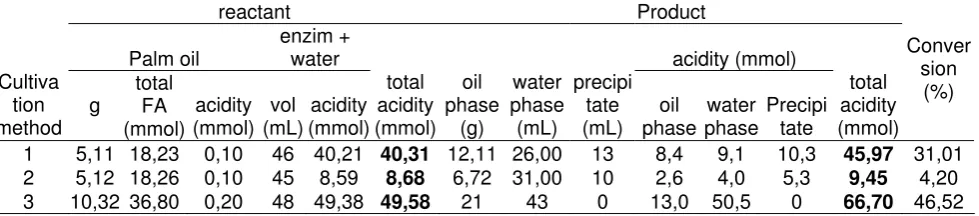
Table 5. Comparison of anaerobic lipase conversion for determine cultivation method
reactant Product
Palm oil
enzim +
water acidity (mmol)
Cultiva the conversions from aerobic fermentation extract is 1.5 times greater than the anaerobic one. However, for the following experiment, we cultivated mould in rice-husk solid medium in anaerobic although the aerobic lipase conversion is greater than anaerobic one. It happened because for the following experiment using ammonium sulfate to precipitate lipase, anaerobic lipase showed better performance than aerobic one as can be seen in the Table 1 for third and fourth day of incubation. The aim of the experiment is producing crude lipase in solid form for its storage stability. So, precipitate performance was preferable.
For studying the effect of nitrogen source in Tempe’s mould cultivation, we used ammonium sulfate ((NH4)2 SO4) and urea (CO(NH2)2) as can be seen in Table 3. From the data, it can be seen that lipase from cultivation with urea as a nitrogen source gave greater conversion than lipase from cultivation with ammonium sulfate as a nitrogen source. The conversion using urea is 2.5 times greater than the ammonium sulfate one.
Coconut oil and palm oil as enzyme substrate were used in reaction in order to study the selectivity of lipase. The result of the experiment can be seen in Table 3. Reaction using coconut oil as a substrate gave higher conversion than using palm oil. Data from Table 1 were also put this conclusion more convincing. These data showed that the crude lipase is not selective to one particular vegetable oil, in this case, palm oil. Even the palm oil was induced to the cultivating media. This result is similar with the result of previous experiment
conducted by Houria Abbas et al [7] that lipase is constitutive enzyme. Inducer didn’t affect the selectivity of lipase but affect the amount of lipases produced.
According to Iwai et al [8], lipase from Rhizopus sp. and Aspergillus sp. both display a high activity toward triglycerides of medium chain length (C8 – C14). This conclusion explains why the hydrolytic activity of lipase from this experiment on coconut oil is higher than its activity on palm oil. Table 4 showed the physical characteristic of coconut oil and palm oil. Coconut oil contained 62.08 % of medium chain length triglycerides, while palm oil only contained 1.4 % of medium chain length triglycerides.
There were three cultivation methods that had already done in order to find the most productive method. The first method used palm oil with low stearine content as substrate, while the second method used palm oil with high stearine content as substrate. For the third variation, cultivation was carried in two steps. In the first step, Tempe’s mould was cultivated in liquid media which consist of water, palm oil with low stearine content and urea with the same portion with solid media. Fermentation broth from this step was separated from unfermented oil and went to the second step. In the second step it will be mixed with rice husk, palm oil with low stearine content and urea.
Data from Table 5 shows that cultivation using low stearine palm oil as substrate gave greater conversion than using high stearine content. This result is in accordance with Iwai et al [8] explanation that lipase from Rhizopus sp. and Aspergillus sp. both
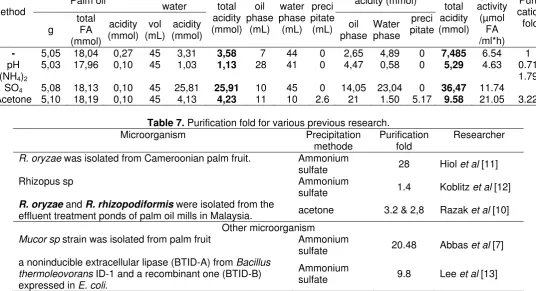
Table 6. Hydrolysis activity conversion of precipitation methods variation
Reactant Product
Palm oil enzim +
water acidity (mmol)
Method
Table 7. Purification fold for various previous research.
Microorganism Precipitation methode
Purification fold
Researcher
R. oryzae was isolated from Cameroonian palm fruit. Ammonium
sulfate 28 Hiol et al [11]
Rhizopus sp Ammonium
sulfate 1.4 Koblitz et al [12]
R. oryzae and R. rhizopodiformis were isolated from the
effluent treatment ponds of palm oil mills in Malaysia. acetone 3.2 & 2,8 Razak et al [10] Other microorganism
Mucor sp strain was isolated from palm fruit Ammonium
sulfate 20.48 Abbas et al [7]
a noninducible extracellular lipase (BTID-A) from Bacillus
thermoleovorans ID-1 and a recombinant one (BTID-B)
expressed in E. coli.
Ammonium
sulfate 9.8 Lee et al [13]
display a high activity toward triglycerides of medium chain length (C8 – C14). High stearine content of palm oil contained more stearate than that in low stearine content of palm oil. Stearate is long-chain fatty acid which poorly hydrolyzed. The greater its content in substrate, the smaller hydrolysis activity observed.
For studying the effect of growth initiation, we cultivated the Tempe’s mould in two methods that were noted in the firs and third cultivation methods. The aim of this experiment is to shorten the adaptation phases of Tempe’s mould in solid medium by doing growth initiation in liquid medium. The mould was expected in its exponential phase condition when moved to solid medium. So it will perform its optimum growth in solid medium in shorter day than usual cultivation. The result is beyond expectation. However, lipase productivity from two steps cultivation is higher than the first cultivation method. The higher productivity is caused by larger amount of mould that was added to solid media.
Study of Purification Methods
Purification is carried by precipitation. There are several precipitation methods that had already reported. Iwai et al [4, 9] reported that extracted lipase from Rhizopus sp can be precipitated by pH adjustment. The
precipitation was in aqueous solution. This method was also suitable for precipitating lipase from rice husk. Most of recent literature used ammonium sulfate to precipitate fungal and bacterial lipase. Another interesting precipitation method was reported by Razak
et al [10]. He used acetone for precipitating lipase from
Rhizopus oryzue and Rhizopus rhizopodiformis.
In this experiment, extracted lipases were
precipitated using all of those three methods. The result can be seen in Table 6.
The result from precipitation method using ammonium sulfate addition in this experiment is still comparable with other previous research that shown in Table 7. It is better than the result reported by Koblitz
et al [12] but still much lower than the result reported by
Hiol et al [11]. reported that lipase from Rhizopus sp is multiform lipase, denoted as lipase A, B and C. after precipitation using pH adjustment method, only Lipase B was in the precipitate. Lipase A and C still lied in supernatant. Lipase A and C could be separated using chromatography technique. This report is the most suitable explanation for explaining the low purification fold for precipitation method using pH adjustment.
Precipitation using acetone addition is very interesting because acetone is easier to be recycled compared to ammonium sulfate. This is a very good
advantage for producing lipase in large scale. From the experiments, precipitation using acetone showed specific activity 21.0597µmol FA /mL.h, with a 3.22-fold purification. It is similar with the result reported by Razak
et al [10].
For its storage stability and its possibility for using as biocatalyst in non aqueous reactant media, study of hydrolysis activity of dried precipitate was required. Filtration using Whatman paper with 0.1 µm pore size followed by drying its cake under 4 oC was done to obtain dried precipitate. One gram of dried precipitate was diluted into 50 mL aquadest for assay of hydrolysis activity. The results was show in Table 7.
Dried precipitate gave higher specific hydrolysis activity than wet precipitate. This is a very promising result for its possibility for using as biocatalyst in non aqueous reactant media. Further work in studying the drying method and yield calculation is in progress.
Addition of Ca cation in form of CaCO3 gave a significant increase for specific activity of lipase and shorter analyzing time was required as shown in Table 8. In this experiment, Ca addition was up to 66 % of its saturation in reactant media. Similar result was reported for lipase from Mucor sp. Ca addition increased its specific activity up to 114 % relative activity compare to its activity to trioctanoine. However, negative effect was reported for lipase from Bacillus thermoleovorans which decrease its activity to 84% relative activity compare to its activity to trioctanoine.
CONCLUSION
The study showed that lipase from Tempe’s mould appeared its best performance in seventh day cultivation in rice-husk-based solid media with urea (CO (NH2)2) as nitrogen source. Among the substrates tested, the enzyme showed better activity against low stearine content of palm oil, suggesting that future catalysis assays should be conducted applying substrates with 12 C or less carbon chains. The precipitation method using ammonium sulfate showed specific activity of 11.74 µmol FA /mL.h, with a 1.795-fold purification, while using acetone showed specific activity 21.0597µmol FA /mL.h, with a 3.22-fold purification.
For its storage stability and its possibility for using as biocatalyst in non aqueous reactant media, dried precipitate can be chosen which showed specific activity of 18,650µmol FA /mL.h, with a 13.23-fold purification. Further work in studying the drying method and yield
calculation is in progress. Addition of Ca cation in form of CaCO3 gave a significant increase for specific activity of lipase and further work in studying the optimum Ca cation should be added is in progress. The purified lipase showed specific activity of 11.74 µmol FA /mL.h, with a 1.795-fold purification.
REFFERENCES
1. Iwai, M., Tsujisaka, Y., Itaya, K., Okamoto, Y. and Fukamoto, J. 1966, Kagaku to Kogyo, 40, 80-89. 2. Iwai, M. 1963, Bulletin of the Osaka Municipal
Technical research Institute. 39, 63-70.
3. Goodman, J.J. 1950, Science. 112, 176-179. 4. Iwai, M. and Tsujisaka, Y. 1966, The Purification
and The Properties of The Three Kinds of Lipase from Rhizopus delemar. Agric. Biol. Chem. 38, 1241-1247.
5. Beisson, F., Tiss, A., Riviere, C., Verger, R. 2000,
Eur. J Lipid Sci. & Tech. 133-153.
6. Nuraida, L., Hariyadi, P., Dewanti, R., and Budiyanto, S. 2000, Production of Lipase with Esterification Activity from Moulds Isolated from
Indonesian Fermented Foods.IFT Annual Meeting
- New Orleans, Louisiana.
7. Abbas, H., Hiol A., Deyris V., and Comeau L., 2002, Enzyme & Microbial Tech., 31, 968–975. 8. Iwai, M., Tsujisaka, Y., Okumura, S., and
Katsumoto H., 1966, Yukagaku, 29, 587-591. 9. Rajasekharan, R. and Kanchan, B., 2002, A
Process of Isolation and Utilization of Rice Bran
Lipase. Patent number(s): WO02101033 A1.
Patent assignee(s): Indian Institute of Science;CB Bio Products India Pvt. Ltd.
10. Razak C.N.A., Salleh A.B., Musani R., Samad M.Y., and Basri M., 1997, J Molec. Catal. B:
Enzymatic. 3, 153-159
11. Hiol, A., Marie, J. R. Nathalie, Druet, D., Sarda L., and Claude L., 2000, Enzyme & Microbial Tech.. 26, 421–430.
12. Koblitz, G. M. B., Pastore, G. M. 2006, Ciênc.
agrotec., Lavras. 30, 3, 494-502.
13. Lee, D.W., 2001, Enzyme & Microbial Tech. 29, 363–371.
14. Hatzinikolaou, D. G., Kourentzi, E., Stamatis , H., Christakopoulos, P., Kolisis, R.N., Kekos, D., and Macris, B. J. 1999. J. Biosci. & Bioeng. 88, 1, 53-56.