*corresponding author : [email protected]
The frequency of DISC1
Leu607
Phegene
polymorphism in schizophrenia
patients at
Dr. Soetomo General Hospital Surabaya
Gwenny Ichsan Prabowo1, Margarita Maria Maramis2, Erikavitri Yulianti2, Afrina
Zulaikah2, Zain Budi Syulthoni2, Hendy Muagiri Margono2, Retno Handajani1,3 1Departement of Biochemistry, Medicine Faculty, Universitas Airlangga, Surabaya, 2Department of Psychiatry, Dr. Soetomo General Hospital Surabaya, 3Institute of
Tropical Disease, Universitas Airlangga,Surabaya, Indonesia DOI: http://dx.doi.org/10.19106/JMedSci005001201802
ABSTRACT
Schizophrenia is a common health problem in the world, including in Indonesia. Polymorphism of gene disrupted in schizophrenia 1 (DISC1) Leu607Phe is allegedly related
to the predisposition to schizophrenia. However, studies on the relationship between polymorphism of DISC1 Leu607Phe and schizophrenia in various etnics provided different
results. The purpose of this study was to determine the frequency of DISC1 Leu607Phegene
polymorphism and its association with treatment response in patients with schizophrenia at Department of Psychiatry, Dr. Soetomo General Hospital Surabaya. In this study, the number of male patients with schizophrenia was more than that of the female patients. The mean age of male patients with schizophenia was lower than that of the female patients. Schizophrenia patients were primarily came from Javanese ethnic with positive and negative symptom score (PANSS) lower in male patients than that in the female patients. In conclusion, no DISC1 gene polymorphism at codon 607 is observed in schizophrenia patients at Dr. Soetomo General Hospital Surabaya, but the G nucleotide variation at the number 196.339 in intron regions is found instead.
ABSTRAK
Skizofrenia adalah masalah kesehatan umum di dunia termasuk di Indonesia. Adanya polimorfisme gen skizoprenia 1 (DISC1) Leu607Phe diduga berkaitan dengan predisposisi
skizofrenia. Namun demikian, berbagai penelitian yang menghubungkan polimorfisme gen DISC 1 Leu607Phe dan skizofrenia pada berbagai etnik memberikan hasil yang berbeda.
Penelitian ini bertujuan menentukan frekuensi gen DISC 1 Leu607Phe dan hubungannya
dengan respon pengobatan pasien skizofrenia di Departemen Psikiatri, Rumah Sakit Umum Dr. Soetomo, Surabaya. Dalam penelitian ini jumlah pasien pria lebih banyak dari pada wanita. Rerata umur pasien pria lebih rendah dari pada pasien wanita. Pasien skizofrenia umumnya dari suku Jawa dengan nilai symptom negatif dan posistif lebih rendah pada pria diabndingkan wanita. Dapat disimpulkan, tidak ditemukan polimorfisme gen DISC1 pada kodon 607 pada psien skizofrenia di Rumah Sakit Umum Dr. Soetomo, Surabaya, namum ditemukan variasi nukleotida G pada bilangan 196.339 di daerah intron.
INTRODUCTION
Schizophrenia is a complex psychiatric disorder,which remains a health problem worldwide,1,2 including Indonesia.3
According to the DSM-IV-TR (Diagnostic and Statistical Manual of Mental Disorders 4th ed. Text Revision), the annual incident of
schizophrenia is inluenced by the geographic
variation.2 It is estimated that there are 24
million people with schizophrenia worldwide, 50% of whom do not get optimal treatment, and 90% of these patients are in developing countries.4 In Indonesia, the prevalence of
schizophrenia ranges from 0.3 to 1% and is especially between the age of 18 - 45 years.5
The mechanisms underlying schizophrenia remain unclear, but there are statements of multifactorial etiology.6
Etiology, which allegedly plays an important role in the predisposition to schizophrenia, is a combination of genetic factors and environmental factors.2 Forms
of genetic variation which allegedly acted as a predisposing factor of schizophrenia is Single Nucleotide Polymorphism (SNP). Polymorphism generally can be analyzed by referencing to the reference sequence (rs) in the database at the National Center of Biotechnology Information (NCBI).7
Polymorphism that has been studied in various countries is the DISC1 gene.8-13 The method
which can be used to detect polymorphism, among others, are Polymerase Chain Reaction (PCR) followed by Restriction Fragment Length Polymorphism (RFLP),13,14 and
sequencing.11,15
DISC1 protein resulted from DISC1 gene
expression is a scafold protein that plays a role
in the regulatory process of neural progenitor cells proliferation, neurite outgrowth, neuronal migration, and c-AMP signals.6
of impaired cognitive function and working memory in patients with schizophrenia.16
Signaling molecules interacting with DISC1 protein plays an important role for developing antipsychotic drugs.2,6
The main therapy for schizophrenia patients is an antipsychotic (typical or atypical
or combination of both). Identiication and
analysis of polymorphisms as biological biomarkers in patients with schizophrenia are expected to be very useful for the clinician
to predict the efectiveness of antipsychotic, side efects of antipsychotic drugs and to
track gene hereditary disease in families of patients.17,18 Considering that there has never
been any research on the role of genetic factors implicated in schizophrenia, the study aimed to detect polymorphisms of DISC1
Leu607Phe gene in patients with schizophrenia
at the Department of Psychiatry, Dr. Soetomo General Hospital, Surabaya.
MATERIALS AND METHODS
Subjects
This was an observational descriptive study with cross-sectional design to evaluate the polymorphism of DISC1 Leu607Phe gene in
patients with schizophrenia and its association with treatment response in patients with schizophrenia at Department of Psychiatry, Dr. Soetomo General Hospital Surabaya. All patients with schizophrenia who came/were treated at the hospital for 4 months and met the inclusion-exclusion criteria were involved in this study. The study was performed after an ethical clearance was obtained from the Research Ethics Committee of Dr. Soetomo General Hospital Surabaya.
Procedure
study and then were given an informed consent to be signed. The diagnosis of schizophrenia of patients was based on a psychiatric history and mental status examination using Code
Classiication and Diagnosis of Mental
Disorders in Indonesia III (PPDGJ issue 3)19
and the criteria of Positive and Negative symptom Scale (PANSS).20
Blood samples of patients were taken and put into venoject 6 ml tubes with EDTA anticoagulant. Mononuclear Peripheral Blood Cells (PBMCs) were then separated and put in eppendorf tubes. Furthermore, PBMC was stored at a temperature of minus 800 C
at the Institute of Tropical Disease, Airlangga University until laboratory examination. Deoxyribonucleic Acids (DNA) was extracted in PBMC, followed by the PCR with the primary: 5 - GAT GGC AAT GGA TTC ACC AC - 3 '(forward) and 5'-CAG ACA GTT GGG GAG AAC AG - 3' (reverse).11 After that,
electrophoresis was performed. PCR products in the form of DNA fragments with a length of 689 bp were done by sequencing using ABI 310 genetic analyzer sequencer from applied
biosystems, inc. Multiple alignment with genetyx version 10 was then conducted to the result of sequencing.
Statistical analysis
Data of the characteristics of patients were presented as percentage.
RESULTS
Characteristics of patients with schizophrenia at Department of Psychiatry, Dr. Soetomo General Hospital are shown in TABLE 1. The number of patients having a history of mental illness in the family was higher than patients who did not have the history. Patients with schizophrenia receiving typical antipsychotic therapy was considerably less (28.28%) compared to those getting atypical antipsychotics (36.36%) and combination (36.36%). Female patients, who received antipsychotic therapy, had the least combination of numbers (22.22%), followed by a typical antipsychotic (33.33%) and the highest was an atypical antipsychotic (44.45%).
TABLE 1. Characteristics of patients with schizophrenia at SMF Dr. Soetomo General Hospital
Sex
Number of
patients Mean age range Ethnic Family History
N % Year Javanese Madurese Mixed Yes No
n % n % n % n % n %
Male 11 55 38.82 (25 – 62) 9 45 1 5 1 5 4 20 7 35
Female 9 45 43.11 (31 – 58) 8 40 1 5 0 0 7 35 2 10
Total 20 100 40.97 (25 – 62) 17 85 2 10 1 5 11 55 9 45
PCR product in this study was DNA fragment with a length of 689 bp. The electrophoresis, when compared with 100 bp
FIGURE 1. Examples of some of the electrophoresis results of PCR products with DISC1 Leu607gene results positive.
If the PCR results were positive, the sequencing would be conducted by using ABI 310 sequencer and forward primary (sense). The results of sequencing were used for Multiple alignment of the nucleotide sequence of the sample compared to rs 6675281, using
FIGURE 2. Results of multiple alignment pieces rs 6675281 (DISC1 SNP Leu607Phe gene) from the sequencing result of 20
samples of schizophrenia patients at Department of Psychiatry of Dr. Soetomo General Hospital Surabaya.
In this study there was no DISC1 Leu607Phe
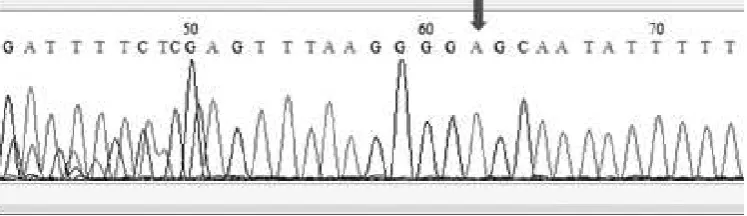
gene polymorphism found with the code of rs 6675281 located in exon 9 at codon number 607, because all samples show C nucleotides in the nucleotide sequence of numbers 196.541 (y), according to the basic data DISC1 gene from NCBI. On further analysis of the sequencing results, it was obtained that electropherogram of samples 1, 6, 8, 9, 10, 12,
16, 18 and 20 had the variation of nucleotide G, while at the the other sample numbers nucleotide A were obtained in accordance with the basic data of DISC1 genes from NCBI (rs 6675281). Example of electropherogram sequencing result DISC1Leu607Phegene with
DISCUSSION
The mean age range of the male schizophrenia patients was younger than the average age of the female patients. It is believed to be related to the estrogen
hormone thought to have a protective efect
against schizophrenia, so the manifestation of schizophrenia in men tend to occur at a younger age than women.2,21 In female
schizophrenia, psychotic symptom luctuation
is obtained during the menstrual cycle. The
estrogen hormone has a pleiotrophic efect to
variations of brain developmental processes in adults.21
The data showed that genetic factors play
a quite signiicant role as predisposition to
schizophrenia. This is supported by previous research on families, twins and adopted children, which demonstrated that genetic factors play a major role for schizophrenia.22
Genetic predisposition to schizophrenia is a complex factor for their interaction with environmental factors.2,22 In Scottish family
DISC1 gene is identiied as potential genes
associated with susceptibility to the onset of psychiatric disorders, because the Scottish family obtained schizophrenia and other psychiatric disorders with a high frequency.15,22
DISC1 gene plays a key role during the
highly hereditary (highly heritable). This is supported by evidence from MRI examination, which shows a reduction of the thickness of the cerebral cortex in schizophrenia patients.23
From the results of sequencing on samples of patients with schizophrenia at SMF Psychiatry of Dr. Soetomo Hospital, there was no DISC1
Leu607Phe gene polymorphism. Study of DISC1
Leu607Phe gene polymorphism in patients with
schizophrenia in some ethnic population provides inconsistent results. The earlier study in patients with schizophrenia by Brauns in 2011 showed an interference of neural activity in the dorsolateral prefrontal cortex (DLPFC) during the process of working memory and the reduction of the thickness of the cortex cerebri in the left part of gyrus supramarginal of the carrier allele Phe from DISC1 Leu607Phe
gene when compared to the homozygote Leu/Leu.23 Hodgkinson’s study in 2004 also
found an increased risk of schizophrenia in the DISC1 Leu607Phe gene polymorphism.24
Results of research DISC1 Leu607Phe gene
are various, because the predisposition to
schizophrenia is inluenced by multigenic and multifactorial factors. Thus, in diferent
demographic areas and ethnicities one can
ind some polymorphisms variations diferent
from the DISC1 gene or polymorphisms in
FIGURE 3. Example of electropherogram intron sequencing result DISC1 Leu607Phe
In the group sample of patients with schizophrenia, it was found that the number of male patients who come from Javanese ethnicity are far more than any other ethnicities or the mixed ones; it also happened in the case of the female patients. This is presumably caused by the fact that the sampling was performed in Dr. Soetomo General Hospital which is a referral hospital in the east region of Java island, so that patients with schizophrenia are mainly dominated by the Javanese. Data from Indonesia Basic Health Research in 2013 reported that the prevalence of severe mental disorders in East Java was 0.22%, and the highest prevalence was found in Yogyakarta Special Region area that was equal to 0.27%, while the national prevalence was 0.17%.
The overall sample of patients with schizophrenia receiving various antipsychotic therapy. Olincy et al.25 reported that the
DISC1 protein is allegedly associated with the response to antipsychotic drug therapy and plays an important role to identify the
lowest efective dose for the patient as well as the lowest side efects. Another previous
studies conducted on rats showed that the administration of atypical antipsychotics will increase the DISC1 gene expression in the frontal cortex, while the provision of typical
antipsychotic efect is not found in the DISC1
gene expression.26
This study did not ind any DISC1 gene
polymorphism at codon 607, but found variations of G nucleotide at the number 196.339 in intron regions. These nucleotide
diferences in this study with the SNP rs 6675281
(NCBI) could occur because schizophrenia is a disease that has a multifactorial etiology, so it is possible that the DISC1 Leu607Phegene
polymorphism is not a dominant genetic factor.
The impact of the diferences in the nucleotide
has been known, yet.
The results of this study were not in accordance with the research conducted previously on the Finnish population15,27 which
found the presence of DISC1 Leu607Phegene.
Presumably, this is because the predisposition to schizophrenia is associated with a multifactorial and multigenetic etiology.2,28
CONCLUSION
It can be concluded that the male patients with schizophrenia is higher in number, with a lower average age, and lower PANSS scores than those of the female patients. Patients with schizophrenia at the Deprtment of Psychiatry, Dr. Soetomo General Hospital mainly come from Javanese ethnic. This study does not
ind any DISC1 gene polymorphism at codon 607, but ind variations of G nucleotide at the
number 196.339 in intron regions.
ACKNOWLEDGMENTS
The researchers would like to express our gratitude to Universitas Airlangga for funding the research through the Annual Work Plan and Budget. We would like to thank the participants who involved in this study. We also would like to thank M. Amin of the Institute of Tropical Disease who gave the assistance to examine the DNA extraction, PCR, and sequencing.
REFERENCES
1. Picchioni MM, Murray RM. Clinical Review: Schizophrenia. BMJ 2007; 335:91-5.
http://dx.doi.org/10.1136/bmj.39227.616447. BE
3. Badan Penelitian dan Pengembangan Kesehatan. Riset Kesehatan Dasar di Indonesia 2013: Prevalensi gangguan jiwa berat berdasar provinsi 2013. Jakarta: Kementrian Kesehatan Republik Indonesia, 2013
4. Mental Health Foundation. Mental health statistics: schizophrenia. [serial online]. 2015. [cited February 22, 2015]. Available from: http://www.mentalhealth.org.uk/ help-information/mental-health statistics/ schizophrenia-statistics//
5. Arif IS. Skizofrenia, Memahami Dinamika
Keluarga Pasien. Bandung: PT Raika
Aditama, 2006.
6. Harrison PJ, Weinberger DR. Schizophrenia genes, gene expression,and neuropathology: on the matter of their convergence. Mol Psychiatry 2005; 10:40-68.
http://dx.doi.org/10.1038/sj.mp.4001558 7. NCBI GTR. Schizophrenia. [serial online].
2012. [cited January 12, 2015]. Available from : http://www.ncbi.nlm.nih.gov/gtr/ genes/1312/.
8. Porteus DJ, Thomson,P, Brandon NJ, Millar JK. The genetics and biology of DISC1--an emerging role in psychosis and cognition. Biol Psyachiatry 2006; 60(2):123-31.
h t t p s : / / d o i . o r g / 1 0 . 1 0 1 6 / j . biopsych.2006.04.008
9. Sawamura N, Sawa A. Disrupted in schizophrenia 1 (DISC1): a key susceptibility factor for major mental illness. Ann N Y Acad Sci 2006;1086:126-33.
http://dx.doi.org/10.1196/annals.1377.018 10. Xiao Y, Wang ZJ, Wan Y, Wang P, Li X, Ji J,
et al. Limited association between disrupted
in schizophrenia 1 (DISC1) gene and bipolar disorder in the Chinese population. Psychiatr Genet 2011; 21(1):42-6.
h t t p : / / d x . d o i . o r g / 1 0 . 1 0 9 7 / YPG.0b013e32834135d2
DISC1 genetic variants reveal a relationship with the structure and functional connectivity of the percuneus in schizophrenia. Hum Brain Mapp 2014; 35 :5414-30.
http://dx.doi.org/10.1002/hbm.22560
12. Ratta AW, Hishmoto A, Mouri K, Shiroiwa K, Sasada T, et al. Haplotype analysis of
the DISC1 ser (704) cys variant in Japanese suicide completers. Psychiatry Res 2014; 30,215(1):249-51.
13. Norlelawati AT, Kartini A, Norsidah K, Ramli M, Tariq AR, Rohani WTW. DISC1 SNPs and Susceptibility to Schizophrenia : Evidence from Malaysia. Psychiatric Invest 2015; 12(1):103-11.
http://dx.doi.org/10.4306/pi.2015.12.1.103 14. Zheng F, Wang L, Jia M, Yue W, Ruan Y, Lu
T, et al. Evidence for association between
Disrupted-in-schizophrenia 1(DISC1) gene polymorphisms and autism in Chinese Han population: a family-based association study. Behav Brain Funct 2011; 7(14):1-8.
http://dx.doi.org/10.1186/1744-9081-7-14 15. Thomson PA, Parla JS, McRae AF, Kramer M,
Ramarkhrisnan K, Yao J et al. 708 Common
and 2010 rare DISC1 locus variants identiied
in 1542 subjects ; analysis for association with psychiatric disorder and cognitive traits. Mol Psychiatry. 2014; 19:668-75.
http://dx.doi.org/10.1038/mp.2013.68
16. Soares DC, Carlyle BC, Bradshaw NJ, Porteous DJ. DISC1: Structure, function, and therapeutic potential for major mental illness. ACS Chem Neurosci 2011; 2:609-32.
http://dx.doi.org/10.1021/cn200062k
17. Karam CS, Ballon JS, Bivens NM, Freyberg Z, Girgis RR, Lizardi-Ortiz JE, et al. Signaling
pathways in schizophrenia: emerging targets and therapeutic. Pharmacol Sci 2010;30:381-90.
O-methyl transferase and schizophrenia. Psychiatria Danubina 2010; 22(2): 270-4. 19. Departemen Kesehatan Republik Indonesia,
Direktorat Jendral Pelayanan Medik. Pedoman penggolongan dan diagnosis gangguan Jiwa di Indonesia, cetakan 1. Jakarta: Departmen Kesehatan Republik Indonesia, 1993.
20. Kay SR, Fiszbein A, Opler LA. The positive & negative syndrome scale (PANSS) for schizophrenia. Schizophr Bull 1987; 13:261-76.
21. http://dx.doi.org/10.1093/schbul/13.2.261 22. Olsen L, Hansen T, Jacobsen KD, Djurovic
A, Melle I, Agartz I, et al. The estrogen
hypothesis of Schizophrenia implicates glucose metabolism: Association study in three independent samples. BMC Med Genet 2008; 9:39:1-13.
http://dx.doi.org/10.1186/1471-2350-9-39 23. Millar JK, Annan JCW, Anderson S, Christie
S, Martin S, Sempe CAM et al. Disruption
of two novel genes by a translocation co-segregating with schizophrenia. Hum Mol Genet 2000; 9:1415-23.
http://dx.doi.org/10.1093/hmg/9.9.1415
24. Brauns S, Gollub RL, Rofman JL, Yendiki
A, Ho BC, Wassink TH, et al. DISC1 is
associated with cortical thickness and neural
eiciency. Neuroimage 2011;
57(4):1591-600.
h t t p : / / d x . d o i . o r g / 1 0 . 1 0 1 6 / j . neuroimage.2011.05.058
25. Hodgkinson CA, Goldman D, Jaeger J, Persaud S, Kane JM, Lipsky RH, et al. Disrupted in
schizophrenia 1 (DISC1): associated with
schizophrenia, schizoafective disorder and
bipolar disorder. Am J Hum Genet 2004; 75:862-72.
http://dx.doi.org/10.1086/425586
26. Olincy A, House R, Gao B, Recksiek P, Phang TL, Sullivan B, et al. Elevated DISC1
transcript levels in PBMCs during acute psychosis in patients with schizophrenia. Transl Biomed 2011; 2(1)pii:183.
27. Chiba S, Hashimoto, Hattori S, Yohda M, Lipska B, Weiberger DR, et al.
Efect of antipsychotic drugs on DISC1
dysbindin expression in mouse frontal cortex and hippocampus. J Neural Transm 2006;113:1337-46.
http://dx.doi.org/10.1007/s00702-005-0414-1 28. Hennah W, Thomson P, Peltonen L, Porteous
D. Gene schizophrenia: beyond schizophrenia: the role of DISC1 in major mental illness. Shizophr Bull 2006; 32(3):409-16.
http://dx.doi.org/10.1093/schbul/sbj079
29. Glessner JT, Hakonarson H. Common variants in polygenic schizophrenia. Genom Biol 2009; 10(9):236-41