RETELLING SHORT STORY TO IMPROVE STUDENTS’
SPEAKING SKILL
AN ARTICLE
BY:
JESSICA NOVIA
NIMF1022131022
ENGLISH EDUCATION STUDY PROGRAM
LANGUAGE AND ART EDUCATION DEPARTMENT
TEACHER TRAINING AND EDUCATION FACULTY
TANJUNGPURA UNIVERSITY PONTIANAK
RETELLING SHORT STORY TO IMPROVE STUDENTS’ SPEAKING SKILL
Jessica Novia
Pendidikan BahasaInggris FKIP Untan Pontianak Email: [email protected]
Abstract
This study is aimed to investigate whether or not the use of retelling short story improves the students’ speaking skill and to find out the effect size of the improvement of students’ speaking skill after being taught using retelling short story of the tenth grade students of SMA Santun Untan Pontianak. The form of this research is pre-experimental study with one group pre-test post-test design. The population of this research is the tenth grade students of SMA Santun Untan Pontianak, while the sample is class X B that consists of 24 students. The research findings show that the mean score of pre-test is 56,04 while the mean score of post-test is 61,46. It shows that retelling short story improves the students’ speaking skill.The result of the research shows that t-test is higher than t-critical the value is 8,34>2.069 it means that the alternative hypothesis (Ha) is accepted. It can be concluded that there is a highly significant effect of retelling short story to improve students’ speaking skill on the tenth grade students of SMA Santun Untan Pontianak.
Keywords: Retelling Short Story, Speaking Skill
English is decided as the first international language in the world. So, English is considered very crucial in various
fields of human’s daily life. There are more
people using English than other languages to be the centre of communication inter country. Even in every country, English is taught in schools as a compulsory subject. In Indonesia, English is mentioned as a foreign language and is taught to students as a subject from elementary until university level.
In senior high school, speaking is one of the English skills that must be studied and practiced by students. Based on the syllabus of KTSP (School-Based Curriculum) 2006 of Senior High School on English subject, the purpose of teaching speaking in the classroom is that the students are expected to be able to achieve the criteria in the competences. The standard competence of English speaking in Senior High School syllabus is that the students are able to express meanings or messages orally and fluently in the context of daily life. One of requirements in teaching learning process is
to make students able to do simple short monologue in the form of narrative text. In schools, the fact is that the teacher usually finds some incompatibilities between the
condition of students’ skill in speaking and
the criteria in the curriculum. Based on the experience the researcher found in SMA Santun Untan when the researcher did the teaching practice, there were problems in English class especially in speaking. The students were not able to speak English properly. It could be seen from the difficulty when they built a sentence to speak because it took some time for them to think what they had to speak.
Moreover, most students were not enthusiastic in learning English. When students are less interested in learning recommended techniques which can help language learners in improving their speaking skill and knowledge of vocabulary, grammatical structures, and pronunciation. Therefore, the researcher decided to use retelling short story as a technique in teaching speaking. By retelling story, students will have opportunity to speak English in classroom. Retelling short story helps students improve speaking skill and
also increase the students’ vocabulary.
Furthermore, retelling helps teachers identify
the level of students’ comprehension of what
they read or listen to. In addition, retelling is a common way that many people use as part of their communication.
Retelling short story has many benefits
in improving students’ speaking skill.
According to Fitzgibbon and Wilhelm (1998, p. 24), stated that the most frequently mentioned benefits in the research literature are affective benefits: storytelling interests students, lower affective filters, and allows learning to take place more readily and more naturally within a meaningful context. Storytelling is also promoted as fostering natural communication, allowing students to experience authentic language input.
Based on the background above, the
problems of this research are: “Does the use
of retelling short story improve significantly
the students’ speaking skill on the tenth grade students of SMA Santun Untan
Pontianak?”and “If it does, what is the size of the effect?”.
The purposes of this research are: “To investigate whether or not the use of retelling
short story improves students’ speaking skill
on the tenth grade students of SMA Santun
Untan Pontianak” and “To find out the effect
size of the improvement of students’
speaking skill after being taught using retelling short story of the tenth grade students of SMA Santun Untan Pontianak”.
Speaking is the process of saying words, delivering messages, or explaining something by the use of voice in order to have a conversation with someone. It is the uniquely human act or process of sharing and exchanging information, ideas, and emotions using oral language (Fisher & Frey, 2007, p. 16). Furthermore, Rickheit and Strohner (2008, p. 207) stated that speaking is a speech or utterance processing that involves the speaker and receiver to recognize the content of the speech. This activity at least involves two persons in which they share any kind of information they have.
In speaking process there are at least five components that generally recognize mentioned by Harris (as cited in Anggryadi, 2014), they are: (1) Pronunciation (including the segmental features vowels and consonants and the stress and intonation patterns). (2) Grammar. (3) Vocabulary. (4) Fluency (the case and speed of the flow of speech). (5) Comprehension.
Teaching speaking is the activity where the teacher leads the students to improve
In this research, retelling short story is the activity by which students work in group retelling a short story using their own words. According to Karen (as cited in Yudistira, 2013), retelling does not mean memorizing, retelling means recounting the same story
into the students’ own words. In retelling a
story, the students require to think more
conceptually. It uses students’ own words, so
they can develop their vocabulary and grammar. Before the students retell a story, the students have to be able to understand the story well. A storyteller can combine expression and some physical aspects such as eye contact, volume, body movement and hand and arm gestures in retelling a story.
Based on the study of Brown and Cambourne (as cited in Mowbray, 2010) in retelling story, the function of a teacher is as a tutor. The teacher helps the students to absorb the information and encourage the students to retell the story. Sometimes the students face the difficulty in understanding about the meaning of the story. The teacher has to help the students by giving some clues related to the story. Dealing with the idea above, Gambrell and Dromsky (as cited in Gibson, 2003, p. 10) stated that there are some tips that should be kept in mind by the teacher to engage students in retelling activities. Those tips are: (1) Model retelling. (2) Use predictable texts and/ or familiar stories, such as fairy tales or folktales. (3) Retell a portion of a familiar text and ask the student to finish the retelling (4) Ask the students to identify the most important part of the text. (5) Have the students work with a partner to practice retelling. information absorbed, and encourage further retelling through the use of concrete materials. If the students are able to retell the story in sequence, with a beginning, middle, and end, it indicates that the students have a good understanding of the story. The
students’ answer to the teacher’s prompts
also can indicate the ability of the students to infer the information from the text.
There are some objectives of doing retelling short story technique in teaching learning speaking. According to Ellis and Brewster (1991), the first objective is to motivate students to develop positive attitudes towards the foreign language and language learning. In every story, there will be a moral message can be taken, whether it is negative or positive. If it is negative, teacher must tell the students not to copy, but if it is positive, teacher must tell the students to do so. The second objective is to exercise
students’ imagination. The third objective is to increase students’ ability to share social
experience. Storytelling is not only
enjoyable, but can help build up students’
confidence and encourage social and emotional development. It provokes a shared response of laughter, sadness, excitement, and anticipation.The fourth objective is to allow teacher to introduce or revise new vocabulary and sentence structures. It can be done by exposing the students to language in varied, memorable and familiar contexts. The
fifth objective is to improve students’ other
skills in some aspects, such as listening, grammar, vocabulary, and concentrate.
From those five objectives of retelling short story, it can be concluded that retelling short story gives many benefits besides improving speaking skills. Other skills that can be improved through retelling short story are listening, grammar, vocabulary, and concentration. Retelling short story is also a convenient activity to improve speaking skill because students can express their experience, opinion, ideas, hopes, etc.
maintain the readers’ or listeners’ attention to
the text.
A narrative text usually contains with features of characters, main character(s), setting, time, problem(s), solution, and a plot (structure). Some authors use plot, structure, or rhetorical step interchangeably. According to Diana (2003), a narrative text usually has description of features and rhetorical steps: (1) Plot. The plot answers the questions
“What is happening in the story?” and “What is the sequence of events?” (2) Characters. Characterization addresses the questions
“Who are these people?” and “Are they believable?” (3) Setting. Setting informs the reader of where the story is taking place. It
answers the questions “Where am I?” and “What will I see if I walk around here?”.
Additionally, Anderson and Anderson (2003) state that narrative usually include the following grammatical features: (1) Nouns that identify the specific characters and places in the story. (2) Adjectives that provide accurate description of the characters and setting. (3) Time words that connect events to tell when they occur. (4) Verbs that show the actions that occur in the story.
The generic structure of a narrative text (1) Orientation: Sets the scene and introduces the participants. It answers questions: who, what, when, where. (2) Complication: A crisis arises. It tells the problems of the story and how the main characters solve them. (3) Resolution: The crisis is resolved, for better or worse. (4) Re-orientation: The moral message of the story. (5) Evaluation: A stepping back to evaluate the plight.
In implementing the retelling short story technique, it is important to look at the procedures. According to Jianing (2007) modified by the researcher, the procedures of conducting the retelling short story for teaching speaking are as follows: (1) Dividing students into groups. (2) Providing some familiar short stories for retelling. (3) Choosing one short story to retell by each group.
(4) Giving the students at least 15 minutes to prepare and understand the story for retelling. (5) Performing the storytelling by the students in groups. (6) Telling the story by the first storyteller of the group and the next one continues until the end of the story. (7) Finding another group to perform.
METHOD
In conducting the research, the researcher applies pre-experimental research as the method of the research. Experimental research seeks to determine if a specific treatment influences an outcome in a study (Creswell, 2012). The researcher uses one group pre-test post-test design to investigate the effect of retelling short story technique in
improving students’ speaking skill before and
after being given a treatment. The one group pre-test post-test design can be formulated as:
Table 1.
One Group Pre-test Post-test Design
Pre-test Treatment Post-test
O1 X O2
Note:
O1: Give the students pre-test to know the
students’ skill before being given the
treatment.
X: Give the students treatment, in this research retelling short story as the treatment.
O2: Give the students post-test to know the
students’ skill after being given the
treatment.
Tool of data collecting in this research was measurement test in form of
performance test. The students’ performance
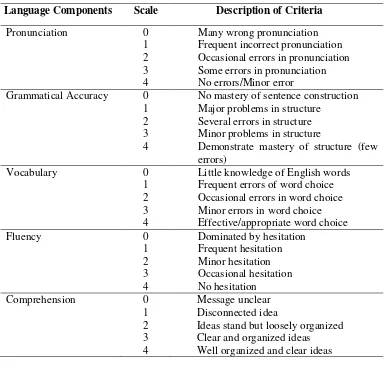
Table 2.
Sample of Analytic Scoring (from Oller in Mukminatien, 2000)
Language Components Scale Description of Criteria
Pronunciation 0
1 2 3 4
Many wrong pronunciation Frequent incorrect pronunciation Occasional errors in pronunciation Some errors in pronunciation No errors/Minor error Grammatical Accuracy 0
1 2 3 4
No mastery of sentence construction Major problems in structure
Several errors in structure Minor problems in structure
Demonstrate mastery of structure (few errors)
Vocabulary 0
1 2 3 4
Little knowledge of English words Frequent errors of word choice Occasional errors in word choice Minor errors in word choice Effective/appropriate word choice
Fluency 0
1 2 3 4
Dominated by hesitation Frequent hesitation Minor hesitation Occasional hesitation No hesitation
Comprehension 0
1 2 3 4
Message unclear Disconnected idea
Ideas stand but loosely organized Clear and organized ideas Well organized and clear ideas
Table 3.
Description of Language Components (from Oller in Mukminatien, 2000)
No. Language Components Description
1. Pronunciation 1. Pronunciation of individual sounds and words
2. Pronunciation of sentences, the right intonation and stress
2. Grammatical Accuracy Accurate use of structure, or how the learner gets his/her utterance correct 3. Vocabulary The leaner’s ability in choosing appropriate
words and how to solve the problems when he/she cannot find suitable words by explaining around the word
4. Fluency The ability to keep the speech or utterance going
listener
Each student’s performance of retelling
short story was measured by this following
formula: X = ∑𝑠
𝑚𝑎𝑥𝑖𝑚𝑢𝑚𝑠𝑐𝑜𝑟𝑒 X 100 Where:
X : student’s total score
∑s : the sum of total score Max. score : the highest score (20)
By computing the results of the students in the pre-test and post-test, the researcher compared and measured the effect of this research.
To determine the effect size of the treatment, the score was measured using following formula:
t
=
X −Y√𝑠₁²𝑛₁ + 𝑠₂²𝑛₂ − 2𝑟 (√𝑛₁𝑠₁ )(√𝑛₂𝑠₂ )
Where:
t = t-test with correlated data
X = the students’ mean score before the treatments
Y = the students’ mean score after the treatments
𝑠₁²= the students’ variant score before the
treatments 𝑠₂² = the students’ variant score after the treatments
𝑠₁ = the students’ standard deviation score
before the treatments
𝑠₂ = the students’ standard deviation score after the treatments
r = the students’ correlation score
𝑛= the number of students
To compute the students’ mean score
before and after the treatments, these following formulas were used:
(1) The students’ mean score before the treatments
X = ∑𝑋𝑖 𝑛
(2) The students’ mean score after the treatments
Y = ∑𝑌𝑖 𝑛
Where:
Xi = the measuring data before the treatments Yi = the measuring data after the treatments
The result of the students’ mean score
is categorized into its qualification. To know the improvement is as follow:
Table 4.
The Criteria of Students’Score
Range
Qualification
80
–
100
Good to Excellent
60
–
79
Average to Good
50
–
59
Poor to Average
0
–
49
Poor
To compute the students’ variant score before and after the treatments, these following formulas were used:
(1) The students’ variant score before the treatments (𝑠₁²)
𝑠₁²
= ∑
(𝑋𝑖 − 𝑛 − 1X )²(2) The students’ variant score after the treatments (𝑠₂²)
𝑠₂²
= ∑
(𝑌𝑖− Y)² 𝑛 − 1To compute the students’ standard
deviation score before and after the treatments, these following formulas were used:
(1) The students’ standard deviation score before the treatments (𝑠₁)
𝑠₁
=
√
∑(𝑋𝑖 − X )² 𝑛 − 1(2) The students’ standard deviation score after the treatments (𝑠₂)
𝑠₂
=
√
∑(𝑌𝑖 − Y)² 𝑛 − 1r =
𝑛(∑𝑋𝑌) − (∑𝑋)(∑𝑌)√[𝑛(∑𝑋2) − (∑𝑋)2] [ 𝑛(∑𝑌2)− (∑𝑌)²
Where:
r = correlation coefficient score X = measuring score of pretest Y = measuring score of posttest
To determine the effect size of the treatment, the following formula was used:
ES = t √
RESEARCH FINDINGS AND
DISCUSSIONS SMA Santun Untan Pontianak is organized as follows:
(1) Pre-test
The researcher asked the students to do retelling short story through group in front of the class based on the text given to each group. Most of the students said that they could not do the retelling even though the researcher had given them some additional times to learn the story. Even many of them asked the researcher if they could bring the text with them while retelling the story but they could not. By forcing the students to come in front of the class, the students finally wanted to move to the front and did the retelling. Total participants were 24 and there were five groups formed. The pre-test was
done in one meeting. The result of pre-test showed the total score of the students was
∑X = 1345 and the mean score was X = 56,04 and it is qualified as poor to average. (2) Treatments
After giving the students pre-test, the researcher then applied retelling short story as the technique in teaching speaking to the students. It was done in two meetings. In the treatments, before the researcher asked the students to retell the short story, the researcher told the students the technique of how to retell a short story. In retelling story, it is not about memorizing but it is recounting the same story into one own words. So, the about the generic structure and the features of a narrative text to just remind them since they had already studied it in the previous semester. That was the theory that the researcher taught the students in this retelling short story.
After giving the theory, the researcher then practiced by modeling of how to retell a story. Here, the researcher modeled one paragraph of the story as the example of how to do retelling. The researcher did it by telling the main idea of the paragraph and saying that it was the most important thing the students should tell on retelling a story, so that the students would think that retelling a story was not that difficult. That was actually one of the aims of implementing this technique; to make retelling short story easy and simple to do for the students seeing their background of English especially in speaking was low.
confidence improved in these two meetings. Those things affected their speaking. The researcher saw that their speaking improved as well because they were told that retelling was not about memorizing as they did in the pre-test so they tried to understand the main idea of the story and they did it better and easier than the previous one.
(3) Post-Test
After doing the treatments, the researcher gave the students post-test.The researcher
wanted to know the students’ speaking
improvement after being taught using Retelling Short Story technique. The activity done in the post-test was the same as in the pre-test. The test was also retelling short story but it went with another new topics for each group. After each group got the story, they were given times at least 15 minutes to learn and understand the story before doing the retelling. In this meeting, all the groups showed a good progress. They came to the front of the class and did the retelling without being asked by the researcher even they wanted to because of their own desirability.
By comparing to the condition in the previous meetings, they came to the front because they were forced by the researcher even there were groups that really did not want to go to the front of the class. Also, it took so long for them to learn and understand the story before doing the retelling until the times given were up. It took them over 30 minutes even more till they wanted to do the retelling in front of the class. Those two problems were very different with the facts happened in this meeting; first, they learned the story faster than before, and second, they went to the front of the class to do retelling without being forced even they did it with their own willingness. All the groups were done with the retelling and the score was analyzed. The total score of the students in
this test was ∑Y = 1475 and the mean score was Y= 61,46. It is qualified as average to good.
(4) The analysis of students’ score of pre-test and post-test
After the researcher collected the
students’ scores of pre-test and post-test, the
researcher compared the result between the pre-test and post-test scores.
The students’ mean score of pre-test: X = 56,04
The students’ mean score of post-test: Y= 61,46
The students’ different score was taken from the students’ mean score of post-test
minus the students’ mean score of pre-test. In this research, the result showed that the
students’ different score of pre-test and post-test was X d = 5,42.
The students’ different score of pre-test and post-test:
X d =X - Y
= 61,46 – 56,04 = 5,42
Table 6.
The qualifications of the students’ mean
score of pre-test and post-test
Test Mean
Score
Qualification
Pre-test 56,04 Poor to Average Post-test 61,46 Average to Good
Interval 5,42
The students’ variant score of pre-test:
S
₁
² =
2948,9223 S₁² = 128,22
The students’ variant score of post-test:
S
₂
² =
2623,9223 S₂² = 114,08
The students’ variant score (S²) is obtained by squaring the score of standard deviation (S). The aim of calculating variant score is to find out the result of t-test since it is required to be calculated in the formula of finding the t-test. The students’ variant score of pre-test is 128,22 while in post-test is
114,08. It shows that the students’ variant
be. It means that the treatments applied have given a positive effect over the research.
The students’ standard deviation score
of pre-test:
S₁ = √2948,92 23 S₁ = 11,32
The students’ standard deviation score
of pre-test:
performance score that has been subtracted with the minimal score determined. The result of standard deviation in the pre-test is 11,32 while in the post-test is 10,68. It shows a difference, that is, the result is lower in the post-test than in the pre-test. It is said to be good if the standard deviation is smaller because it means that the treatments have
given a better improvement on the students’
speaking skill.
Measuring the correlation score (r)
r =
6392566761 r = 0,957
the “r” or correlation score is obtained
to fulfill the calculation of the t-test score because it is concluded in the t-test formula especially for the correlated sample test. The
“r” score is used to measure the data that is
correlated. It means, between the data or sample to be measured for comparing is similar. Here, the research is measuring or comparing the result of the treatment to the same group, that is to see if there is an effect after being given the treatment in the one computation for the effect size. The t-test was resulted and it was -8,34. After computing
the t-test, it was continued to determining the t-critical in order to compare both the t-test and the t-critical whether the t-test is higher than the t-critical or the t-critical is higher than the t-test, so that it could be decided if null hypothesis or alternative hypothesis is accepted or rejected.
Based on the graphic above, it could be concluded that the t-test = ±8,34 is in the null hypothesis (Ho) rejection area. It means that the alternative hypothesis (Ha) is accepted, so that continuing to computing the effect size is needed.
a)
Computing the effect sizeES = 8,34√1 24 ES = 1,7
From the detailed computation above, the effect size of the treatment is 1,7. The effect size is categorized as high because ES 1,7> 0,8. So the alternative hypothesis that states retelling short story technique
improves the students’ speaking skill is
accepted.
Discussions
From the research findings, the
researcher can conclude that the students’
achievement in speaking skill improved. In the pre-test, the mean score of the students’ speaking achievement was 56,04. After two times treatments were given by the researcher before the post-test was given, the significant difference between pre-test and post-test was resulted. In the post-test, the mean score of
the students’ speaking achievement was
61,46.
This progress showed that retelling short story in teaching speaking was
successful in improving the students’
achievement of speaking skill. The improvement of the achievement was considered an effect of the treatment. The treatment in this research is retelling short
story to improve students’ speaking skill. As
a result, the treatments that were done by the researcher in this research showed a
significant positive effect to the students’
The research was conducted within two weeks. Each week consisted of two meetings. At the first meeting, the researcher introduced herself as the temporary teacher. The researcher told the students that they were going to practice speaking. The students were asked to perform speaking in front of the class in order to take their speaking score. In retelling story, there are five components to be scored. Those five components are pronunciation, grammar, vocabulary, fluency, and comprehension as mentioned by Harris (in Anggryadi, 2014).
The researcher asked the students to of five students but because of the number of students that were not possible to make it five students in each group, so there were some groups formed as four students and it did not matter. The researcher gave the students pre-test by sharing short stories to each group members. The students then were given 15 to 20 minutes to learn and understand the story. They said that they could not do that and did not want to go in front of the class for retelling. It took some times to force them to do retelling and finally they wanted to do it.
In the second meeting, before applying retelling short story technique, the teacher
first asked the students’ opinions on the way how they learned the story before retelling. Most of the students answered by saying they learned it by memorizing the text of the story. Then the researcher responded to their answers by giving feedback, that was, retelling story was not about memorizing but it was recounting the same story into the comprehended or understood the content of the story then retold it using their own words. The researcher gave a brief example by retelling one paragraph of a story. The
students were allowed to ask the meaning of the vocabularies they did not know or about how to pronounce the words and it was no problem for them to use their mobile phones for helps. The teacher helped the students to absorb the information and encourage them to retell the story. Here, the function of a teacher was as a tutor and it is according to Brown and Cambourne (in Mowbray, 2010). After the students were done learning and understanding the story, they were asked to do retelling and each member of the groups went to the front of the class for retelling even though some of them did the retelling by memorizing. The first treatment was done in one meeting. thought. The researcher tried to give them the translation of the story in order to make them easier to understand the story.
Again, based on the study of Brown and Cambourne (as cited in Mowbray, 2010), in retelling story, the function of a teacher is as a tutor. Sometimes the students face difficulty in understanding about the meaning of the story so the teacher has to help the students by giving some clues related to the story. The researcher reminded the students that they should not learn the story by memorizing but asked them to try to understand the content of the story. Then the students again went to the front of the class to perform the retelling short story.
students’ confidence and encourage them to
speak up. It was different as when they did it in the pre-test.
In the fourth and the last meeting, the researcher gave the students post-test. The post-test was also in form of retelling short story through the same group members from the beginning and done in front of the class but the stories given were different with the ones given in the pre-test. All the groups came in front of the class and performed the retelling. They showed some progress when speaking, but retelling story also improved their other skills in some aspects, such as listening, grammar, vocabulary, and concentration as it was stated in the fifth objective of retelling short story by Ellis and Brewster (1991). The post-test was done in one meeting.
Finally, based on the data analysis, the researcher found that there was an
improvement of the students’ achievement in
speaking skill. It could be proven by comparing the mean score of the pre-test and post-test. Based on the score indicated
students’ performances in post-test was better than in pre-test. This finding showed that there was a difference score of pre-test and post-test after receiving the treatments.
CONCLUSIONS AND SUGGESTIONS Conclusions
Based on the research findings, the conclusion of this research can be described as follows: (1) Retelling short story technique
highly significantly improves the students’
speaking skill since there is a significant
improvement on the students’ speaking performance. It was shown by the students’
mean score of post-test which is higher than the students’ mean score of pre-test, and the
effect size is categorized as high. (2) Retelling short story has the strengths and weaknesses. One of the strengths of retelling short story technique is that it motivates the students to speak up in front of class. One of the weaknesses of retelling short story technique is that it could be not fun for the students who were not really excited with it. However, it is still considered as significant
in improving the students’ speaking skill on
the tenth grade students of SMA Santun Untan Pontianak in academic year 2016/2017.
Suggestions
By looking at the research findings and what happened during the research, there are some suggestions that the writer would like to expose to improve the teaching learning process, especially in teaching speaking. The suggestions can be described as follows: (1)
builds the students’ creative thinking since it
forces the students to think fast and retell using their own words. (3) In applying retelling short story, teachers need to control
the students’ activity and manage the class Types in English.Macmillan Education: Australia PTY LTD. Anggryadi, M. A. (2014). The Effectiveness
of Storytelling in Improving Students’ Speaking Skill. Jakarta: UHAMKA. Brown, H.D. (2001).Teaching by Principles:
An Active Approach to Language Pedagogy. (2nd ed). San Francisco: Addison Wesley Longman, Inc. Creswell, J. W. (2012). Educational
evaluating quantitative and qualitative research, 4th Edition. Boston: Pearson Education, Inc.
Diana, M. (2003). Children’s Literature: An Invitation to the World. Boston: Pearson Education, Inc.
Ellis, G., & Brewster. (1991). The Storytelling Handbook for Primary Teacher. Middlesex: Penguin Group. Fisher, D., & Frey, N. (2007). Checking for
Understanding: Formative Assessment Techniques for Your Classroom. USA: ASCD.
Fitzgibbon, H. B., & Wilhelm, K. H. (1998).Storytelling in ESL/EFL Classrooms, TESL Reporter, 31(2), 21-31 Carbondale: Southern Illinois University.
Gibson, A. (2003). The Power of Story Retelling: the tutor. Portland. Retrieved from
https://www.nationalservice.gov/sites/ default/files/resource/spr2003.pdf Lukens, R. J. (2010). A Critical Handbook of
Children's Literature. Massachuset: Pearson Education, Inc.
Mowbray, T. (2010).The Power of Read and Retell. Australian Journal of Language & Literacy, 15(2). Retrieved from
http://www.adsb.on.ca/sites/Schools/B LI/Resources/Curriculum/ The Power of Read and Retell[1].pdf
Mukminatien, N. (2000). The Advantages of Using an Analytic Scoring Procedure in Speaking Assessment, TEFLIN JOURNAL, Vol.XI, No. 1 Agustus 2000. Malang: Universitas Negeri Malang.
Nunan, D. (2003). Practical English Language Teaching. NY: McGraw-Hill.
Rickheit, G., & Strohner, H. (2008). Handbook of Communication Competence. Germany: Walter de Gruyter GmbH & Co. KG.
Xu, Jianing. (2007). Storytelling in the EFL Speaking Classroom, The Internet TESL Journal, Vol. XIII, No. 11, November 2007. Retrieved from
http://iteslj.org/Techniques/Jianing-Storytelling.html