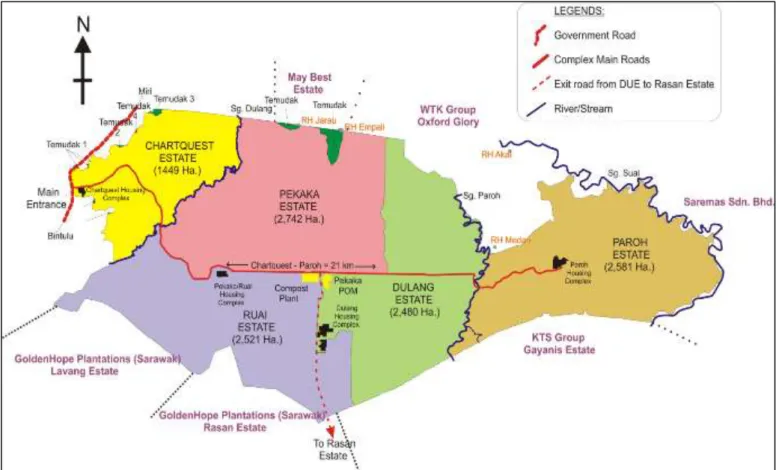
SCOPE of the CERTIFICATION ASSESSMENT
Type of Assessment
Locations of Mill and Plantation .1 Location of Mill
Description of Area Statement .1 Tenure
Description of Mill and Supply Base .1 Description of Mill
Time Bound Plan
GP Plasma 2017 Kabupaten Musi Banyuasin Provinsi Sumatera Selatan 2017 Budidaya Agro Lestari 2018 Pelanjau, Sungai Putih,.
Assessment Team
Assessment Methodology, Assessment Process and Locations of Assessment .1 Figure of person days to implement assessment
Locations of Assessment
Observing and interviewing workers at the harvest, all workers are satisfied with their work and no regulations have been passed, they know about the new minimum wages and know how to direct a complaint. They have worked for 2-3 years and can also explain the ban on the use of chemicals in relation to the HCV area.
Stakeholder Consultation and Stakeholders Contacted .1 Summary of stakeholder consultation process
Stakeholder contacted Please find appendix 1
Interview with 10 fertilization workers. All adequate PPE was provided by the company, such as: apron, helmet, mask, rubber gloves and safety boots.
Determining Next Assessment
ASSESSMENT FINDINGS
Summary of Assessment Report of the RSPO Certification
Based on the audit, a complaint was made by the workers and the issues were resolved in a timely and appropriate manner and all actions were documented. It was made available on office property: and management had shown that they had a legal right to the land in question (refer to 2.2.1). ii) There is documented health and environmental safety in each of the properties. There is a plan for social and environmental impacts and mitigation measures (Impact Assessment and Environmental Aspects & Impact Identification is FY iv).
There is Biodiversity Baseline Assessment Report for SOU 34. v) The impact assessment plans of the plan were made available on the estate and the manual procedure has been carried out to monitor all the activities. Pollution Prevention Plans are available which include Emergency Preparedness - the full contingency plan procedure including the Emergency Roadmap (Pollution Prevention Plan - FY vii).
There is compliance with all applicable local, national and ratified international laws and regulations
The right to use the land is demonstrated and not legitimately contested by local residents who can demonstrate that they have legal, customary or user rights. Ruai Estate was established together with Pekaka Estate in 1989 and initially Ruai known as Pekaka II which was under the management 1 of Pekaka Estate. Ruai Estate [2,521 HA] – Pekaka POM, Lavang & Rasan Estate, Dulang Estate, Pekaka Estate and Chartquest Estate [Sime Darby].
Pekaka Estate [2,742 HA] – Pekaka POM, Dulang Estate, Ruai Estate and Chartquest Estate [Sime Darby] and May Best Estate [smallholder – separated by a moat]. Looked at the land title and checked with the DOE letter of approval and license to operate the mill. There is no evidence of the presence of legal, customary or user rights identification as the estate has been in oil palm operation since 1990.
2.3.3 and 2.3.4
There is an implemented management plan that aims to achieve long term economic and financial viability
Based on an interview with the sterilizer operator in Pekaka POM, he can explain occupational safety and his job descriptions. Moreover, according to an interview with harvesters at Paroh Estate on field 95PB, an interview with sprayers at Ruai Estate on field 2014B and an interview with sprayers at Pekaka Estate, 2012D, they can explain the job descriptions and the safe working environment. According to an interview with the estate manager and the mill manager, a mill advisor and/or a plantation advisor was paid a field visit every year.
Based on document verification and interview with security guard, weighbridge operator and plant manager known in the last year, there is no FFB from external sources. Following an interview with the estate manager at Ruai and Pekaka Estate, replanting of the peat area will be carried out by 2020/2021.
Practices maintain the quality and availability of surface and ground water
This process was available at every land office; based on field observation at field 92RM Ruai Estate, silt pits and road pits were available to prevent surface soil erosion. Monitoring parameters for BOD, COD, TSS, Total Solids, Ammonium Nitrogen, Total Nitrogen and O & G. The latest results showed that all parameters were below the standard limit set by DOE based on the trend of 3 sampling 7 .June 2016, July 4, 2016 and September 2, 2016. Pekaka POM obtained a license from the DOE, license number 003056 Pekaka Palm Oil Mill (July 1, 2016 - June 30, 2017). During the field observation of field 95PB Ruai Estate and field 2012D Pekaka Estate known to have been observed that the spraying worker was using a chemical material with the active ingredient “glyphosate” targeting broadleaf weeds on oil palm.
Weed control such as circular spraying works selectively adapted to conditions on the field. While warfarin can be used in the field without barn exchange, especially in Borneo Island.
The company uses pesticides in accordance with the goal, and we actually achieve the goal in the field three to four times a year. The pesticide was registered in the national regulation based on the results of field observations in the chemical cycle of weed control in the field. When spraying, pesticides are used that are already registered in the MPOB, i.e. the active ingredient glyphosate in a dose of 300 ml/ha to control broad-leaved weeds in the oil crop circle.
In estates where barn owls are not known to acclimatise, as in the case of Borneo Island, the Plant Protection Unit/PA should be consulted for baiting, importing barn owls and establishing owl nest boxes. Based on interview with PSQM assistant, today Takau Estate (Rajawali POM) developed this barn owl (± 70 km). The company has a complete list of pesticides designated by the World Health Organization (WHO) Class 1A or 1B or listed in the Stockholm or Rotterdam Conventions.
Based on the data from the use of pesticides, the decrease in the use of pesticides is known, in the recapitulation of 2015, the use of pesticides with the active ingredient glufosinate-ammonium: 3.3 liters/Ha; Glyphosate isopropylamine 41.0% is 1.5 litres/ha in Paroh Estate, while Ruai Estate used pesticide at 0.077 litres/ha and Pekaka Estate is 1608.87 litres/ha. Last empty chemical containers transported dated: 1 October 2016 at Paroh Estate, 18 July 2016 at Ruai Estate and 15 October 2016 at Pekaka Estate. According to the interview with the estate manager in Paroh Estate, Ruai Estate and Pekaka Estate, there is no aerial spraying during 2015 and 2016.
Medical records of all pesticide operators are available and maintained on file the most recent medical surveillance is on 25/03/2016. Therefore, Ruai Estate cannot show the result of the specific annual medical surveillance for all pesticide operators in 2016.
The relevant type of test such as audiogram test, medical supervision, CHRA is performed according to legal requirements. Corresponding actions proposed for the identified risk. Some operation controls defined with relevant procedures such as Personal Protective Equipment (PPE), Log Out and Take Out (LOTO), Permit to work, person with specific competence, management of chemical stores, etc.
Opportuity For Improvement
Adequate training records such as training attendance record, training evaluation record, training certificate etc. available during training. There is specific training for all staff and workers for Pekaka POM on the last day and for external stakeholders (stakeholder consultation meeting on training for all staff and workers for Paroh Estate at the latest and for external stakeholders (stakeholder consultation meeting on training for all staff and workers for Ruai Estate no later than 14 June 2016 and for external stakeholders (consultative meeting with stakeholders on 9 September 2016) Pekaka Estate no later than 14 June 2016 and for external stakeholders (consultative meeting with stakeholders on 9 September 2016).
There is a timetable for defining the environmental problems, the mitigation measures, the action period and the time frame. The assessment did not identify any HCV habitats, such as rare and endangered ecosystems. However, a river buffer zone of 30 hectares has been established on the Paroh Estate, the Ruai Estate has reserve areas of 0.25 hectares on the estate as a biodiversity area. An inventory of the planned waste is maintained by the retailer and there is a notification to DOE via e-Swiss from Pekaka POM and a bill of lading for Paroh Estate, Ruai Estate and Pekaka Estate.
No open fire is used to dispose of the waste, there is documentation for disposal through an authorized disposal contractor. There is monitoring of the diesel consumption at Paroh, at the latest in September 2016, it is 24.83 liters per CPO, Ruai Diesel consumption per ton FFB at the latest in September is 1.58 litres/FFB and Pekaka Estate Diesel consumption per ton FFB at the latest in August is 11.18 litres/FFB.
Evidence is available that relevant stakeholders participated in the SIA, for example through formal interviews. The POM's method of communication and consultation is well described in the “Sustainable Plantation Management System” – Chapter 01 dated 1/11/2008. The estates maintain a list of local communities and other involved or interested parties in the “List of Stakeholders – 2015/16”.
There is a flow diagram titled dated Sustainable Plantation Management System” – Annexure 5 available in the mill for dealing with social issues. There is no complaint or dispute in the estate processing, which is either due to internal or external stakeholders.
Children are not employed or exploited
There is a clear agreement between the workers, including foreign workers, about the welfare of the workers. Based on the interview of Indonesian workers, no problems of discrimination against local and foreign workers have been found. There is no harassment or abuse in the workplace and reproductive rights are protected.
There is SPMS (Flow Chart and Procedures on Handling Social Issues) there is a manual of the gender committee, first edition of 2004. There is no restriction for foreign workers to leave the mill or their property or residential facilities outside working hours.
Growers and millers regularly monitor and review their activities and develop and implement action plans that allow demonstrable continuous improvement in key operations
Summary of Assessment Report of Supply Chain Requirement
Explanation .1
- Conformity Checklist of Certificate and Logo Use
- Evidence of permission or approval certificate and logo from Certification Body which
- Implementation of certificate and logo used by Client comply with size and type (shape)
- Implementation of Certificate and Logo is not used on product X or√
- Summary of RSPO Partial Certification
- There is compliance with all applicable local, national and ratified international laws and
- The right to use the land can be demonstrated, and is not legitimately contested by local
- There is a mutually agreed and documented system for dealing with complaints and
- Any negotiations concerning compensation for loss of legal or customary rights are dealt with through a documented system that enables indigenous peoples, local communities and
- New plantings since November 2005, have not replaced primary forest or any area required
- No new plantings are established on local peoples’ land without their free, prior and informed consent, dealt with through a documented system that enables indigenous
- Local people are compensated for any agreed land acquisitions and relinquishment of
- Identification of Findings, Corrective Action, Observations, Opportunity for Improvement and Noteworthy Positive Components
- Summary of Arising Issues from Public, Management and Auditor Response Public Issues
- CERTIFIED ORGANISATION'S ACKNOWLEDGEMENT OF INTERNAL RESPONSIBILITY
For diversion of RSPO-certified FFB to any other RSPO-certified mill, RSPO-certified production of CPO and KP can be counted. The mill must ensure that there is no mixing of RSPO-certified and non-RSPO-certified material in the processing and storage of stable products (through cleaning, rinsing or other appropriate methods). RSPO certified CPOs and PKs on the RSPO IT Platform or book and claim.
All FFB product processed and generated is entirely product claimed as RSPO certified product. The site will record and balance all RSPO-certified FFB receipts and RSPO-certified CPO and PK shipments on a quarterly basis. Pekaka Palm Oil Mill - Sime Darby Plantation has a monthly RSPO report certified by FFB, CPO & PK.
Examples: "The Group Employee Handbook" latest revision May 2014, explains to employees their benefits and company rules.
Program